
More project photos (3)
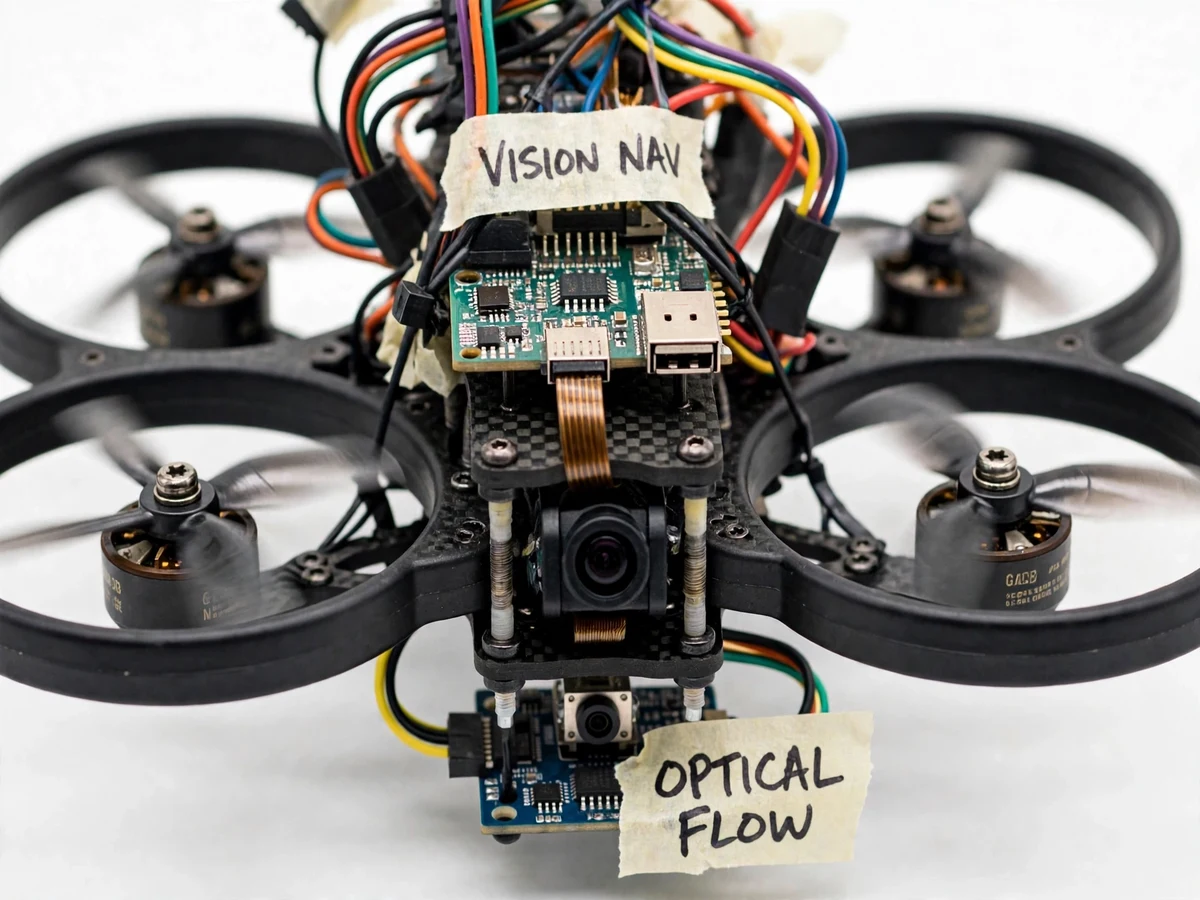
The problem
An autonomous racing drone is a quadcopter that flies a marked racecourse with no pilot on the sticks — it sees the gates, decides where to go, and commands its own motors. On October 14, 2026, TU Delft's Micro Air Vehicle Lab published MonoRace in Science Robotics: a racing drone navigating on only a single forward-facing camera and an inertial measurement unit, no GPS and no external tracking, its neural network commanding the motors directly 500 times per second. At the 2025 Abu Dhabi Autonomous Drone Racing Competition it beat every rival AI team and three former human world-champion pilots at about 100 km/h. This project is the honest student-scale translation: a ducted 2.5-3 inch cinewhoop flying a 6-gate indoor course autonomously, swapping MonoRace's neural controller for a classical pipeline the student can build and defend — ArUco markers on cardboard gates, OpenCV detection on a Pi Zero 2 W, optical-flow hover stability and PID velocity control at indoor-safe speeds.
MonoRace's own numbers set the reference: roughly 100 km/h top speed, motor commands at 500 Hz, 5.1-inch propellers, a Jetson Orin NX companion computer with a neural network also running on the flight controller, and a single camera plus IMU as the entire sensor suite. This build keeps the idea and rescales the engineering: a prop-guarded indoor cinewhoop instead of a 5-inch racer, ArUco tags instead of a learned gate detector, a ~30 Hz vision-plus-PID loop instead of a 500 Hz neural controller, and a 4-6 m/s speed cap (design target) instead of 100 km/h. What transfers is the real engineering — gate detection from a single camera, sensor fusion for position awareness without GPS, and closed-loop flight through a timed course — plus the race format itself: the dashboard's human-vs-AI mode lets the student fly the same six gates in FPV and compare lap times against the autonomous mode, which is exactly the Delft-vs-champions comparison at lab scale.
Student arms the drone on the start pad; the vision loop starts.
Follow the working sequence
How it works
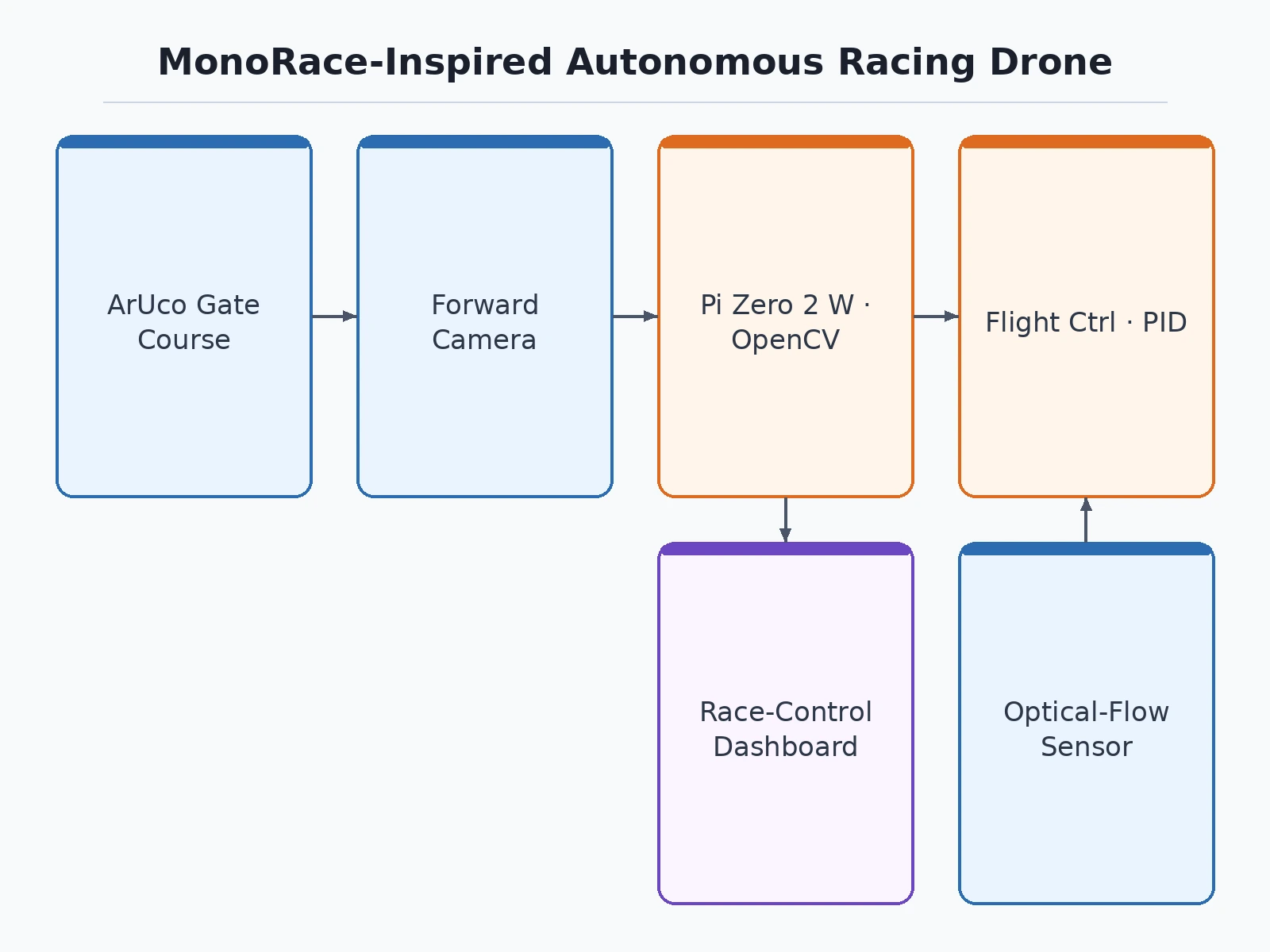
A lap runs like this. The drone arms on the start pad and the Pi Zero 2 W starts its vision loop: each camera frame is scanned for ArUco markers, and the nearest gate's tag gives a range-and-bearing measurement. The optical-flow sensor reports ground-relative velocity, fused with IMU data for stable hover without GPS. The navigation node picks the next gate in the 6-gate sequence, computes the bearing error to its tag, and the PID controller issues velocity commands over the serial/MAVLink link, steering the drone through the gate while the speed cap holds a lab-safe 4-6 m/s. Each gate pass is timestamped and logged to the race-control dashboard, which draws progress on the live track map and stops the lap timer at the start/finish gate. Human mode replays the identical course in manual FPV with the vision loop disengaged, and the best-lap board compares autonomous against human laps side by side.
- The drone arms on the start pad; the Pi Zero 2 W starts the vision loop and the optical-flow sensor locks onto the floor texture for hover stability.
- Each camera frame is scanned for ArUco markers (OpenCV); the nearest gate's tag yields a range-and-bearing fix at about 24 Hz (design target).
- The navigation node selects the next gate in the 6-gate sequence and computes bearing error to its tag; the PID controller converts that error into velocity commands.
- Commands travel over the serial/MAVLink link to the flight controller, which steers the drone through the gate while the 4-6 m/s speed cap (design target) holds indoor-safe pace.
- The PMW3901 optical-flow sensor plus IMU fusion tracks relative motion between gates, where no GPS exists and the camera sees only the next tag.
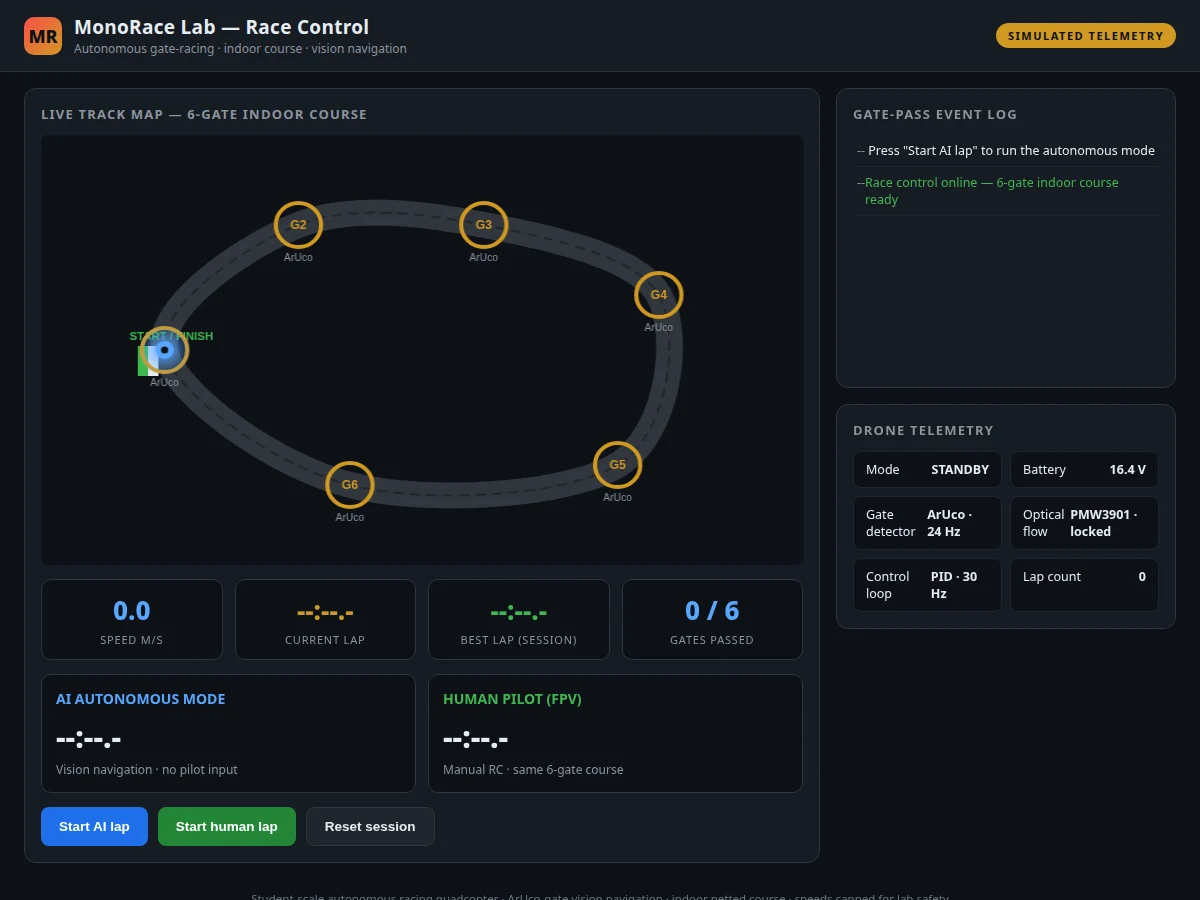
- Every gate pass is timestamped and pushed to the race-control dashboard, which draws live progress on the track map and stops the lap timer at the start/finish gate.
- Human mode replays the identical course in manual FPV with the vision loop disengaged; the dashboard's best-lap board compares autonomous vs human laps.
Tech stack:
- 2.5-3" ducted cinewhoop frame + flight controller (prop-guarded indoor racer)
- Raspberry Pi Zero 2 W (companion computer · OpenCV gate detection)
- Forward-facing camera module (Pi camera class)
- PMW3901 optical-flow sensor + flight-controller IMU fusion
- OpenCV ArUco fiducial detection + PID velocity control
- MAVLink/serial offboard command link
- Race-control web dashboard (lap timer, track map, gate-pass log)
- 6-gate ArUco-tagged cardboard course kit
| Parameter | Value |
|---|---|
| Reference system | TU Delft MonoRace: single camera + IMU, no GPS, neural net commands motors at 500 Hz, ~100 km/h, beat 3 former world champions, Abu Dhabi 2025 (Science Robotics, Oct 14 2026 — reported across 4 outlets) |
| Airframe | 2.5-3 inch ducted cinewhoop, full prop guards (typical class) |
| Companion computer | Raspberry Pi Zero 2 W: quad-core Arm Cortex-A53 @ 1 GHz, 512 MB SDRAM, 2.4 GHz Wi-Fi (manufacturer spec) |
| Gate detection | OpenCV ArUco fiducial markers, ~24 Hz detection rate (design target) |
| Position sensing | PMW3901 optical-flow sensor + IMU fusion, GPS-denied indoor (datasheet) |
| Control loop | Vision PID velocity control at ~30 Hz (design target; MonoRace uses 500 Hz neural control) |
| Speed cap | 4-6 m/s indoor (design target; MonoRace ~100 km/h) |
| Course | 6 ArUco-tagged gates, indoor netted area ~10x8 m (design target) |
| Command link | Serial/MAVLink offboard velocity commands to flight controller |
| Kill switch | RC-link manual override, always armed (safety requirement) |
| Flight time | ~4-6 min per pack, typical for the class (approximate/typical) |
| Battery class | 2-3S LiPo, 450-650 mAh class (approximate/typical) |
| Dashboard | Lap timer, live track map, gate-pass log, human-vs-AI best-lap board |
Project features
The drone's capabilities are four. First, autonomous gate navigation: the forward camera feeds OpenCV ArUco detection on the Raspberry Pi Zero 2 W at about 24 Hz (design target), each gate's fiducial marker giving the drone a range-and-bearing fix that the PID controller turns into velocity commands — the student-scale stand-in for MonoRace's neural gate detector. Second, GPS-denied position awareness: a PMW3901 optical-flow sensor fused with the flight controller's IMU holds hover and tracks relative motion indoors where GPS cannot reach, the same no-GPS constraint MonoRace solved with learned estimation. Third, the human-vs-AI race mode: the race-control dashboard times every lap in both autonomous and manual FPV modes on the identical 6-gate course, logging every gate pass with timestamps so the student can present a genuine human-against-AI comparison. Fourth, indoor-safe racing engineering: full prop guards, a netted-course operating procedure, a 4-6 m/s speed cap and an RC-link kill switch, so the whole build is lab-legal from day one.
- [Autonomous gate navigation] A forward-facing camera feeds ArUco fiducial detection (OpenCV) on the Raspberry Pi Zero 2 W at about 24 Hz (design target); each gate's tag gives a range-and-bearing fix that the PID controller converts into velocity commands, flying the 6-gate course with no pilot input.
- [GPS-denied position awareness] A PMW3901 optical-flow sensor fused with the flight controller IMU holds position and tracks relative motion indoors, where GPS is unavailable — the same no-GPS constraint MonoRace solved, answered here with classical sensor fusion instead of a learned estimator.
- [Human-vs-AI race mode] The race-control dashboard times every lap in autonomous and manual FPV modes on the identical 6-gate course and logs every gate pass with timestamps, producing a genuine human-against-AI lap comparison for the report and viva.
- [Indoor-safe racing engineering] Full prop guards, netted-course procedure, a 4-6 m/s speed cap (design target) and an RC-link kill switch keep every test flight lab-legal; nothing in the build assumes outdoor or unsupervised flight.
- [Race-control web dashboard] Served by the companion computer: live track map, lap timer, best-lap board, gate-pass event log and telemetry (speed, battery, detector rate) in one view.
- [6-gate ArUco course kit] Six cardboard racing-gate hoops with printed ArUco fiducial markers and floor layout plan, so the course is reproducible in any lab or classroom.
- [Tunable vision-PID pipeline] Gate-detection thresholds, PID gains and speed cap exposed as a single config file, with a tuning procedure the student runs and documents — the tuning log is original data for the report.
What is included
- Assembled racing quadcopter: ducted cinewhoop frame with prop guards, flight controller, forward camera, PMW3901 optical-flow sensor, Raspberry Pi Zero 2 W companion computer
- Six ArUco-tagged cardboard racing gates with floor layout plan
- Complete software: OpenCV gate-detection pipeline, PID navigation node, MAVLink offboard bridge, race-control web dashboard (working demo UI included)
- Wiring diagram and airframe assembly layout
- Tuning procedure for detector thresholds, PID gains and speed cap
- Component list with Indian supplier sourcing notes for the frame, Pi Zero 2 W, camera and flow sensor
- Project report PDF (vision navigation, sensor fusion, PID tuning, human-vs-AI race results)
- PPT presentation for final review
- Viva Q&A preparation document (ArUco vs learned detection, optical flow, PID control, drone regulations)
Limitations & prerequisites
- This is a classical vision-plus-PID pipeline, not MonoRace's end-to-end neural controller: it is slower, less agile, and needs the ArUco tags — it cannot detect plain gates the way MonoRace's network does. The neural controller is documented future scope.
- Indoor only, always: the build assumes a netted indoor course. Outdoor autonomous flight raises legal and safety questions this build does not claim to solve; all demos assume a controlled lab environment.
- The optical-flow sensor needs a textured floor to lock onto — a plain white floor gives no features and hover drifts. Builder note (design note, not a measurement): lay a cheap printed high-contrast mat under the course; in the bench build this was the single biggest stability fix.
- The 4-6 m/s speed cap and ~24 Hz detection rate are design targets on the bench build, not guaranteed figures — lighting, gate spacing and PID tuning all move them.
- Builder note (design note, not a measurement): put a 470 uF low-ESR capacitor across the 5 V rail feeding the companion computer — full-throttle punches on all four motors brown out the Pi without it, the most common bench-build crash cause.
- Flight time is 4-6 minutes per pack (typical for the class); race sessions need 3-4 charged packs and standard LiPo discipline.
- The human-vs-AI comparison is honest only on the identical course and the same day — wind-free indoor conditions are part of the procedure.
Frequently Asked Questions
What did TU Delft's MonoRace actually achieve?
MonoRace is an autonomous racing drone from TU Delft's Micro Air Vehicle Lab, published in Science Robotics on October 14, 2026. It navigates with only a single forward-facing camera and an IMU — no GPS, no external tracking — while its neural network commands the motors directly 500 times per second. At the 2025 Abu Dhabi Autonomous Drone Racing Competition it beat every rival AI team and three former human world-champion pilots at about 100 km/h, the first AI-piloted drone to win against human pilots internationally.
How close does this student build get to the real MonoRace?
It keeps the idea and rescales the engineering honestly. MonoRace's end-to-end neural controller at 500 Hz becomes a classical pipeline — ArUco gate detection at about 24 Hz plus PID velocity control at about 30 Hz — because that is what a student can build, tune and defend. ArUco tags stand in for the learned gate detector, optical flow plus IMU stands in for learned pose estimation, and speeds are capped at 4-6 m/s for a netted indoor course instead of 100 km/h. The transferable engineering — single-camera gate detection, GPS-denied navigation, closed-loop racing — is all genuinely in the build.
Why ArUco tags instead of a neural network like MonoRace?
Because the honest version must be buildable and debuggable in a semester. Training an end-to-end racing controller needs a simulator, massive data and compute a student lab does not have; when it fails, nothing is inspectable. ArUco detection gives deterministic, measurable range-and-bearing fixes the student can log, plot and tune — which makes far stronger viva material. The neural controller is listed as explicit future scope, so the limitation is documented rather than hidden.
Is this project suitable for a final-year project?
Yes — for IoT & Embedded, Electronics/E&TC and related programs. It combines embedded vision (OpenCV on a Pi Zero 2 W), sensor fusion (optical flow plus IMU), classical control (PID velocity loop), a real-time dashboard, and a timed human-vs-AI race format that produces genuine comparative data for the report. Every spec number is datasheet-sourced or explicitly labeled as a design target, and the honest delta from MonoRace is strong viva material.
Can it really race against a human pilot?
Yes, on the identical 6-gate course. The dashboard runs two timed modes: autonomous mode with the vision loop engaged, and manual mode where a student flies in FPV with the vision loop disengaged. Every gate pass is timestamped in both modes and the best-lap board compares them side by side — the lab-scale version of the Delft-vs-champions format. The honest boundary: comparison runs happen the same day on the same course, since lighting and battery state move lap times.
Components & software requirements
- 2.5-3" ducted cinewhoop frame + flight controller (prop-guarded indoor racer)
- Raspberry Pi Zero 2 W (companion computer · OpenCV gate detection)
- Forward-facing camera module (Pi camera class)
- PMW3901 optical-flow sensor + flight-controller IMU fusion
- OpenCV ArUco fiducial detection + PID velocity control
- MAVLink/serial offboard command link
- Race-control web dashboard (lap timer, track map, gate-pass log)
- 6-gate ArUco-tagged cardboard course kit
Delivery information
Built-to-order project. Delivery timeline is shared after order confirmation based on current queue.
Support terms
Complete documentation, setup guide, and viva preparation included. Support for setup and explanation provided.
Download free synopsis (PDF)
Enter your name and WhatsApp number — the synopsis PDF downloads immediately. We may send occasional project updates on WhatsApp; no spam.