
More project photos (3)
The problem
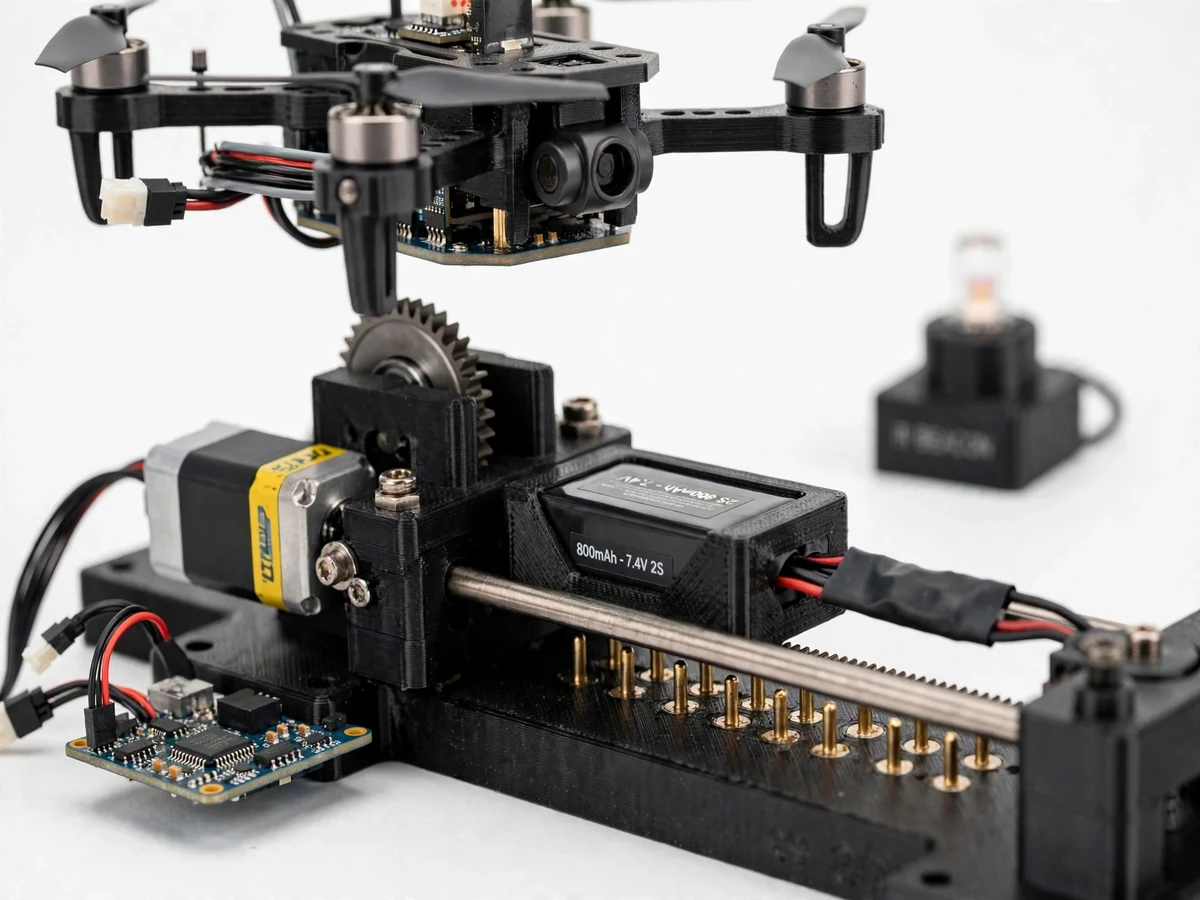
An automated drone dock is a ground station that receives a returning quadcopter, swaps its depleted battery for a charged one, and clears the aircraft to relaunch — all without human hands. DJI's Dock 4, announced October 14 2026, swaps in about 25 seconds but costs roughly $25,000. The honest student version keeps the same idea at bench scale: a desktop pad for a small 2S LiPo quadcopter where the aircraft is landed manually, seated by IR homing beacons, a sled ejects the spent pack, and a rack-and-pinion loader pushes in a charged battery from a three-slot rack while the depleted pack begins recharging. The problem it solves is the flight-time ceiling: a small quadcopter flies 10-15 minutes per pack, so any mission needing more time stalls on a manual battery change. This build demonstrates the dock's core engineering — landing guidance, battery handling, charge management and mission state logic — on hardware a student can actually defend.
DJI's own numbers set the reference: 25-second automated battery swap, landing-to-takeoff turnaround under 45 seconds, a sector-shaped compartment with four independent bays (three charged batteries, one empty for the depleted pack), induction power keeping the aircraft on during the swap, IP56 rating, 12 m/s maximum landing wind, -40 to +50 C operating range, about 66 kg, about 2000 W maximum power, and a bundle around 167,999 yuan (roughly $25,000). The Dock 3 it replaced needed about 27 minutes to recharge. This build copies none of the enclosure and all of the idea: the state machine (landed, swap, charged, cleared), the three-plus-one battery inventory, and the charge-while-waiting logic, at a bench scale where every number can be measured by the student who built it.
How it works
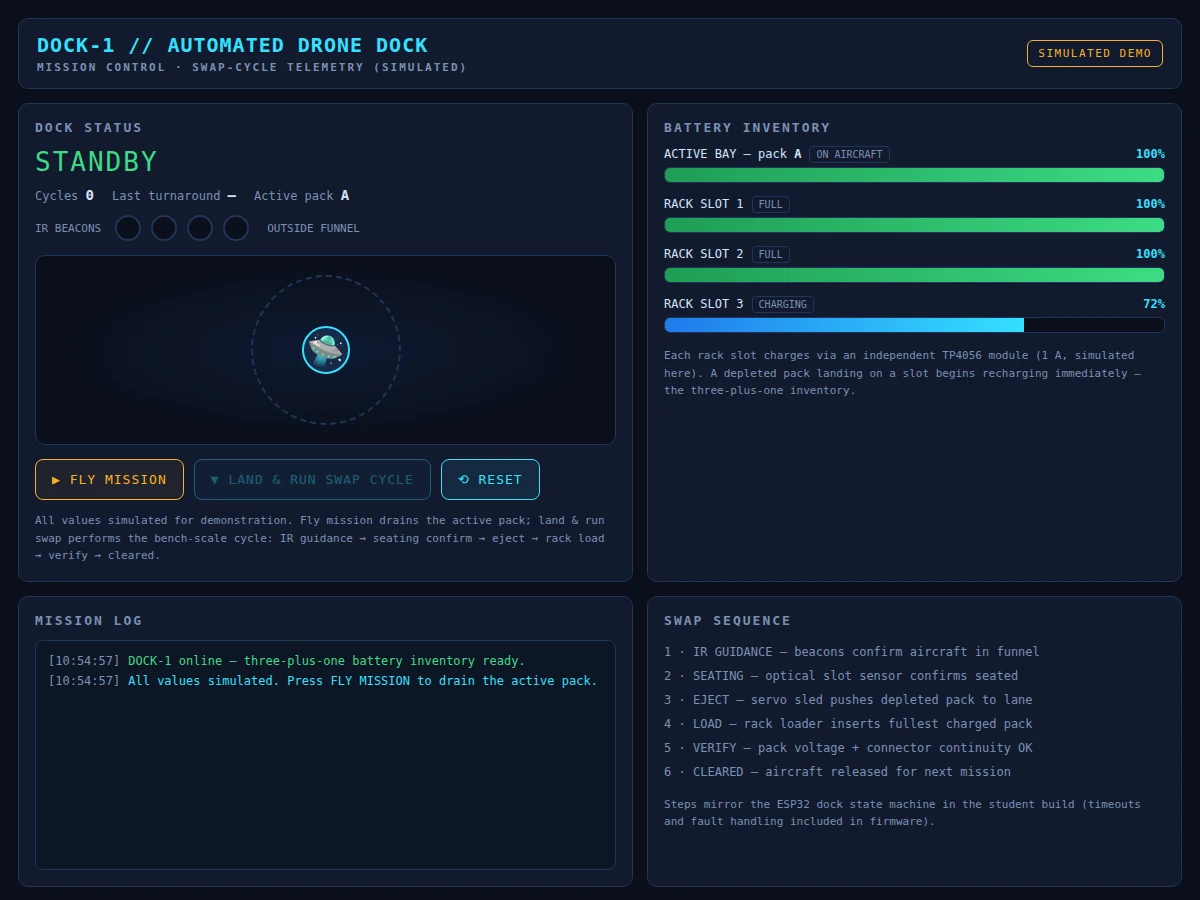
A swap cycle runs like this. The quadcopter is flown onto the pad manually and its IR receiver locks onto the four 940 nm beacons, confirming it sits inside the landing funnel. An optical slot sensor confirms the aircraft is seated; the ESP32 latches the dock state machine into SWAP_STARTED and arms the servo rail. An MG996R-class servo drives the eject sled forward, pushing the depleted 2S pack out of the aircraft's belly tray onto the discharge lane. The rack-and-pinion loader then indexes the three-slot rack to the fullest charged battery, rams it into the tray, and the pack's connector mates with the drone-side pogo pins. The depleted pack now sits on its rack slot, where its TP4056 module begins recharging at up to 1 A. The ESP32 verifies pack voltage, updates the 0.96-inch OLED, logs the cycle to the dashboard's mission log, and clears the aircraft for relaunch — landing to relaunch in roughly 45-60 seconds (design target).
- The quadcopter is flown onto the pad manually; its onboard IR receiver array locks onto the four 940 nm beacons, and the pilot nudges the aircraft until all four beacons read above threshold — confirming it is inside the landing funnel.
- An optical slot sensor confirms the aircraft is seated; the ESP32 latches the state machine into SWAP_STARTED, arms the servo rail, and logs the cycle start to the dashboard's mission log.
- The MG996R-class servo drives the eject sled forward on its rack-and-pinion rail, pushing the depleted 2S pack out of the belly tray onto the discharge lane.
- The loader indexes the three-slot rack to the fullest charged battery and rams it into the tray; the pack connector mates with the drone-side pogo pins, and the ESP32 verifies pack voltage before proceeding.
- The depleted pack now sits on its rack slot, where its TP4056 module begins recharging at up to 1 A (datasheet); each cell is charged through a per-cell tap from an isolated 5 V rail.
- The ESP32 updates the 0.96-inch OLED, appends the cycle to the mission log, clears the aircraft for relaunch, and returns to standby — ready to guide the next landing.
Tech stack:
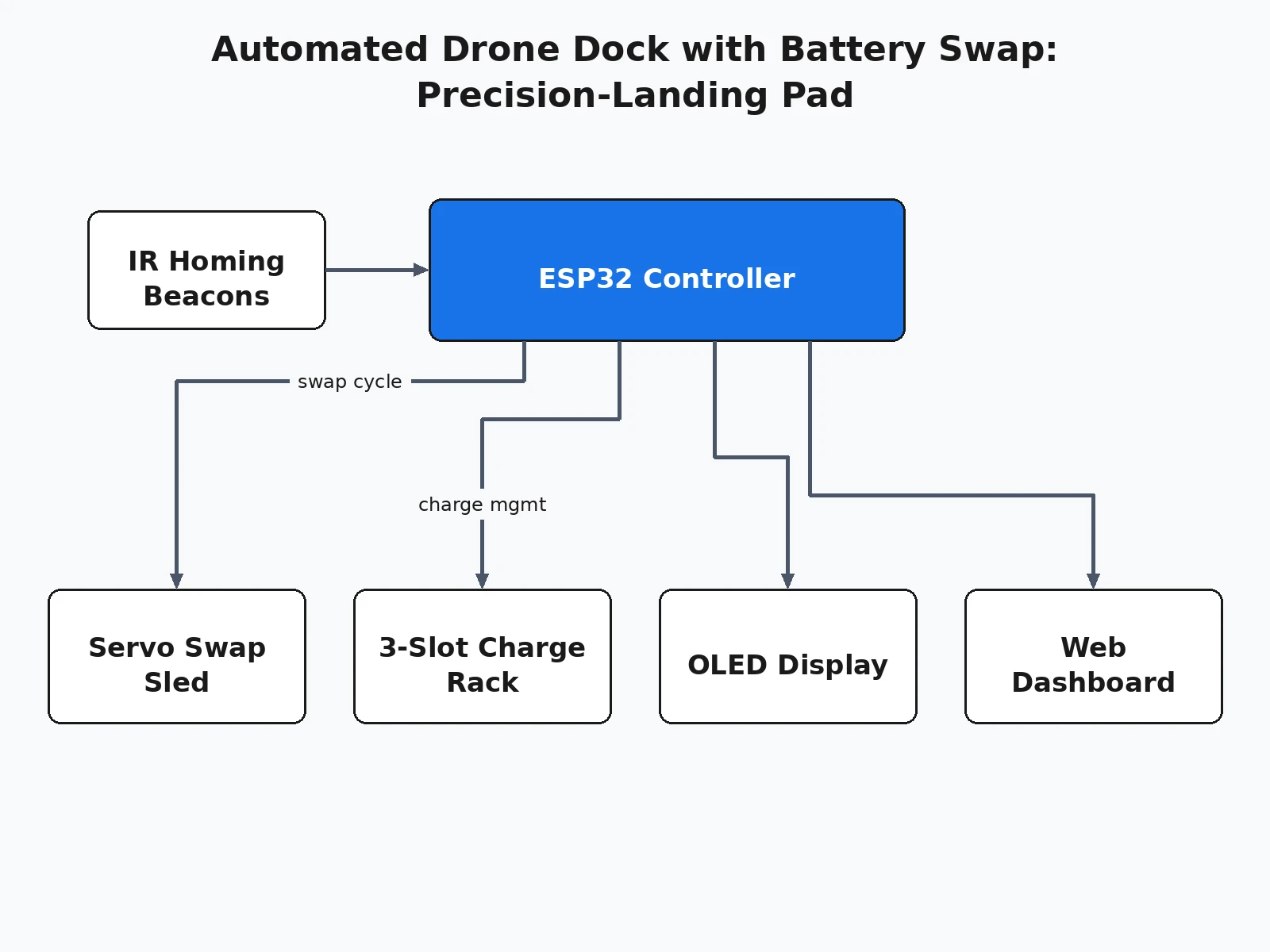
- ESP32 (dual-core · dock state machine + Wi-Fi web dashboard)
- MG996R-class servo + rack-and-pinion swap sled
- 940 nm IR homing beacons + optical seating sensor
- TP4056 charge modules (3-slot rack, 1 A per slot)
- 0.96" 128x64 OLED status display
- 2S 7.4 V LiPo battery packs (~800 mAh class)
- Mission-control web dashboard (ESP32-hosted)
- 3D-printed dock body, landing funnel and battery tray
| Parameter | Value |
|---|---|
| Homing beacons | 4x 940 nm IR LEDs + matching receiver array (datasheet) |
| Precision reference | DJI Dock 4 uses RTK-grade positioning at 12 m/s max landing wind (manufacturer spec — this build uses IR funnel guidance at bench scale) |
| Swap servo | MG996R-class: stall torque 9.4 kg-cm @ 4.8 V, 0.17 s/60 deg (datasheet) |
| Controller | ESP32: dual-core Xtensa 32-bit, up to 240 MHz (datasheet) |
| Charger | 3x TP4056 modules, 1 A charge current each (datasheet) |
| Display | 0.96" 128x64 OLED (datasheet) |
| Landing pad | ~45 cm diameter desktop pad (design target) |
| Swap cycle | 45-60 s landing-to-relaunch (design target; DJI Dock 4 achieves ~25 s) |
| Battery inventory | 3 charging slots + 1 active bay |
| Battery class | 2S 7.4 V LiPo, ~800 mAh class (approximate/typical) |
| Landing tolerance | ±5 cm funnel seating via beacon homing (design target) |
| Tray design note | 1-2 deg draft angle + chamfered sled leading edge (design note, not a measurement) |
| Dock 4 reference | 25 s swap, <45 s turnaround, IP56, ~66 kg, ~2000 W max, -40 to +50 C, ~$25,000 (manufacturer specs, Oct 2026) |
Project features
The dock's capabilities are four. First, precision landing guidance: four 940 nm IR homing beacons ring the pad and the quadcopter carries a matching receiver array, so a manually flown aircraft can be nudged into the funnel with roughly ±5 cm seating tolerance (design target) — the student-scale stand-in for DJI's RTK precision landing. Second, the automated battery swap: an MG996R-class servo driving a rack-and-pinion sled ejects the depleted 2S pack and pushes a charged one from the three-slot rack, targeting a 45-60 second swap cycle (design target). Third, charge management: each rack slot carries its own TP4056 1 A charge module (datasheet), so a depleted pack starts recharging the moment it lands on the rack. Fourth, mission state logic: an ESP32 (dual-core, up to 240 MHz — datasheet) runs the dock state machine, drives a 0.96-inch OLED status display, and serves the mission-control web dashboard where swap history, battery charge levels and dock state are visible in real time.
- [IR homing beacon guidance] Four 940 nm IR beacons (datasheet) ring the pad and a matching receiver array on the quadcopter confirms it is inside the landing funnel; an optical slot sensor verifies seating before the state machine arms the swap — the student-scale stand-in for RTK precision landing.
- [Automated battery-swap sled] An MG996R-class servo (9.4 kg-cm @ 4.8 V — datasheet) drives a rack-and-pinion sled that ejects the depleted 2S pack from the belly tray; a second loader pushes a charged pack from the three-slot rack, mating its connector with drone-side pogo pins.
- [Three-slot charging rack] Each slot carries its own TP4056 charge module (1 A — datasheet); a depleted pack starts recharging the moment it lands on the rack, so the dock always holds up to three charged batteries against one active bay.
- [ESP32 dock state machine] The ESP32 (dual-core, up to 240 MHz — datasheet) runs the dock's state logic — landed, swapping, charging, ready — with timeout and fault handling, driving the 0.96-inch 128x64 OLED status display (datasheet).
- [Mission-control web dashboard] Served over Wi-Fi by the ESP32: live dock status, per-slot charge bars, a swap-cycle animation button, and a timestamped mission log recording every cycle.
- [Balance-aware charging scheme] The 2S packs charge through per-cell taps to two independent TP4056 modules on isolated 5 V rails; the honest limitation is stated (see Limitations) rather than hidden.
- [45-60 s turnaround, bench scale] The swap cycle targets 45-60 seconds landing-to-relaunch (design target) — stated honestly against DJI's 25 seconds at roughly $25,000.
What is included
- Assembled dock: 3D-printed body, ~45 cm landing pad with IR beacon ring, swap sled, 3-slot charging rack
- Complete ESP32 firmware source (dock state machine, OLED UI, Wi-Fi dashboard server) with tuning guide
- Mission-control dashboard with the working demo UI
- Wiring diagram and dock assembly layout
- 3D-print files for the dock body, landing funnel and battery tray
- Component list with Indian supplier sourcing notes for the servo, ESP32 board and LiPo cells
- Project report PDF (precision-landing guidance, swap mechanics, charge management, dock state logic)
- PPT presentation for final review
- Viva Q&A preparation document (IR homing vs RTK, balance charging, state machines, drone regulations)
Limitations & prerequisites
- Landing is manual: the pilot flies the quadcopter onto the pad and nudges it into the funnel using the beacon indicators. There is no autonomous flight, no GPS waypoint landing and no BVLOS capability — autonomous landing via a downward camera is documented future scope.
- The 45-60 second swap cycle is a design target measured on the bench build, not a guaranteed figure — tray friction, pack connector wear and servo load all move it. DJI's 25 seconds belongs to a roughly $25,000 industrial dock.
- Charge management honesty: the 2S packs charge through per-cell taps to two independent TP4056 modules on isolated 5 V rails (isolation is mandatory — two TP4056s on a shared rail would short the cells). This is balance-equivalent charging, not a purpose-built balance charger; check packs periodically on a commercial balance charger and retire any cell that drifts.
- TP4056 modules charge at up to 1 A with no thermal foldback — charge on a fire-safe surface, never leave charging unattended, and follow standard LiPo discipline.
- Builder note (design note, not a measurement): give the battery tray a 1-2 deg draft angle and chamfer the leading edge of the eject sled so it never wedges mid-travel — this came out of the bench build.
- Outdoor flight is subject to drone regulations; this build does not claim legal outdoor BVLOS operation. All mission demos assume an indoor or controlled lab environment.
Frequently Asked Questions
What does DJI Dock 4 do, and how close does this build get to it?
DJI Dock 4 is DJI's automated battery-swap drone dock (announced Oct 14, 2026): it swaps a battery in 25 seconds and relaunches in under 45 seconds, with four bays, an IP56 enclosure, at roughly $25,000. This build copies the idea at bench scale — IR beacons instead of RTK, a servo sled instead of industrial actuators, a 45-60 second swap cycle — and claims nothing the bench hardware doesn't demonstrate. The state machine, the three-plus-one battery inventory and the charge-while-waiting logic are the transferable engineering, not the industrial enclosure.
Why is the landing manual instead of autonomous?
Because autonomous landing needs positioning the budget build doesn't have. DJI uses RTK-grade positioning and vision; the student dock guides a manually flown aircraft into the funnel with IR beacons and confirms seating with an optical sensor. Autonomous landing via a downward camera with fiducial detection is listed as explicit future scope — the limitation is documented, not hidden, and it makes honest viva material.
Is this project suitable for a final-year project?
Yes — for IoT & Embedded, Electronics/E&TC and related programs. It combines precision-landing guidance, servo-driven battery handling, charge management on TP4056 modules, an ESP32 state machine with fault handling, and a web mission-control dashboard in one working build. The documented honest limitation (manual landing) gives strong viva material on engineering trade-offs, and every spec number is either datasheet-sourced or explicitly labeled as a design target.
How is the 2S pack charged with single-cell TP4056 modules?
Each battery is wired with a per-cell tap to two independent TP4056 modules, each fed from its own isolated 5 V rail — isolation is mandatory, because two TP4056s sharing one rail would short the cells together. Each cell charges to 4.2 V individually, which is balance-equivalent charging. The honest limitation is stated plainly: this is not a purpose-built balance charger, so packs must be checked periodically on a commercial balance charger and any drifting cell retired.
What missions can the dock actually run?
Any indoor or controlled-lab mission where flight time is the bottleneck: repeated survey passes over a marked area, long-duration sensor logging, endurance and reliability demos. The honest boundary: the aircraft is a small 2S quadcopter landed manually onto the pad, so this is a bench-scale mission demo, not outdoor BVLOS operations — outdoor autonomous flight raises legal and safety questions this build does not claim to solve.
Components & software requirements
- ESP32 (dual-core · dock state machine + Wi-Fi web dashboard)
- MG996R-class servo + rack-and-pinion swap sled
- 940 nm IR homing beacons + optical seating sensor
- TP4056 charge modules (3-slot rack, 1 A per slot)
- 0.96" 128x64 OLED status display
- 2S 7.4 V LiPo battery packs (~800 mAh class)
- Mission-control web dashboard (ESP32-hosted)
- 3D-printed dock body, landing funnel and battery tray
Delivery information
Built-to-order project. Delivery timeline is shared after order confirmation based on current queue.
Support terms
Complete documentation, setup guide, and viva preparation included. Support for setup and explanation provided.
Download free synopsis (PDF)
Enter your name and WhatsApp number — the synopsis PDF downloads immediately. We may send occasional project updates on WhatsApp; no spam.