
More project photos (3)
The problem
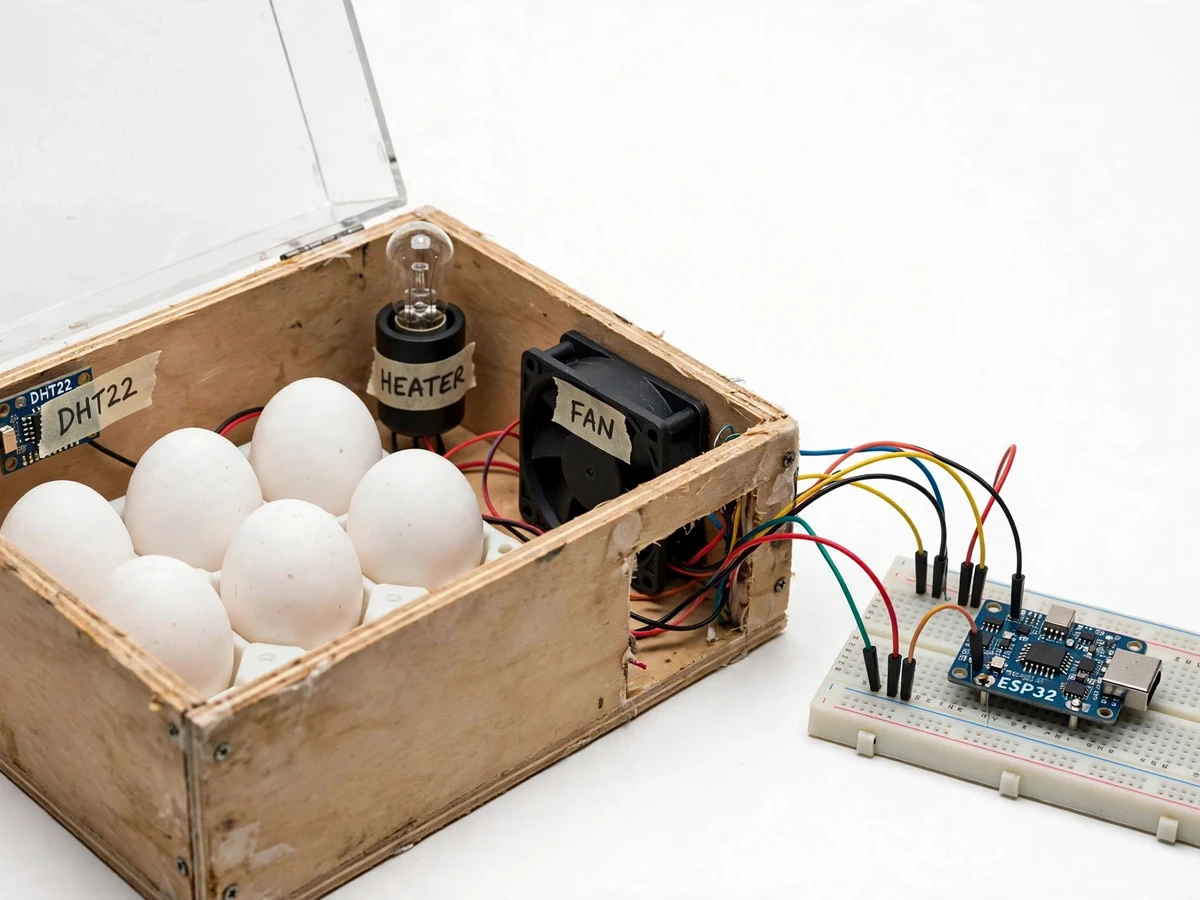
Hatching eggs needs three things held steady for 21 days: temperature near 37.5 °C, humidity in the 55–65 %RH band, and regular turning. Most student incubators are a bulb in a box with a thermostat — they overshoot, dry out, and give the student nothing to measure or explain. The engineering gap is a closed-loop system: a sensor that actually reads the chamber, a controller that modulates the heater instead of banging it on and off, a turner that runs on schedule, and a dashboard that records the whole hatch so the report shows real curves, not claims. This project builds exactly that on an ESP32: a DHT22 monitors the chamber, firmware drives the heater through a relay with PID-style control, a geared motor turns the egg tray on schedule, and every reading streams to a hatch dashboard with day count, turner log and alarm history.
Samples chamber temperature and humidity every 2 seconds.
Follow the working sequence
How it works
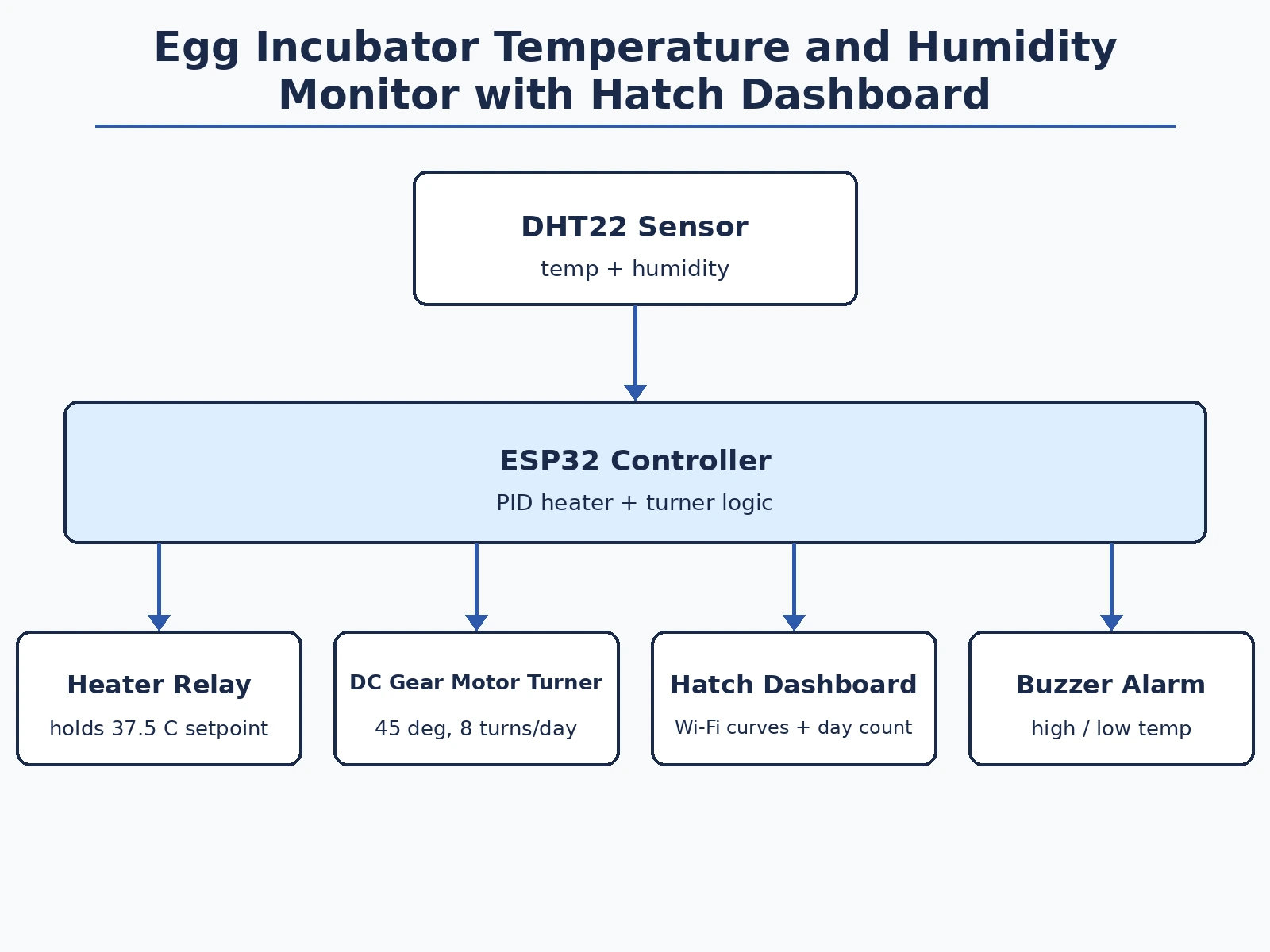
- The DHT22 inside the chamber samples temperature and humidity every 2 seconds and reports them to the ESP32.
- The firmware compares the reading with the 37.5 °C setpoint and adjusts the heater relay duty to close the error, with a small dead-band to avoid relay chatter.
- A ventilation fan runs on a duty cycle to even out hot spots and to vent the chamber if temperature overshoots.
- The turner motor rotates the egg tray on schedule; a limit switch confirms each turn and the event is logged.
- Every reading, turn event and alarm is published over Wi-Fi to the dashboard, which plots the curves and keeps the day count.
- At day 18 the firmware stops turning automatically (lockdown) and raises the humidity target band for hatching.
Tech stack:
- ESP32 development board (Wi-Fi telemetry)
- DHT22 temperature-humidity sensor
- 12 V heater element + relay module
- DC ventilation fan
- Geared DC motor + limit switch (egg turner)
- Buzzer, status LEDs, 12 V supply
- Single-page hatch dashboard (HTML/JS)
| Parameter | Value |
|---|---|
| Controller | ESP32, Wi-Fi telemetry to dashboard |
| Temperature sensor | DHT22; ±0.5 °C per datasheet (verify against a reference thermometer at build) |
| Humidity sensor | DHT22; ±2–5 %RH per datasheet |
| Control setpoint | 37.5 °C; design control band 37.2–37.8 °C |
| Humidity band | 55–65 %RH (design target, lockdown 65–75 %RH) |
| Turner | Geared DC motor; design target 8 turns/day, 45° each |
| Heater | 12 V element, relay-switched with firmware duty control |
| Chamber | Insulated box, approximately 30-egg tray capacity (design target) |
| Dashboard | Live curves, day count, turner/alarm log; demo uses simulated telemetry |
Project features
- [Closed-loop temperature control] The DHT22 feeds chamber temperature to the firmware, which modulates the heater relay to hold the 37.5 °C setpoint — no crude on/off thermostat overshoot.
- [Humidity monitoring with refill alerts] Relative humidity is tracked against the 55–65 %RH band; the dashboard flags when the water tray needs refilling.
- [Automatic egg turner] A geared DC motor rotates the egg tray 45° on a schedule (design target 8 turns/day), with each turn logged to the dashboard.
- [Hatch-day countdown] The dashboard counts incubation days 1–21 and marks candling day and lockdown (day 18, turning stops) automatically.
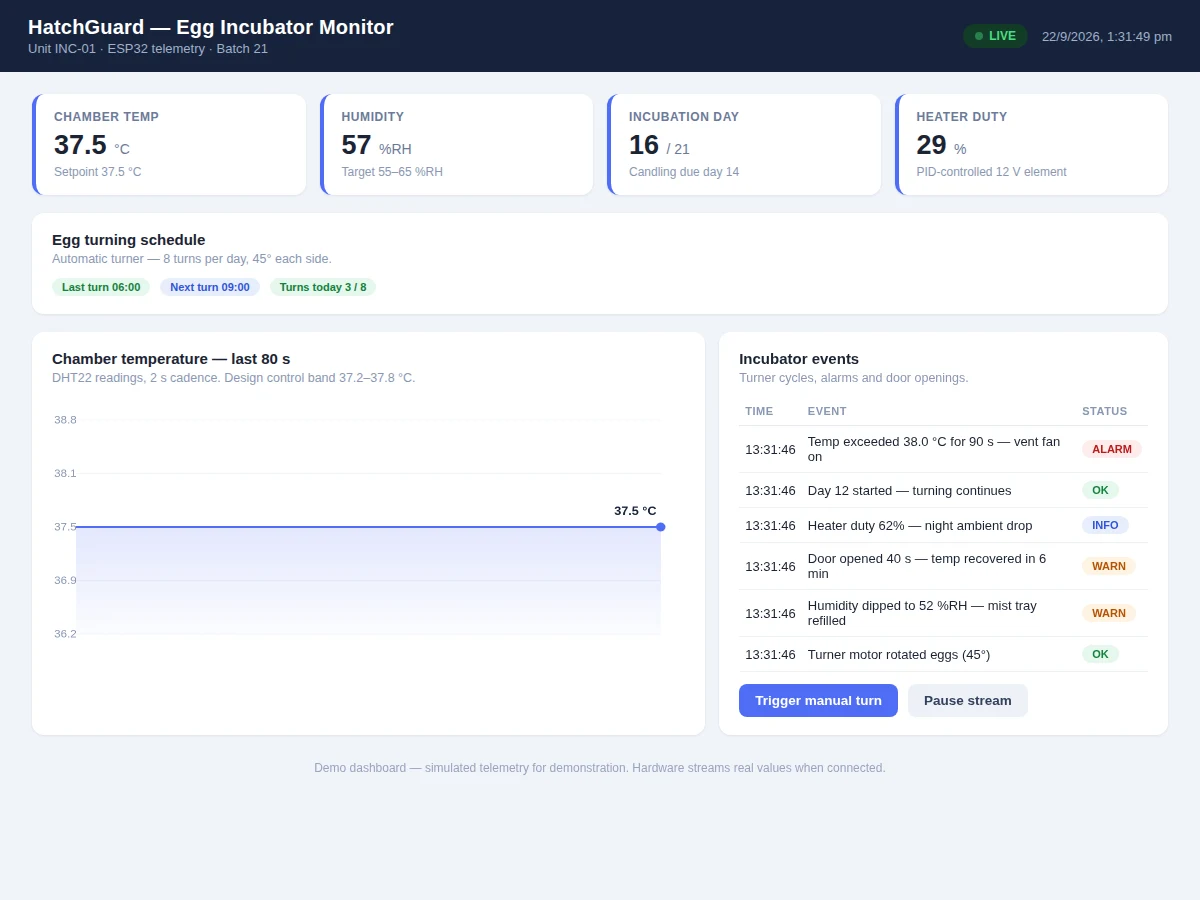
- [Live hatch dashboard] Temperature and humidity curves, heater duty, turner log and alarm history stream to a single-page dashboard.
- [High/low alarms] The buzzer and dashboard alert if temperature leaves the configured safe band, so a failed heater or a left-open lid is caught fast.
- [Tuning procedure included] The report documents the buyer's own calibration run: setpoint verification against a reference thermometer and turner timing checks.
What is included
- Working incubator prototype (chamber, heater, fan, turner, DHT22, ESP32)
- Complete firmware source code (control loop, turner schedule, alarms, dashboard sync)
- Live hatch dashboard setup with temperature/humidity plots and event log
- Circuit and wiring documentation
- Calibration procedure (setpoint check, turner timing, sensor verification steps the buyer runs)
- Project report PDF (control theory, build, calibration results from the buyer's own run)
- PPT presentation for final review
- Viva Q&A preparation document (PID basics, sensor accuracy, incubation biology)
Limitations & prerequisites
- Hatch success depends on egg fertility and handling — the project controls the chamber, it cannot guarantee any hatch rate figure.
- DHT22 accuracy is ±0.5 °C per datasheet; a reference thermometer check at build is part of the procedure, not optional.
- The chamber is a prototype build, not a certified hatcher — insulation and uniformity are student-grade.
- Wi-Fi is needed for the live dashboard; on-device the controller keeps running and logs locally without it.
- Humidity control is monitor-and-alert (manual tray refill), not automatic humidification.
- Heater duty figures are design targets; actual duty depends on ambient temperature and insulation.
Frequently Asked Questions
How is the temperature actually controlled?
The DHT22 reads the chamber every 2 seconds and the firmware adjusts the heater relay's duty cycle to hold 37.5 °C, with a dead-band to stop relay chatter and a fan to even out hot spots — a closed loop, not a thermostat click.
Why stop turning at day 18?
Real hatchery practice: chicks position themselves for hatching in the last three days, so turning stops (lockdown) and humidity is raised. The firmware does this automatically on the day count.
What does the dashboard show?
Live temperature and humidity curves, heater duty, the incubation day (1–21), a log of every turner rotation, and an alarm history — everything the report needs as evidence.
Can it really hatch eggs?
It provides the controlled environment hatching needs, and the procedure includes a full calibration run. Fertility, egg quality and handling are outside the project's control, so no hatch-rate number is promised.
What if the Wi-Fi drops?
The controller keeps the chamber regulated on-device; readings buffer locally and sync to the dashboard when connectivity returns.
Is this project suitable for a final-year project?
Yes — for Electronics, Electrical and IoT & Embedded programs. It demonstrates sensing, closed-loop control, actuation and telemetry around a real biological process with measurable outcomes. Suitable for B.E./B.Tech final-year projects in Electronics, Electrical and IoT & Embedded Systems.
Components & software requirements
- ESP32 development board (Wi-Fi telemetry)
- DHT22 temperature-humidity sensor
- 12 V heater element + relay module
- DC ventilation fan
- Geared DC motor + limit switch (egg turner)
- Buzzer, status LEDs, 12 V supply
- Single-page hatch dashboard (HTML/JS)
Delivery information
Built-to-order project. Delivery timeline is shared after order confirmation based on current queue.
Support terms
Complete documentation, setup guide, and viva preparation included. Support for setup and explanation provided.
Download free synopsis (PDF)
Enter your name and WhatsApp number — the synopsis PDF downloads immediately. We may send occasional project updates on WhatsApp; no spam.