
More project photos (3)

The problem
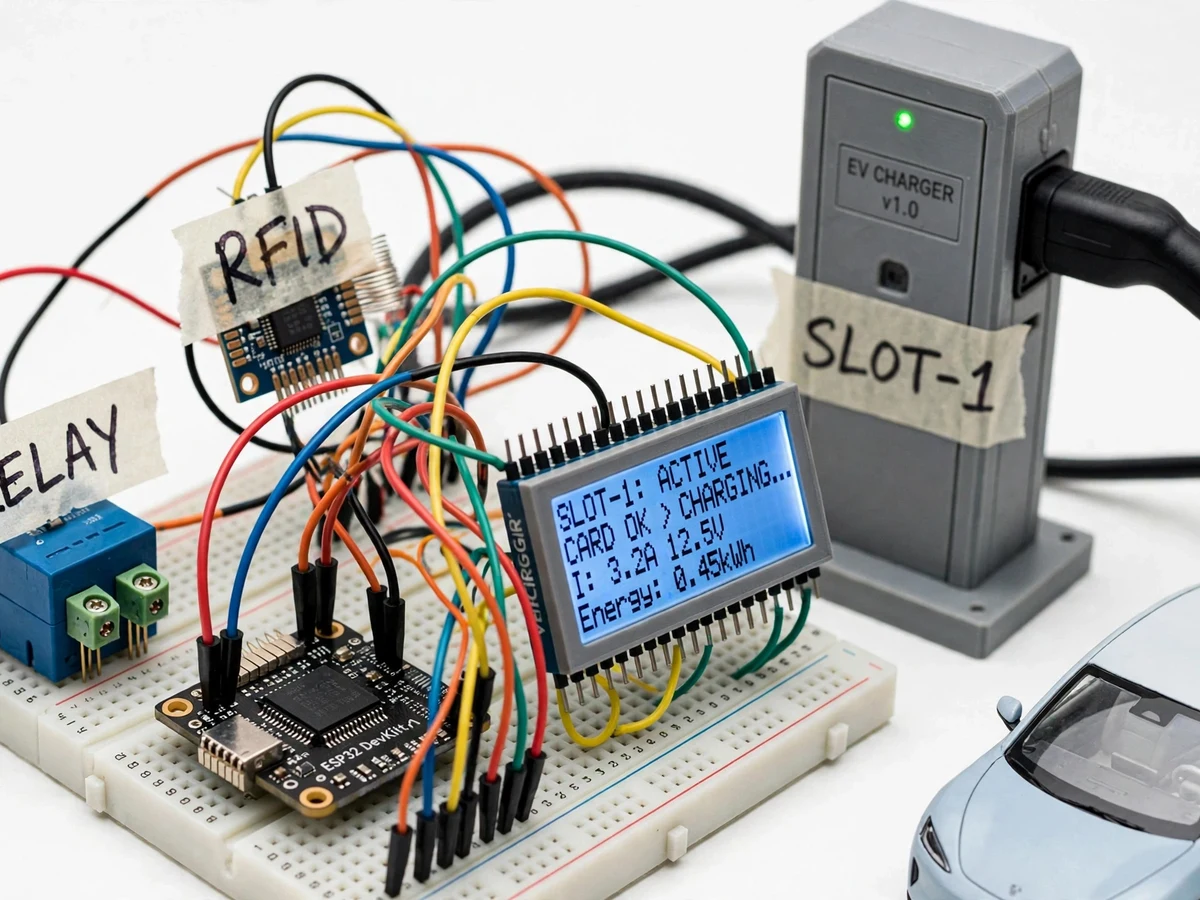
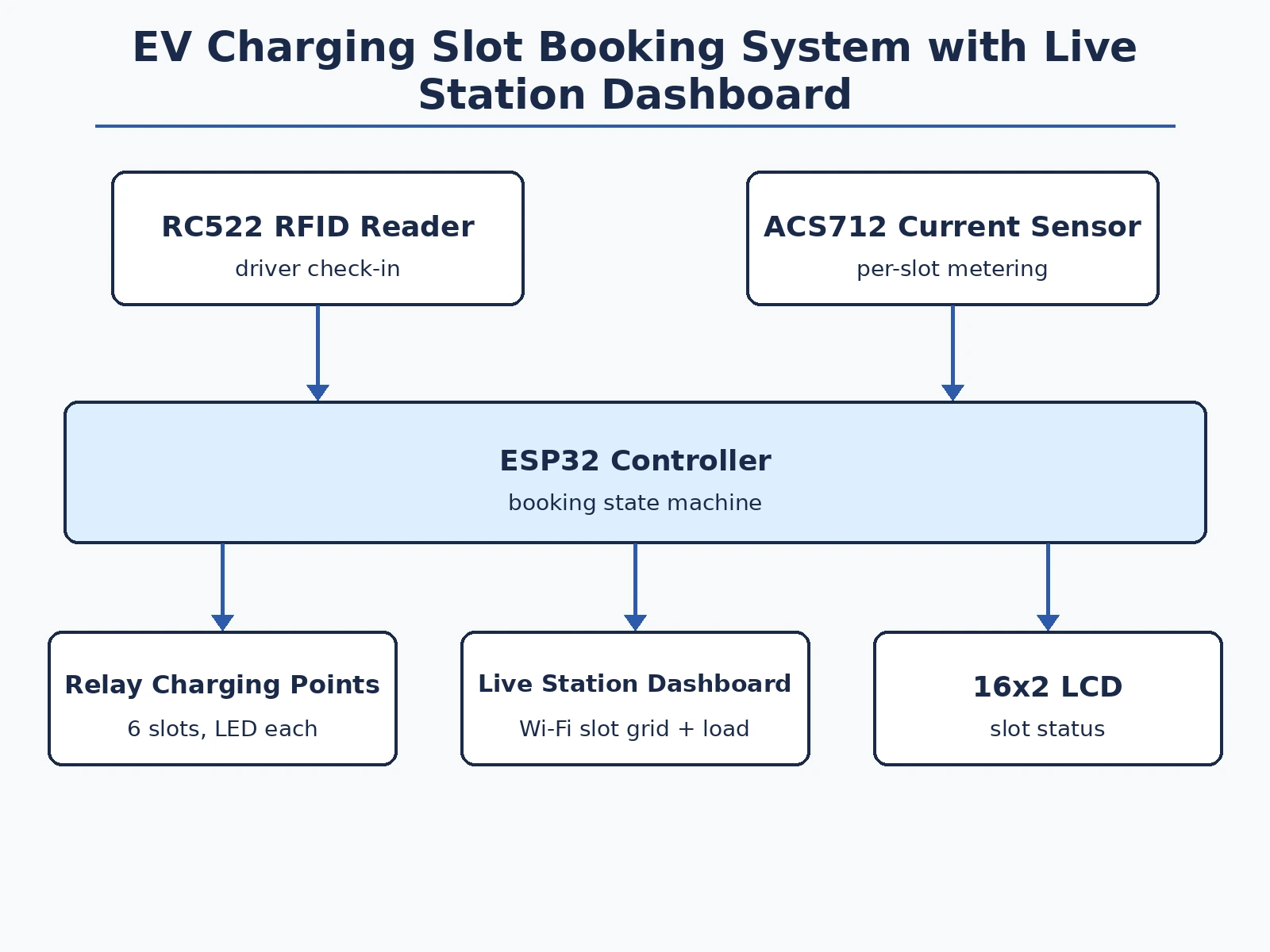
Public EV chargers fail drivers in a boring way: you arrive and the point is taken, broken, or occupied by a car that finished hours ago. The fix used by real networks is a booking layer — reserve the slot, authenticate at the post, and meter the session. Students usually build either a charger or a booking website, never the two joined together. This project joins them on one controller: an ESP32 runs six model charging points, each with an RFID reader for check-in, a relay that switches the point, and current sensing for load telemetry. The station dashboard shows every slot's state — free, reserved, charging — plus aggregate load and today's energy, and reservations made on the dashboard are honored by the hardware when the driver taps in.
Books a charging slot on the dashboard and taps the RFID card at the post.
Follow the working sequence
How it works
- A booking is created on the dashboard for a slot and time window; the ESP32 stores the reservation with the card UID.
- The driver arrives and taps the RFID card at the post; the reader sends the UID to the controller.
- The firmware matches the UID against active reservations (or accepts a walk-in if the slot is free and unreserved).
- On a match, the slot's relay energizes the point, the status LED changes, and the dashboard marks the slot as charging.
- Current sensing meters the session; energy accumulates until the driver taps out or the vehicle signals full.
- On session end the relay drops, the dashboard logs kWh delivered, and the slot returns to free or to its next reservation.
Tech stack:
- ESP32 development board (Wi-Fi + booking state)
- RC522 RFID reader + registered cards/tags
- 4/8-channel relay module (point switching)
- ACS712 current sensors (per-slot metering)
- 16x2 LCD (post status display)
- Single-page station dashboard (HTML/JS)
- Arduino IDE (C/C++ firmware)
| Parameter | Value |
|---|---|
| Controller | ESP32, Wi-Fi dashboard sync |
| Charging points | 6 model points (scaled demo of 7.4 kW AC class) |
| Access | RC522 RFID, 13.56 MHz; registered UID whitelist in firmware |
| Switching | Relay module per point with status LED |
| Metering | ACS712 per-slot current sensing; energy accumulated in firmware |
| Aggregate ceiling | Configurable; design default 80% of installed point capacity |
| Reservation grace | Configurable; design default 15 minutes |
| Dashboard | Live slot grid, load curve, bookings and session log |
Project features
- [Slot booking engine] Six charging points can be reserved for a time window from the dashboard; the controller holds the reservation state per slot.
- [RFID check-in] The driver taps a registered RFID card at the post; only a matching active reservation (or a walk-in, if the slot is free) energizes the point.
- [Relay-switched points] Each point is switched by its own relay module with an indicator LED, so the power path is visible and demonstrable.
- [Live station dashboard] Slot grid (free/reserved/charging), aggregate load curve, energy delivered today and a booking/session log update in real time.
- [Session metering] Per-slot current sensing accumulates energy per session; the dashboard shows kWh delivered when a session ends.
- [Reservation expiry] Unclaimed reservations auto-release after a configurable grace window, so one no-show cannot block a point all evening.
- [Overload guard] If aggregate load crosses a configured ceiling, the firmware refuses new sessions and flags the dashboard — a real protection behavior.
What is included
- Working charging-station prototype (6 model points, RFID, relays, current sensing, LCD, ESP32)
- Complete firmware source code (booking engine, RFID auth, metering, dashboard sync)
- Live station dashboard with slot grid, load curve and logs
- Circuit and wiring documentation
- RFID enrollment procedure (registering driver cards)
- Project report PDF (system design, state machine, test sessions from the buyer's own runs)
- PPT presentation for final review
- Viva Q&A preparation document (RFID, relay switching, load management, OCPP concepts)
Limitations & prerequisites
- A scaled prototype of AC charging points — it switches model loads, not a real EV's high-voltage battery; high-voltage charging is explicitly out of scope.
- Payment integration is not implemented; the build covers booking, authentication and metering only.
- RFID range is a few centimeters per the RC522's design — cards must be tapped, not waved at distance.
- Energy figures are computed from the current sensors on model loads; accuracy is indicative, not revenue-grade metering.
- Real OCPP back-end integration is described as future scope, not implemented.
- Booking conflicts across midnight windows need the firmware's day-rollover handling, documented in the report.
Frequently Asked Questions
How does the booking actually control the hardware?
Reservations made on the dashboard are stored on the ESP32 with the card UID. When that card is tapped at the post, the firmware matches it to the reservation and only then energizes the slot's relay.
What stops someone using another driver's slot?
The relay stays off unless the tapped card UID matches an active reservation for that slot — or the slot is free and walk-ins are allowed. The dashboard logs every check-in.
What happens on a no-show?
The reservation auto-releases after the grace window (design default 15 minutes) and the slot returns to free, so one booking cannot block a point all evening.
Does it charge a real EV?
No — this is a scaled prototype that switches model loads to demonstrate the booking, authentication and metering loop safely. Real high-voltage charging is out of scope.
How is energy per session measured?
An ACS712 current sensor on each point feeds the firmware, which accumulates kWh over the session; the dashboard shows the delivered energy when the session ends.
Is this project suitable for a final-year project?
Yes — for Electrical, Electronics and IoT & Embedded programs. It combines access control, power switching, metering and a booking state machine into one demonstrable system. Suitable for B.E./B.Tech final-year projects in Electrical, Electronics and IoT & Embedded Systems.
Components & software requirements
- ESP32 development board (Wi-Fi + booking state)
- RC522 RFID reader + registered cards/tags
- 4/8-channel relay module (point switching)
- ACS712 current sensors (per-slot metering)
- 16x2 LCD (post status display)
- Single-page station dashboard (HTML/JS)
- Arduino IDE (C/C++ firmware)
Delivery information
Built-to-order project. Delivery timeline is shared after order confirmation based on current queue.
Support terms
Complete documentation, setup guide, and viva preparation included. Support for setup and explanation provided.
Download free synopsis (PDF)
Enter your name and WhatsApp number — the synopsis PDF downloads immediately. We may send occasional project updates on WhatsApp; no spam.