
More project photos (3)
The problem
Lifts are among the hungriest loads in a building, yet almost no building meters them separately — the energy bill just absorbs it. Without per-trip data you cannot say whether the standby controller, the cabin light left on, or the actual hoisting dominates consumption, and you cannot evaluate any saving measure. The engineering gap is a dedicated logger: real power metering on the lift supply, trip detection from cabin movement, and standby power measured honestly, all feeding a dashboard that splits the daily total into useful versus wasted energy. This project builds that on an ESP32 with a model elevator: a PZEM-004T meters the supply, an ultrasonic sensor tracks cabin position for trip counting, and the dashboard shows energy per trip, hourly profiles and standby share.
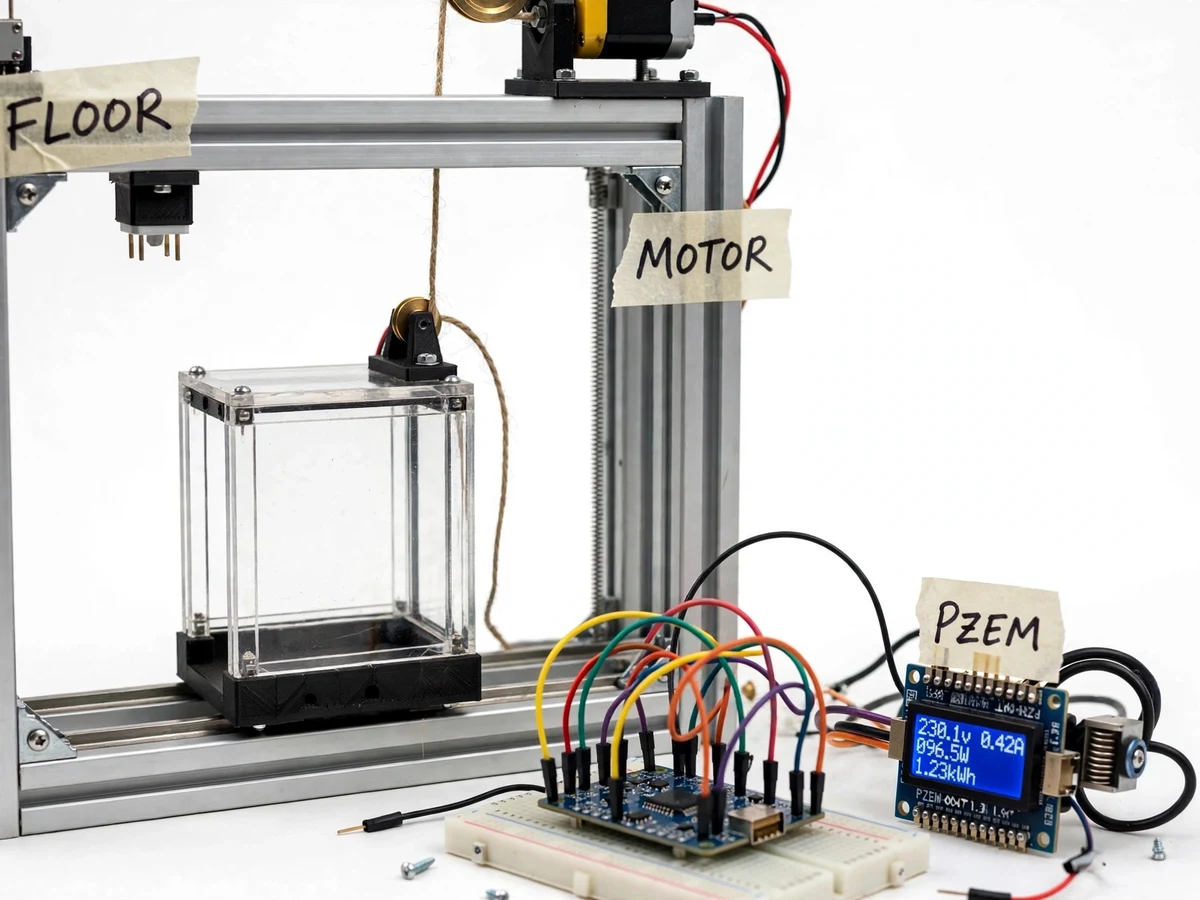
Energy module metering the lift supply continuously: voltage, current, active power and cumulative energy.
Follow the working sequence
How it works
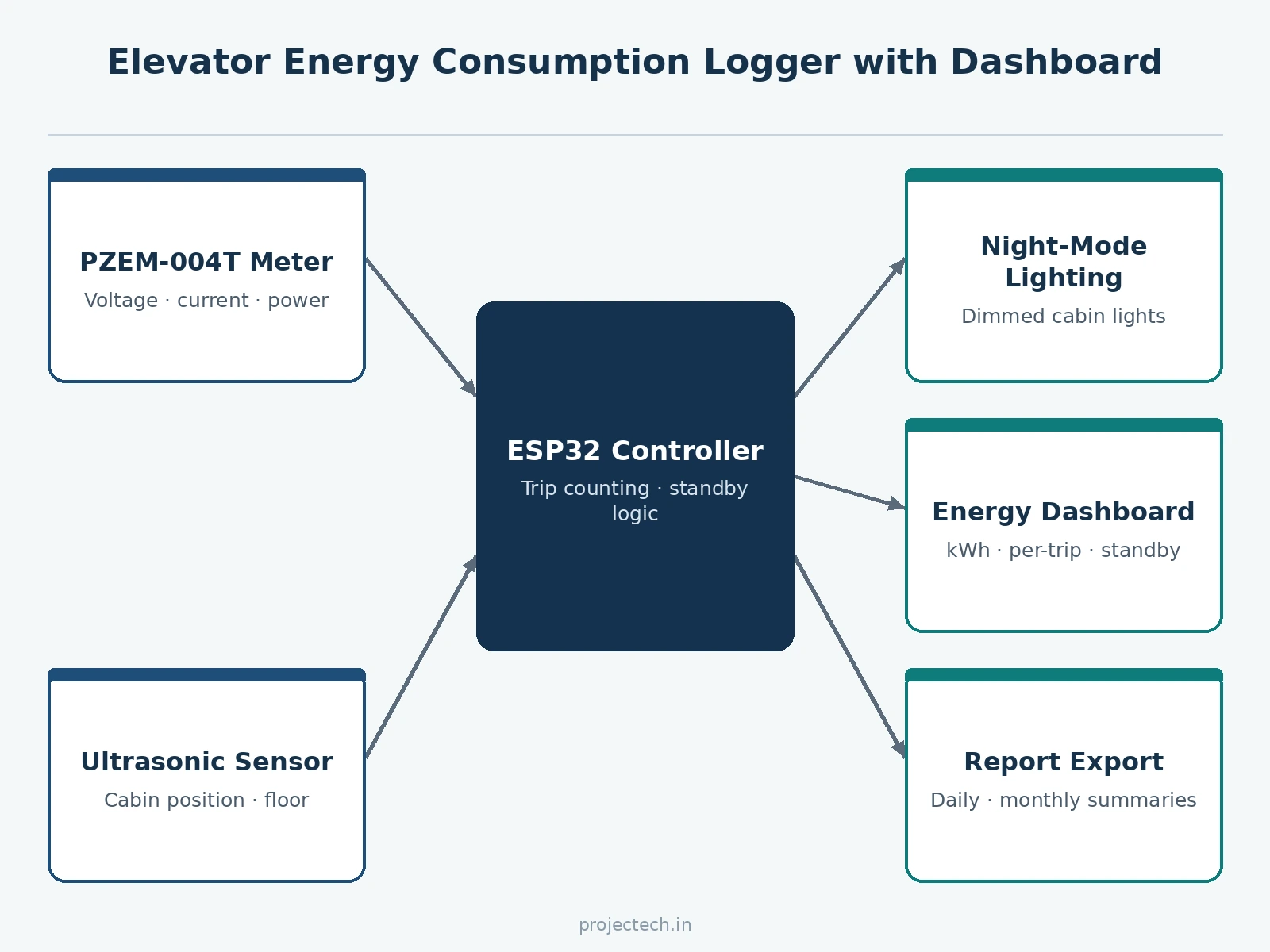
- The PZEM-004T meters the model's lift supply continuously: voltage, current, active power and cumulative energy.
- The ultrasonic position sensor watches the cabin; each completed floor-to-floor movement registers as one trip.
- Firmware splits energy into trip energy (power above the standby baseline during movement) and standby energy (the idle baseload).
- Every trip logs with timestamp, floors traveled and energy used; standby accumulates through the night.
- Readings and trip events stream over Wi-Fi to the dashboard, which builds the hourly profile and daily totals.
- Night-mode dims the cabin light after idle timeout; the dashboard quantifies the standby reduction.
Tech stack:
- ESP32 development board (Wi-Fi telemetry)
- PZEM-004T energy meter module (V, A, W, kWh)
- Ultrasonic position sensor (cabin tracking)
- Model elevator (shaft, cabin, DC hoist motor)
- Relay (cabin light / night-mode control)
- Single-page energy dashboard (HTML/JS)
- Arduino IDE (C/C++ firmware)
| Parameter | Value |
|---|---|
| Controller | ESP32, Wi-Fi dashboard sync |
| Energy metering | PZEM-004T; voltage, current, active power, cumulative kWh |
| Trip detection | Ultrasonic cabin-position sensor; floor-to-floor run = 1 trip |
| Standby measurement | Idle baseload metered separately from trip energy |
| Model scale | Demonstration currents in the low-amp range; method scales to real lifts |
| Night mode | Cabin light dimmed after configurable idle timeout |
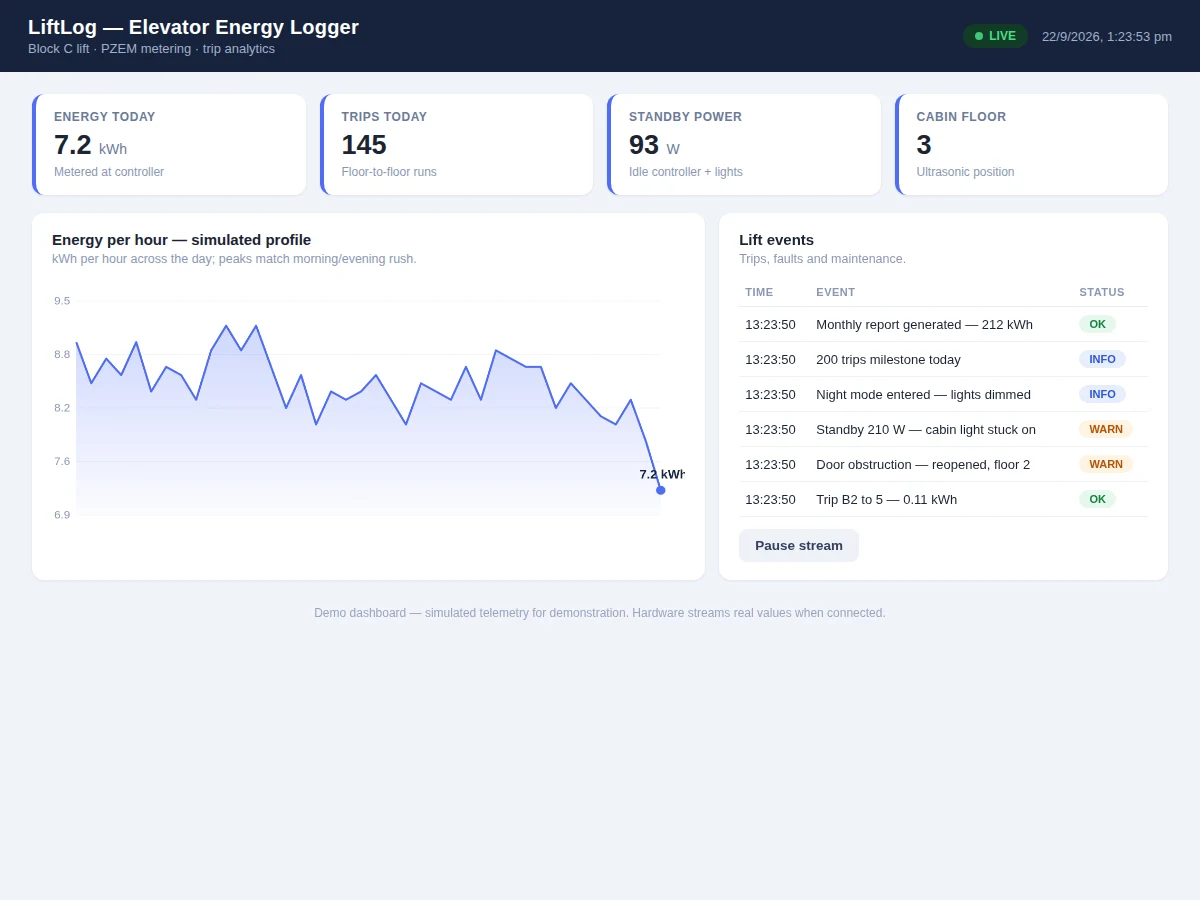
| Dashboard | Daily kWh, per-trip energy, hourly profile, standby share, trip log |
| Reports | Daily/monthly summaries for the audit discussion |
Project features
- [Real power metering] A PZEM-004T module measures voltage, current, power and cumulative energy on the lift supply — real electrical measurement, not estimates.
- [Trip detection and counting] Cabin position sensing detects each floor-to-floor run; the firmware counts trips and attributes energy per trip.
- [Standby-power tracking] Idle power is measured separately and accumulated, exposing the controller-and-lights baseload most audits miss.
- [Energy analytics dashboard] Daily kWh, per-trip energy, hourly profile, standby share and a trip log update live.
- [Floor-position sensing] An ultrasonic sensor tracks the cabin, giving position for trip detection and a live floor indicator.
- [Night-mode behavior] The firmware dims cabin lighting in idle hours and the dashboard shows the standby saving — a demonstrable efficiency measure.
- [Report-ready exports] Daily and monthly summaries (kWh, trips, standby share) are formatted for the report's audit discussion.
What is included
- Working elevator-logger prototype (model lift, PZEM metering, position sensing, ESP32)
- Complete firmware source code (metering, trip detection, standby split, dashboard sync)
- Energy analytics dashboard with profiles and trip log
- Circuit and wiring documentation
- Meter verification procedure (buyer-run check against a reference meter)
- Project report PDF (lift energy audit method, results from the buyer's logged runs)
- PPT presentation for final review
- Viva Q&A preparation document (energy metering, standby loads, trip energy, audit method)
Limitations & prerequisites
- Demonstrated on a model elevator at safe low currents; metering a real lift needs a qualified electrician and proper CT installation — explicitly out of student scope.
- Per-trip energy on the model is small; the value is in the method and the standby-vs-trip split, not the absolute numbers.
- The PZEM's accuracy class is indicative; the buyer's verification run against a reference meter is documented, not skipped.
- Regenerative braking energy is not measured — the model has no regen drive.
- Night-mode savings are demonstrated on the model; real-building savings need a proper audit.
Frequently Asked Questions
What is the point of metering a model lift?
The method is the project: separating trip energy from standby baseload, counting trips honestly, and building the audit numbers. The same firmware logic applies at building scale with proper CTs.
How is standby separated from trip energy?
The idle baseload is measured when the cabin is stationary; energy above that baseline during movement counts as trip energy. The dashboard shows both shares.
How are trips detected?
The ultrasonic sensor tracks cabin position; a completed movement between floors registers one trip with its floors and energy.
Why does standby matter so much?
Lifts idle most of the day, and the controller, lights and fans draw power the whole time. Audits routinely find standby is a large share — the dashboard makes it visible.
Can this be fitted to a real building lift?
The metering and analytics transfer directly, but installation on live lift supplies must be done by qualified personnel — the project documents the method, not the high-voltage work.
Is this project suitable for a final-year project?
Yes — for Electrical, Electronics and IoT & Embedded programs. It is a genuine energy-audit instrument: real metering, honest baseload separation and report-ready numbers. Suitable for B.E./B.Tech final-year projects in Electrical, Electronics and IoT & Embedded Systems.
Components & software requirements
- ESP32 development board (Wi-Fi telemetry)
- PZEM-004T energy meter module (V, A, W, kWh)
- Ultrasonic position sensor (cabin tracking)
- Model elevator (shaft, cabin, DC hoist motor)
- Relay (cabin light / night-mode control)
- Single-page energy dashboard (HTML/JS)
- Arduino IDE (C/C++ firmware)
Delivery information
Built-to-order project. Delivery timeline is shared after order confirmation based on current queue.
Support terms
Complete documentation, setup guide, and viva preparation included. Support for setup and explanation provided.
Download free synopsis (PDF)
Enter your name and WhatsApp number — the synopsis PDF downloads immediately. We may send occasional project updates on WhatsApp; no spam.