
More project photos (3)
The problem
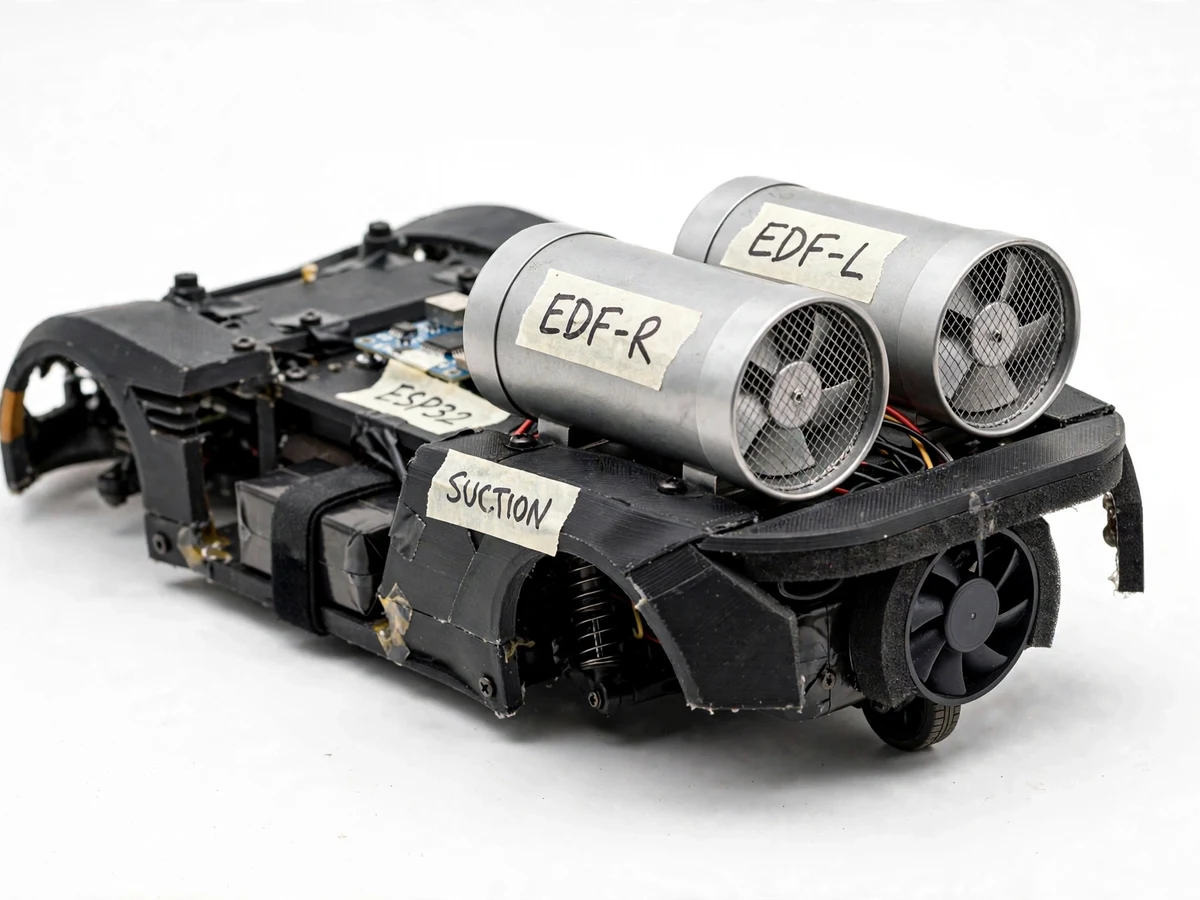
The 2026 Tesla Roadster reveal put cold-gas thrusters and suction-mode downforce on a production car's spec sheet — ideas students immediately wanted to try at RC scale. The thrusters don't scale down: the real car's system runs on ultra-high-pressure tanks, and a student-scale version is a pressure vessel that no college lab can charge, store or legally operate. The gap is a stunt car that produces the same two effects — vectored thrust and active downforce — with safe, rechargeable, lab-legal hardware. This project is that build: a 1:10-scale RC stunt car driven gearless by twin 64mm electric ducted fans (EDFs) on servo-vectoring pods, with an underfloor suction fan and flexible skirt generating atmospheric downforce. An ESP32 fuses MPU6050 IMU data to hold the car level mid-jump, with a companion phone dashboard streaming live telemetry. The honest math: twin 64mm EDFs on 4S give roughly 1.7 kgf of combined static thrust (per manufacturer test figures) against an expected 2.5–3.5 kg all-up weight — thrust-to-weight below 1, so this car does assisted jumps, wheelies and mid-air attitude control, not flight.
How it works
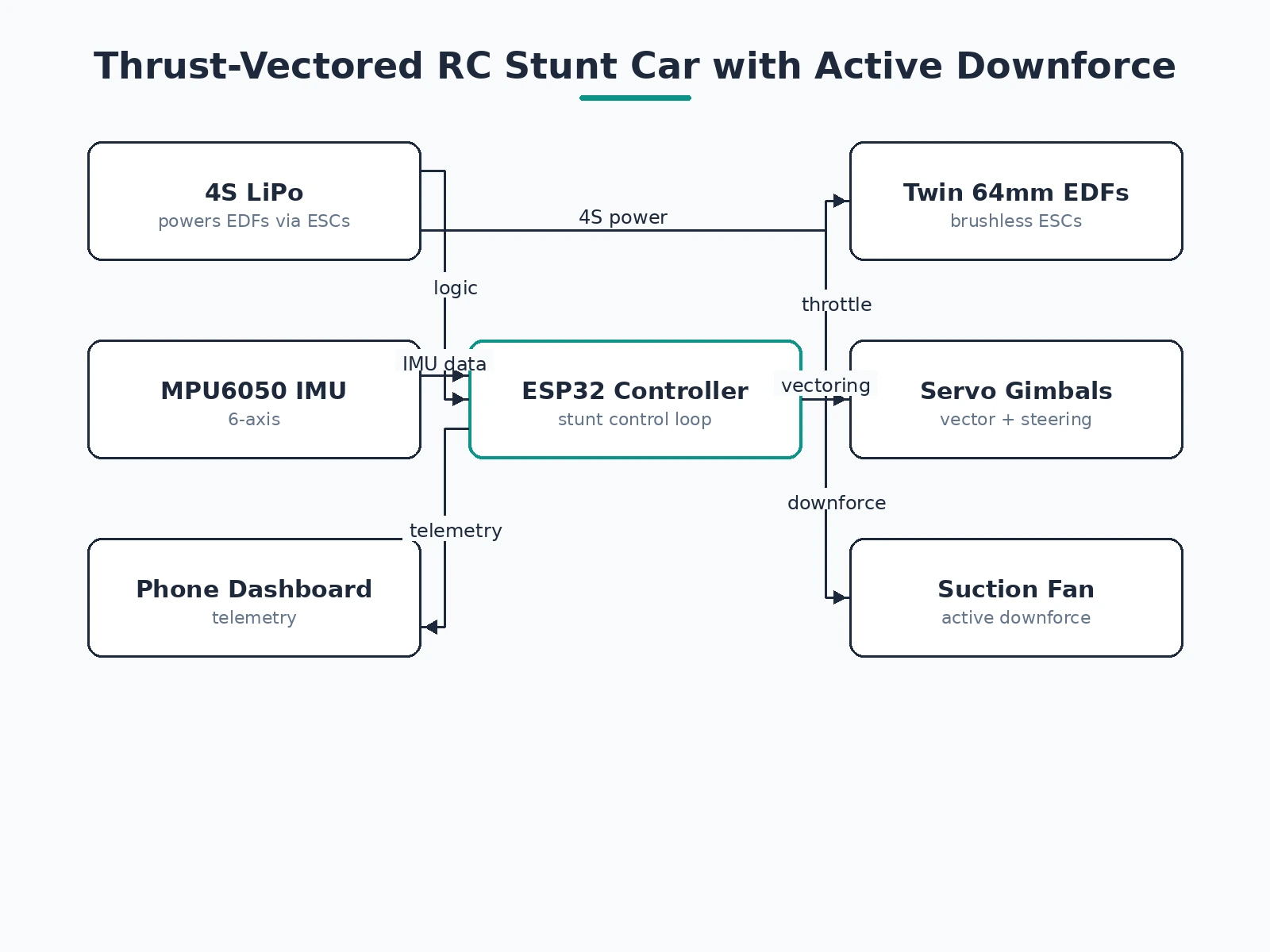
- The driver moves the phone controller's throttle, steering and vectoring sliders; commands travel to the car over Wi-Fi as short control packets.
- The ESP32 mixes the inputs: a front-wheel servo for steering, twin servo gimbals for nozzle angle, and 50 Hz PWM (1–2 ms pulses) to the two brushless ESCs that drive the EDFs.
- At full horizontal thrust the car accelerates like a jet car — gearless — while the angled nozzles add turning force alongside the steering servo.
- During a jump, the MPU6050's MEMS sensors — microscopic silicon masses on springs whose tilt changes capacitance, digitized by the chip's 16-bit ADCs — report pitch and roll to the ESP32, which trims the two EDFs differentially to hold a level attitude in the air.
- The suction fan runs on demand from the phone: it pulls air from under the floor through a screened duct, the rubber skirt seals against the track, and atmospheric pressure outside presses the car down; the acceptance test is a slow inverted run on a smooth rig.
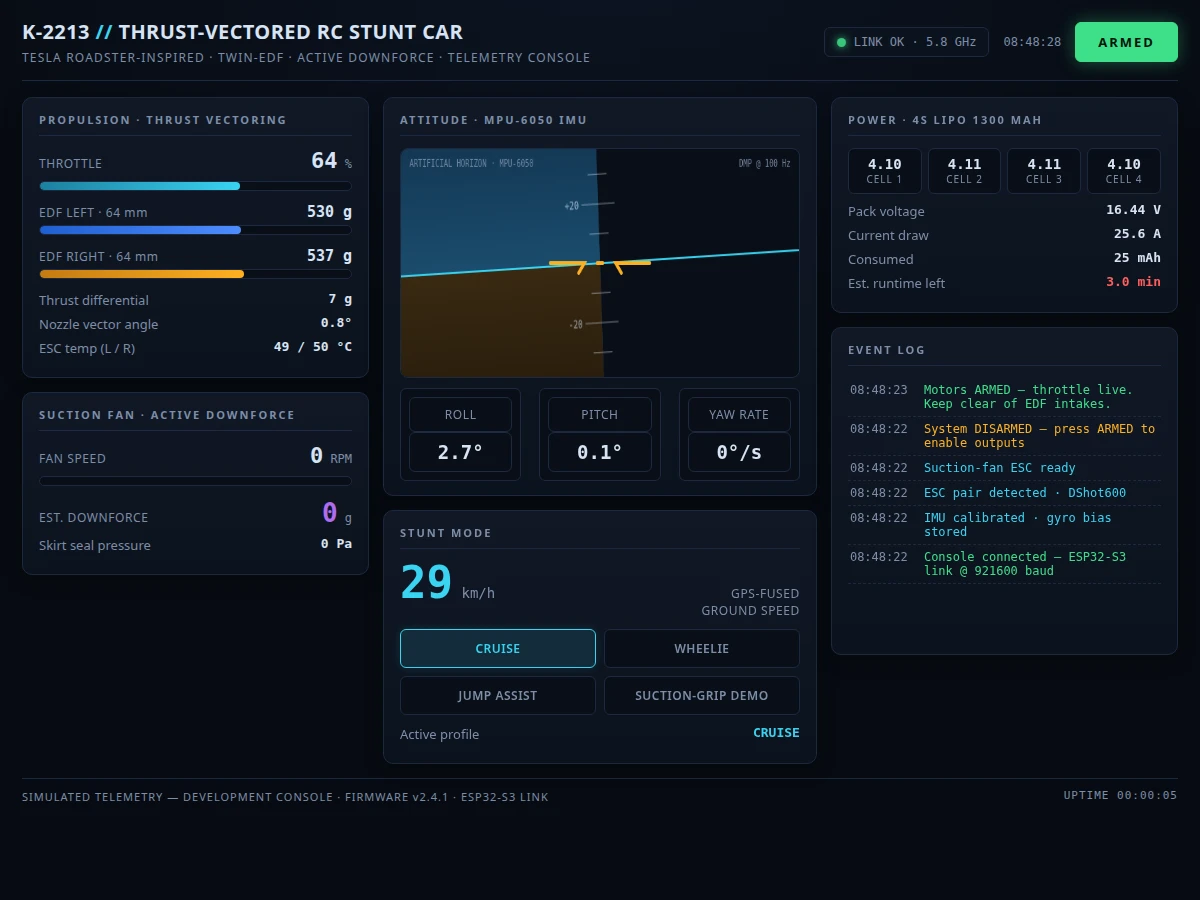
- Telemetry packets (attitude angles, throttle percentage, battery voltage, fan state) stream to the companion phone dashboard at a 10 Hz design target, and the controller idles the EDFs the instant the IMU registers a hard touchdown, protecting the battery and the printed mounts.
Tech stack:
- ESP32 (dual-core · Wi-Fi control and telemetry)
- MPU6050 6-axis IMU (I2C attitude sensing)
- 64mm EDF ducted fans × 2 (4S)
- Brushless ESC × 2 (design reference: 50A class)
- 4S LiPo battery (14.8 V nominal)
- Servo gimbals + steering servo
- 3D-printed chassis and body shell
- Arduino IDE firmware + companion phone dashboard
| Parameter | Value |
|---|---|
| Chassis scale | 1:10 (design target) |
| Controller | ESP32: dual-core Xtensa 32-bit LX6, up to 240 MHz (datasheet) |
| IMU | MPU6050: 3-axis MEMS gyroscope + 3-axis MEMS accelerometer, 16-bit ADC per axis (datasheet) |
| Gyroscope range | ±250 to ±2000 °/s, programmable (datasheet) |
| Accelerometer range | ±2g to ±16g, programmable (datasheet) |
| Thrust units | 2 × 64mm EDF on 4S LiPo (design reference) |
| Static thrust per EDF | Approximately 850 g on 4S (per manufacturer test figures — 64mm 12-blade unit with 2500Kv motor) |
| Combined static thrust | Approximately 1.7 kgf (design calculation: sum of the two units) |
| All-up weight | Expected 2.5–3.5 kg with 4S LiPo fitted |
| Thrust-to-weight ratio | Approximately 0.5–0.7 (design calculation: below 1 — assisted jumps, not flight) |
| Suction fan | Underfloor fan with flexible skirt; atmospheric-pressure downforce (design reference) |
| Inverted acceptance test | Suction system must hold the car's own all-up weight on a smooth rig (acceptance procedure — not a measured claim) |
| ESC | 2 × brushless ESC, 50A class (design reference) |
| PWM drive | 50 Hz, 1–2 ms pulse to EDF ESCs and servos (design target) |
| Battery | 4S LiPo, 14.8 V nominal (design reference) |
| Telemetry rate | 10 Hz (design target) to the companion dashboard |
| Parts budget | Expected ₹35,000–₹60,000 (quotation basis — not a fixed price) |
Project features
- [Twin 64mm EDF thrust pods] Two 64mm electric ducted fans on 4S drive the car with gearless thrust — no drivetrain, no gears — producing roughly 1.7 kgf of combined static thrust (per manufacturer test figures) for launches and stunt assists.
- [Servo thrust vectoring] Each EDF pod sits on a servo gimbal; the ESP32 angles the nozzles for steering at speed, rearward-down vectoring for jump lift, and differential thrust for mid-air attitude correction.
- [IMU-stabilized stunt control] A MPU6050 6-axis IMU feeds pitch, roll and yaw rates to the ESP32, which trims the two EDFs differentially during jumps to hold a level attitude, then idles them on touchdown.
- [Active downforce suction fan] An underfloor fan with a flexible rubber skirt evacuates air from under the chassis, so outside atmospheric pressure presses the car down — the fan-car physics behind suction modes. Builder note: the skirt must be a soft seal with full floor contact; without it the low-pressure zone leaks and the downforce collapses.
- [Wheelie and jump-assist modes] Firmware stunt modes fire short, timed full-thrust bursts — rearward-down vectoring for wheelies, paired bursts over ramps for jumps. Burst timings are configurable in firmware.
- [Wi-Fi telemetry link] The ESP32 streams attitude, throttle position, battery voltage and fan state to the project's companion phone dashboard in real time.
- [Roadster-style 3D-printed body] A 1:10-scale body shell styled on the Roadster reveal car, printed in sections for the chassis, thrust pods and fan floor. Livery and trim are configurable; body geometry is implemented as designed.
What is included
- 3D-printed 1:10 chassis and Roadster-style body shell
- Twin 64mm EDF thrust pods on servo gimbals with brushless ESCs
- Suction-fan floor assembly with flexible rubber skirt
- ESP32 control board with MPU6050 IMU, wired and programmed
- 4S LiPo battery and balance-charger sourcing notes for Indian suppliers
- Complete firmware source (Arduino IDE) with stunt-mode tuning guide
- Wiring diagram and electronics-bay layout
- Project report PDF (build, thrust-to-weight math, suction physics, calibration procedure)
- PPT presentation for final review
- Viva Q&A preparation document (thrust vectoring, IMU fusion, downforce physics)
- Companion phone dashboard for live telemetry (built alongside the car)
Limitations & prerequisites
- No compressed-gas thrusters — deliberately. The real Roadster's cold-gas system needs ultra-high-pressure tanks; a student-scale version is a pressure vessel, and charging, storing or operating one in a college lab is a rupture hazard that is not legally viable. Twin EDFs are the safe, rechargeable, lab-legal electric equivalent of the same vectored-thrust idea.
- Thrust-to-weight sits below 1 by design: roughly 1.7 kgf of combined EDF thrust against 2.5–3.5 kg means assisted jumps, wheelies and attitude control — the car cannot fly or hover, and any claim otherwise would be false.
- The suction fan only works on a smooth, prepared surface: dust, cracks or a curled skirt leak the low-pressure zone and the downforce vanishes. The inverted demo needs a purpose-built smooth ramp or ceiling rig, not any wall.
- 4S LiPo packs demand discipline: balance charging, no puncture or over-discharge, storage voltage between sessions. EDFs draw high current, so expect short high-thrust bursts rather than long cruises — a design target of 3–6 minutes of stunt driving per charge.
- Control runs over Wi-Fi from a phone app, so the practical range is short and dropouts are possible at the edge; this is a demo link, not a long-range RC system.
- The printed chassis is a demo prototype, not a basher: hard landings crack mounts. Flying, public roads and crowds are out of scope — demonstrate in open, controlled spaces only.
Frequently Asked Questions
Why doesn't it use real cold-gas thrusters like the actual Roadster?
Ultra-high-pressure tanks are pressure vessels: they need certified charging, leak-proof plumbing and rupture protection that no college lab can provide. An electrically driven EDF pair gives the same vectored-thrust effect, recharges from a LiPo, and stays legal — which is exactly why this build exists in this form.
How does the mid-air stabilization actually work?
The MPU6050 IMU samples pitch and roll at a high rate (design target: several hundred Hz); the ESP32 compares them against a level reference and trims each EDF's throttle differentially so the car holds its attitude off a jump, then cuts thrust when the IMU registers touchdown.
Can the suction fan really stick the car to a ceiling?
Only on a smooth, sealed surface: the fan pulls air from under the floor while the flexible skirt seals the low-pressure zone, so outside air pressure pins the car up. The build's acceptance test is a slow inverted run on a smooth rig — dust or a bad seal kills the effect instantly.
What power and charging gear do I need?
A 4S LiPo (14.8 V nominal) plus a balance charger and a LiPo-safe charging bag — LiPo discipline is mandatory. The build notes name Indian suppliers for cells, chargers and spare EDF units, so every part is actually buyable rather than theoretical.
Is this project suitable for a final-year project?
Yes — for Electronics, Electrical, IoT/Embedded and Mechatronics programs. It demonstrates brushless-motor drive through ESCs, IMU sensor fusion running on an ESP32 control loop, thrust-vectoring geometry and fan-generated downforce physics in a single working car. Because every subsystem can be tuned and measured by the student, it produces strong viva material across control systems, embedded programming and aerodynamics.
Can it be customized?
Yes — body livery and trim, stunt-mode timings in firmware, a larger EDF class, onboard data logging, and telemetry UI changes on the companion dashboard are realistic extensions. Real gas thrusters stay excluded for the safety reasons given under Limitations.
Components & software requirements
- ESP32 (dual-core · Wi-Fi control and telemetry)
- MPU6050 6-axis IMU (I2C attitude sensing)
- 64mm EDF ducted fans × 2 (4S)
- Brushless ESC × 2 (design reference: 50A class)
- 4S LiPo battery (14.8 V nominal)
- Servo gimbals + steering servo
- 3D-printed chassis and body shell
- Arduino IDE firmware + companion phone dashboard
Delivery information
Built-to-order project. Delivery timeline is shared after order confirmation based on current queue.
Support terms
Complete documentation, setup guide, and viva preparation included. Support for setup and explanation provided.
Download free synopsis (PDF)
Enter your name and WhatsApp number — the synopsis PDF downloads immediately. We may send occasional project updates on WhatsApp; no spam.