
More project photos (3)
The problem
Deepinder Goyal's Temple is a head-worn wearable, announced for pre-order on November 1, 2026, that tracks cerebral blood flow with optical sensors and scores physiological strain on a 1-250 "Entropy" scale — explicitly exploring how gravity and posture change blood supply to the brain. The problem for students is that Temple is a closed, handmade, Rs 75,000-80,000 (reported) device: nobody can open it, nobody can repeat its measurements, and a wrist smartwatch cannot answer the posture question anyway because the wrist is not the head. This project is the honest open answer: a headband carrying dual reflective PPG sensors at the left and right temple plus an IMU, worn through a fixed 5-posture protocol — seated, standing, supine, head-down tilt, recovery — while it records how local head perfusion changes against the gravity vector. It does not claim to measure true cerebral blood flow; it measures the same physical quantity Temple made famous, openly and repeatably.
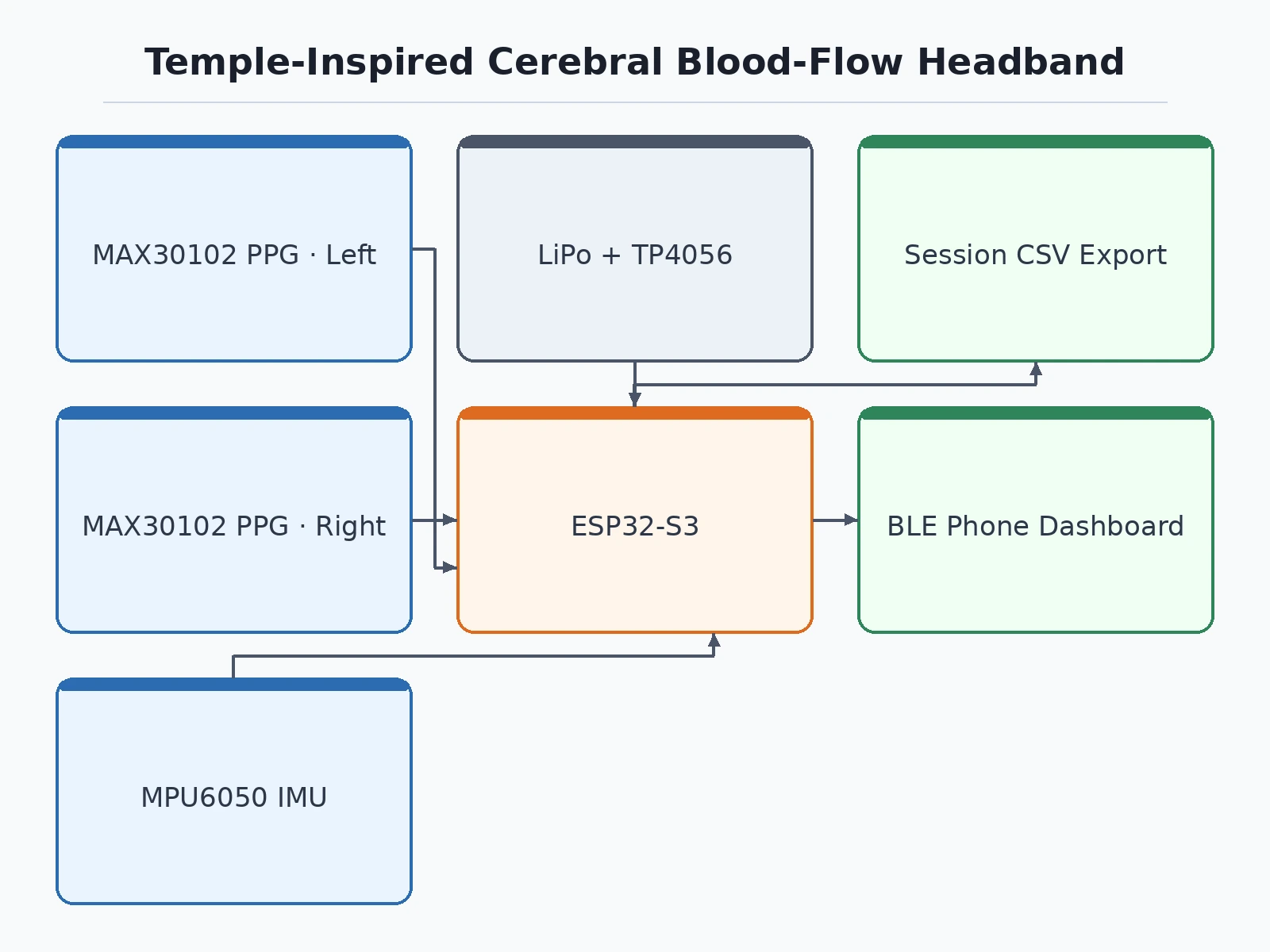
Temple's reference numbers set the context: BrainFlow optical sensing of cerebral blood flow, an Entropy strain score from 1 to 250, six launch colours, handmade units delivered within three months of ordering, and an explicit wellness-not-medical-diagnosis positioning. This build keeps the question and rescales the engineering honestly: two MAX30102 PPG modules (red 660 nm, IR 880 nm, I2C) on the ESP32's two hardware I2C buses at 100 Hz (design target), an MPU6050 IMU for head-pitch tagging and motion flagging, and a BLE dashboard — instead of Temple's proprietary sensing and closed app. What transfers is the real science — photoplethysmography at the head, posture-tagged perfusion trends, and a repeatable gravity protocol — plus the experimental discipline the topic demands: settle windows after every posture change, motion-flagged data, and relative trends instead of absolute clinical claims.
How it works
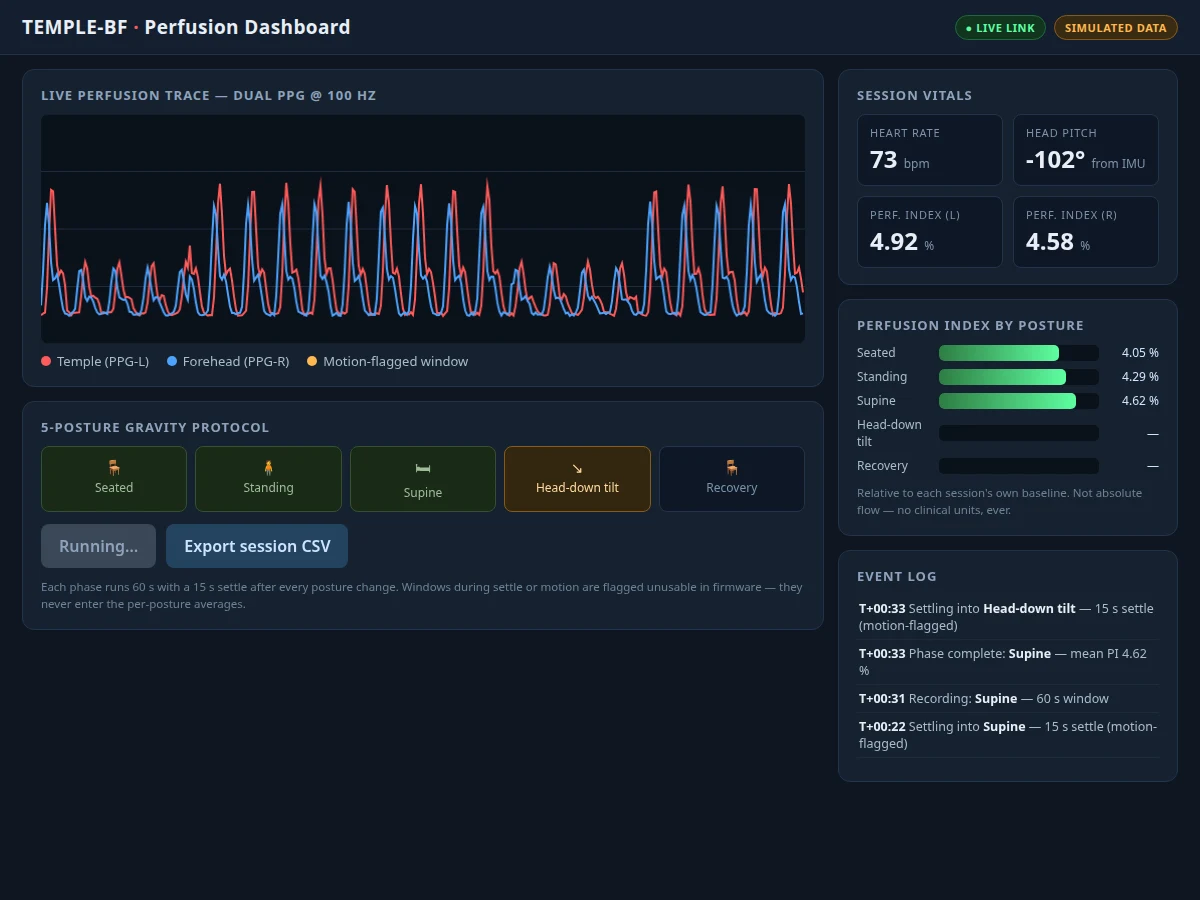
A session works like this. The student fits the headband with both PPG pods on bare skin at the temples, powers the ESP32-S3, and starts the session from the dashboard. The firmware samples both MAX30102 sensors at 100 Hz (design target) — red and infrared channels each — while the MPU6050 streams the head's gravity vector. For every 5-second window the firmware computes the perfusion index (AC/DC) per sensor, tagged with the IMU posture label; any window with acceleration variance above the motion threshold is flagged unusable. The protocol runs five phases — seated, standing, supine, head-down tilt, recovery — with a 15-second settle after each transition so readings reflect circulation, not movement. Results stream over BLE to the dashboard, which draws the live trace, accumulates per-posture averages, and logs every phase change and flagged window. One tap exports the session as CSV — timestamps, posture labels, perfusion indices, heart rate — for the report's graphs.
- The student fits the headband with both PPG pods on bare skin at the left and right temple, powers the ESP32-S3 and starts the session from the BLE dashboard.
- Firmware samples both MAX30102 sensors at 100 Hz (design target), red and IR channels each, while the MPU6050 streams the head gravity vector.
- Every 5 s window computes perfusion index (AC/DC) per sensor; windows with acceleration variance above the motion threshold are flagged unusable automatically.
- The protocol card guides the five phases — seated, standing, supine, head-down tilt (~15-20 degrees), recovery — with a mandatory 15 s settle after each transition.
- Posture classification from the IMU gravity vector tags every window; the dashboard accumulates per-posture perfusion averages as comparison bars.
- The live dashboard draws the perfusion trace, posture phase indicator and event log while the session runs.
- One tap exports the session as CSV — timestamps, posture labels, perfusion indices, heart rate — for plotting in the report.
Tech stack:
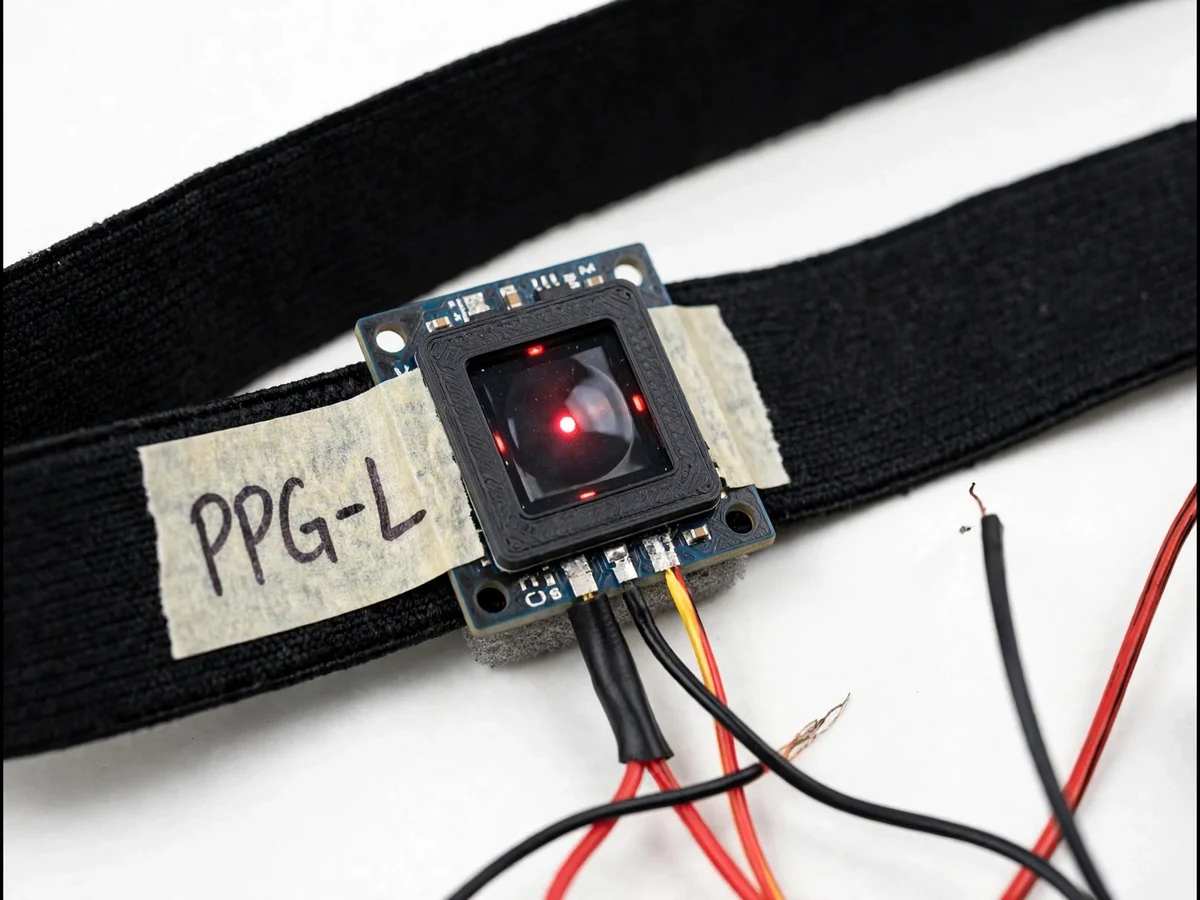
- Elastic sensor headband + 3D-printed PPG pods with foam pressure pads (repeatable skin contact)
- ESP32-S3 dev board (dual-core Xtensa LX7 @ 240 MHz · BLE 5 · two hardware I2C buses)
- 2x MAX30102 reflective PPG modules (red 660 nm + IR 880 nm · I2C, fixed address 0x57 each)
- Dual-bus I2C wiring (one PPG per hardware I2C bus — fixes the fixed-address clash honestly)
- MPU6050 6-axis IMU (accel ±2g to ±16g · gyro ±250 to ±2000 deg/s · I2C)
- 3.7 V 500 mAh LiPo + TP4056 charger module (single-cell wearable power)
- BLE perfusion streaming to phone/web dashboard (live trace · posture bars · event log)
- Session CSV export + 5-posture protocol card + tuning log
| Parameter | Value |
|---|---|
| Reference system | Temple by Deepinder Goyal: head-worn optical cerebral-blood-flow wearable, BrainFlow metric, Entropy strain score 1-250, pre-orders open November 1 2026, handmade to order, ~Rs 75,000-80,000 expected (reported), wellness positioning — not medical diagnosis (reported across 3 outlets, Oct 22 2026) |
| Controller | ESP32-S3: dual-core Xtensa LX7 @ 240 MHz, BLE 5, two hardware I2C controllers (manufacturer spec) |
| PPG sensors | 2x MAX30102: reflective photoplethysmography, red 660 nm + IR 880 nm LEDs, 18-bit ADC, I2C fixed address 0x57, sampling up to 3200 Hz (datasheet values); run at 100 Hz (design target) |
| Dual-sensor wiring | One PPG module per ESP32 hardware I2C bus — the fixed 0x57 address makes a shared bus impossible (design note) |
| IMU | MPU6050: 3-axis accel ±2g/±4g/±8g/±16g + 3-axis gyro ±250/±500/±1000/±2000 deg/s, I2C (datasheet values) |
| Perfusion index | AC pulse amplitude / DC baseline per 5 s window, computed per sensor (method definition) |
| Posture protocol | 5 phases x 60 s: seated, standing, supine, head-down tilt (~15-20 deg), recovery — 15 s settle after each transition (design target) |
| Motion flag | Windows with accel variance above threshold marked unusable in firmware (design rule, not a measurement) |
| Dashboard | Live perfusion trace, per-posture comparison bars, posture phase indicator, event log, CSV export (working demo UI included) |
| Power | 3.7 V 500 mAh LiPo + TP4056 charger; ~6-8 h streaming (design target/approximate) |
| Band | Elastic headband, 3D-printed pods, foam pressure pads; one physical power switch, no mains connection |
| Honest boundary | Measures local head perfusion (a proxy), NOT true cerebral blood flow; relative trends only, no absolute flow values, no diagnosis (stated limitation) |
Project features
The headband's capabilities are six. First, dual-PPG head sensing: two MAX30102 reflective optical sensors sit at the left and right temple, sampling red and infrared channels at 100 Hz (design target) to compute a perfusion index (AC/DC) from the temporal region's microcirculation. Second, posture-tagged logging: the MPU6050 IMU reads the head's gravity vector, classifies the current posture and flags motion-contaminated windows, so every perfusion reading carries its posture label. Third, the 5-posture gravity protocol: a fixed script of seated, standing, supine, head-down tilt and recovery phases with 15-second settle windows, making sessions repeatable experiments. Fourth, the BLE perfusion dashboard: live perfusion trace, per-posture comparison bars and a session event log. Fifth, motion-artifact discipline: settle windows and motion flags are enforced in firmware, not left to the user's judgment. Sixth, exportable session data: every session exports CSV with timestamps, posture labels and perfusion indices for the report.
- [Dual-PPG temple sensing] Two MAX30102 reflective optical sensors (red 660 nm + IR 880 nm, I2C) sample at 100 Hz (design target) from the left and right temple, computing perfusion index (AC/DC) from the head's microcirculation — the open, student-scale echo of Temple's BrainFlow sensing.
- [IMU posture tagging] An MPU6050 6-axis IMU reads the head's gravity vector, classifies the posture phase and flags motion-contaminated windows, so every perfusion sample carries its posture label and bad data is rejected in firmware.
- [5-posture gravity protocol] A fixed experimental script — seated, standing, supine, head-down tilt (~15-20 degrees, design target), recovery — with 15 s settle windows after each transition, making the session a repeatable experiment instead of casual readings.
- [BLE perfusion dashboard] The phone dashboard shows the live perfusion trace, per-posture comparison bars, posture phase indicator and session event log (working demo UI included).
- [Motion-artifact discipline] Settle windows are mandatory and motion flags are automatic: readings taken during or just after movement are marked unusable, the single biggest honesty feature of the build.
- [Session CSV export] Every session exports timestamped CSV — posture label, perfusion index per sensor, heart rate — ready for plotting and the report's results section.
- [Adjustable sensor headband] Elastic band with 3D-printed sensor pods and foam pressure pads that hold both PPG modules against the skin with repeatable contact pressure.
- [Low-power wearable build] Single 3.7 V LiPo cell with TP4056 charger, ~6-8 h streaming battery life (design target), one physical power switch, no mains connection.
What is included
- Assembled sensor headband: elastic band, 2x PPG sensor pods with foam pressure pads, ESP32-S3, MPU6050, LiPo cell with charger module
- Complete firmware: dual-bus PPG sampling at 100 Hz, IMU posture tagging, motion flagging, BLE streaming (design targets labeled in code comments)
- Perfusion dashboard app: live trace, per-posture bars, event log, CSV export (working demo UI included)
- 5-posture gravity protocol card with settle-time procedure and safety notes for the head-down tilt phase
- Wiring diagram and headband assembly layout
- Component list with Indian supplier sourcing notes for the ESP32-S3, MAX30102 modules, MPU6050 and LiPo cell
- Project report PDF (PPG physics, posture-perfusion method, session results with CSV plots, honest Temple delta)
- PPT presentation for final review
- Viva Q&A preparation document (photoplethysmography, perfusion index, motion artifacts, why head not wrist, Temple comparison)
Limitations & prerequisites
- This is NOT a cerebral blood flow device: Temple's BrainFlow sensing is proprietary, and this build measures local skin perfusion at the left and right temple — a related but different quantity. No claim of equivalence is made anywhere on this page.
- Not a medical device of any kind: readings are relative perfusion trends for engineering study, never diagnosis, and the page states this in the protocol card and the report.
- Motion artifact is the dominant error source: any window during or just after movement is flagged unusable, which is why the 15 s settle windows are mandatory — skipping them invalidates the session.
- Perfusion index is relative, not absolute: the build reports change vs the session's own baseline, never mL/min or any clinical unit — the sensor cannot measure absolute flow.
- Temple's Entropy score (1-250) is a proprietary metric; this build computes a labeled simplified strain index from heart-rate variability proxies, which is a different thing and is named differently on the dashboard.
- Forehead/temple PPG quality varies with skin tone, hairline position and contact pressure — the foam pressure pads and placement guide exist precisely because of this, and the Limitations section of the report documents it.
- The head-down tilt phase (~15-20 degrees) is done reclined on a chair with the student supervised; it is a gentle posture change, not a medical stress test, and the protocol card states the stop conditions.
- Battery life ~6-8 h streaming (design target); BLE range is room-scale (approximate).
Frequently Asked Questions
What is Deepinder Goyal's Temple, and why did it inspire this project?
Temple is a head-worn wearable from the Zomato/Eternal founder that tracks cerebral blood flow with optical sensors, scores physiological strain on a 1-250 "Entropy" scale, and explicitly studies how gravity and posture change blood supply to the brain — with pre-orders opening November 1, 2026. It inspired this project because it asked a new question for wearables — but as a closed, handmade, ~Rs 75,000-80,000 device it cannot be opened or repeated. This build asks the same posture-and-blood-flow question with open, student-buildable hardware.
Is this the same as measuring brain blood flow?
No — and that boundary is explicit on this page: Temple's BrainFlow sensing is proprietary, while this build measures local skin perfusion at the left and right temple with reflective PPG, a related but honestly different quantity reported as relative perfusion-index trends against each session's own baseline, never absolute flow values or clinical units. It is a wellness-engineering instrument, not a medical device.
Why two PPG sensors, and why the head instead of the wrist?
Two sensors because the honest version of Temple's question needs spatial comparison — temple vs forehead perfusion can differ as posture changes, and dual channels let the student cross-check instead of trusting one reading. The head because the research question is blood supply to the head under gravity: a wrist sensor answers a different question. The fixed 0x57 I2C address on both MAX30102 modules is why the ESP32's two hardware I2C buses each carry one sensor — a real engineering detail documented in the build.
How does the 5-posture gravity protocol work?
The student wears the headband through five 60-second phases — seated, standing, supine, head-down tilt at about 15-20 degrees, then seated recovery — with a mandatory 15-second settle after each transition. The IMU tags every 5-second window with the head's posture from its gravity vector and flags motion-contaminated windows unusable in firmware. The dashboard accumulates per-posture perfusion averages, and one tap exports the full session as CSV for the report's graphs.
Is this project suitable for a final-year project?
Yes — for IoT & Embedded, Electronics/E&TC and related programs, because it combines five defensible engineering layers in one build: optical biosensing, inertial sensing, real-time firmware with motion-artifact discipline, BLE streaming, and a data-analysis deliverable. Every spec number is datasheet-sourced or explicitly labeled as a design target, and the honest delta from Temple's proprietary sensing is strong viva material.
Components & software requirements
- Elastic sensor headband + 3D-printed PPG pods with foam pressure pads (repeatable skin contact)
- ESP32-S3 dev board (dual-core Xtensa LX7 @ 240 MHz · BLE 5 · two hardware I2C buses)
- 2x MAX30102 reflective PPG modules (red 660 nm + IR 880 nm · I2C, fixed address 0x57 each)
- Dual-bus I2C wiring (one PPG per hardware I2C bus — fixes the fixed-address clash honestly)
- MPU6050 6-axis IMU (accel ±2g to ±16g · gyro ±250 to ±2000 deg/s · I2C)
- 3.7 V 500 mAh LiPo + TP4056 charger module (single-cell wearable power)
- BLE perfusion streaming to phone/web dashboard (live trace · posture bars · event log)
- Session CSV export + 5-posture protocol card + tuning log
Delivery information
Built-to-order project. Delivery timeline is shared after order confirmation based on current queue.
Support terms
Complete documentation, setup guide, and viva preparation included. Support for setup and explanation provided.
Download free synopsis (PDF)
Enter your name and WhatsApp number — the synopsis PDF downloads immediately. We may send occasional project updates on WhatsApp; no spam.