
More project photos (3)
The problem
Subnetting is pure binary arithmetic, yet most students practice it with online calculators that show only the final answer and hide the method. In a viva, "what is the broadcast address?" is easy; "show me how you got it" is where candidates stumble. The gap is a tool that exposes every intermediate result — the mask, the wildcard, the AND/OR logic, the network-vs-host bit split — while still giving correct answers fast. SubnetIQ fills that gap as a single-file web app: type an IPv4 address and prefix, and it returns the network address, broadcast address, usable range, host count, address class and private/public classification, alongside a color-coded binary view. A subnet splitter divides any network into 2–32 equal subnets with full per-subnet tables, and a reference view documents common CIDR blocks. Because all computation is client-side JavaScript, it works offline in any lab browser.
Enters an IP address and picks a prefix length.
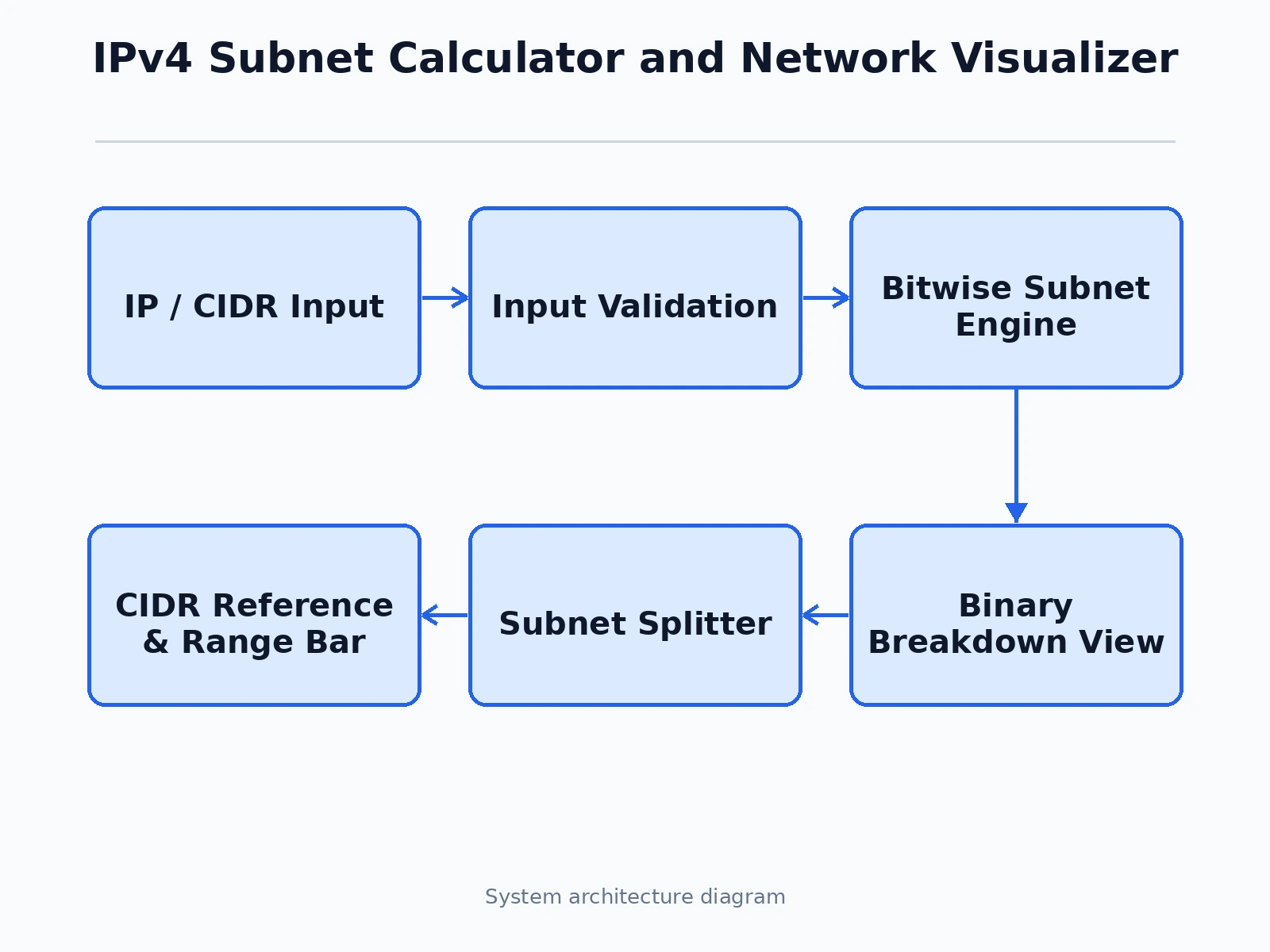
Follow the working sequence
How it works
- The dotted-decimal input is parsed and validated octet by octet; the selected prefix length (1–32) is read from the dropdown.
- The subnet mask is derived by left-shifting 32 ones by (32 − prefix) bits, using 32-bit integer arithmetic in JavaScript.
- The network address is computed as IP AND mask; the broadcast address as network OR (inverted mask).
- Usable hosts are counted as 2^(32−prefix) − 2 (with /31 and /32 handled as special cases), and the first/last usable addresses are derived from the network and broadcast.
- The 32-bit binary string is rendered with per-bit spans, coloring the first "prefix" bits as network and the rest as host.
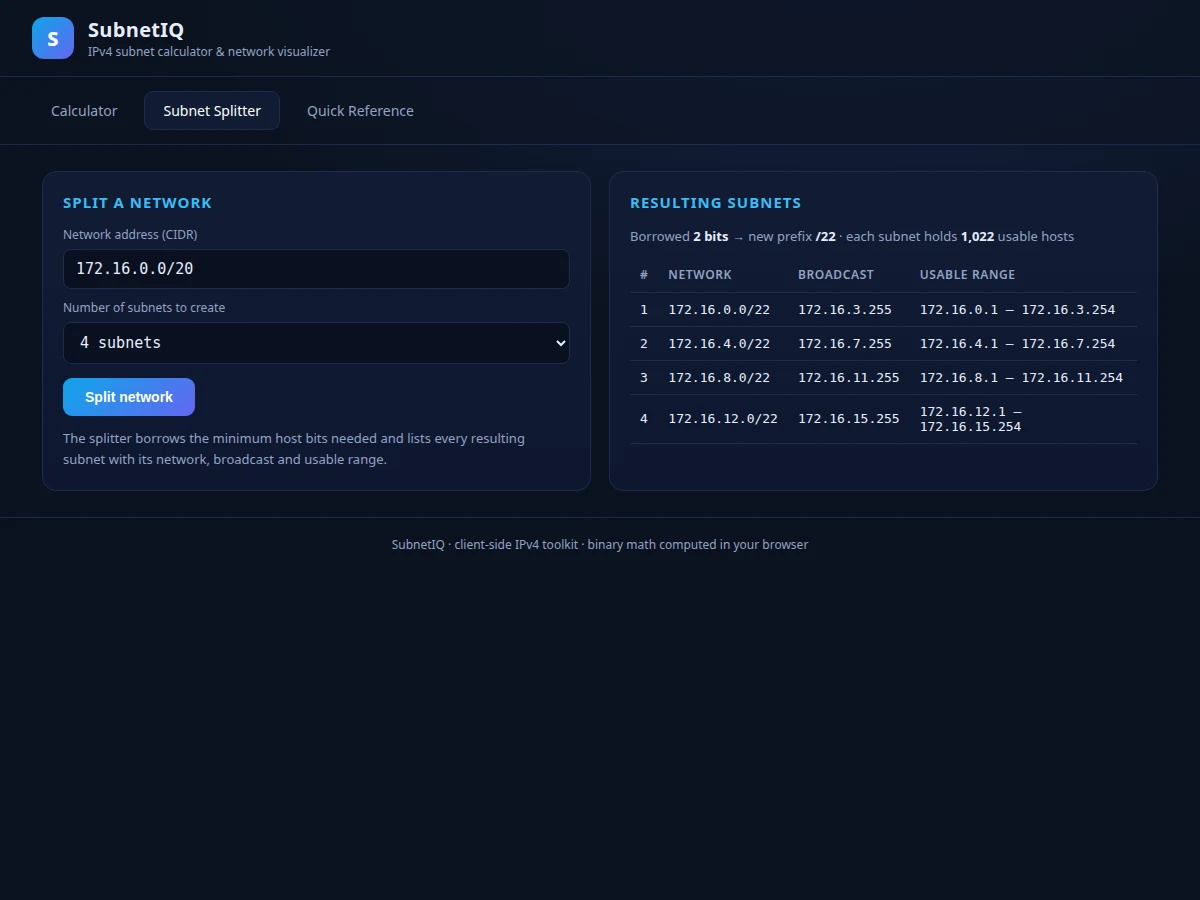
- The splitter takes a base network and subnet count, computes the new prefix, and enumerates each subnet's network, broadcast and usable range in a table.
Tech stack:
- HTML5, CSS3 (single-file app, no frameworks)
- Vanilla JavaScript (bitwise subnet engine)
- URL-hash view routing (calculator / splitter / reference)
- No backend, no dependencies — runs offline
| Parameter | Value |
|---|---|
| Input range | Any valid IPv4 address, prefix /1 to /32 |
| Outputs per calculation | Network, broadcast, first/last usable, wildcard, host count, class, private/public flag (7 fields) |
| Subnet splitter | 2 / 4 / 8 / 16 / 32 subnets (design target) |
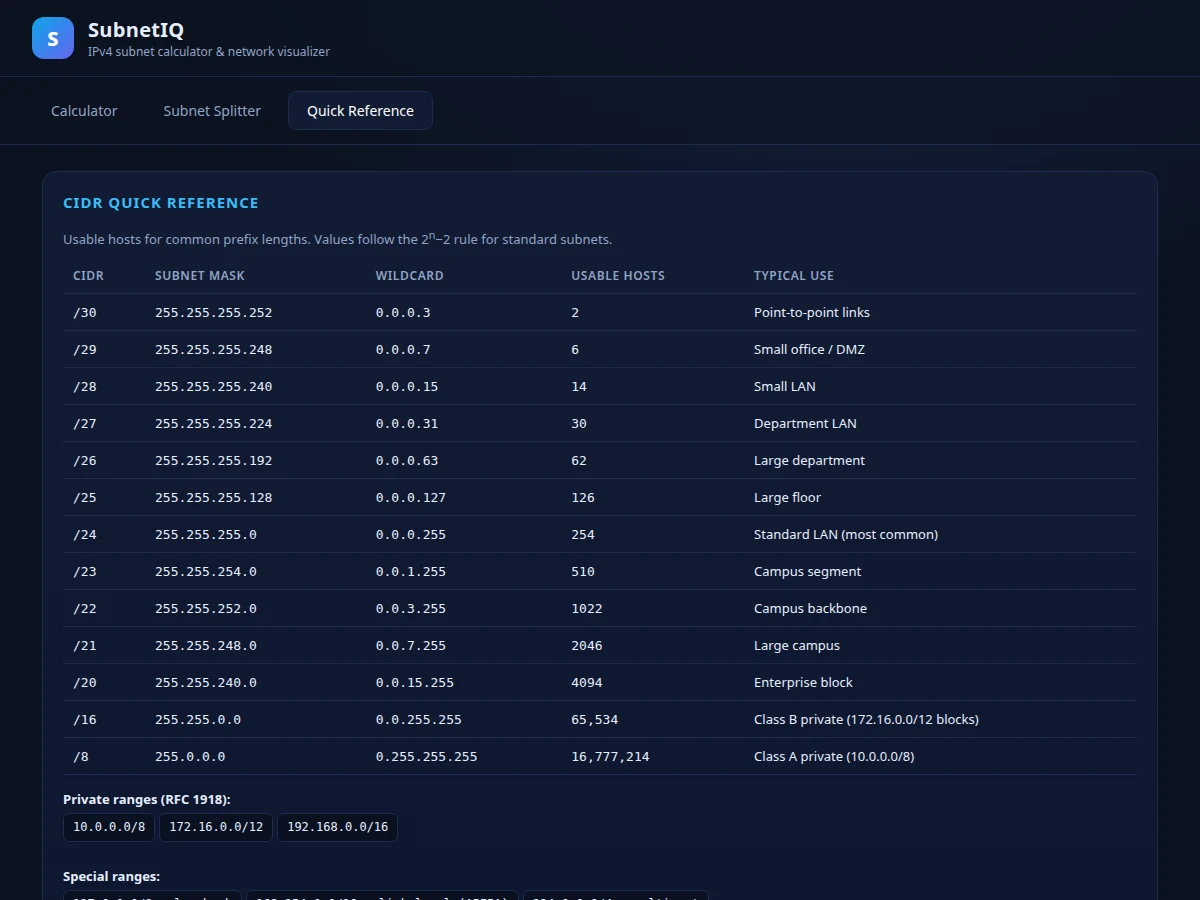
| Reference table rows | 13 CIDR blocks (/30 to /8) (as shipped) |
| Computation | 100% client-side; response is immediate (expected) |
| Dependencies | None — zero npm packages (as shipped) |
| File size | Single HTML file, approximately 15 KB (expected) |
| Browser support | Chrome, Edge, Firefox, Safari (current versions, expected) |
Project features
- [Live subnet calculator] Enter any IPv4 address and CIDR prefix (1–32); network, broadcast, first/last usable host, wildcard mask and usable-host count update as you type, with input validation.
- [Binary network/host breakdown] The full 32-bit address rendered bit-by-bit with network bits in blue and host bits in amber, so the masking logic is visible, not hidden.
- [Address classification] Automatic class A–E detection plus private (RFC 1918) vs public flagging, with special ranges (loopback, link-local, multicast) documented in the reference view.
- [Subnet splitter] Split any network into 2, 4, 8, 16 or 32 equal subnets; the tool borrows the minimum host bits and lists every subnet's network, broadcast and usable range.
- [CIDR quick-reference table] Common prefixes with mask, wildcard, usable hosts and typical use, generated from the same engine as the calculator so the two can never disagree.
- [Usable-range visualizer] A range bar showing where the usable host range sits between the network and broadcast addresses.
- [Zero-setup delivery] One HTML file, no frameworks, no build step, no server — runs from a pen drive in any modern browser.
What is included
- Complete single-file web app (calculator, splitter, reference views)
- Documented JavaScript subnet engine (bitwise functions explained line by line)
- Project report PDF (background, binary subnetting theory, methodology, screenshots)
- PPT presentation for final review
- Viva Q&A preparation document (masking, AND/OR logic, CIDR, VLSM concepts)
- User guide for running and demonstrating the app
Limitations & prerequisites
- IPv4 only — IPv6 visualization is listed as future scope, not implemented.
- The splitter creates equal-sized subnets only; variable-length (VLSM) allocation is not supported.
- /31 and /32 are handled per point-to-point conventions; the app does not model every vendor-specific edge case.
- The tool teaches and computes subnetting — it does not configure real routers or switches.
- Reference "typical use" notes are guidance, not addressing-plan advice for production networks.
Frequently Asked Questions
Does it need the internet or a server?
No. Everything runs in the browser from a single HTML file — open it from a pen drive in any lab and it works, including offline.
How is this different from online subnet calculators?
Most calculators show only answers. SubnetIQ shows the method: the binary bit breakdown, the mask derivation and the AND/OR logic — exactly what examiners ask students to explain.
Can it split a network into subnets?
Yes — the splitter view divides any network into 2, 4, 8, 16 or 32 equal subnets and lists each subnet's network, broadcast and usable range in a table.
Is the binary math actually correct?
Yes. All values come from 32-bit integer bitwise operations in JavaScript (AND for network, OR with inverted mask for broadcast), and the reference table is generated by the same functions as the calculator.
What should I be able to explain in the viva?
How the mask is derived from the prefix, why the broadcast is network OR inverted-mask, the 2^n − 2 host rule and its /31 exception, and what borrowing bits does in the splitter — all covered in the Q&A document.
Is this project suitable for a final-year project?
Yes — for Computer Science, IT and networking-focused programs. It demonstrates binary arithmetic, bitwise programming, and a genuinely useful networking tool with clean UI. Suitable for B.E./B.Tech final-year projects in Computer Science, IT and Computer Networks.
Components & software requirements
- HTML5, CSS3 (single-file app, no frameworks)
- Vanilla JavaScript (bitwise subnet engine)
- URL-hash view routing (calculator / splitter / reference)
- No backend, no dependencies — runs offline
Delivery information
Built-to-order project. Delivery timeline is shared after order confirmation based on current queue.
Support terms
Complete documentation, setup guide, and viva preparation included. Support for setup and explanation provided.
Download free synopsis (PDF)
Enter your name and WhatsApp number — the synopsis PDF downloads immediately. We may send occasional project updates on WhatsApp; no spam.