
More project photos (3)
The problem
Traditional water tanks often require manual checking to determine water availability and pump status. This can result in overflow, water wastage, unnecessary electricity consumption, and inconvenience caused by frequent manual monitoring. This project provides an automated solution by continuously measuring tank water level and controlling the pump operation according to configured limits. The IoT monitoring feature allows users to observe tank status remotely and manage water usage more efficiently.
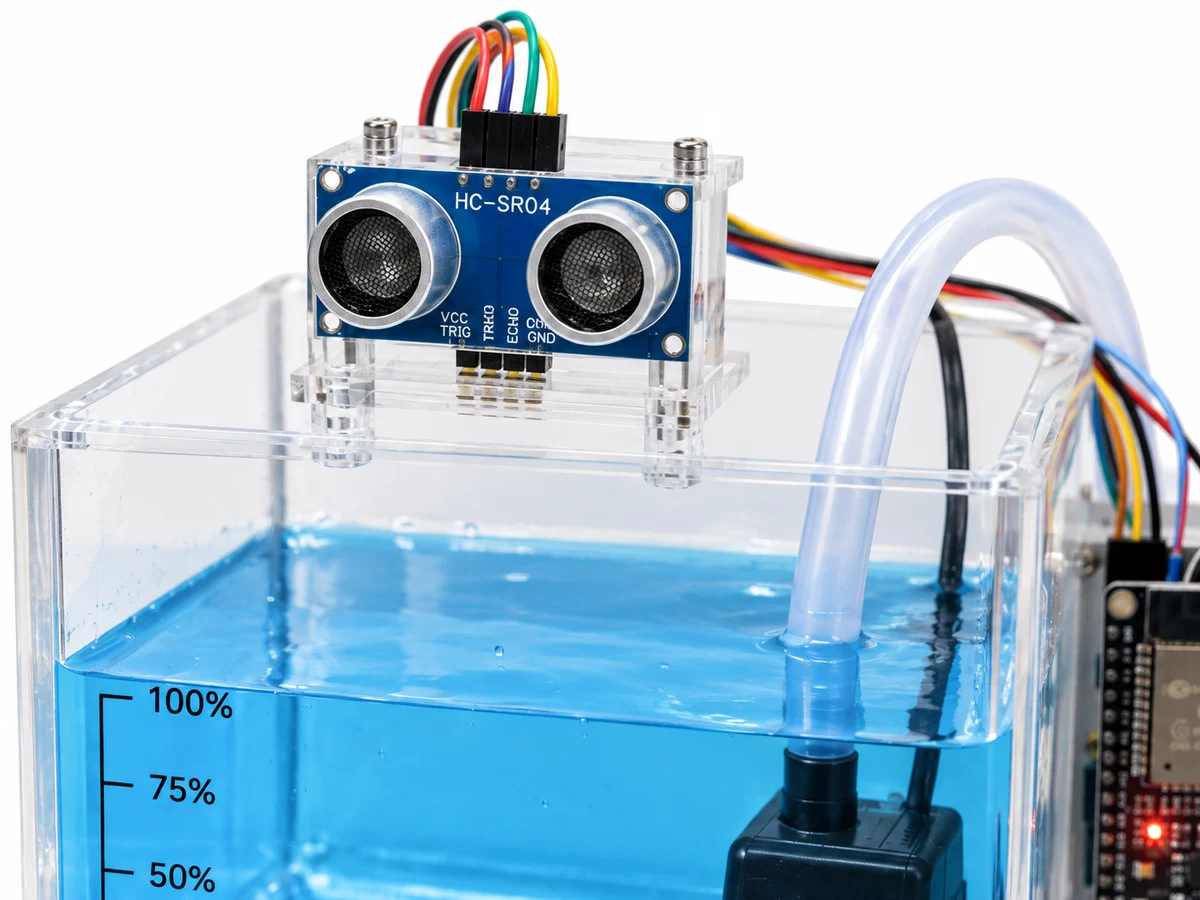
Ultrasonic sensor measures the distance to the water surface inside the tank.
Follow the working sequence
How it works
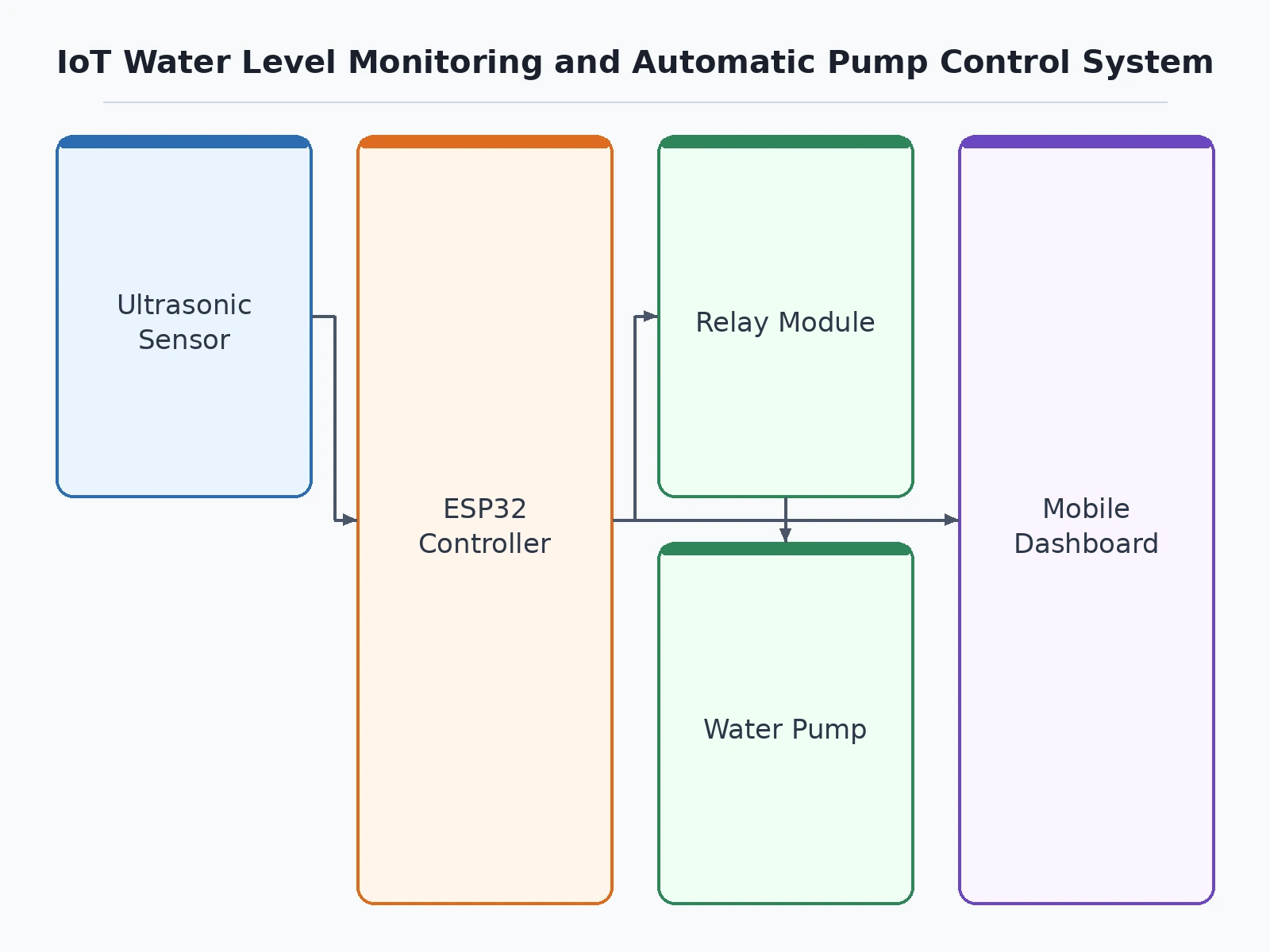
The HC-SR04 ultrasonic sensor measures the distance between the sensor and the water surface inside the tank.
The ESP32 microcontroller processes the sensor readings and calculates the approximate water level.
The current water level is displayed on the OLED screen.
When the water level reaches the lower threshold, the ESP32 activates the relay module to start the pump.
When the tank reaches the upper threshold, the controller turns OFF the pump automatically.
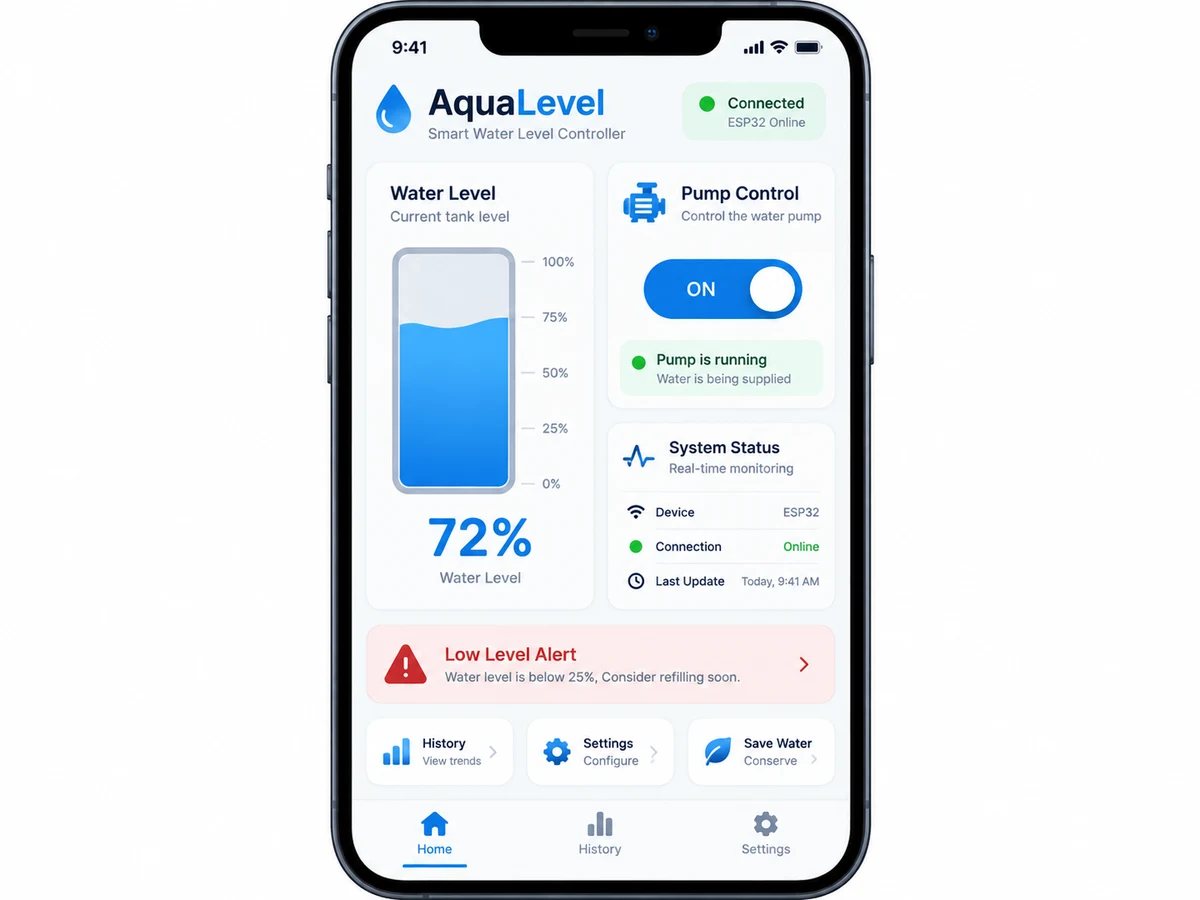
Water level information is transmitted to the connected mobile dashboard through IoT communication.
Users can monitor the tank status and use manual override control when required.
Project features
Automatic Water Pump Control – Automatically switches the pump ON or OFF based on predefined water level thresholds.
Ultrasonic Water Level Measurement – Uses a non-contact ultrasonic sensor to measure the water level inside the tank.
Real-Time Level Display – Displays current water level information on an OLED screen.
IoT-Based Monitoring – Enables remote viewing of water level data through a connected mobile dashboard.
Manual Pump Override – Allows users to manually control pump operation when required.
Dry-Run Protection – Includes logic to prevent unnecessary pump operation when water availability conditions are unsuitable.
Low-Cost Smart Automation Design – Uses commonly available development boards and modules suitable for academic prototypes.
Expandable Monitoring System – Can be extended with additional sensors and cloud features.
What is included
Complete working prototype assembly.
ESP32-based control unit.
Water level sensing module integration.
Automatic pump switching mechanism.
OLED display interface.
Basic IoT monitoring dashboard/app integration.
Source code and firmware files.
Project documentation and explanation material.
Advantages
- Automatic pump control: switches the pump ON/OFF at predefined water-level thresholds, saving water and electricity.
- Non-contact ultrasonic measurement of tank water level — no sensor is immersed in the water.
- Real-time level information on an OLED screen plus remote viewing through the connected mobile dashboard.
- Manual pump override lets the user take control of pump operation whenever needed.
- Dry-run protection logic prevents unnecessary pump operation when water conditions are unsuitable; the design can be extended with more sensors and cloud features.
Disadvantages
- Ultrasonic readings can vary with water-surface movement and sensor placement; excessive vibration or interference reduces accuracy.
- The prototype tank scale may differ from real household water tanks.
- Internet-based monitoring depends on network availability.
- Relay and pump ratings must match the intended application; additional safety circuits may be needed for high-voltage pump use.
Limitations & prerequisites
Prerequisites:
- Basic understanding of IoT concepts.
- Knowledge of embedded systems and microcontrollers.
- Basic programming knowledge for ESP32 development.
- Understanding of sensor interfacing and relay control.
- Internet connectivity for IoT monitoring features.
Limitations:
- Ultrasonic readings may vary due to water surface movement or sensor placement.
- Prototype tank size may differ from real household water tanks.
- Internet-based monitoring depends on network availability.
- Relay and pump ratings must match the intended application.
- Sensor accuracy may reduce in environments with excessive vibration or interference.
- Industrial-scale water management features are not included in the academic prototype.
- Additional safety circuits may be required for high-voltage pump applications.
Components & software requirements
ESP32 Development Board
HC-SR04 Ultrasonic Sensor
Relay Module
Mini Submersible Water Pump
OLED Display Module
Transparent Water Tank Model
Embedded C Firmware
IoT Monitoring Dashboard
Delivery information
Estimated delivery: Needs confirmation. Delivery timeline depends on: prototype complexity, required customization, component availability, documentation requirements.
Customisation options
Custom tank size simulation.
Additional water quality sensors.
Mobile application development.
Cloud database integration.
Voice assistant integration.
Multiple tank monitoring.
Solar-powered operation.
Advanced analytics dashboard.
Download free synopsis (PDF)
Enter your name and WhatsApp number — the synopsis PDF downloads immediately. We may send occasional project updates on WhatsApp; no spam.
Naas et al. (2025), J. of Information Systems Engineering and Management