
More project photos (3)
The problem
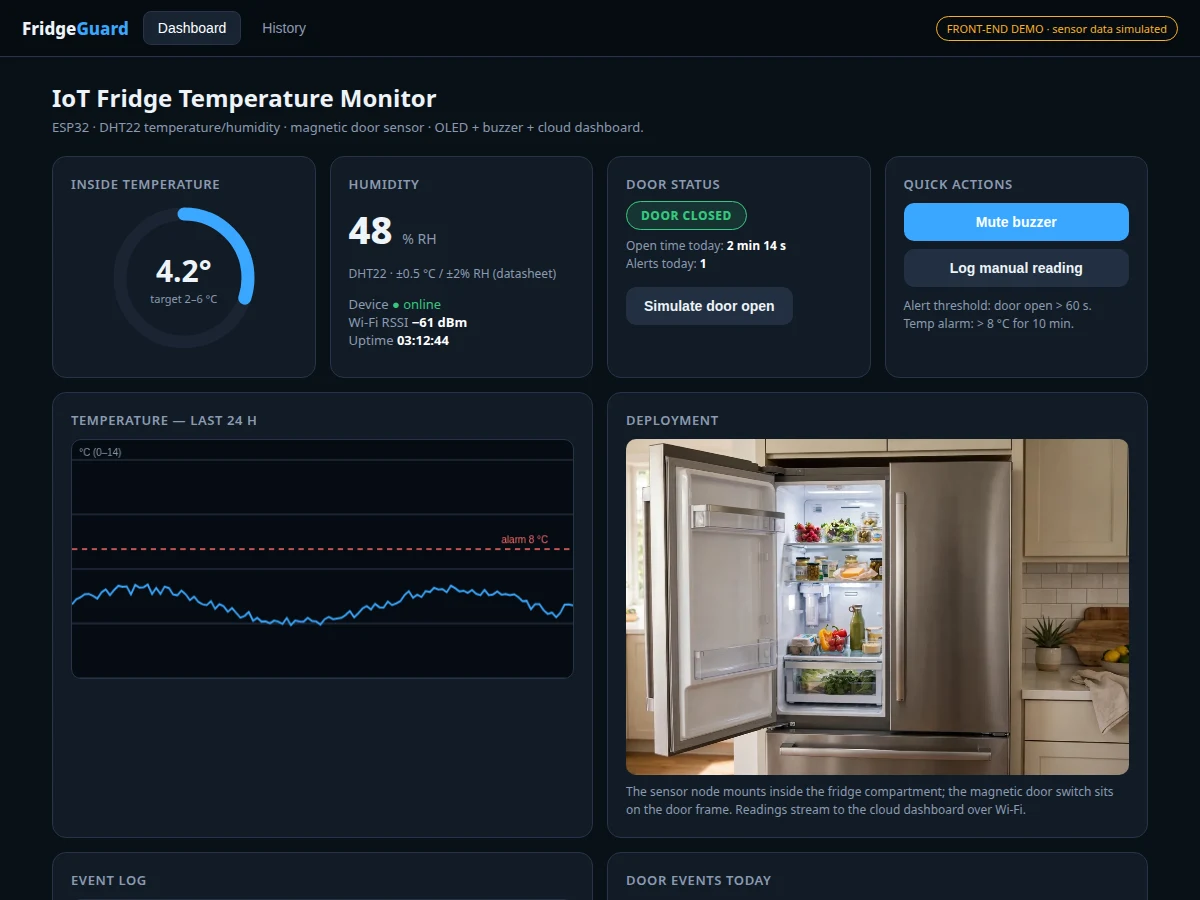
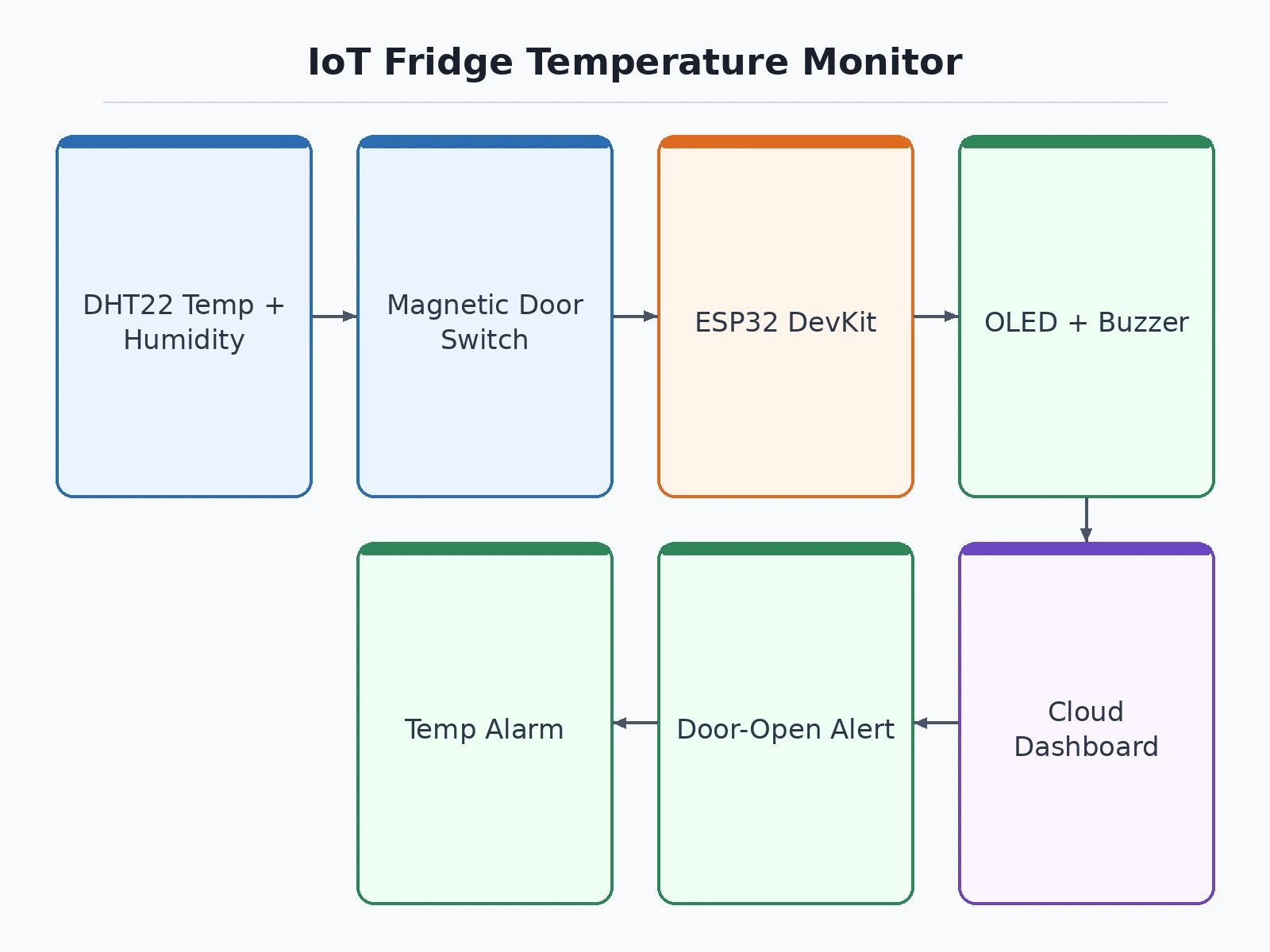
A fridge door left ajar for an hour, a compressor that quietly dies overnight, a power cut nobody notices until morning — in homes, hostels, canteens and clinics, the cost is spoiled food, wasted medicine or a ruined experiment. Nobody watches a fridge continuously, and the failure is always discovered after the damage is done. The engineering fix is a small always-on sentinel: sense temperature and humidity inside the compartment, sense the door itself, and raise the alarm locally and remotely the moment something is wrong. This project builds exactly that on an ESP32: a DHT22 for temperature/humidity, a magnetic reed switch for the door, a buzzer and OLED for local feedback, and Wi-Fi telemetry to a cloud dashboard with live readings, charts, threshold alerts and a full event history. Battery backup keeps it watching through short power cuts. It is the classic closed-loop IoT project — sensing, local actuation, cloud telemetry, alerting — in a package every examiner instantly understands.
Reports temperature and humidity from inside the fridge compartment every 30 seconds.
Follow the working sequence
How it works
- The DHT22, mounted inside the fridge compartment away from the cooling vent, reports temperature and humidity to the ESP32 every 30 seconds.
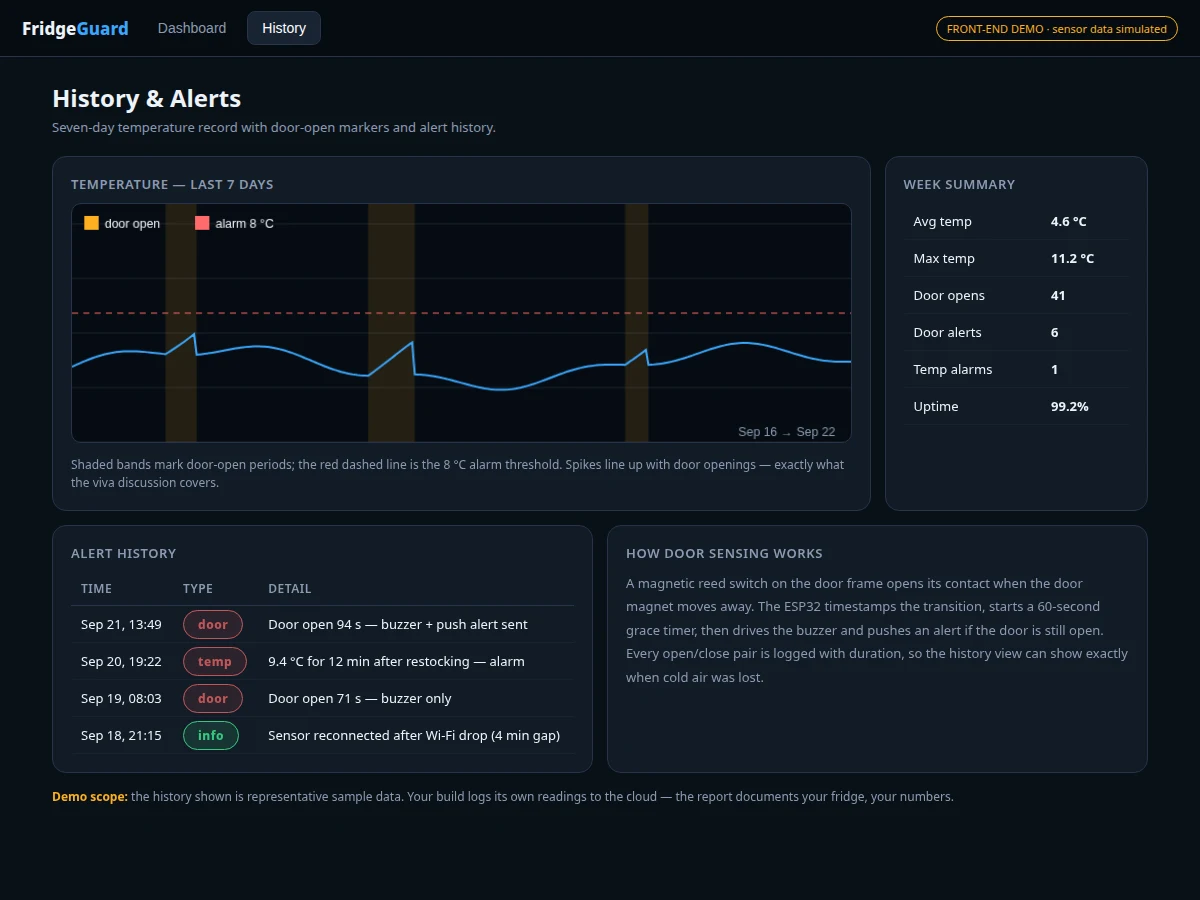
- The magnetic reed switch on the door frame opens its contact when the door magnet moves away; the ESP32 timestamps the transition and starts a 60-second grace timer.
- If the door is still open when the timer expires, the firmware drives the buzzer and publishes an alert to the cloud dashboard; closing the door silences it and logs the event duration.
- Temperature readings are compared against the 8 °C threshold: 10 continuous minutes above it triggers the high-temperature alarm, locally and remotely.
- Every reading, door event and alert is published over Wi-Fi (MQTT/HTTP) to the dashboard's gauge, 24-hour chart and event log; the OLED mirrors the current state locally.
- On power loss the battery backup keeps sensing and logging; readings are buffered and backfilled when Wi-Fi returns.
- Thresholds, grace periods and alert routing are configurable in firmware and documented in the tuning guide; the report's test procedure has the buyer verify alert timing with a stopwatch.
Tech stack:
- ESP32 DevKit (Arduino-core firmware, Wi-Fi telemetry)
- DHT22 temperature/humidity sensor (±0.5 °C / ±2% RH per datasheet)
- Magnetic reed-switch door sensor with door magnet
- 0.96-inch OLED display (I2C) + active buzzer
- Cloud dashboard (MQTT/HTTP telemetry, live gauge, charts, alert log)
- Rechargeable battery backup with mains-loss sensing
- Single-file HTML/CSS/JS dashboard demo (dashboard + history views)
| Parameter | Value |
|---|---|
| Controller | ESP32 DevKit, Arduino-core firmware |
| Temperature sensor | DHT22, ±0.5 °C accuracy (datasheet), 30 s sampling |
| Humidity | DHT22, ±2% RH (datasheet) |
| Door sensor | Magnetic reed switch, timestamped open/close events |
| Door alert | Buzzer + push alert after 60 s open (configurable) |
| Temperature alarm | > 8 °C for 10 min continuous (configurable) |
| Local UI | 0.96" OLED + buzzer |
| Telemetry | Wi-Fi (MQTT/HTTP) to cloud dashboard |
| Backup | Rechargeable cell; mains-loss event flagged |
| Dashboard | Live gauge, 24-h chart, door markers, alert history, device health |
Project features
- [Temperature + humidity sensing] DHT22 inside the compartment logs temperature (±0.5 °C per datasheet) and humidity (±2% RH) every 30 seconds — the two variables that actually determine food safety.
- [Magnetic door sensing] A reed switch on the door frame with a magnet on the door timestamps every open/close transition; each event is logged with its duration.
- [Door-open alert] If the door stays open past the configurable 60-second grace period, the buzzer sounds and a push alert goes to the dashboard — the project's headline feature.
- [Temperature alarm] If the compartment crosses 8 °C for 10 continuous minutes (configurable), a separate high-temperature alarm fires — catching compressor failure and power cuts.
- [Local OLED + buzzer] A 0.96-inch OLED shows live temperature, humidity and door state; the buzzer gives immediate local feedback even with no phone in hand.
- [Cloud dashboard] Live gauge, 24-hour temperature chart with alarm-threshold line, door-open markers on the chart, alert history and device health (Wi-Fi RSSI, uptime) in the companion web app.
- [Battery backup] A rechargeable cell keeps the node alive through short outages; the dashboard flags mains-loss events from the power-rail sense line.
- [Complete build docs] Wiring diagram, sensor placement guide (where the DHT22 goes and why), threshold-tuning guide, and commented firmware.
What is included
- Complete ESP32 firmware (sensing, door logic, alerts, OLED, telemetry, backup handling)
- Wiring diagram and sensor placement guide
- Cloud dashboard web app (live view, history view, alert log)
- Threshold-tuning guide (grace periods, alarm limits, alert routing)
- Project report PDF (background, system design, alert logic, test procedure)
- PPT presentation for final review
- Viva Q&A preparation document (DHT22, reed switches, ESP32 sleep/Wi-Fi, MQTT, threshold design)
- Setup guide (assembly, Wi-Fi provisioning, first alert test)
Limitations & prerequisites
- The DHT22's ±0.5 °C accuracy is a datasheet value, not a calibrated claim; absolute accuracy depends on placement away from the cooling vent, covered in the placement guide.
- The reed switch detects the door frame magnet — it cannot tell a genuinely ajar door from a weak magnet alignment; mounting alignment is part of the setup procedure.
- Alerts need Wi-Fi: local buzzer and OLED work offline, but push alerts and dashboard updates pause until the link returns; events are buffered and backfilled.
- Battery backup covers short outages (hours, not days); the sizing calculation is in the report so the buyer knows the limit honestly.
- This monitors conditions — it cannot fix a failing compressor; the temperature alarm is an early-warning, not a repair.
Frequently Asked Questions
How does the door alert work?
A magnetic reed switch on the door frame detects when the door opens. The ESP32 starts a 60-second grace timer; if the door is still open when it expires, the buzzer sounds and a push alert goes out. Closing the door silences everything and logs how long it was open.
What triggers the temperature alarm?
The compartment crossing 8 °C for 10 continuous minutes — the signature of a dead compressor or a long power cut. Both the threshold and the duration are configurable in firmware.
How accurate is the temperature reading?
The DHT22 is rated ±0.5 °C by its datasheet. Real-world accuracy also depends on placement — the guide puts it away from the cooling vent and the door, where readings represent the compartment, not a cold spot.
What happens during a power cut or Wi-Fi outage?
The battery backup keeps the node sensing; the OLED and buzzer keep working. Cloud alerts pause without Wi-Fi, but readings are buffered on the device and backfilled to the dashboard when the link returns.
Where should the sensors be mounted?
The DHT22 goes mid-compartment on a side wall (not near the vent or door), the reed switch on the door frame with its magnet aligned on the door edge. The placement guide explains the reasoning examiners will ask about.
Is this project suitable for a final-year project?
Yes — for Electronics, IoT and Embedded Systems programs. It demonstrates sensor interfacing, interrupt-driven event detection, local actuation, Wi-Fi telemetry, cloud dashboards and alert design, all strong viva material. Suitable for B.E./B.Tech final-year projects in Electronics, IoT and Embedded Systems.
Components & software requirements
- ESP32 DevKit (Arduino-core firmware, Wi-Fi telemetry)
- DHT22 temperature/humidity sensor (±0.5 °C / ±2% RH per datasheet)
- Magnetic reed-switch door sensor with door magnet
- 0.96-inch OLED display (I2C) + active buzzer
- Cloud dashboard (MQTT/HTTP telemetry, live gauge, charts, alert log)
- Rechargeable battery backup with mains-loss sensing
- Single-file HTML/CSS/JS dashboard demo (dashboard + history views)
Delivery information
Built-to-order project. Delivery timeline is shared after order confirmation based on current queue.
Support terms
Complete documentation, setup guide, and viva preparation included. Support for setup and explanation provided.
Download free synopsis (PDF)
Enter your name and WhatsApp number — the synopsis PDF downloads immediately. We may send occasional project updates on WhatsApp; no spam.