
More project photos (2)
The problem
Beekeepers still check hive health by opening boxes — disruptive to the colony, infrequent, and easy to postpone until a problem is advanced. Between inspections, a lost queen, an overheating brood nest, a failing nectar flow or a pre-swarm buildup can develop unseen for days. Continuous monitoring helps, but commercial hive scales and sensors are expensive and closed. The engineering answer is a low-cost, non-invasive node: measure the three signals that matter most — brood-box temperature, humidity and total hive weight — and watch their trends instead of opening the hive. The ESP32 fits naturally: Wi-Fi for telemetry, deep sleep for battery life, and enough ADC and digital interfaces for a DHT22 plus an HX711 load-cell amplifier. This project builds the complete system: the sensor node with a weatherproof enclosure, a two-point load-cell calibration the buyer runs on their own stand, threshold and swarm-heuristic logic, and an MQTT dashboard with gauges, climate charts, weight trends and an event log.
How it works
- On each wake cycle the ESP32 reads the DHT22 (temperature, humidity) and the HX711 load-cell amplifier (hive weight, averaged over samples).
- Readings are compared against configured thresholds: brood over-temperature, humidity extremes, and sudden weight changes.
- The swarm heuristic evaluates sustained temperature elevation together with weight-pattern changes and raises an inspection flag when both persist.
- Data is published over Wi-Fi via MQTT with the hive ID, and the node returns to deep sleep until the next cycle.
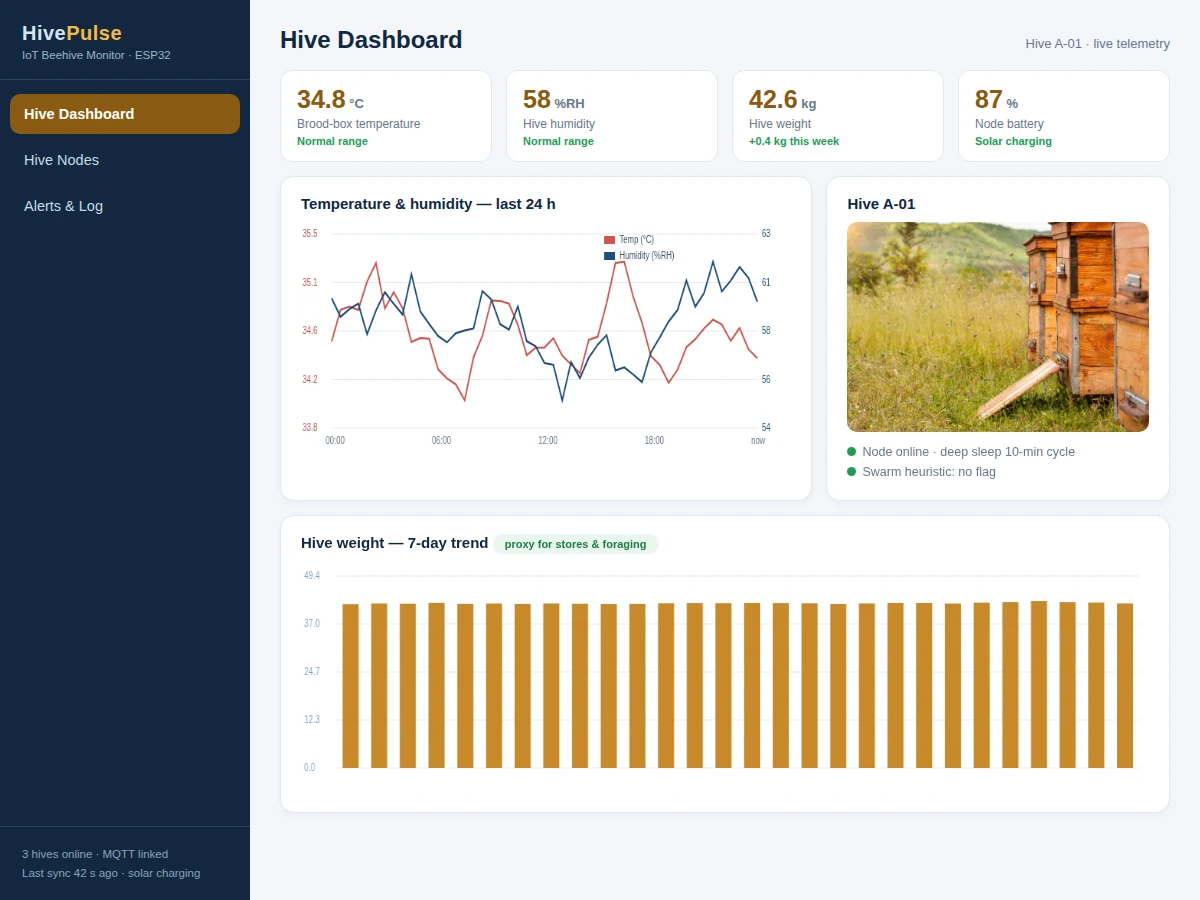
- The dashboard renders live gauges, appends to the 24-hour climate chart and the 7-day weight trend, and writes threshold crossings to the event log.
- Missed uploads are buffered in RTC memory and backfilled when connectivity returns.
- The buyer calibrates the load cell once with known weights using the included tare/calibration procedure, so weight readings are meaningful on their own stand.
Tech stack:
- ESP32 DevKit (Arduino-core firmware, deep sleep)
- DHT22 temperature-humidity sensor (digital)
- Load cell with HX711 24-bit amplifier
- MQTT broker plus web dashboard (gauges, charts, event log)
- 18650 cell with solar charging module; weatherproof enclosure
- 0.96-inch OLED for on-device readout
| Parameter | Value |
|---|---|
| Controller | ESP32 DevKit, Arduino-core firmware |
| Climate sensor | DHT22, digital (datasheet ±0.5 °C, ±2–5 %RH) |
| Weight sensing | Load cell with HX711 amplifier; buyer-run tare + known-weight calibration |
| Read interval | Configurable 5–30 minutes, deep sleep between cycles |
| Connectivity | MQTT over Wi-Fi; buffered backfill after outages |
| Power | 18650 cell with solar charging; unattended apiary operation |
| Dashboard | Per-hive gauges, 24-h climate chart, 7-day weight trend, event log |
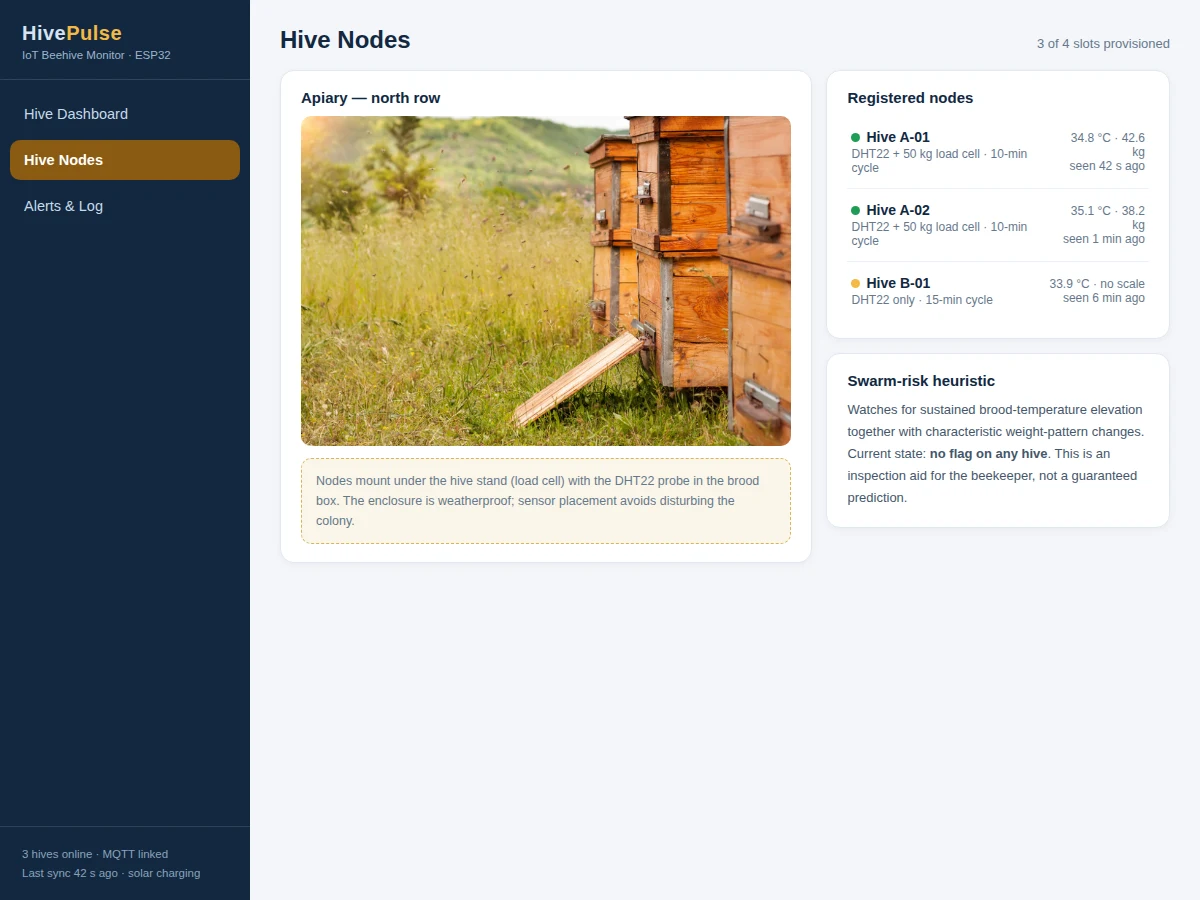
| Capacity | Up to 4 hive nodes per dashboard |
| Swarm flag | Heuristic inspection aid based on temperature + weight patterns, not a guaranteed prediction |
| Weight reading | Trend proxy for stores/foraging, not a direct honey-mass measurement |
Project features
- [In-hive temperature & humidity sensing] A DHT22 placed in the brood box reports temperature and humidity on every wake cycle, so overheating or excess moisture shows up on the dashboard instead of at the next inspection.
- [Hive weight tracking] A load cell under the hive stand with an HX711 amplifier tracks total weight; the 7-day trend acts as a proxy for honey stores and daily foraging activity.
- [Swarm-risk heuristic] A sustained brood-temperature rise combined with characteristic weight-pattern changes raises a "inspect this hive" flag — a heuristic aid for the beekeeper, not a guaranteed prediction.
- [MQTT telemetry dashboard] Live gauges for temperature, humidity and weight, 24-hour climate charts, a 7-day weight trend with annotations, and a timestamped event log.
- [Multi-hive support] The dashboard handles up to four hive nodes, each with its own gauges, charts and alert thresholds.
- [Solar deep-sleep operation] The ESP32 sleeps between configurable 5–30 minute wake cycles; a small solar panel tops up the 18650 cell for unattended apiary use.
- [Offline resilience + local display] Readings continue on schedule if Wi-Fi drops and backfill when the link returns; a small OLED shows the last reading at the hive.
What is included
- Complete ESP32 firmware (sensing, HX711 averaging, thresholds, swarm heuristic, MQTT, deep sleep, backfill)
- Wiring diagram and weatherproof-enclosure mounting guide
- Load-cell tare and known-weight calibration guide (procedure the buyer runs on their stand)
- MQTT dashboard web app (gauges, charts, weight trend, event log, multi-hive views)
- Project report PDF (background, sensor choice, power budget, evaluation method)
- PPT presentation for final review
- Viva Q&A preparation document (DHT22, HX711, MQTT, deep sleep, calibration, beekeeping basics)
- Setup guide (broker setup, Wi-Fi provisioning, first calibration run)
Limitations & prerequisites
- Weight is a trend proxy for honey stores and foraging, not a direct measurement of honey mass — rain, wind and beekeeper handling all move the reading, so only multi-day trends are meaningful.
- The DHT22 is a slow, modest-accuracy sensor (datasheet ±0.5 °C); it tracks hive climate trends well but is not a precision instrument.
- The swarm flag is a heuristic inspection aid based on temperature and weight patterns; it does not guarantee swarm prediction and the report states this plainly.
- The node needs a weatherproof enclosure and sensible sensor placement that does not disturb the bees — the mounting guide covers this, but colony behavior varies.
- Wi-Fi range limits apiary placement; the node keeps logging locally and backfills, but the dashboard goes stale until the link returns.
- Electronics are prototype-grade, not apiary-certified equipment; long-term outdoor reliability depends on the enclosure build.
Frequently Asked Questions
How does it detect swarming?
It doesn't detect swarms directly. A heuristic watches for a sustained brood-temperature rise together with characteristic weight-pattern changes and raises an "inspect this hive" flag. The report presents this honestly as an inspection aid, not a prediction.
Is the weight reading the honey weight?
No — it's the total hive weight trend. Over days, the trend reflects honey stores and foraging activity, but rain, wind and handling move single readings, so the dashboard emphasizes the 7-day trend.
What power does the node need?
A single 18650 cell with a small solar charging module. The ESP32 deep-sleeps between 5–30 minute wake cycles, so the node runs unattended at the apiary.
Does it work without Wi-Fi?
Sensing and local OLED display continue; readings are buffered and backfilled over MQTT when the link returns. The dashboard only updates while connected.
Can I add more hives or different sensors?
Yes — the dashboard supports up to four hive nodes, and the firmware structure documents where an extra sensor channel (e.g. a second DHT22 or a microphone module) would attach as a customization.
Is this project suitable for a final-year project?
Yes — for Electronics, Electrical and IoT programs. It demonstrates digital and analog sensor interfacing, load-cell calibration, MQTT telemetry, deep-sleep power design and honest trend-based analysis, all strong viva material. Suitable for B.E./B.Tech final-year projects in Electronics, Electrical and IoT.
Components & software requirements
- ESP32 DevKit (Arduino-core firmware, deep sleep)
- DHT22 temperature-humidity sensor (digital)
- Load cell with HX711 24-bit amplifier
- MQTT broker plus web dashboard (gauges, charts, event log)
- 18650 cell with solar charging module; weatherproof enclosure
- 0.96-inch OLED for on-device readout
Delivery information
Built-to-order project. Delivery timeline is shared after order confirmation based on current queue.
Support terms
Complete documentation, setup guide, and viva preparation included. Support for setup and explanation provided.