
More project photos (3)
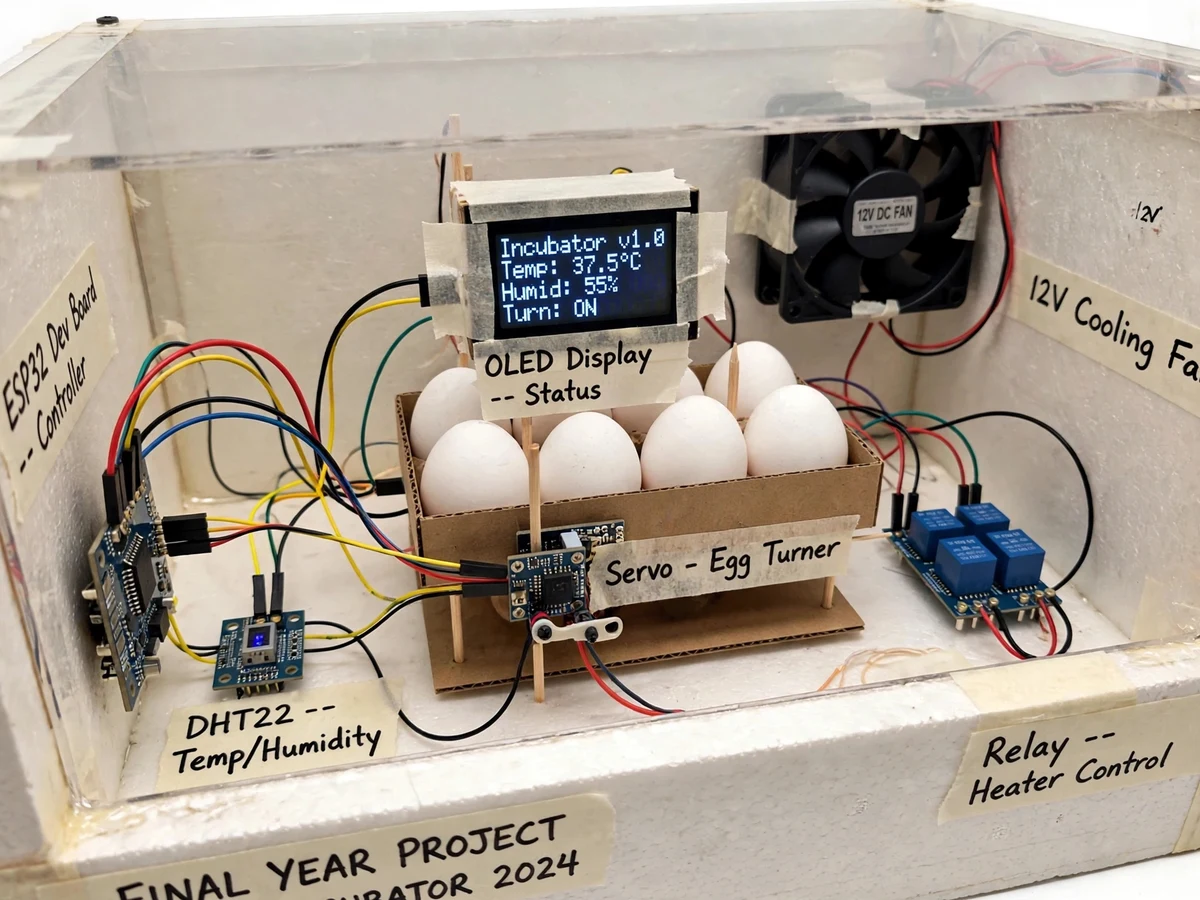
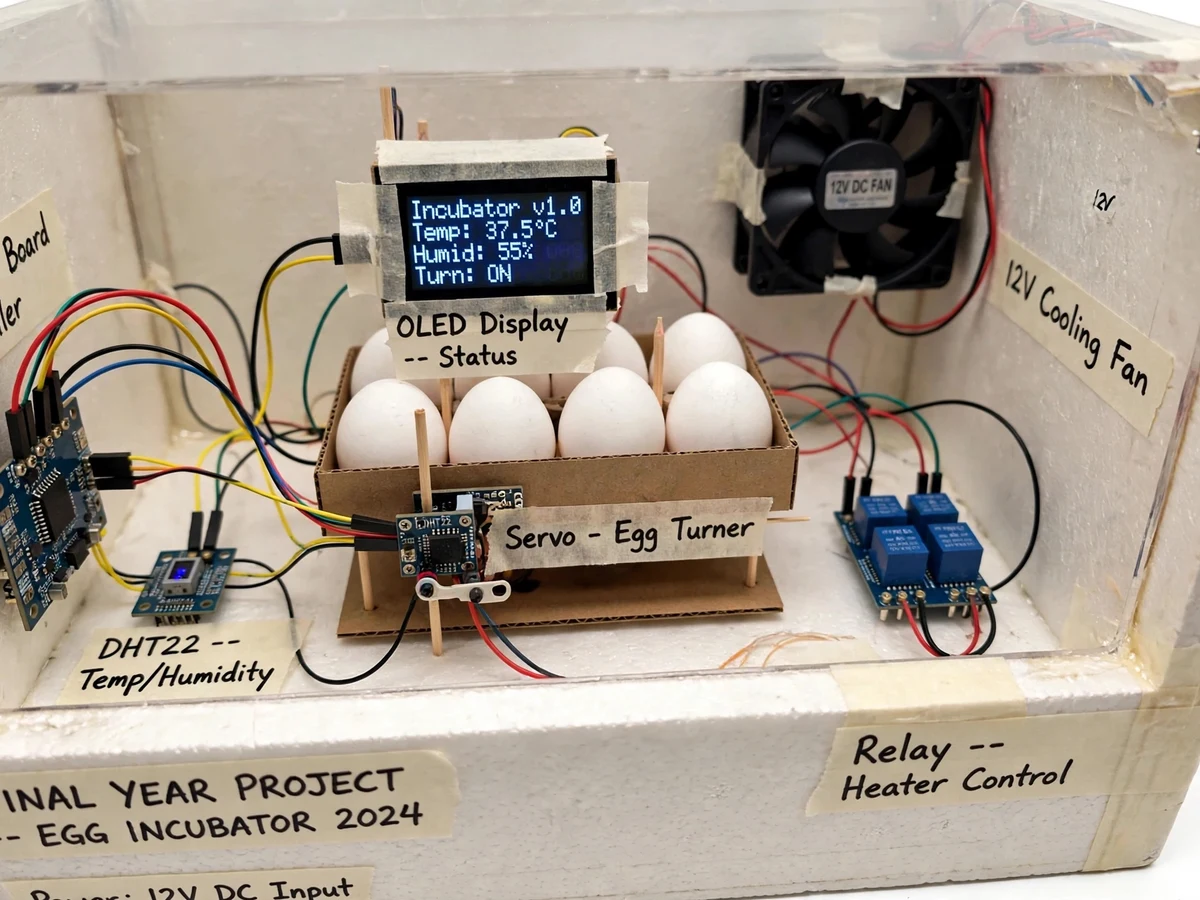
The problem
Chicken eggs need roughly 21 days near 37.5°C at 55–65% relative humidity with regular turning; most student-built incubators fail when turnings are missed or the temperature swings unnoticed overnight. Commercial digital incubators hide their control logic entirely, so there is nothing to study or document. This project builds a transparent IoT incubator: an insulated chamber, a relay-driven heater, a circulation fan, a DHT22 sensor, a water tray for humidity, and a servo-driven turning tray — all governed by an ESP32 running a local control loop. The firmware turns the eggs on a configurable schedule, parks the tray for the final lockdown days, publishes live temperature, humidity, turning count and the day counter to a phone dashboard, and raises alerts on out-of-range conditions. The student calibrates the sensor against a reference thermometer and documents the procedure — the honest engineering content that carries the viva.
Reads chamber temperature and humidity for the closed-loop heater control.
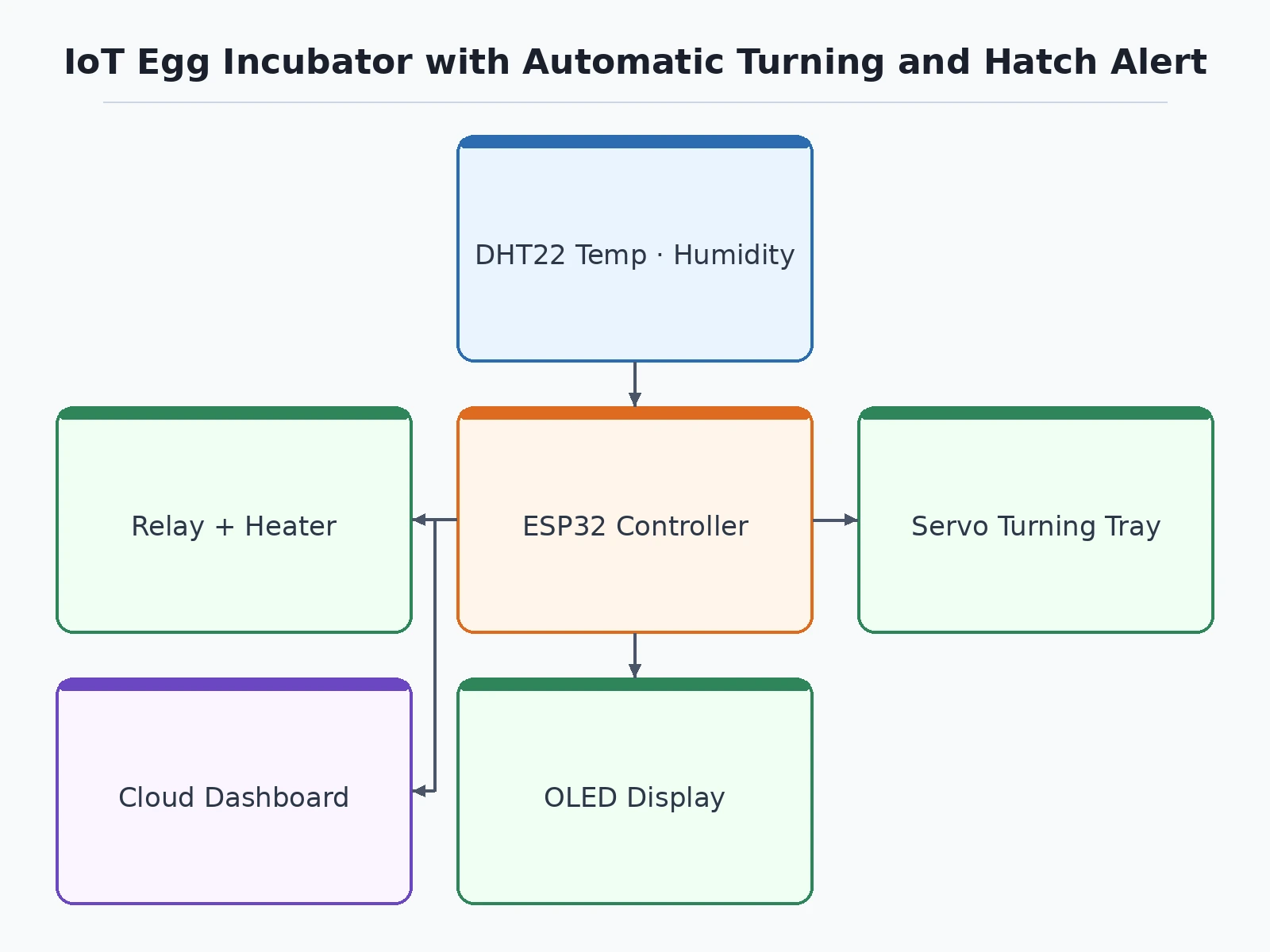
Follow the working sequence
How it works
- Eggs are placed in the turning tray inside the insulated chamber; the heater and circulation fan are positioned for even airflow.
- On power-up the ESP32 reads temperature and humidity from the DHT22 and starts the control loop at the configured setpoint.
- When temperature falls below setpoint minus hysteresis, the relay energizes the heater; it cuts off at setpoint, targeting ±0.3°C stability (design target).
- Every configured interval the servo tilts the tray to turn the eggs; turning stops automatically during the final lockdown days.
- Readings, turning count and day counter are pushed to the cloud dashboard over Wi-Fi, and out-of-range values raise alerts.
- On hatch day the dashboard flags completion, and the student records the hatch outcome in the report's results section.
Tech stack:
- ESP32 development board (Wi-Fi)
- DHT22 temperature · humidity sensor
- Relay module + PTC heater / heat lamp
- Servo-driven egg-turning tray
- 12 V circulation fan
- 0.96-inch OLED display
- Blynk / ThingSpeak class dashboard
- Arduino IDE (C/C++ firmware)
| Parameter | Value |
|---|---|
| Temperature sensor | DHT22, ±0.5°C accuracy (datasheet) |
| Humidity sensor | DHT22, ±2–5% RH (datasheet) |
| Control method | On/off with hysteresis; stability target ±0.3°C (design target) |
| Turning interval | Configurable; typically every 2 hours (design) |
| Egg capacity | Approximately 12–24 chicken eggs (design) |
| Incubation countdown | 21 days, configurable |
| Heater power | Up to approximately 40 W (design) |
| Connectivity | Wi-Fi 2.4 GHz to cloud dashboard |
Project features
- [Automatic egg turning] A servo-driven rocking tray turns the eggs at a configurable interval (typically every 2 hours) and automatically parks flat for the final lockdown days — no manual turning.
- [Closed-loop temperature control] DHT22 feedback drives the heater relay with a configurable setpoint around 37.5°C and hysteresis, targeting stability within ±0.3°C of setpoint (design target).
- [Humidity monitoring with refill alert] DHT22 humidity readout with a configurable low-humidity alarm that reminds the user to refill the evaporation water tray.
- [Mobile dashboard and alerts] Live temperature, humidity, turning count and day counter are published over Wi-Fi; out-of-range conditions raise alerts on the cloud dashboard.
- [Hatch-day countdown] A configurable incubation day counter issues a lockdown reminder and a hatch-day flag on the dashboard.
- [On-device display] An OLED shows current temperature, humidity, turning status and day count at a glance without opening the phone app.
- [Sensor calibration procedure] A step-by-step procedure calibrates the DHT22 against a reference thermometer so the report's numbers are honestly sourced.
What is included
- Insulated incubator chamber with heater, fan and servo turning tray
- ESP32 firmware (control loop, turning schedule, dashboard publishing)
- Wiring diagram and step-by-step assembly guide
- Sensor calibration procedure against a reference thermometer
- Project report PDF (background, control logic, calibration, results log)
- PPT presentation and viva Q&A document
Limitations & prerequisites
- DHT22 accuracy is ±0.5°C (datasheet) — outcomes depend on the buyer-run calibration; this is not a certified hatchery device.
- Humidity is monitored, not actively humidified; the water tray is refilled manually on the low-humidity alert.
- Wi-Fi alerts need a stable 2.4 GHz network; the control loop runs locally and keeps working offline.
- Tray capacity and egg size are fixed by the fabricated tray (design approximately 12–24 chicken eggs).
- No hatch rate is claimed — fertility, handling and calibration dominate the outcome, recorded as a buyer-run experiment.
Frequently Asked Questions
How does the temperature control work?
The ESP32 reads the DHT22 and switches the heater relay with hysteresis around the configured setpoint (around 37.5°C). The design target is stability within ±0.3°C of setpoint; the report documents the calibration procedure used to verify it on the built unit.
How are the eggs turned?
A servo tilts the rocking tray at a configurable interval, typically every 2 hours. The firmware automatically stops turning for the final lockdown days, matching standard incubation practice.
What happens if the Wi-Fi drops?
Nothing critical — the temperature control loop and turning schedule run entirely on the ESP32. Only remote monitoring and phone alerts pause until the network returns.
Can it incubate other bird eggs?
Yes, within reason: setpoint, humidity target and turning schedule are configurable. The report documents typical design ranges for quail and duck eggs as guidance.
Do you guarantee a hatch rate?
No honest project can. Hatch rate depends on egg fertility, storage and handling before incubation. The kit includes a hatch-log template so the student records the outcome of their own run.
Is this project suitable for a final-year project?
Yes — for IoT & Embedded, Electronics and Instrumentation programs. It combines sensing, actuation, control logic, IoT telemetry and a documented calibration procedure. Suitable for B.E./B.Tech final-year projects in IoT & Embedded Systems, Electronics and Instrumentation.
Components & software requirements
- ESP32 development board (Wi-Fi)
- DHT22 temperature · humidity sensor
- Relay module + PTC heater / heat lamp
- Servo-driven egg-turning tray
- 12 V circulation fan
- 0.96-inch OLED display
- Blynk / ThingSpeak class dashboard
- Arduino IDE (C/C++ firmware)
Delivery information
Built-to-order project. Delivery timeline is shared after order confirmation based on current queue.
Support terms
Complete documentation, setup guide, and viva preparation included. Support for setup and explanation provided.
Download free synopsis (PDF)
Enter your name and WhatsApp number — the synopsis PDF downloads immediately. We may send occasional project updates on WhatsApp; no spam.