
More project photos (2)
The problem
Beekeepers cannot open every hive every day, yet the most important colony signals — honey stores building up, a swarm leaving, brood chilling — are invisible from outside. Commercial hive scales exist but are expensive closed boxes, and students who study precision agriculture rarely get to build the sensing loop themselves. Hive weight is the single most informative metric: it rises during honey flow, falls when stores are consumed, and drops sharply when a swarm departs. Temperature and humidity inside the hive complete the picture, since brood development stalls outside its climate band. This project puts all three on one ESP32 node: a bar load cell under the hive digitized by an HX711, a DHT22 for hive climate, and Wi-Fi telemetry to a cloud dashboard with threshold alerts — a complete, demonstrable precision-apiculture system built from standard parts.
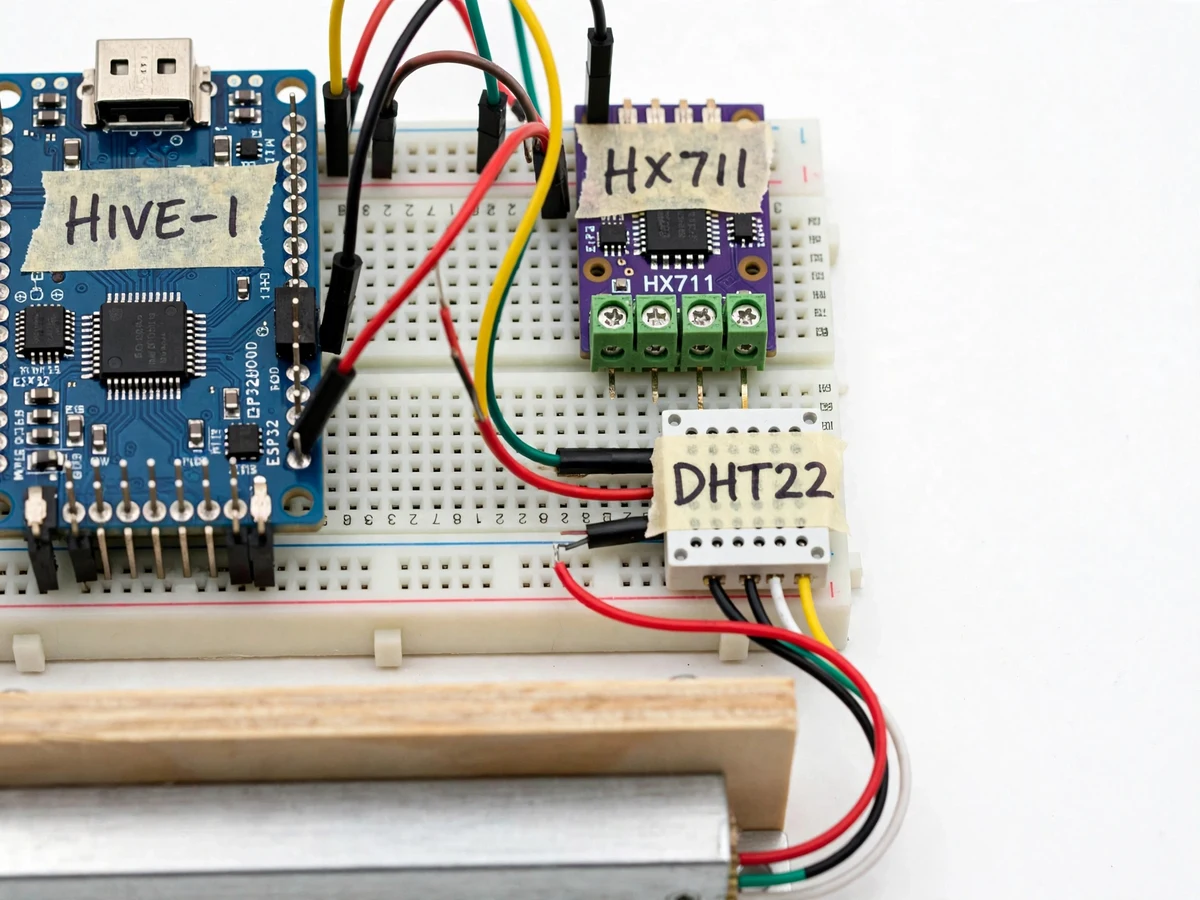
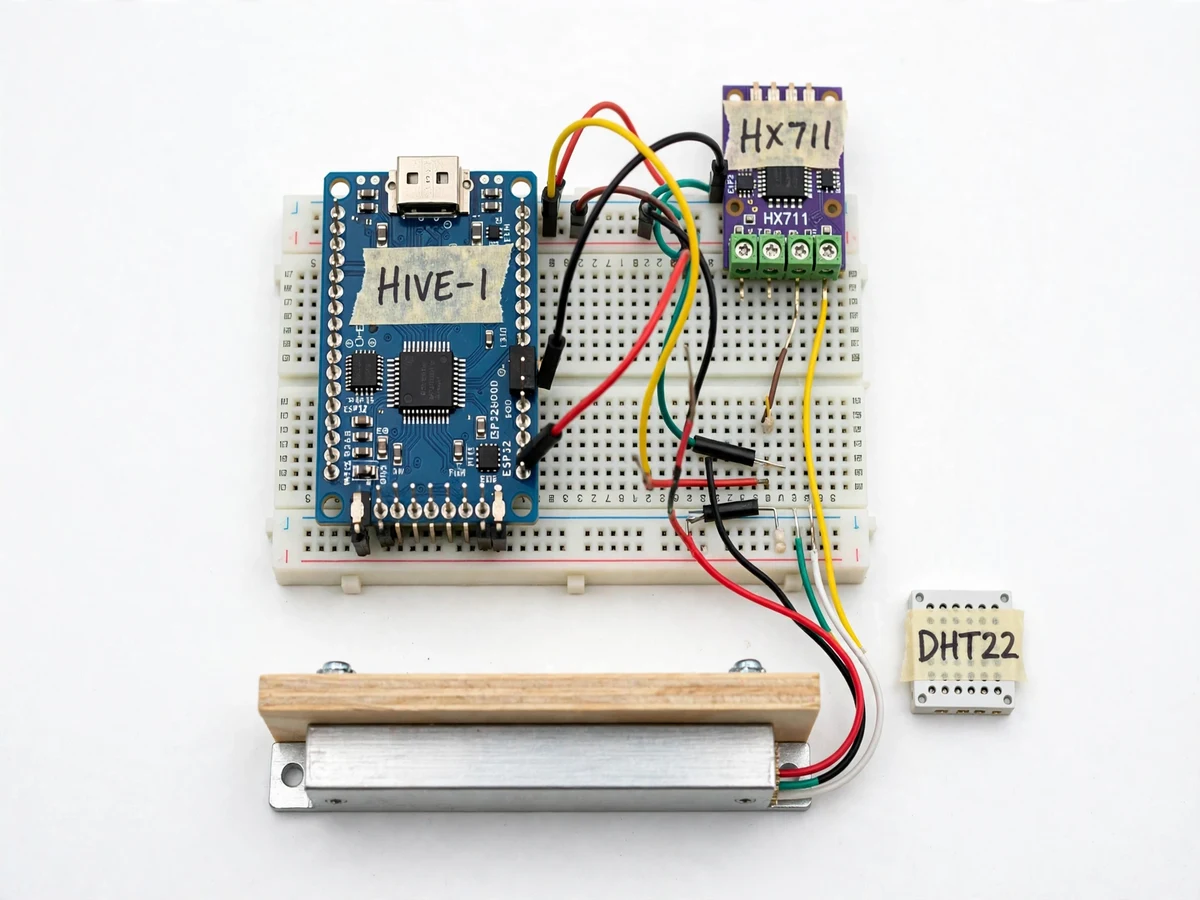
Straight-bar load cell under the hive that converts weight into a millivolt bridge signal.
Follow the working sequence
How it works
- The bar load cell under the hive converts weight into a millivolt bridge signal; the HX711 amplifies it at gain 128 and digitizes it at 24-bit resolution, 10 samples per second.
- The ESP32 reads the HX711 over its 2-wire serial interface, averages the samples, applies the stored tare offset and calibration factor, and produces a kilogram reading.
- The DHT22 reports temperature and humidity on a single digital pin (datasheet: new reading available at most every 2 s); values are sanity-checked against the previous reading before use.
- Every 60 seconds (configurable in firmware) the ESP32 wakes from deep sleep, publishes weight, temperature and humidity over Wi-Fi (MQTT/HTTP) to the cloud dashboard, then sleeps again.
- The dashboard stores the readings, plots the 7-day weight trend and the 24-hour temperature/humidity curves, and computes the 24-hour weight delta.
- The threshold engine flags events: a drop beyond the configured 24-hour limit suggests swarming or an inspection, humidity above 75 %RH suggests poor ventilation, and temperature outside 24–36 °C flags brood-zone risk.
Tech stack:
- ESP32 development board (240 MHz dual-core, Wi-Fi 802.11 b/g/n)
- HX711 24-bit ADC + straight-bar load cell
- DHT22 temperature/humidity sensor
- Arduino IDE (C/C++ firmware)
- MQTT/HTTP telemetry over Wi-Fi
- Cloud dashboard (ThingSpeak/Blynk class)
- Solar panel + Li-ion battery power
| Parameter | Value |
|---|---|
| Controller | ESP32 dev board: 240 MHz dual-core, Wi-Fi 802.11 b/g/n, 3.0–3.6 V supply (datasheet) |
| Weight sensing | Straight-bar load cell + HX711 24-bit ADC; PGA gain 128 (±20 mV full scale at 5 V); 10/80 SPS selectable (datasheet) |
| Scale capacity | 200 kg (design target; depends on the fitted load cell) |
| Weight resolution | Approximately 10 g (design target, after buyer-run calibration) |
| Climate sensing | DHT22: −40 to +80 °C ±0.5 °C; 0–100 %RH ±2 %RH (±5 %RH outside 20–90 %RH band) (datasheet) |
| Sensor read interval | DHT22: minimum 2 s between readings (datasheet); publish every 60 s, configurable |
| Telemetry | Wi-Fi MQTT/HTTP to cloud dashboard; configurable publish interval |
| Power | 5 V adapter for bench; solar panel + Li-ion battery for field (design, site-dependent) |
| Alert thresholds | Weight drop beyond set 24 h limit; humidity >75 %RH; temperature outside 24–36 °C (all configurable) |
| Prototype form | Breadboard-wired sensor node + scale platform; enclosure for outdoor use is a customization |
Project features
- [Continuous hive-weight tracking] A straight-bar load cell mounted under the hive platform feeds an HX711 24-bit ADC; the ESP32 converts readings to kilograms with tare and a buyer-run calibration factor, published on a configurable interval.
- [Hive temperature and humidity sensing] A DHT22 inside the hive reports climate on one digital pin (datasheet ±0.5 °C, ±2–5 %RH, minimum 2 s between readings) so brood-zone conditions are watched continuously.
- [Cloud dashboard] Live weight, temperature and humidity, the 7-day weight trend, 24-hour weight change and node health are rendered on a web dashboard fed over Wi-Fi by MQTT/HTTP telemetry.
- [Threshold alerts] The dashboard flags a sudden weight drop over 24 hours (swarming/inspection signature), humidity above 75 %RH (ventilation warning) and temperature outside the 24–36 °C brood band — all thresholds configurable.
- [Deep-sleep duty cycling] The ESP32 wakes, senses, publishes and returns to deep sleep between cycles, keeping average draw low for solar-plus-battery field operation.
- [Tare and calibration procedure] Scale zero is set on demand and the buyer calibrates with known weights using the included step-by-step procedure — every number in the report comes from the student's own rig.
- [Multi-hive ready] Firmware supports named nodes (HIVE-1, HIVE-2, ...) so additional hives can be added, each with its own dashboard view.
What is included
- Working sensor-node prototype (ESP32 + HX711 + load cell + DHT22, wired and bench-verified)
- Complete firmware source (Arduino IDE, C/C++) with tare, calibration, deep-sleep and MQTT/HTTP publish
- Scale platform assembly guide and known-weights calibration procedure
- Cloud dashboard setup guide: channel/feed configuration and alert-rule setup
- Wiring diagram and full component list with part numbers
- Project report PDF, PPT presentation, viva Q&A document and project abstract PDF
Limitations & prerequisites
- DHT22 readings are datasheet-limited (±0.5 °C, ±2–5 %RH); it is a hobby sensor, not a calibrated lab instrument.
- Weight readings drift with temperature and mechanical settling; the scale must be re-tared after any installation move — the procedure is buyer-run.
- A single load cell under one platform edge measures approximately; trend and 24-hour delta are more meaningful than absolute weight.
- Wi-Fi range limits hive placement; the dashboard and alerts need internet at the receiving end.
- The base build is a bench prototype — a weatherproof outdoor enclosure is a customization, not included.
- Solar sizing is site-dependent (shade, season, latitude); the design assumes reasonable daylight and a sized battery buffer.
Frequently Asked Questions
Which controller and sensors are used?
An ESP32 development board runs the node. Hive weight comes from a straight-bar load cell digitized by an HX711 24-bit ADC, and hive temperature/humidity from a DHT22 sensor — all standard, well-documented parts with official datasheets.
Can it detect swarming?
It detects the signature, not the event with certainty: a sudden weight drop over 24 hours is consistent with a swarm departing, and the dashboard flags it. The report explains this as an indicator with false-positive sources (inspections, feeder removal), which is honest viva material.
Does it work without Wi-Fi?
Sensing and tare/calibration work fully offline, but the cloud dashboard and remote alerts need Wi-Fi at the hive and internet at the receiving end. Offline gaps simply do not appear on the dashboard; local SD-card logging can be added as a customization.
Can more hives be added later?
Yes. The firmware supports named nodes (HIVE-1, HIVE-2, ...) and the dashboard lists each hive separately, so the system scales one node per hive with no redesign.
Is this project suitable for a final-year project?
Yes — for Electronics, Electrical and IoT programs. It demonstrates sensor interfacing, ADC signal chains, calibration methodology, low-power embedded design and end-to-end IoT telemetry in one build.
Components & software requirements
- ESP32 development board (240 MHz dual-core, Wi-Fi 802.11 b/g/n)
- HX711 24-bit ADC + straight-bar load cell
- DHT22 temperature/humidity sensor
- Arduino IDE (C/C++ firmware)
- MQTT/HTTP telemetry over Wi-Fi
- Cloud dashboard (ThingSpeak/Blynk class)
- Solar panel + Li-ion battery power
Delivery information
Built-to-order project. Delivery timeline is shared after order confirmation based on current queue.
Support terms
Complete documentation, setup guide, and viva preparation included. Support for setup and explanation provided.
Download free synopsis (PDF)
Enter your name and email — the synopsis PDF downloads immediately. We may send occasional project updates; no spam, unsubscribe anytime.