
More project photos (2)
The problem
A large share of stored grain is lost every year to moisture migration and insect infestation inside silos and godowns — damage that starts invisibly, deep in the grain bulk, and is discovered only when the lot is already spoiled. Manual probing with thermometers catches problems late and cannot run continuously. This project applies continuous IoT sensing to the problem: a low-cost ESP32 node with temperature, humidity and CO2 sensors sits inside a tabletop silo model and streams readings to a cloud dashboard. The engineering insight students learn is that carbon dioxide is the early-warning channel — insects and mold respire, so a rising CO2 trend flags an infestation days before temperature alone would. Threshold alerts configured in firmware push notifications to the owner's phone, demonstrating a complete sense-to-alert pipeline on a real storage problem.
How it works
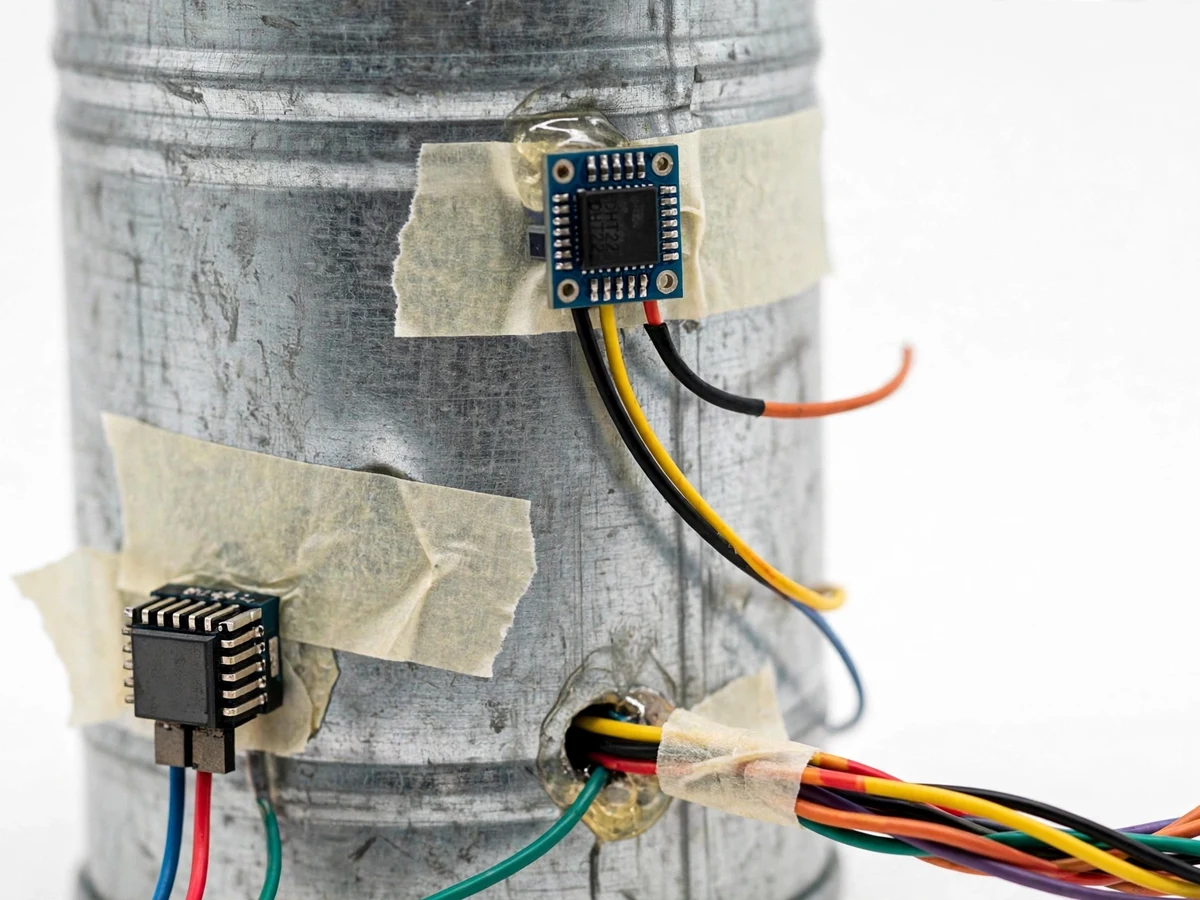
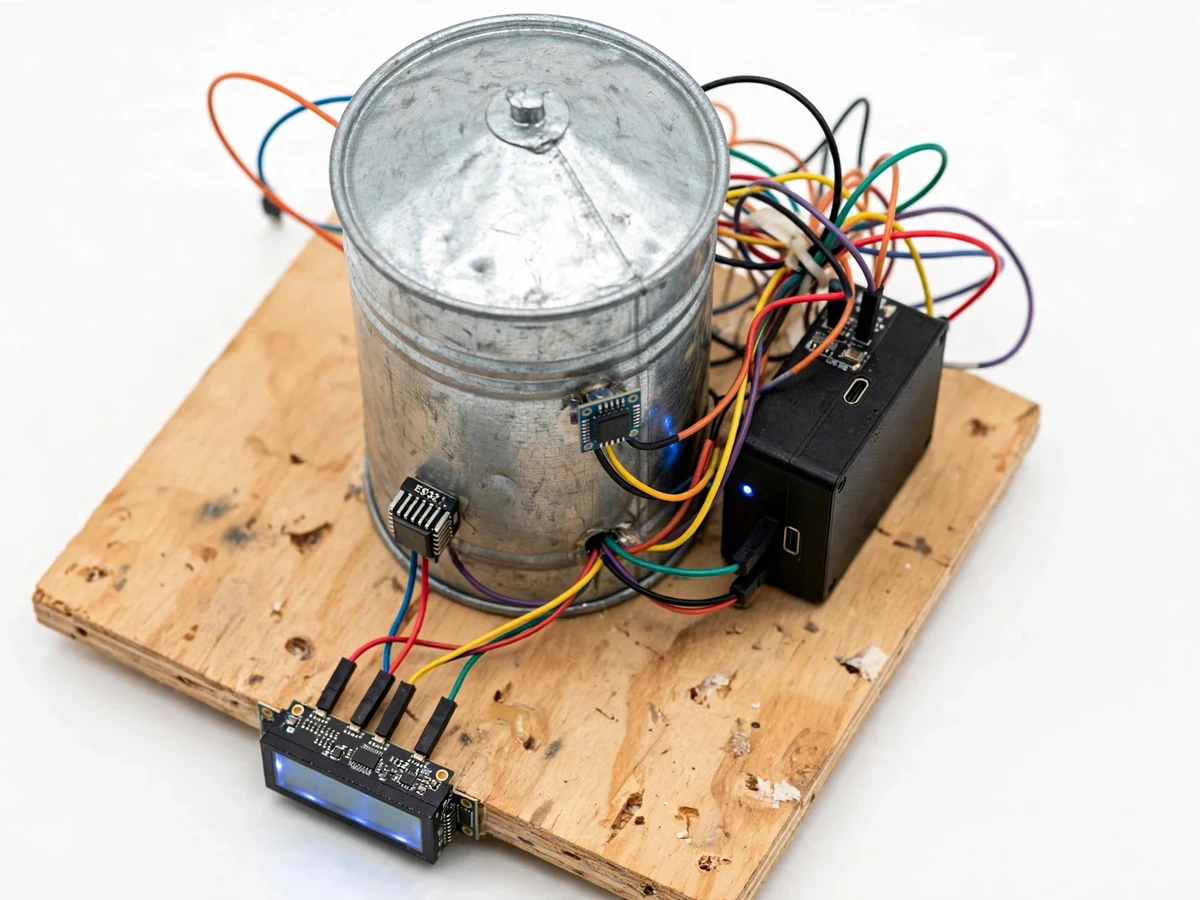
- The DHT22 and CO2 sensor probes are positioned inside the tabletop silo model, which is filled with a grain-like medium to emulate a real grain bulk.
- The ESP32 wakes on its sampling schedule, reads temperature, relative humidity and CO2 concentration, and timestamps each reading.
- Readings publish over Wi-Fi to the cloud dashboard (MQTT), where they appear as live time-series charts of the silo's microclimate.
- Firmware compares each reading against configurable thresholds and tracks the CO2 trend across a rolling window.
- A sustained CO2 rise above baseline raises a pest-activity warning; humidity above the safe band raises a moisture warning.
- Alerts are pushed to the owner's phone instantly, while the local LCD always shows the latest values for on-site checks.
- All readings are logged to the cloud, so the report can show multi-day trend plots from the student's own test runs.
Tech stack:
- ESP32 (Wi-Fi microcontroller)
- DHT22 temperature/humidity sensor
- NDIR CO2 sensor module
- MQTT broker + cloud dashboard
- 16x2 LCD display
- Arduino IDE (C++ firmware)
- 5 V regulated power supply
| Parameter | Value |
|---|---|
| Controller | ESP32 DevKit (dual-core, Wi-Fi) — datasheet |
| Temperature range | -40 to +80 °C (DHT22 datasheet) |
| Humidity range | 0–100% RH, ±2–5% typical (DHT22 datasheet) |
| CO2 range | 0–5,000 ppm (sensor module datasheet, approximate) |
| Sampling interval | Configurable; default 60 s (firmware) |
| Alert channels | Push notification + on-device LCD + buzzer (implemented) |
| Dashboard | Live charts + historical log (MQTT) |
| Power | 5 V DC regulated; deep-sleep option documented (design) |
| Silo model | Approximately 30 cm tabletop cylinder (prototype) |
Project features
- [Silo microclimate sensing] DHT22 temperature/humidity sensor plus an NDIR CO2 module placed inside the grain bulk of the tabletop silo, capturing the three signals that matter for stored-grain health.
- [Pest early-warning logic] Firmware tracks the CO2 trend over time and flags a sustained rise as probable insect or mold activity — the established early indicator used in real grain monitoring.
- [Moisture hotspot alerts] Configurable temperature and humidity thresholds trigger alerts when conditions favor mold growth or moisture migration in the silo.
- [Cloud dashboard] Readings publish over Wi-Fi (MQTT) to a live dashboard with time-series charts, so the silo's condition is visible from anywhere.
- [Phone alerts] Threshold crossings push instant notifications, demonstrating the full sense-to-alert chain end to end.
- [On-device display] A 16x2 LCD shows live temperature, humidity and CO2 at the silo itself for checks without a phone.
- [Deployment-ready power design] The sensor node runs from a regulated 5 V supply with deep-sleep options documented, so the report can discuss real deployment power budgets honestly.
What is included
- Tabletop grain silo model with sensor probes fitted
- ESP32 sensor node (assembled, programmed)
- Cloud dashboard setup with live charts and alert rules
- Complete firmware source code with threshold configuration guide
- Wiring diagram and sensor placement guide
- Project report PDF (background, sensing principle, firmware, results)
- PPT presentation for final review
- Viva Q&A preparation document (sensors, MQTT, CO2-as-indicator reasoning)
Limitations & prerequisites
- CO2 trend detection indicates probable pest or mold activity but cannot identify the species or count insects — it is an early-warning proxy, not a pest assay.
- The NDIR CO2 module is approximate (±50 ppm typical per datasheet); calibration against a fresh-air baseline is a buyer-run procedure documented in the report.
- The tabletop silo models a small grain bulk; real silos need multiple nodes and the report discusses this scaling honestly.
- Wi-Fi coverage is required at the silo for cloud upload; without it only the LCD and buzzer work locally.
- Humidity readings drift if condensation forms directly on the DHT22 — the probe placement guide keeps the sensor out of direct wetting.
- Alert thresholds are design starting points; the buyer tunes them during their own test runs.
Frequently Asked Questions
Why measure CO2 in a grain silo?
Because insects and mold respire. A rising CO2 trend inside the grain bulk is the established early signature of infestation or spoilage — it appears days before temperature spikes or visible damage, which is exactly what makes continuous sensing valuable.
How does the pest alert actually work?
Firmware keeps a rolling baseline of CO2 readings; a sustained rise above baseline beyond a configurable margin raises a pest-activity warning. It is a trend-based proxy, not a species identification — the report states this honestly.
What does the cloud dashboard show?
Live temperature, humidity and CO2 time-series charts, current status (NORMAL / WARNING), and a historical log that can be exported for the report's results section.
Can this scale to a real godown?
The sensing principle scales, but a real silo needs multiple sensor nodes at different depths, mains power and weatherproofing — all discussed as future scope. The prototype demonstrates the complete pipeline on a tabletop silo model.
What if Wi-Fi is unavailable?
The node keeps working locally: the LCD shows live readings and the buzzer sounds on threshold crossings. Cloud charts and phone alerts need connectivity.
Is this project suitable for a final-year project?
Yes — for Electronics, Electrical and IoT programs. It combines sensor interfacing, embedded firmware, wireless telemetry and a real agricultural problem with measurable outcomes. Suitable for B.E./B.Tech final-year projects in Electronics, Electrical and IoT.
Components & software requirements
- ESP32 (Wi-Fi microcontroller)
- DHT22 temperature/humidity sensor
- NDIR CO2 sensor module
- MQTT broker + cloud dashboard
- 16x2 LCD display
- Arduino IDE (C++ firmware)
- 5 V regulated power supply
Delivery information
Built-to-order project. Delivery timeline is shared after order confirmation based on current queue.
Support terms
Complete documentation, setup guide, and viva preparation included. Support for setup and explanation provided.