
More project photos (3)
The problem
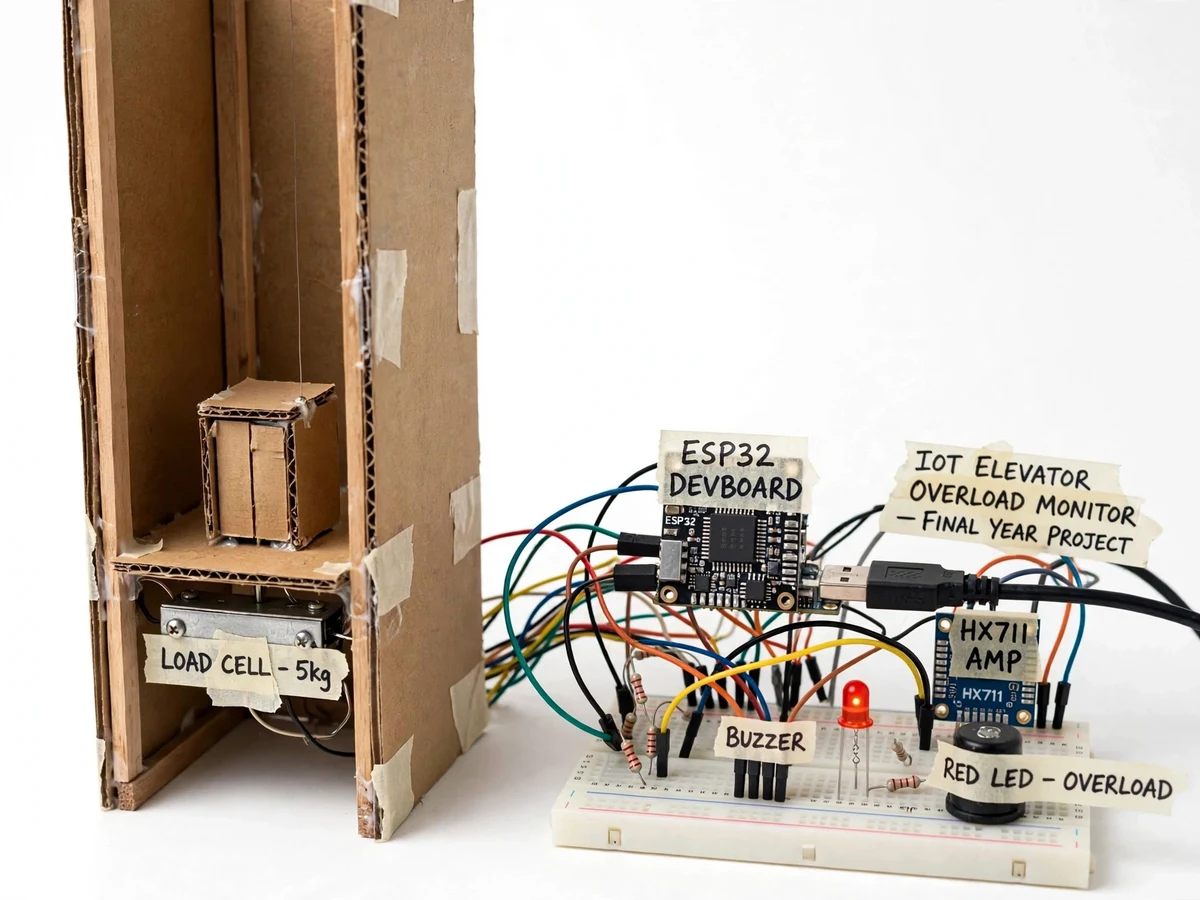
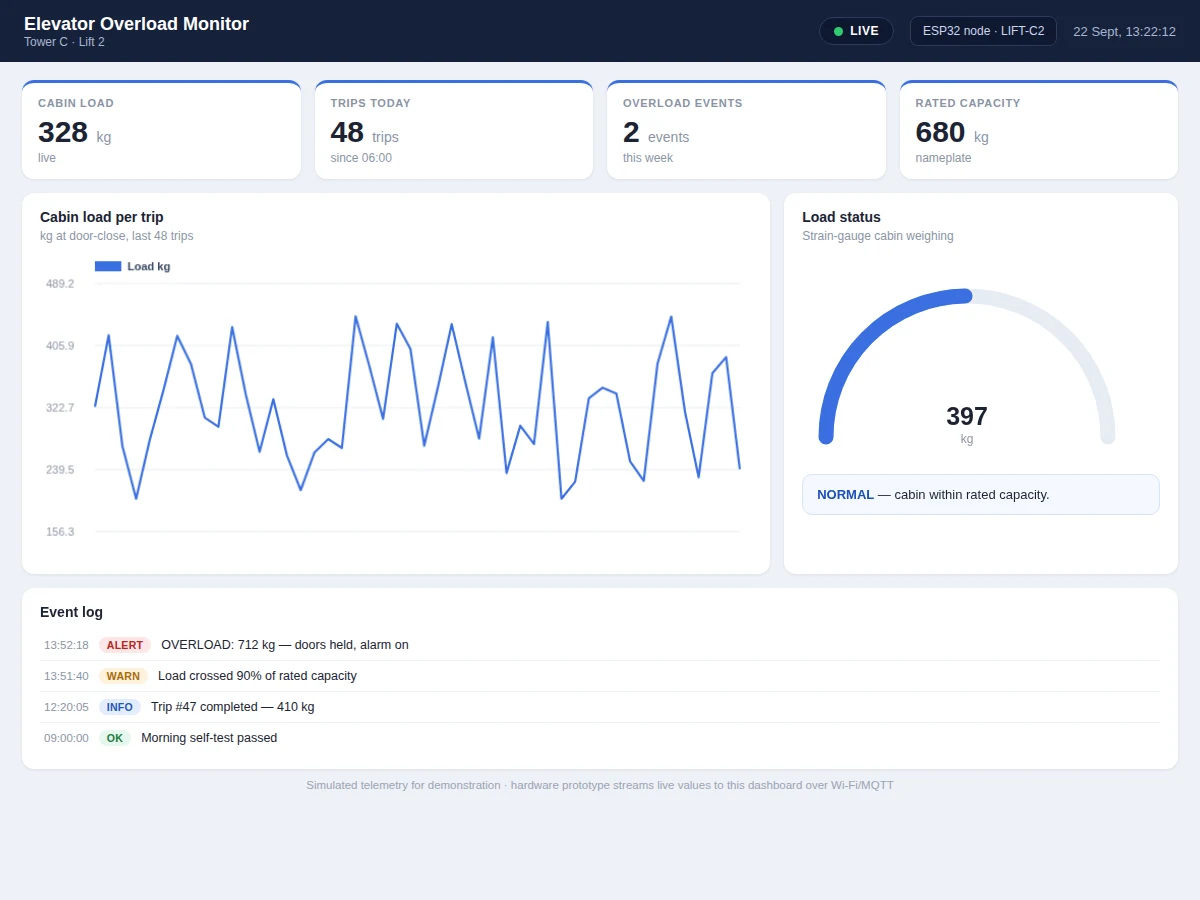
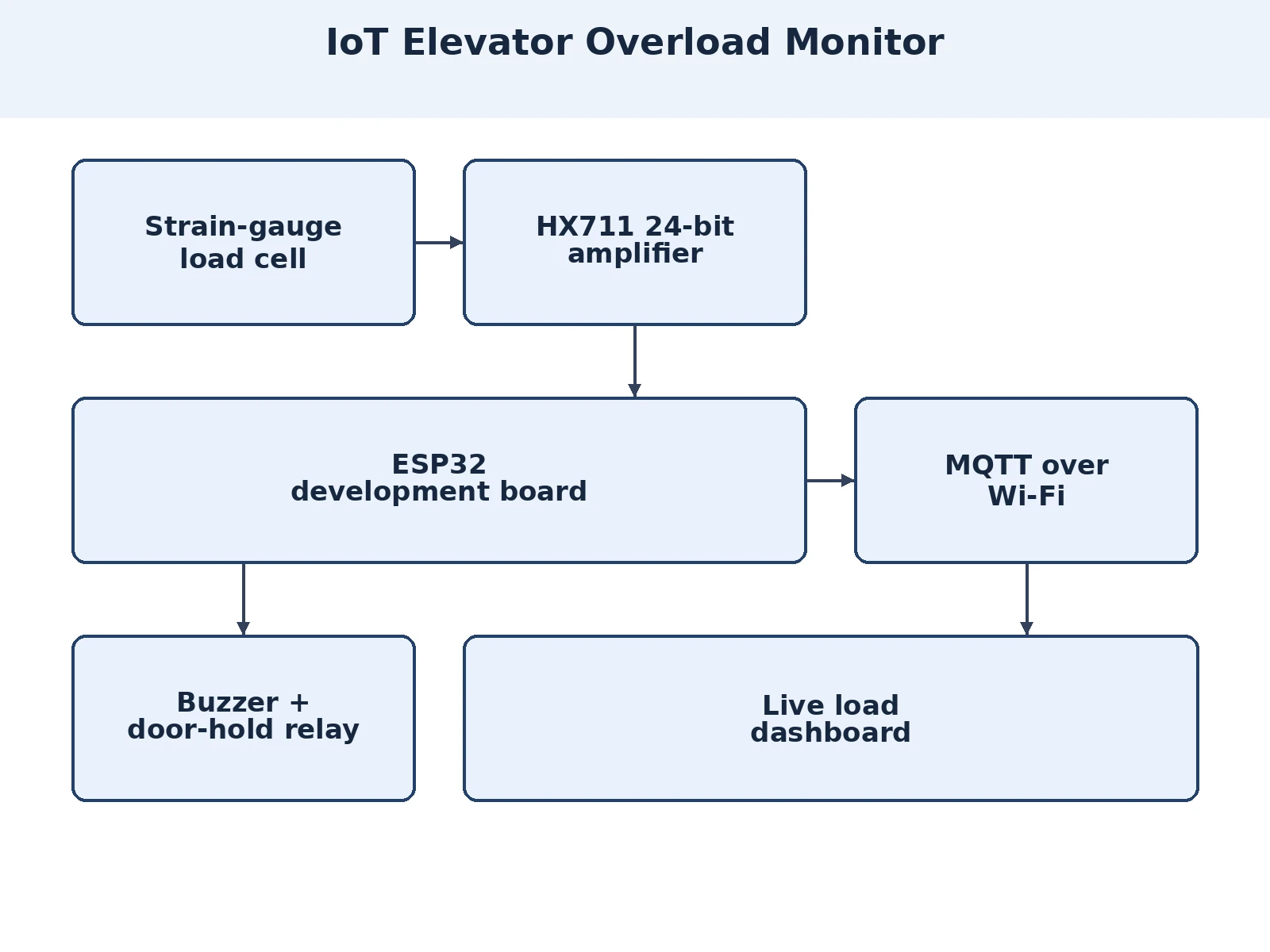
Overloaded lifts are a daily reality in residential towers, and the consequences range from rope wear to trapped passengers. Most small lifts have no weighing at all, or a crude switch that nobody trusts. This project implements proper cabin weighing: a strain-gauge load cell mounted under the cabin platform of a scaled lift model, read by an HX711 24-bit amplifier into an ESP32. Firmware tracks live load, counts trips, and on overload holds the doors open while sounding the buzzer — the standard real-lift behaviour. Every trip and every overload event is published over Wi-Fi via MQTT to a dashboard showing the live load gauge, per-trip load bars and the overload event log. The project is clear about scale: it is demonstrated on a model lift with a kilogram-range load cell; the weighing principle, calibration and alarm logic are what transfer to a real installation.
Strain-gauge load cell under the cabin platform converts passenger load into a small electrical signal.
Follow the working sequence
How it works
- The load cell under the cabin platform is wired to the HX711 amplifier, which streams 24-bit readings to the ESP32.
- Firmware applies the stored tare and span calibration to convert counts to kilograms and smooths the reading.
- Every 2 seconds (design target) the ESP32 publishes the live load over Wi-Fi via MQTT; trip and overload events are published immediately.
- The dashboard renders the load gauge, appends per-trip peak loads to the bar chart, and logs overload events with timestamp and peak value.
- When load exceeds the rated capacity, the firmware activates the buzzer, holds the door relay open and flags the dashboard.
- At door-close the trip's peak load is recorded, the trip counter increments, and the daily summary updates.
- The buyer runs the tare/span calibration with known weights and verifies against the expected values in the manual.
Tech stack:
- ESP32 development board
- Strain-gauge load cell (kg range)
- HX711 24-bit load-cell amplifier
- Buzzer + indicator LEDs
- Relay module (door-hold output)
- MQTT broker + web dashboard
- Arduino IDE (C/C++ firmware)
- Scaled lift model with cabin and doors
| Parameter | Value |
|---|---|
| Controller | ESP32, Wi-Fi MQTT telemetry (JSON payloads) |
| Weighing | Strain-gauge load cell + HX711 24-bit ADC |
| Capacity | Model rated 5 kg demonstration (design target); real-lift scaling in report |
| Resolution | Approximately 10 g on the model scale (expected after calibration) |
| Update rate | 2-second design-target live load; events immediate |
| Alarm | Buzzer + door-hold relay on overload, auto-reset below rated load |
| Dashboard | Live gauge, per-trip bars, trip log, overload event history |
| Power | 5 V DC, approximately 0.8 A (expected) |
Project features
- [Strain-gauge cabin weighing] A load cell under the cabin platform with an HX711 24-bit amplifier gives true weight measurement, not a crude limit switch.
- [Overload alarm logic] On overload the firmware holds the doors open, sounds the buzzer and lights the indicator — mirroring real lift behaviour — until load drops below rated capacity.
- [Live load dashboard] A load gauge, per-trip load bars, trip counter and overload event log update from live telemetry.
- [Trip analytics] The dashboard records every trip's peak load, building the per-trip chart and daily trip counts used in the report.
- [MQTT telemetry] The ESP32 publishes load readings and trip/overload events as JSON over Wi-Fi via MQTT with a design-target 2-second update interval.
- [Buyer-run calibration] Tare and span calibration with known weights is a documented procedure, with expected HX711 counts in the manual.
- [Scaled lift model] A working model lift — cabin, counterweight, doors, floor buttons — carries the weighing hardware for realistic demonstration.
What is included
- Working instrumented lift model (cabin, doors, load cell, HX711, ESP32, buzzer)
- Complete firmware source (weighing, calibration, alarm logic, MQTT)
- Live web dashboard (gauge, trip chart, event log) demonstrated with the model
- Circuit and wiring documentation
- Buyer-run tare/span calibration procedure with expected HX711 values
- Component list with ratings
- Project report PDF (lift safety background, strain-gauge principles, IoT architecture, methodology)
- PPT presentation for final review
- Viva Q&A preparation document (load cells, HX711, MQTT, alarm logic)
- Setup and demonstration guide
Limitations & prerequisites
- Demonstrated on a scaled model with a kilogram-range load cell — it proves the weighing principle and alarm logic, not a certified lift installation.
- Load-cell accuracy is approximately +/-10 g on the model after calibration (expected); real-lift certification needs rated hardware and statutory testing.
- The door-hold output drives the model's door relay; interfacing a real lift controller is outside the student build and needs the lift OEM.
- Vibration during cabin travel adds noise; firmware smoothing is tuned for the model, not a full-speed lift.
- Telemetry needs the same Wi-Fi network as the dashboard; local alarm works without network.
Frequently Asked Questions
How does it weigh the cabin?
A strain-gauge load cell under the cabin platform converts weight to a tiny resistance change; the HX711 24-bit amplifier digitizes it and the ESP32 converts counts to kilograms using the stored tare and span calibration — the same principle as real lift weighing, at model scale.
What happens on overload?
The firmware sounds the buzzer, holds the doors open via the door relay and lights the overload indicator until the load drops back below rated capacity — the standard behaviour of real lifts. The event is published to the dashboard with timestamp and peak load.
How is it calibrated?
With a documented tare (empty cabin) and span (known weights) procedure. The manual gives expected HX711 count ranges so the buyer can verify the calibration is sane.
What does the dashboard show?
A live load gauge, per-trip peak-load bars, the trip counter, and the overload event log — plus daily summaries for the report.
Can this be fitted to a real lift?
The principle transfers directly, but a real installation needs rated load cells, the lift controller interface and statutory certification — all listed as future scope. The student build is demonstrated on the model.
Is this project suitable for a final-year project?
Yes — for IoT and Embedded Systems programs. It combines precision analog sensing, calibration discipline, safety alarm logic and MQTT telemetry, all strong viva material. Suitable for B.E./B.Tech final-year projects in IoT and Embedded Systems.
Components & software requirements
- ESP32 development board
- Strain-gauge load cell (kg range)
- HX711 24-bit load-cell amplifier
- Buzzer + indicator LEDs
- Relay module (door-hold output)
- MQTT broker + web dashboard
- Arduino IDE (C/C++ firmware)
- Scaled lift model with cabin and doors
Delivery information
Built-to-order project. Delivery timeline is shared after order confirmation based on current queue.
Support terms
Complete documentation, setup guide, and viva preparation included. Support for setup and explanation provided.
Download free synopsis (PDF)
Enter your name and WhatsApp number — the synopsis PDF downloads immediately. We may send occasional project updates on WhatsApp; no spam.