
More project photos (3)
The problem
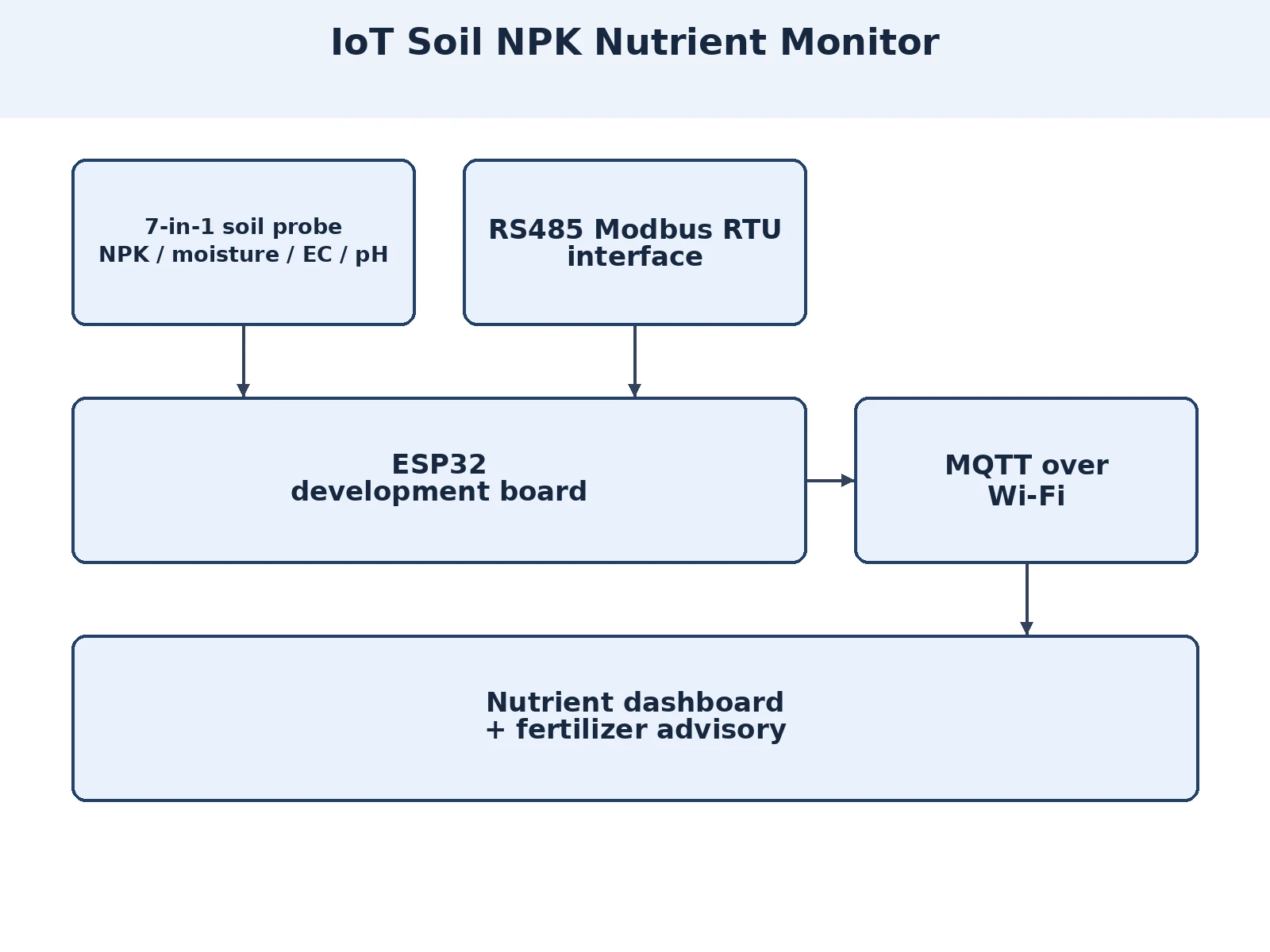
Farmers typically fertilize by habit or by a dealer recommendation, not by what their soil actually contains — wasting money and degrading soil. Lab soil tests are accurate but take days and are done rarely. This project brings nutrient visibility to the field edge: a 7-in-1 soil probe (nitrogen, phosphorus, potassium, moisture, temperature, EC, pH) talks Modbus RTU over RS485 to an ESP32, which publishes readings over Wi-Fi via MQTT. A web dashboard shows live NPK values, 14-day nutrient trends and a fertilizer advisory that converts the readings into per-acre dose guidance for common fertilizers. The project is candid about probe limits: electrochemical NPK probes are indicative rather than lab-accurate, so the advisory is framed as guidance to be confirmed with periodic lab tests — and the manual says so plainly.
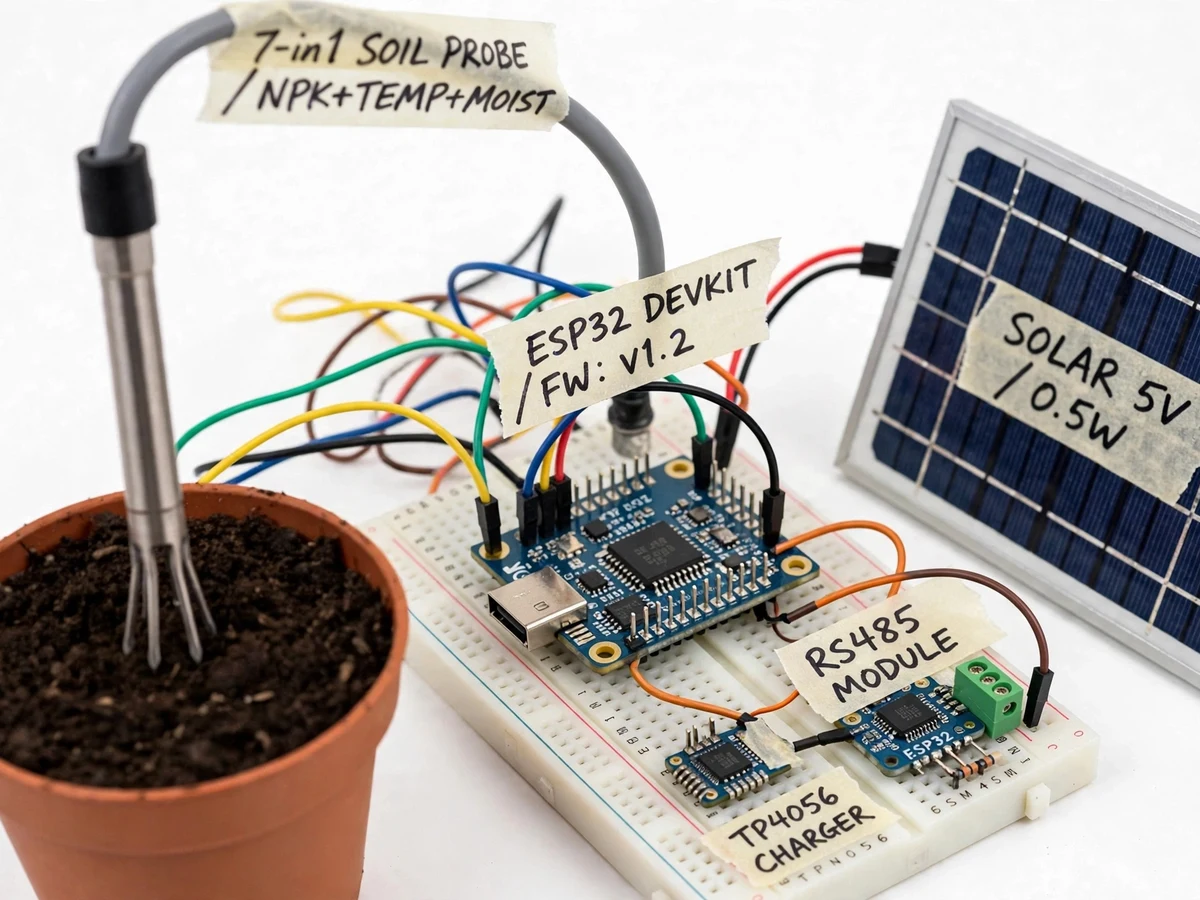
7-in-1 probe reports nitrogen, phosphorus, potassium, moisture, temperature, EC and pH over Modbus RTU.
Follow the working sequence
How it works
- The 7-in-1 probe is buried at root-zone depth and wired to the ESP32 via an RS485 transceiver module.
- Firmware polls the probe's Modbus registers on schedule, validates CRCs, retries on timeout, and converts raw registers to mg/kg, percent and pH.
- Every 30 minutes (design target) the ESP32 publishes a JSON payload over Wi-Fi via MQTT; between readings it can deep-sleep on the solar option.
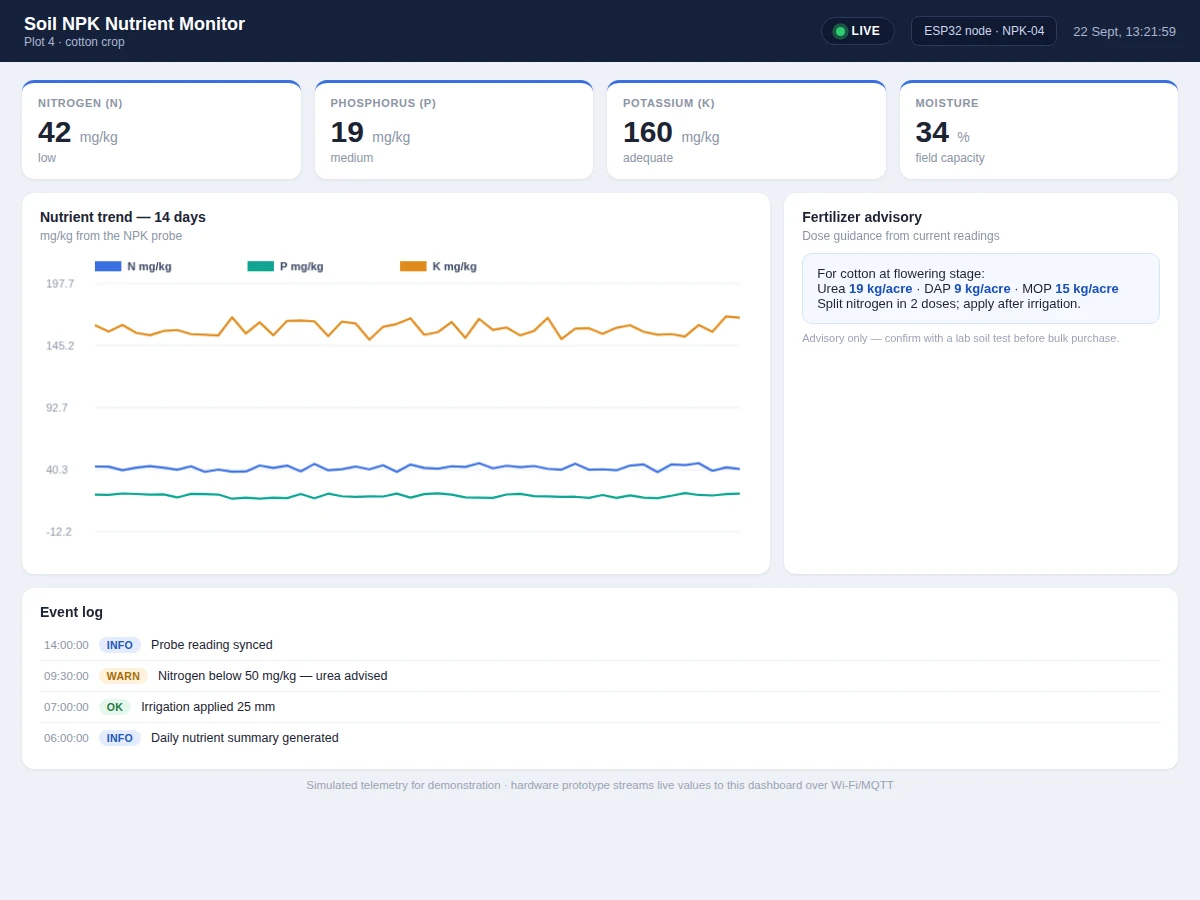
- The dashboard stores the series and renders live NPK cards, 14-day trends and moisture/EC graphs.
- The advisory engine compares current NPK against the selected crop-stage targets and computes per-acre urea/DAP/MOP doses.
- When a nutrient falls below its threshold, the dashboard flags it and refreshes the advisory with the shortfall highlighted.
- The buyer runs the probe check procedure — readings in air, water and a reference soil — documented in the manual.
Tech stack:
- ESP32 development board
- 7-in-1 soil NPK probe (RS485 Modbus)
- RS485-to-TTL transceiver module
- MQTT broker + web dashboard
- Arduino IDE (C/C++ firmware)
- Solar + battery field-power option
- Soil sample test rig (demo)
- IP65-style probe housing notes
| Parameter | Value |
|---|---|
| Controller | ESP32, Wi-Fi MQTT telemetry (JSON payloads) |
| Probe | 7-in-1 soil probe: N, P, K (mg/kg), moisture, temp, EC, pH; RS485 Modbus RTU |
| NPK accuracy | Indicative, approximately +/-10-20% vs lab (expected); advisory framed as guidance |
| Reporting | 30-minute design-target interval; deep-sleep option for solar |
| Dashboard | Live NPK, 14-day trends, fertilizer advisory, crop-stage profiles |
| Advisory | Per-acre urea/DAP/MOP doses from readings vs crop-stage targets |
| Power | USB 5 V, or solar + battery with deep-sleep (documented option) |
Project features
- [7-in-1 soil probe] One RS485 Modbus probe reports nitrogen, phosphorus, potassium, moisture, temperature, EC and pH — a complete field-fertility snapshot.
- [Modbus RTU interfacing] The ESP32 polls the probe over RS485 with proper Modbus framing, timeouts and CRC checking — real industrial-protocol experience.
- [Live nutrient dashboard] Current NPK values, 14-day trends, moisture and EC graphs, all updating from live telemetry.
- [Fertilizer advisory] Readings are converted to per-acre dose guidance for urea, DAP and MOP, adjusted for the selected crop stage.
- [MQTT telemetry] The ESP32 publishes readings as JSON over Wi-Fi via MQTT on a configurable interval with a 30-minute design target for field use.
- [Crop-stage profiles] Advisory targets change with the selected crop growth stage, demonstrating how recommendations depend on context.
- [Solar field-power option] A documented solar + battery option with deep-sleep between readings supports unattended field deployment.
What is included
- Working soil probe station (7-in-1 probe, RS485 interface, ESP32, test rig)
- Complete firmware source (Modbus polling, CRC, MQTT, deep-sleep)
- Live web dashboard (nutrient trends, advisory) demonstrated with soil samples
- Circuit and wiring documentation
- Probe check procedure (air/water/reference-soil readings, expected ranges)
- Component list with ratings
- Project report PDF (soil fertility background, Modbus/RS485, IoT architecture, methodology)
- PPT presentation for final review
- Viva Q&A preparation document (NPK sensing, Modbus, MQTT, advisory logic)
- Setup and demonstration guide
Limitations & prerequisites
- Electrochemical NPK probes are indicative (approximately +/-10-20% vs lab, expected) — the advisory is guidance, and the manual requires periodic lab confirmation before bulk fertilizer purchase.
- Probe readings depend on soil moisture and contact; dry or stony soil reads approximately.
- The demonstration uses prepared soil samples in a test rig, not a full growing season in the field.
- Advisory targets are generic crop-stage values; local agronomist recommendations take precedence.
- Field deployment needs weatherproofing and the solar option; the base build is demonstrated indoors.
Frequently Asked Questions
How does the probe measure NPK?
The 7-in-1 probe uses ion-selective electrodes for nitrogen, phosphorus and potassium plus capacitive moisture, temperature, EC and pH elements. It reports over RS485 Modbus RTU, and the ESP32 polls its registers with CRC validation — the same protocol real industrial sensors use.
How accurate is it compared to a lab test?
Indicative — approximately +/-10-20% versus lab analysis (expected). That is honest and useful: it shows trends and shortfalls for advisory purposes. The manual states plainly that bulk fertilizer decisions should be confirmed with periodic lab tests.
What does the fertilizer advisory do?
It compares current NPK against targets for the selected crop stage and computes per-acre doses of urea, DAP and MOP to close the gap, with guidance like splitting nitrogen across two applications.
What does the dashboard show?
Live NPK cards, 14-day nutrient trends, moisture and EC graphs, the dose advisory with shortfall highlighting, and threshold flags when any nutrient drops below its limit.
Can it run in a real field?
With the documented solar + battery option and deep-sleep firmware, yes for the electronics. Weatherproofing the enclosure and the probe burial are covered as deployment notes; the base demonstration is indoors with soil samples.
Is this project suitable for a final-year project?
Yes — for IoT and Embedded Systems programs. It covers industrial Modbus interfacing, multi-parameter sensing, MQTT telemetry and an advisory engine with an honest accuracy discussion, all strong viva material. Suitable for B.E./B.Tech final-year projects in IoT and Embedded Systems.
Components & software requirements
- ESP32 development board
- 7-in-1 soil NPK probe (RS485 Modbus)
- RS485-to-TTL transceiver module
- MQTT broker + web dashboard
- Arduino IDE (C/C++ firmware)
- Solar + battery field-power option
- Soil sample test rig (demo)
- IP65-style probe housing notes
Delivery information
Built-to-order project. Delivery timeline is shared after order confirmation based on current queue.
Support terms
Complete documentation, setup guide, and viva preparation included. Support for setup and explanation provided.
Download free synopsis (PDF)
Enter your name and WhatsApp number — the synopsis PDF downloads immediately. We may send occasional project updates on WhatsApp; no spam.