
More project photos (3)
The problem
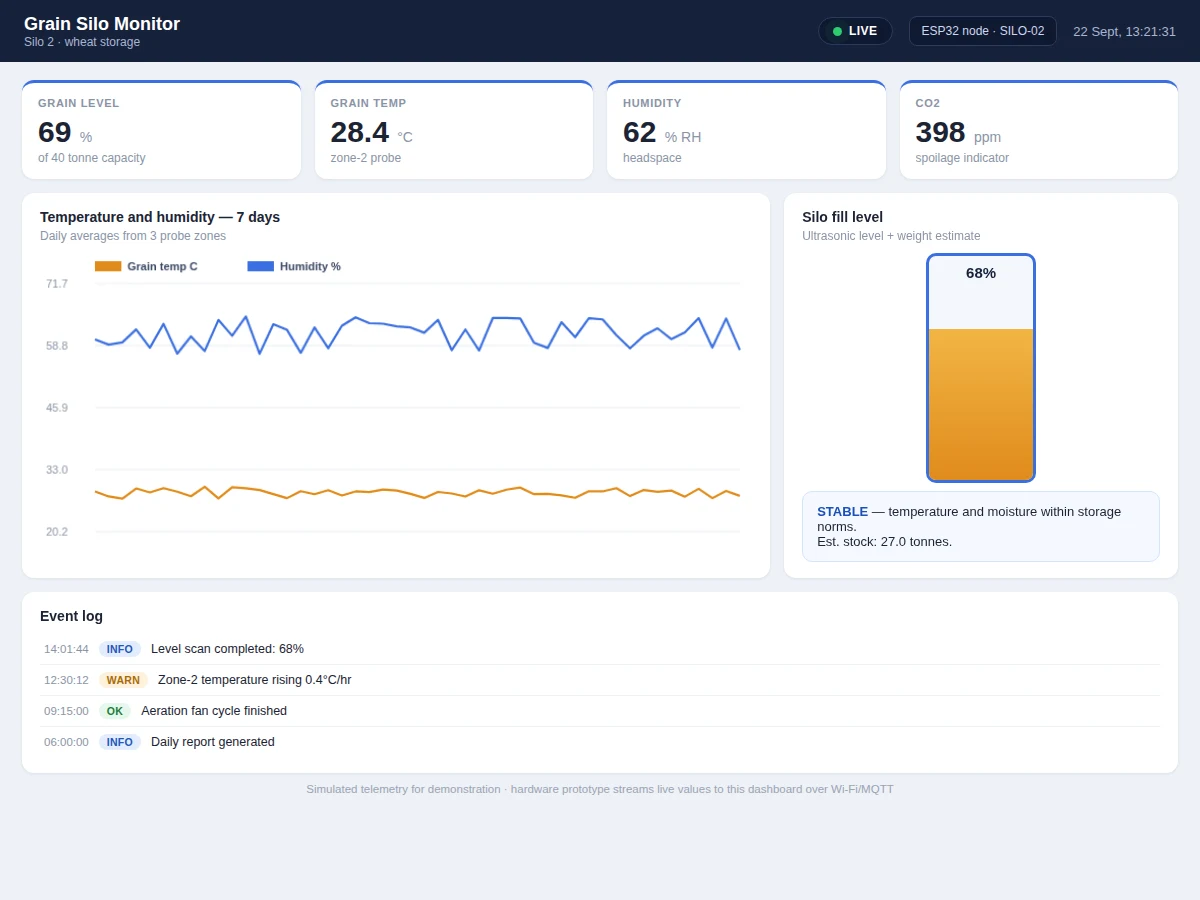
Stored grain spoils silently: moisture migration and insect activity create hotspots that can ruin tonnes before anyone notices, and manual level checks with a tape are infrequent and approximate. This project instruments a scaled silo model with three DHT22 temperature/humidity zones, a JSN-SR04T ultrasonic level sensor and an optional CO2 channel as a spoilage indicator. An ESP32 publishes zone readings over Wi-Fi via MQTT to a dashboard that renders the silo fill graphic, 7-day temperature and humidity trends, and hotspot alerts when a zone rises faster than the configured rate. The project is honest about the demonstration scale — the model holds kilograms, the physics and the firmware logic are what transfer to a real silo — and aeration-fan control is included as a documented relay output.
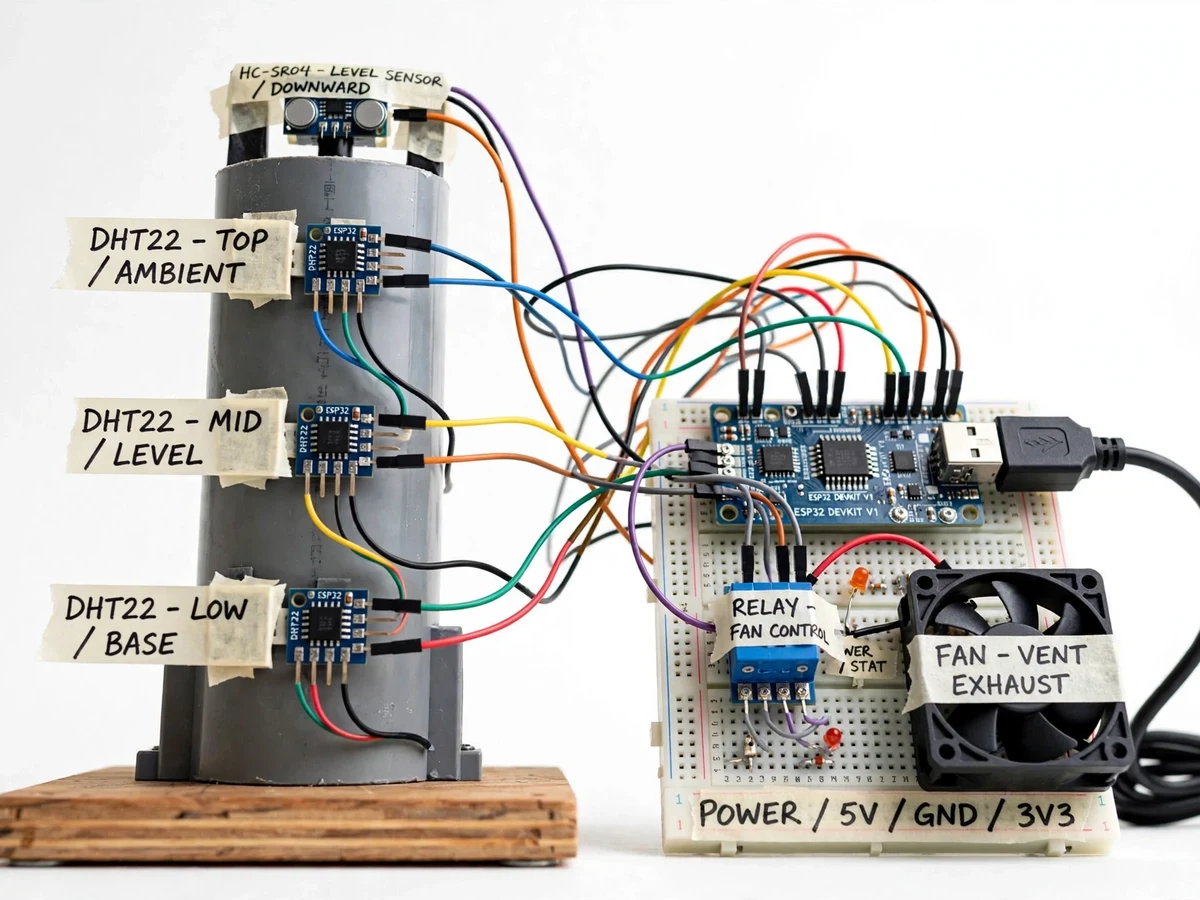
Temperature/humidity probes in the top, middle and bottom zones capture gradients that reveal developing hotspots.
Follow the working sequence
How it works
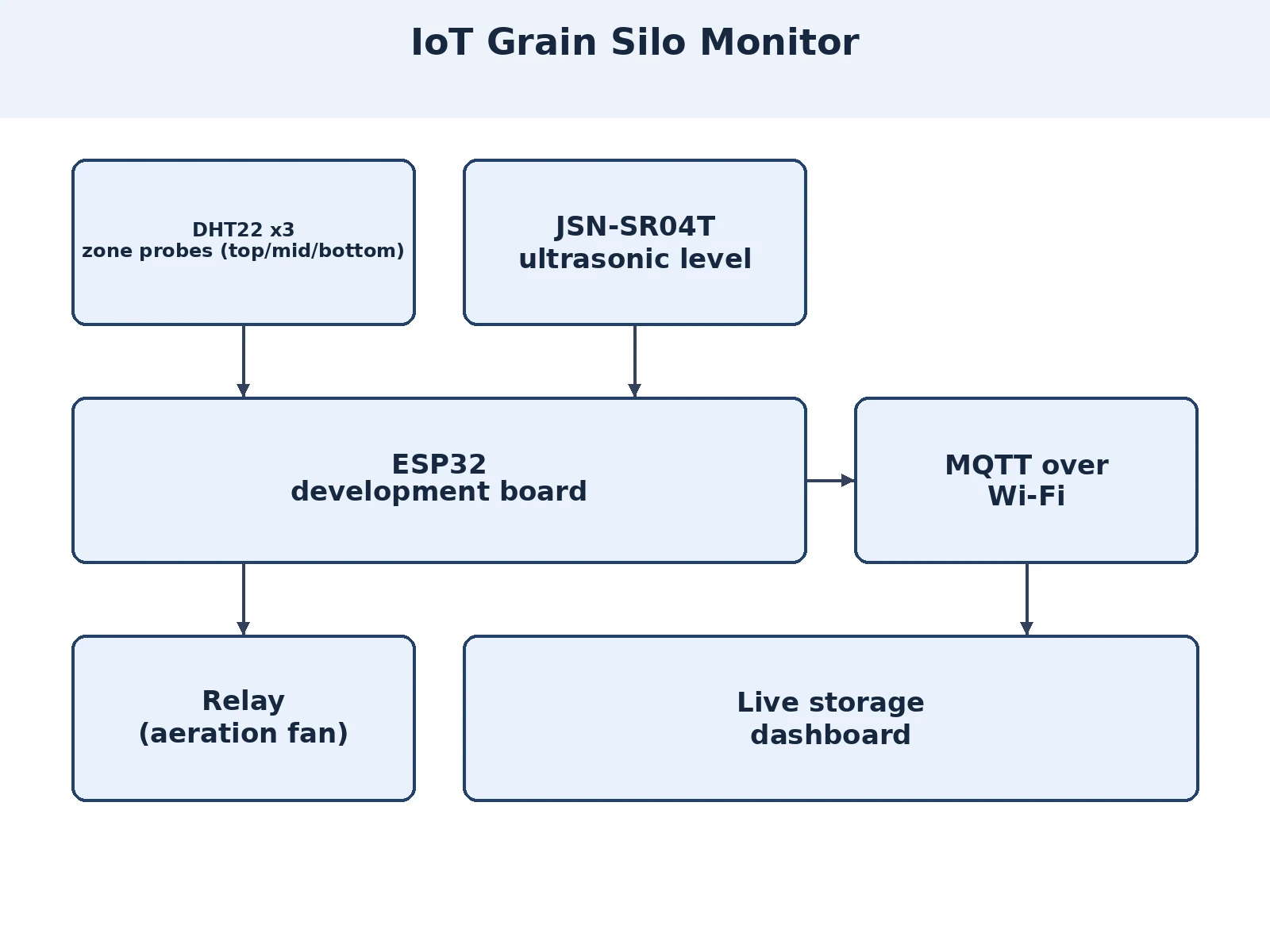
- DHT22 probes in the top, middle and bottom zones and the ultrasonic level sensor are wired to the ESP32 on the silo model.
- Firmware samples each zone, reads the grain-surface distance, and converts distance to fill percentage using the calibrated empty/full references.
- Every 10 minutes (design target) the ESP32 publishes a JSON payload with zone readings and level over Wi-Fi via MQTT.
- The dashboard renders the silo fill graphic, zone trend graphs and the estimated stock, and evaluates the hotspot rule on each new reading.
- When a zone's temperature rise exceeds the threshold, an alert is raised and logged with the zone, value and rate.
- The aeration fan relay can be switched from the dashboard or by an automatic rule when headspace humidity crosses the set point.
- Daily min/max/average per zone are computed for the storage report view and CSV export.
Tech stack:
- ESP32 development board
- DHT22 temperature/humidity sensors x3
- JSN-SR04T ultrasonic level sensor
- MH-Z19 CO2 sensor (optional spoilage channel)
- Relay module (aeration fan)
- MQTT broker + web dashboard
- Arduino IDE (C/C++ firmware)
- Scaled silo model with probe mounts
| Parameter | Value |
|---|---|
| Controller | ESP32, Wi-Fi MQTT telemetry (JSON payloads) |
| Zones | 3x DHT22 (temp/RH): top, middle, bottom |
| Sensor accuracy | DHT22: +/-0.5 C / +/-2% RH typical (datasheet) |
| Level sensing | JSN-SR04T ultrasonic, approximately 25-450 cm range (datasheet) |
| Reporting | 10-minute design-target interval; MQTT reconnect with backoff |
| Dashboard | Silo fill graphic, 7-day zone trends, hotspot alerts, stock estimate |
| Aeration output | 1x relay channel, dashboard or rule-driven |
| Power | 5 V DC, approximately 1 A with fan (expected) |
Project features
- [Three-zone sensing] DHT22 probes at top, middle and bottom zones capture temperature and humidity gradients — the signature of developing hotspots.
- [Ultrasonic level sensing] A JSN-SR04T measures grain surface distance and firmware converts it to fill percentage and an estimated stock weight.
- [Live storage dashboard] Silo fill graphic, zone-wise 7-day trends, current readings and alert banners, all updating from live telemetry.
- [Hotspot alerts] When a zone's temperature rise rate exceeds the configured threshold, the dashboard flags a hotspot risk with the zone and the trend.
- [MQTT telemetry] The ESP32 publishes zone readings as JSON over Wi-Fi via MQTT on a configurable interval with a 10-minute design target for storage monitoring.
- [Aeration relay output] A relay channel drives the model's aeration fan from dashboard commands or automatic rules tied to humidity thresholds.
- [Stock estimation] Fill percentage is converted to an estimated tonnage using the configured bulk density, shown on the dashboard and in daily reports.
What is included
- Working instrumented silo model (3-zone probes, level sensor, aeration fan, ESP32)
- Complete firmware source (sensing, level math, MQTT, relay rules)
- Live web dashboard (fill graphic, trends, alerts) demonstrated with the model
- Circuit and wiring documentation
- Level calibration procedure (empty/full reference capture)
- Component list with ratings
- Project report PDF (grain storage background, sensor principles, IoT architecture, methodology)
- PPT presentation for final review
- Viva Q&A preparation document (DHT22, ultrasonic ranging, MQTT, hotspot physics)
- Setup and demonstration guide
Limitations & prerequisites
- DHT22 accuracies are datasheet values (+/-0.5 C, +/-2% RH typical); this is a demonstration model, not a certified grain-monitoring installation.
- The scaled model holds kilograms — fill and stock math is demonstrated at model scale and scaled by configuration, not validated on a real silo.
- CO2 as a spoilage indicator is included as an optional channel; correlation with actual spoilage is indicative, not diagnostic.
- Ultrasonic level readings assume a reasonably level grain surface; heaped cones read approximately.
- Telemetry needs stable 2.4 GHz Wi-Fi; the model is demonstrated indoors.
Frequently Asked Questions
How does it detect grain spoilage risk?
Three DHT22 zones track temperature and humidity gradients, and the firmware watches the rate of temperature rise per zone. A zone climbing faster than the configured threshold raises a hotspot alert — the classic early signature of insect activity or moisture migration. An optional CO2 channel adds a second spoilage indicator.
How is the grain level measured?
A JSN-SR04T ultrasonic sensor measures the distance to the grain surface; firmware converts it to fill percentage using empty/full references captured during calibration, then to an estimated weight with the configured bulk density.
What does the dashboard show?
A silo fill graphic, live zone readings, 7-day temperature and humidity trends, estimated stock, hotspot alerts and aeration fan control — plus daily summaries and CSV export.
Can it control the aeration fan automatically?
Yes — a relay channel drives the model's fan from dashboard commands or from an automatic rule tied to headspace humidity, demonstrating closed-loop storage management.
Is this validated on a real silo?
No — it is demonstrated on a scaled model holding kilograms. The sensing physics, firmware logic and dashboard are real and transferable; full-scale validation is listed as future scope.
Is this project suitable for a final-year project?
Yes — for IoT and Embedded Systems programs. It covers multi-zone sensing, ultrasonic ranging, MQTT telemetry, rule-based actuation and an honest discussion of scale, all strong viva material. Suitable for B.E./B.Tech final-year projects in IoT and Embedded Systems.
Components & software requirements
- ESP32 development board
- DHT22 temperature/humidity sensors x3
- JSN-SR04T ultrasonic level sensor
- MH-Z19 CO2 sensor (optional spoilage channel)
- Relay module (aeration fan)
- MQTT broker + web dashboard
- Arduino IDE (C/C++ firmware)
- Scaled silo model with probe mounts
Delivery information
Built-to-order project. Delivery timeline is shared after order confirmation based on current queue.
Support terms
Complete documentation, setup guide, and viva preparation included. Support for setup and explanation provided.
Download free synopsis (PDF)
Enter your name and WhatsApp number — the synopsis PDF downloads immediately. We may send occasional project updates on WhatsApp; no spam.