
More project photos (3)
The problem
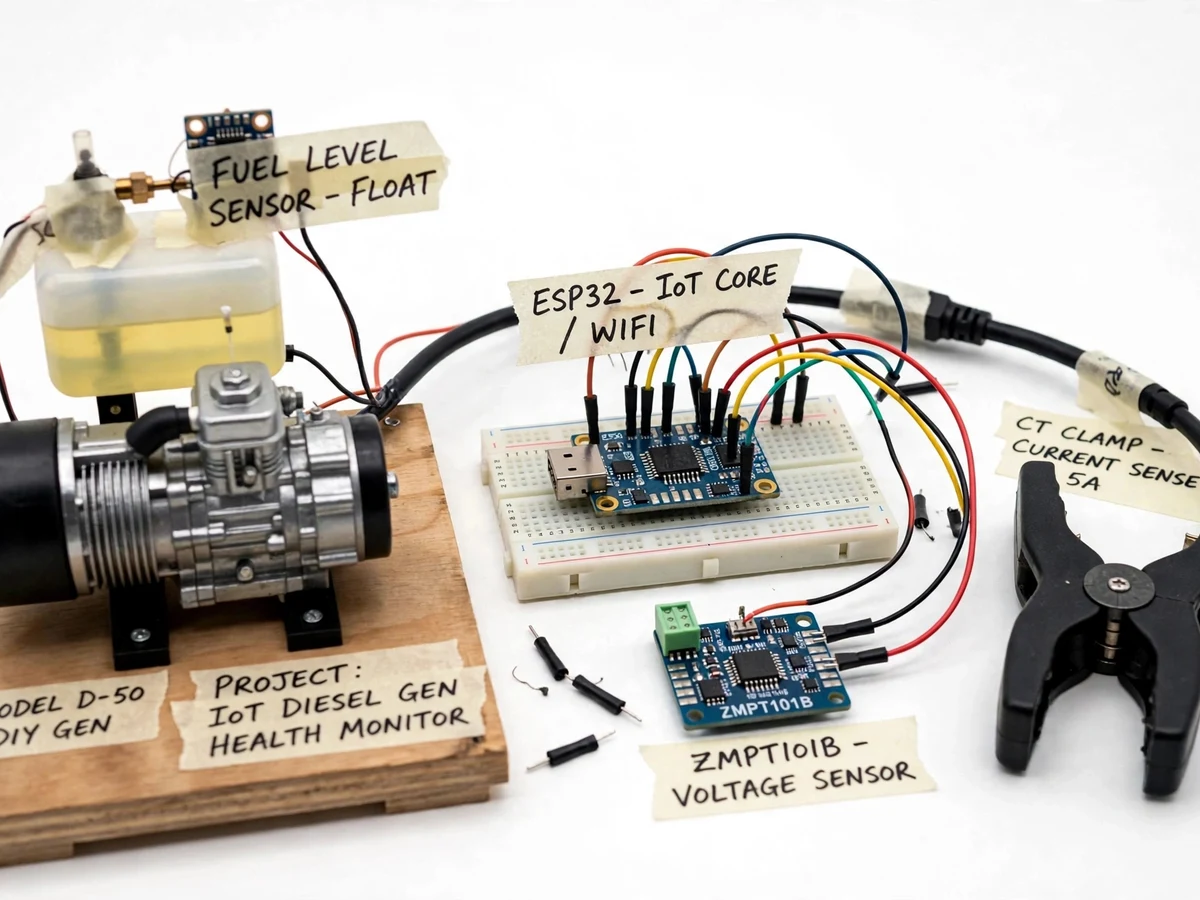
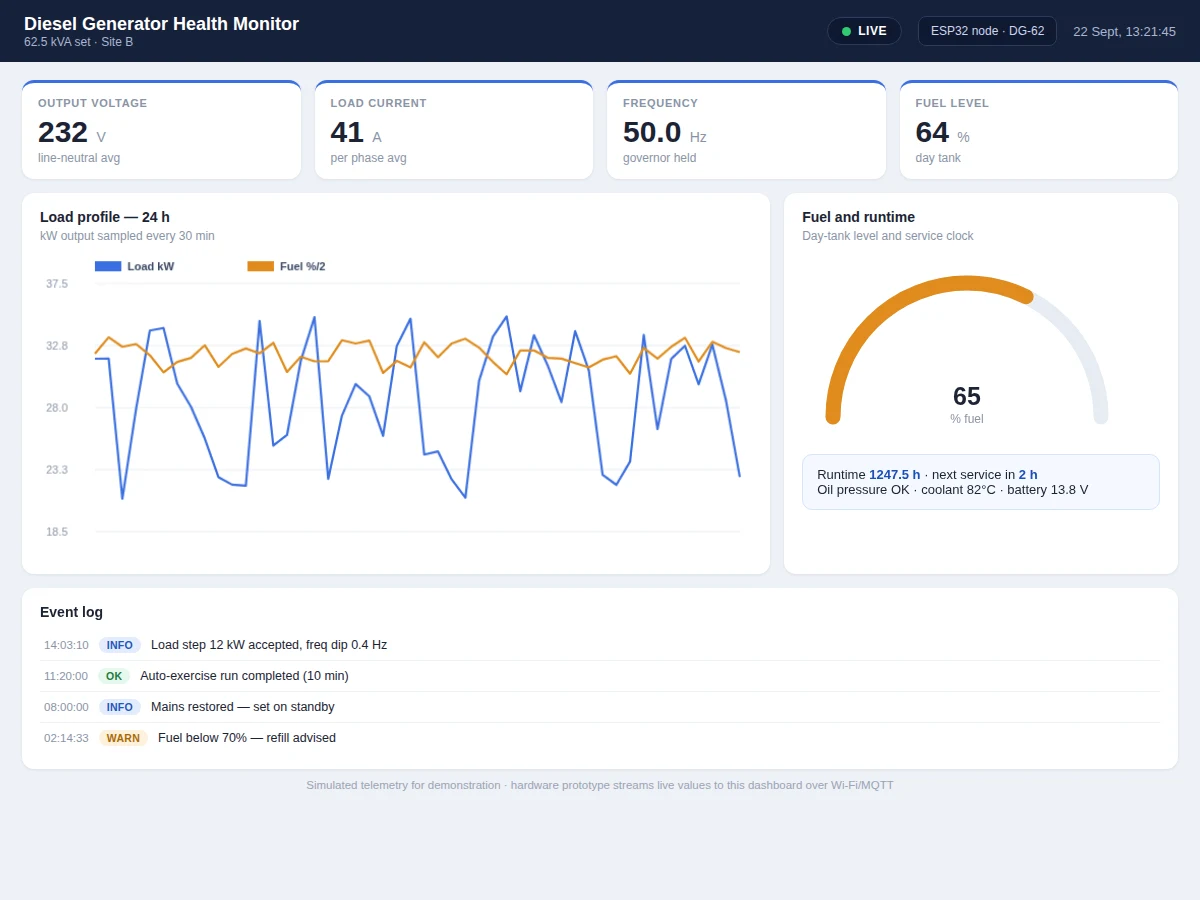
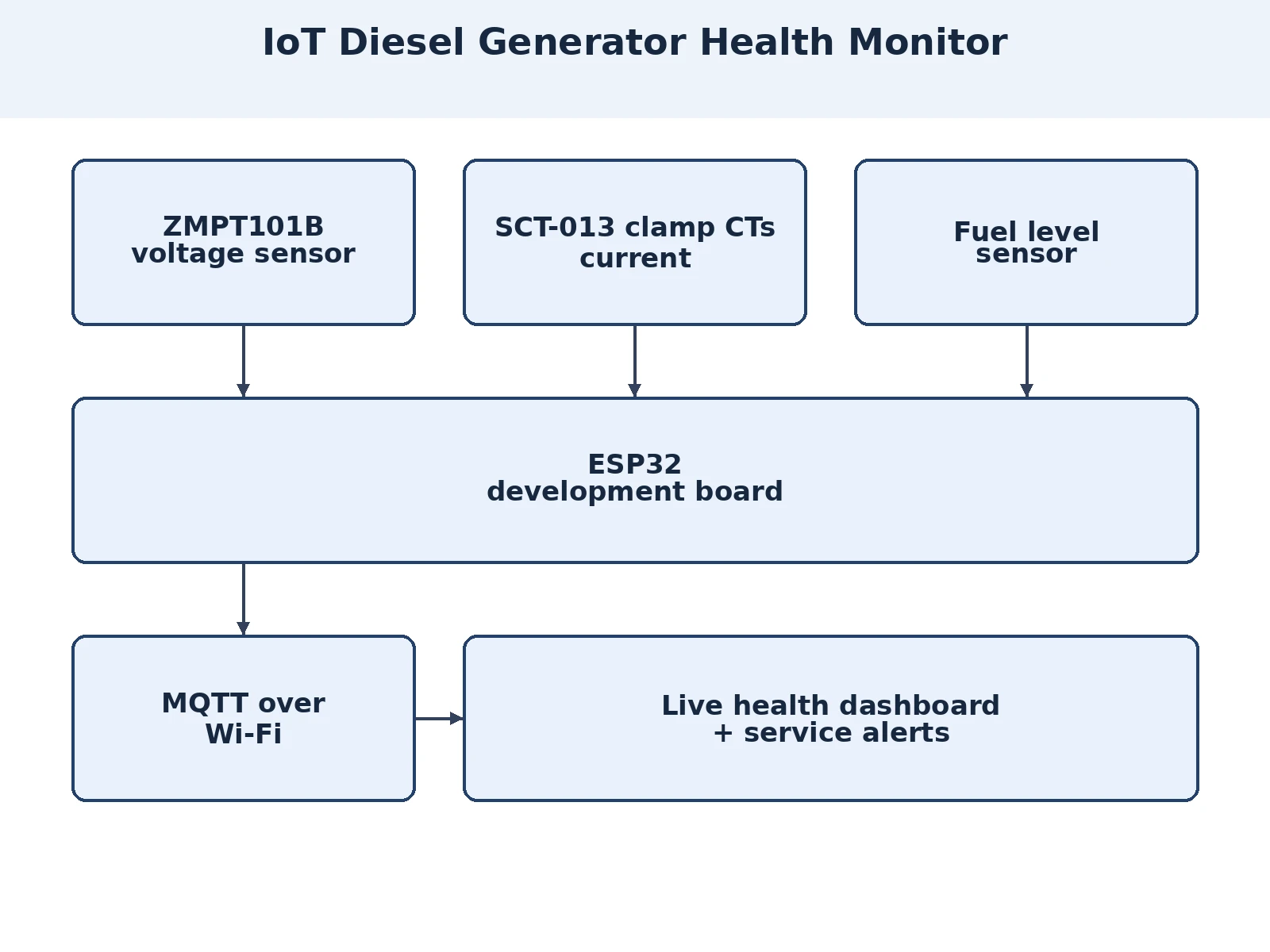
Diesel generator sets fail at the worst moment — during a mains outage — usually from neglected fuel, missed services or unnoticed overloads. Caretakers check them rarely, and there is no record of how hard the set worked during the last outage. This project instruments a generator demonstration rig with a ZMPT101B voltage sensor, SCT-013 current transformers, frequency derived from the voltage waveform, and a fuel-level sensor on the day tank. An ESP32 publishes electrical and fuel readings over Wi-Fi via MQTT to a dashboard showing live gauges, the 24-hour load profile, cumulative runtime and hours-to-next-service. Alerts cover low fuel, frequency excursions and overload. The project is explicit about the demonstration boundary: sensing is done on a low-voltage model/load bank with proper isolation — students never interface directly with lethal generator terminals without supervision.
Measures generator output voltage; firmware derives frequency from the voltage zero-crossing timing.
Follow the working sequence
How it works
- The ZMPT101B, SCT-013 CTs and fuel-level sensor are interfaced to the ESP32; frequency is computed from voltage zero-crossing timing.
- Firmware samples voltage and current, computes RMS values, derives frequency, reads fuel level, and accumulates runtime while the set runs.
- Every 10 seconds (design target) the ESP32 publishes a JSON payload over Wi-Fi via MQTT.
- The dashboard renders live gauges, the 24-hour load profile, the runtime counter and the service countdown.
- When fuel drops below the threshold, frequency leaves the configured band, or current exceeds the rating, an alert is raised and logged.
- The service reminder decrements from the configured interval (e.g. 250 hours) and flags the dashboard when due.
- A weekly auto-exercise run can be scheduled from the dashboard, logging start, duration and parameters.
Tech stack:
- ESP32 development board
- ZMPT101B voltage sensor module
- SCT-013 clamp current transformers
- Fuel level sensor (day tank)
- MQTT broker + web dashboard
- Arduino IDE (C/C++ firmware)
- Generator demonstration rig / load bank
- Isolated transducer wiring kit
| Parameter | Value |
|---|---|
| Controller | ESP32, Wi-Fi MQTT telemetry (JSON payloads) |
| Voltage sensing | ZMPT101B, isolated; approximately +/-2% typical (module grade) |
| Current sensing | SCT-013 clamp CTs, non-invasive |
| Frequency | Derived from voltage zero-crossings, 50 Hz nominal |
| Fuel sensing | Day-tank level, percentage with low-fuel threshold |
| Reporting | 10-second design-target interval; MQTT reconnect with backoff |
| Dashboard | Live gauges, 24-hour load profile, runtime, service countdown, alerts |
| Safety | Isolated transducers only; supervised wiring per build guide |
Project features
- [Electrical sensing] ZMPT101B voltage sensing, SCT-013 clamp current transformers and frequency derived from the voltage zero-crossings cover the set's electrical health.
- [Fuel and runtime tracking] Day-tank level sensing plus cumulative runtime hours give fuel planning and service scheduling a real data basis.
- [Live health dashboard] Gauges for voltage, current, frequency and fuel, a 24-hour load profile, runtime counter and hours-to-service — all from live telemetry.
- [Service reminders] The dashboard counts down to the next oil/filter service from runtime hours and flags when it is due.
- [Threshold alerts] Low fuel, frequency excursion beyond the configured band and overload current raise dashboard alerts with event logging.
- [MQTT telemetry] The ESP32 publishes readings as JSON over Wi-Fi via MQTT with a design-target 10-second interval and reconnect handling.
- [Isolation-first design] All mains-side sensing uses isolated transducers (voltage transformer, clamp CTs); the student build guide stresses supervised wiring only.
What is included
- Working generator monitor interface (sensors, ESP32, isolation) on a demonstration rig
- Complete firmware source (RMS computation, frequency, fuel, runtime, MQTT)
- Live web dashboard (gauges, load profile, service tracking) demonstrated with the rig
- Circuit and wiring documentation with the isolation and supervision notes
- Sensor calibration procedure (voltage/current against reference meters)
- Component list with ratings
- Project report PDF (DG set background, sensing principles, IoT architecture, methodology)
- PPT presentation for final review
- Viva Q&A preparation document (CTs, RMS, frequency measurement, MQTT, maintenance logic)
- Setup and demonstration guide
Limitations & prerequisites
- Demonstrated on a low-voltage model/load bank with isolated transducers — direct wiring to a real generator's lethal terminals is supervised-only and outside the student build.
- Voltage and current accuracies are module-grade (approximately +/-2-3%, expected); this is a health monitor, not a revenue meter.
- Fuel-level sensing is approximate and tank-geometry dependent; calibration against manual dip readings is documented.
- Frequency derivation needs a clean voltage waveform; heavily distorted outputs read approximately.
- Service reminders are hour-counters, not oil analysis — they schedule maintenance, they do not diagnose engine wear.
Frequently Asked Questions
What does the monitor measure?
Output voltage (ZMPT101B), load current per phase (SCT-013 clamp CTs), frequency from voltage zero-crossings, day-tank fuel level and cumulative runtime — the five quantities a caretaker needs to judge generator health.
Is it safe to connect to a real generator?
The design uses only isolated, non-invasive transducers, but the build guide is explicit: any wiring near a real set's terminals is done under qualified supervision. The student demonstration uses a low-voltage model/load bank.
What does the dashboard show?
Live gauges for voltage, current, frequency and fuel, the 24-hour load profile, total runtime, a countdown to the next service, and alerts for low fuel, frequency excursions and overload.
How does it know when service is due?
It accumulates runtime hours while the set runs and counts down from the configured service interval (250 hours is typical for small sets), flagging the dashboard when the service is due.
How accurate are the readings?
Module-grade — approximately +/-2-3% for voltage and current (expected). Enough for health trending and overload detection, not for billing; the manual documents calibration against reference meters.
Is this project suitable for a final-year project?
Yes — for IoT and Embedded Systems programs. It combines isolated power sensing, frequency measurement, MQTT telemetry and a maintenance dashboard with an honest safety discussion, all strong viva material. Suitable for B.E./B.Tech final-year projects in IoT and Embedded Systems.
Components & software requirements
- ESP32 development board
- ZMPT101B voltage sensor module
- SCT-013 clamp current transformers
- Fuel level sensor (day tank)
- MQTT broker + web dashboard
- Arduino IDE (C/C++ firmware)
- Generator demonstration rig / load bank
- Isolated transducer wiring kit
Delivery information
Built-to-order project. Delivery timeline is shared after order confirmation based on current queue.
Support terms
Complete documentation, setup guide, and viva preparation included. Support for setup and explanation provided.
Download free synopsis (PDF)
Enter your name and WhatsApp number — the synopsis PDF downloads immediately. We may send occasional project updates on WhatsApp; no spam.