
More project photos (2)
The problem
Vaccines lose potency silently when a fridge drifts outside the 2–8 °C window, and food spoils the same way — yet most clinics and small food businesses still log temperatures by hand twice a day. A door left open at noon and closed at 2 pm leaves no trace on a paper register, but the excursion still happened. This project replaces the register with continuous, timestamped monitoring: an ESP32 with a waterproof DS18B20 probe inside the storage box records the temperature every minute, the cloud dashboard keeps a tamper-evident log, and a Telegram message reaches the responsible person within seconds of a breach. Because the alert thresholds, the logging interval and the dashboard layout are all configurable in firmware, the build doubles as a solid platform for demonstrating IoT sensing, cloud integration and compliance-style reporting in a viva.
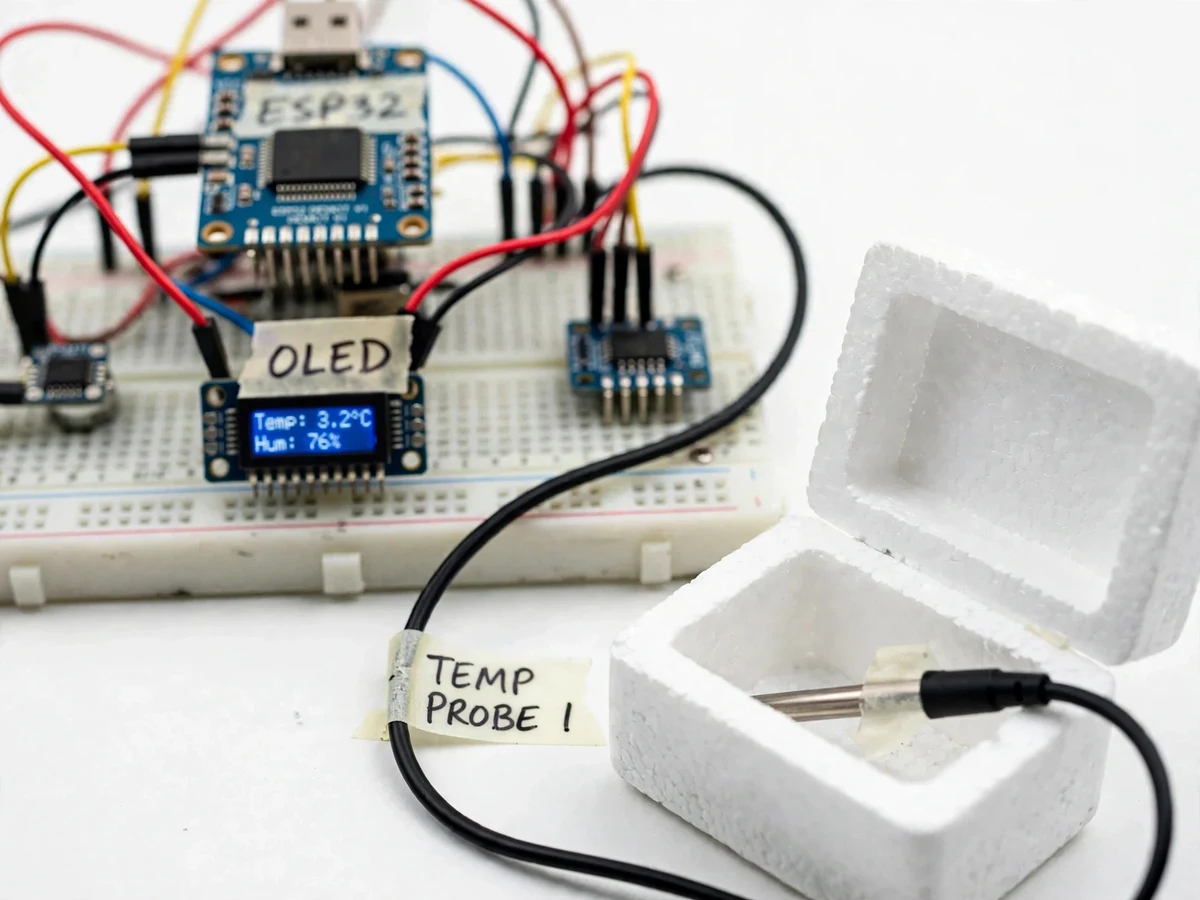
Waterproof probe inside the fridge reporting temperature every 60 seconds.
Follow the working sequence
How it works
- The waterproof DS18B20 probe is placed inside the fridge or insulated cold box, while the ESP32, DHT22, DS3231 and OLED sit outside the cold zone and connect over jumper wires.
- Every 60 seconds the firmware reads the DS18B20 (±0.5 °C, 12-bit resolution) and the DHT22 (temperature ±0.5 °C, humidity ±2% RH per datasheet), and stamps each sample with the DS3231 clock.
- The OLED shows the live fridge temperature and humidity so the status is visible without opening the dashboard.
- Each reading is compared against the configured band (default design target: 2–8 °C, the WHO-recommended vaccine storage window). A reading outside the band starts a breach; recovery below the hysteresis point closes it.
- On every breach start and breach end, the ESP32 issues an HTTPS request that sends a Telegram bot message (and email, if configured) with the time, the reading, and the threshold that tripped.
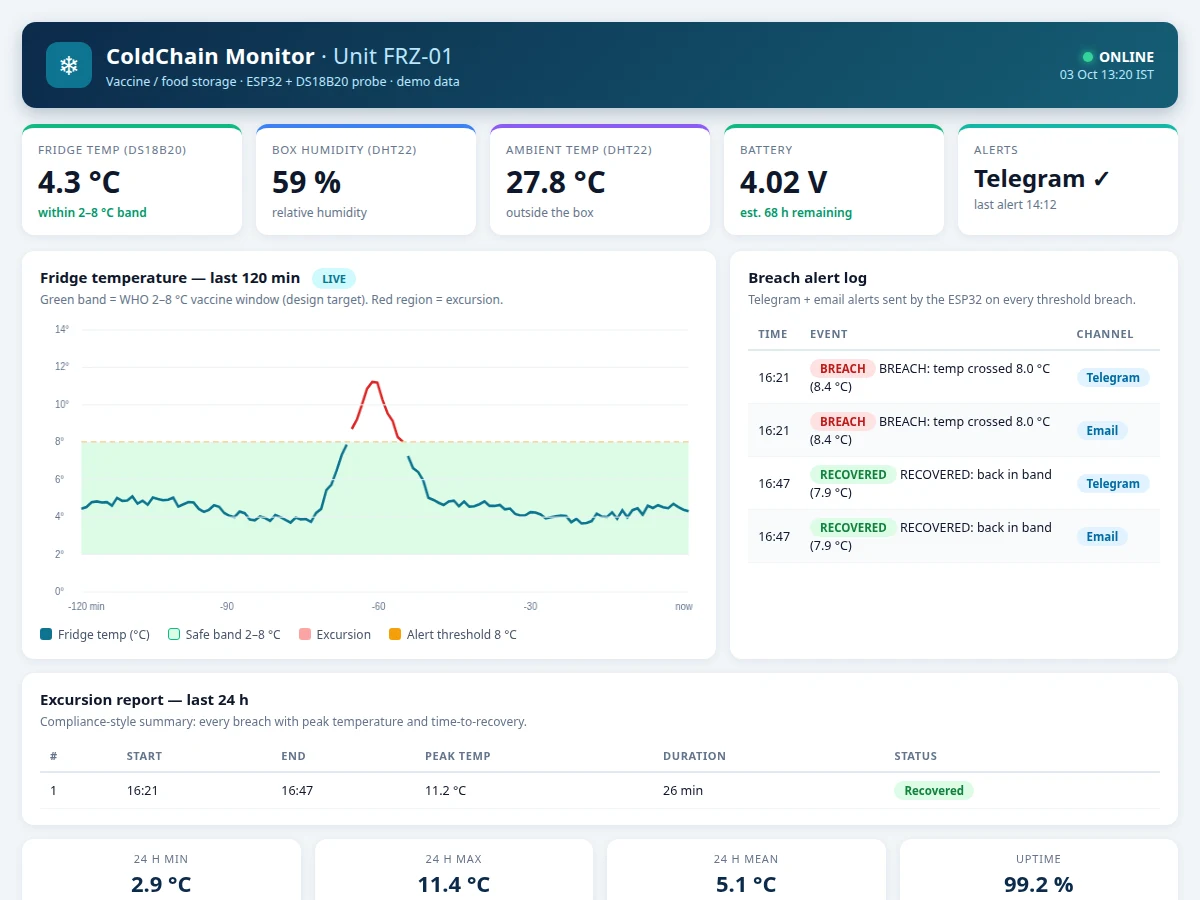
- Readings are POSTed to the cloud dashboard backend over WiFi, which renders live tiles, the scrolling chart, the alert log and the 24-hour excursion report with min/max/mean statistics.
Tech stack:
- ESP32 DevKit V1 (firmware in Arduino/C++)
- DS18B20 waterproof temperature probe (±0.5 °C datasheet)
- DHT22 temperature & humidity sensor
- DS3231 real-time clock module
- 0.96″ OLED display (SSD1306)
- Telegram Bot API · SMTP email for alerts
- Single-file HTML/CSS/JS cloud dashboard (no build step)
- HTTP POST/JSON telemetry (WiFi)
| Parameter | Value |
|---|---|
| Temperature sensor | DS18B20, waterproof probe; ±0.5 °C accuracy (datasheet, not a measured claim) |
| Temperature range | −55 °C to +125 °C (datasheet); design target use 2–8 °C band |
| Humidity sensor | DHT22; ±2% RH, ±0.5 °C (datasheet) |
| Alert band | 2–8 °C default (WHO vaccine window, design target); configurable in firmware |
| Sampling interval | 60 seconds (configurable); expected, not measured |
| Alert latency | Seconds after threshold cross over WiFi (expected; depends on network) |
| Alert channels | Telegram bot message + optional email (implemented); SMS not in the shipped build |
| Logging | Timestamped readings via DS3231 RTC; retained on the dashboard backend |
| Power | 5 V USB; approximately 2–3 days on a 10,000 mAh power bank (expected, depends on WiFi conditions) |
| Dashboard | Single-file web page; no server build step required |
Project features
- [Continuous fridge monitoring] A waterproof DS18B20 probe sits inside the cold box and reports the temperature every 60 seconds; readings are shown live on the OLED and pushed to the cloud. (Datasheet accuracy ±0.5 °C — no claim is made beyond the datasheet.)
- [Instant Telegram breach alerts] The moment the reading crosses the configured high or low threshold, the ESP32 sends a Telegram bot message (plus optional email) with the current temperature and timestamp — no app to open, no polling.
- [Cloud dashboard with breach log] A live dashboard shows current temperature and humidity, a 120-minute scrolling chart with the safe band shaded, a full breach alert log, and a 24-hour excursion report (start, end, peak temperature, duration).
- [Humidity and ambient tracking] A DHT22 logs box humidity and ambient temperature alongside the fridge reading, so excursions can be correlated with door openings and room conditions.
- [Battery-backed timestamps] A DS3231 real-time clock stamps every reading, so the log stays accurate even if WiFi drops and the device re-syncs later.
- [Configurable thresholds and intervals] High/low alert limits, the logging interval, the Telegram bot token and the probe count are all configurable in the firmware — demonstrated as configuration, not hard-coded magic.
- [Optional: second DS18B20 probe] The firmware supports a second probe (e.g. freezer vs chiller zones); shipped as an optional build variant, not the default build.
- [Future scope: GSM fallback] Documented as future scope only — the shipped build relies on WiFi; SMS-over-GSM is described in the report as a possible extension for areas without WiFi.
What is included
- Assembled and tested hardware prototype (ESP32 DevKit, DS18B20 waterproof probe, DHT22, DS3231 RTC, OLED, insulated demo cold box section)
- Complete firmware source (Arduino/C++) with threshold/alert configuration documented
- Sensor calibration procedure the buyer runs on their own build (ice-point and room-reference method, step-by-step)
- Cloud dashboard code (single HTML file) with live tiles, scrolling chart, breach log and excursion report
- Wiring diagram and connection table
- Project report PDF (background, cold-chain problem, design, firmware architecture, demo results)
- PPT presentation for final review
- Viva Q&A preparation document (1-Wire protocol, DHT22 timing, Telegram Bot API, HTTPS on ESP32, RTC vs NTP)
Limitations & prerequisites
- WiFi is mandatory — without a network the device still logs locally and shows the OLED, but no alerts or cloud updates go out (GSM fallback is future scope, not shipped).
- This is an educational/prototype build, not a certified medical device — it cannot replace regulated pharma-grade data loggers for real vaccine stores.
- DS18B20 accuracy is ±0.5 °C per the manufacturer datasheet; the report never claims better precision or any measured accuracy figure.
- Battery life is an estimate (2–3 days on 10,000 mAh, expected) and varies with WiFi signal strength and alert frequency.
- The demo cold box is an insulated foam section, not a real refrigerator — behaviour against a real fridge's defrost cycles is a deployment consideration.
- Email alerts depend on an SMTP provider's credentials and rate limits, which the buyer configures.
Frequently Asked Questions
Why is the 2–8 °C band the default?
That is the WHO-recommended storage window for most vaccines, and this project adopts it as its design-target alert band. The thresholds are configurable in firmware, so the same build can monitor a food chiller or a different cold band — the dashboard shading follows whatever limits are set.
How do the Telegram alerts actually work?
The ESP32 makes an HTTPS request to the Telegram Bot API the moment a reading crosses a threshold, using a bot token and chat ID configured in firmware. Each alert carries the timestamp, the reading and the threshold that tripped, and a recovery message goes out when the temperature returns inside the band.
What happens if WiFi drops during a breach?
Readings continue locally with DS3231 timestamps and the OLED keeps showing the live temperature, but no alert or cloud update can leave the device until WiFi returns. The log is back-filled with correct timestamps after re-sync.
Is the DS18B20 really ±0.5 °C accurate?
That is the manufacturer datasheet specification for the −10 °C to +85 °C range, and the project claims exactly that — nothing better. The kit includes a buyer-run ice-point check procedure so the student verifies the probe on their own build.
Can I add a second probe for the freezer?
Yes — the firmware is written to support an optional second DS18B20 on the same 1-Wire bus (e.g. chiller vs freezer zones), and the dashboard can be extended to plot both. It ships as an optional variant rather than the default build.
Is this project suitable for a final-year project?
Yes — for IoT, Electronics and Embedded programs. It covers real sensing hardware, 1-Wire and digital protocols, cloud telemetry, alert automation and a compliance-style reporting dashboard, all demonstrable live in the viva. Suitable for B.E./B.Tech final-year projects in IoT, Electronics and Embedded Systems.
Components & software requirements
- ESP32 DevKit V1 (firmware in Arduino/C++)
- DS18B20 waterproof temperature probe (±0.5 °C datasheet)
- DHT22 temperature & humidity sensor
- DS3231 real-time clock module
- 0.96″ OLED display (SSD1306)
- Telegram Bot API · SMTP email for alerts
- Single-file HTML/CSS/JS cloud dashboard (no build step)
- HTTP POST/JSON telemetry (WiFi)
Delivery information
Built-to-order project. Delivery timeline is shared after order confirmation based on current queue.
Support terms
Complete documentation, setup guide, and viva preparation included. Support for setup and explanation provided.
Download free synopsis (PDF)
Enter your name and email — the synopsis PDF downloads immediately. We may send occasional project updates; no spam, unsubscribe anytime.