
More project photos (3)
The problem
Aquarium water evaporates daily, and the falling level concentrates waste while stressing fish; meanwhile a stuck heater can cook a tank overnight. Hobbyists check both by eye, which fails the moment they travel. The engineering answer is a controller that maintains the level itself and watches temperature continuously. This project builds a student-scale IoT aquarium controller on an ESP32: a float switch at the rim detects low water and runs a small submersible pump from a reservoir to top off the tank, while a waterproof DS18B20 probe tracks temperature. The OLED shows level and temperature live, and the ESP32 publishes both to a phone dashboard with alerts for low water and out-of-range temperature.
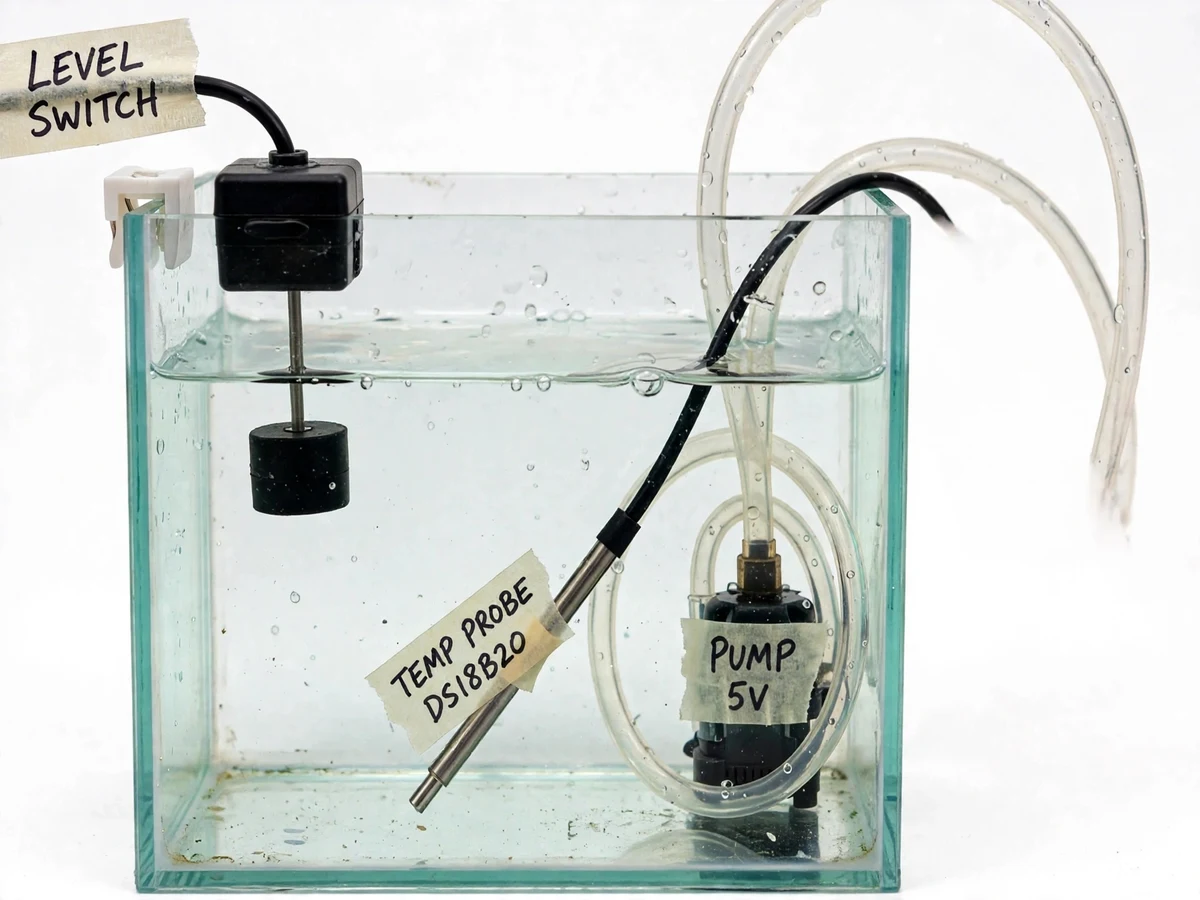
Level switch at the tank rim reporting whether the water level is low.
Follow the working sequence
How it works
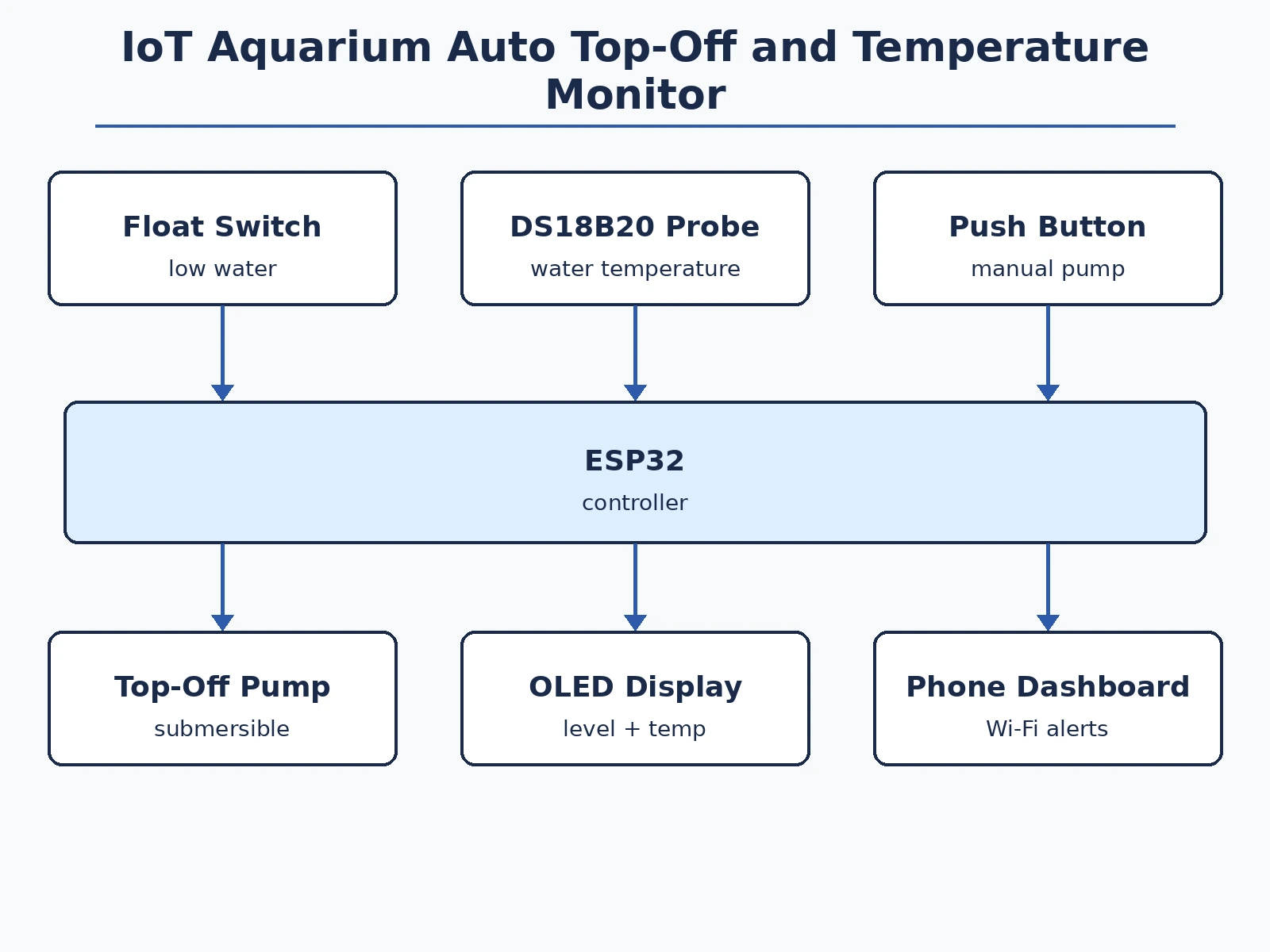
- The float switch at the tank rim reports the water level to the ESP32; the DS18B20 probe reports temperature on the same loop.
- When the level drops below the switch point, the ESP32 energizes the pump relay and the reservoir pump tops off the tank.
- The pump stops when the float switch rises again, or when the firmware safety timeout elapses — whichever comes first.
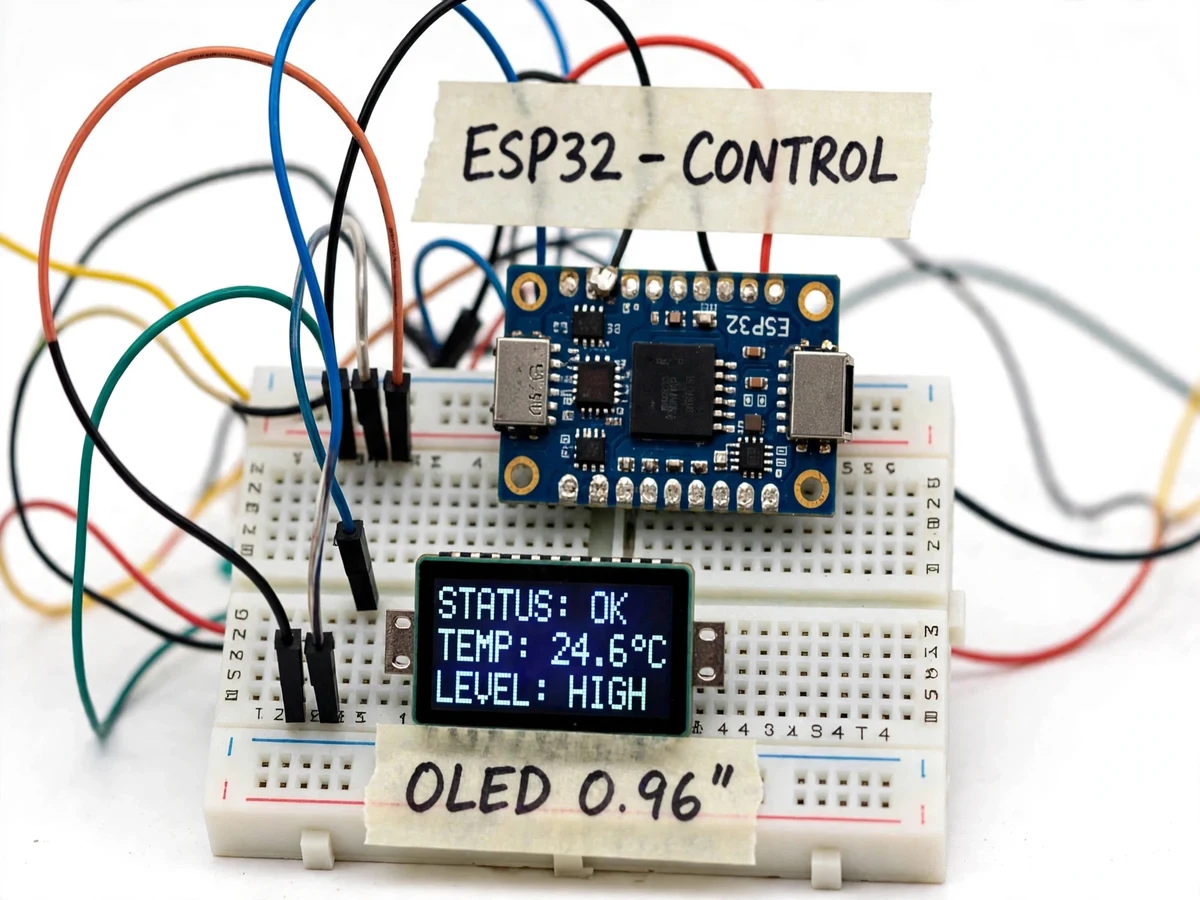
- The OLED continuously shows LEVEL OK / TOPPING UP and the live temperature reading.
- Over Wi-Fi the ESP32 publishes level state and temperature to the phone dashboard on a periodic heartbeat and immediately on alert conditions.
- If temperature crosses the configured high limit, the dashboard raises a high-temperature alert and the local buzzer sounds.
Tech stack:
- ESP32 development board
- Float switch level sensor
- Mini submersible pump with tubing
- DS18B20 waterproof temperature probe
- 0.96-inch OLED display
- Blynk-style IoT dashboard (phone alerts)
- Arduino IDE (C/C++ firmware)
| Parameter | Value |
|---|---|
| Controller | ESP32 development board |
| Level sensing | Float switch at rim (design) |
| Top-off pump | Mini submersible pump, relay-switched |
| Pump safety cap | Approximately 60 s per run (design) |
| Temperature | DS18B20, ±0.5 °C per datasheet |
| Display | 0.96-inch OLED |
| Alerts | Wi-Fi dashboard push + local buzzer |
| Power | 5 V regulated supply (design) |
Project features
- [Automatic top-off] A float switch detects low water and the ESP32 runs the submersible pump until the level is restored, with a firmware run-time cap as a safety limit.
- [Water temperature monitoring] A waterproof DS18B20 probe reports tank temperature with the sensor's ±0.5 °C datasheet accuracy.
- [OLED live display] Level state and temperature are shown continuously on a 0.96-inch OLED.
- [Wi-Fi telemetry and alerts] Level and temperature publish to a phone dashboard over Wi-Fi, with low-water and high-temperature alerts.
- [Pump safety timeout] Firmware caps each pump run (design approximately 60 seconds) so a stuck float switch cannot flood the setup.
- [Manual pump button] A push button runs the pump on demand for water changes and priming.
- [Dashboard setup guide] Step-by-step instructions connect the ESP32 to the notification dashboard on the student's own phone.
What is included
- Working model aquarium setup with float switch, pump, temperature probe, ESP32 and OLED
- Complete firmware with commented level-control and telemetry logic
- Phone dashboard setup guide with screenshots
- Wiring diagram and connection table
- Project report PDF (background, system design, firmware logic, IoT architecture)
- PPT presentation for final review
- Viva Q&A preparation document (float switches, DS18B20, relays, ESP32 Wi-Fi)
Limitations & prerequisites
- The prototype is a small demonstration tank, not a full-size aquarium — pump flow and level geometry are sized for the model.
- Temperature accuracy follows the DS18B20 datasheet (±0.5 °C); no independent calibration measurement is claimed.
- The pump safety timeout is a firmware design value verified functionally on the buyer's build, not a certified flood-prevention figure.
- Wi-Fi alerts depend on the buyer's own network and the third-party dashboard service; no uptime is guaranteed for external services.
- The system tops off evaporated water only — it does not filter, heat or dose the water.
- Battery operation is not included; the unit runs on a 5 V adapter.
Frequently Asked Questions
How does the auto top-off work?
A float switch at the rim detects when evaporation drops the level. The ESP32 then runs a small pump from a reservoir until the switch floats back up, with a firmware timeout as a backup stop.
What stops the pump from flooding the tank?
Two layers: the float switch itself cuts the pump at the target level, and a firmware run-time cap stops the pump after about 60 seconds even if the switch sticks.
How accurate is the temperature reading?
The DS18B20 is rated ±0.5 °C in its datasheet, which is the figure the project uses — no better accuracy is claimed.
How do the phone alerts work?
The ESP32 publishes level and temperature to a Blynk-style dashboard over the buyer's Wi-Fi, with alerts for low water and high temperature. The setup guide covers the whole configuration.
Can it control a heater or filter too?
Not as built — level top-off and temperature monitoring only. Heater relay control is listed as future scope.
Is this project suitable for a final-year project?
Yes — for Electronics and IoT & Embedded programs. It covers waterproof sensing, relay-switched actuation, safety timeouts and a full device-to-phone telemetry loop. Suitable for B.E./B.Tech final-year projects in Electronics and IoT & Embedded.
Components & software requirements
- ESP32 development board
- Float switch level sensor
- Mini submersible pump with tubing
- DS18B20 waterproof temperature probe
- 0.96-inch OLED display
- Blynk-style IoT dashboard (phone alerts)
- Arduino IDE (C/C++ firmware)
Delivery information
Built-to-order project. Delivery timeline is shared after order confirmation based on current queue.
Support terms
Complete documentation, setup guide, and viva preparation included. Support for setup and explanation provided.
Download free synopsis (PDF)
Enter your name and WhatsApp number — the synopsis PDF downloads immediately. We may send occasional project updates on WhatsApp; no spam.