
More project photos (2)
Watch it work
The problem
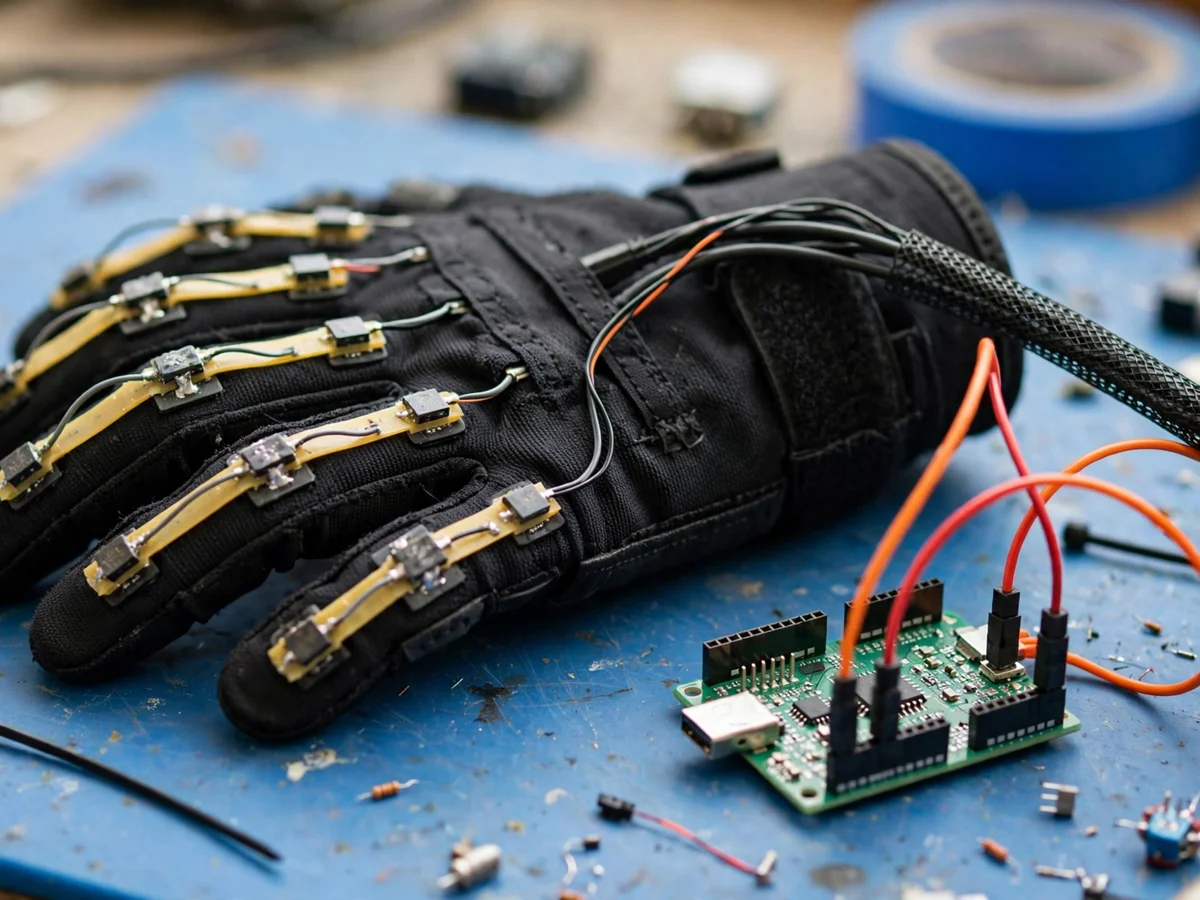
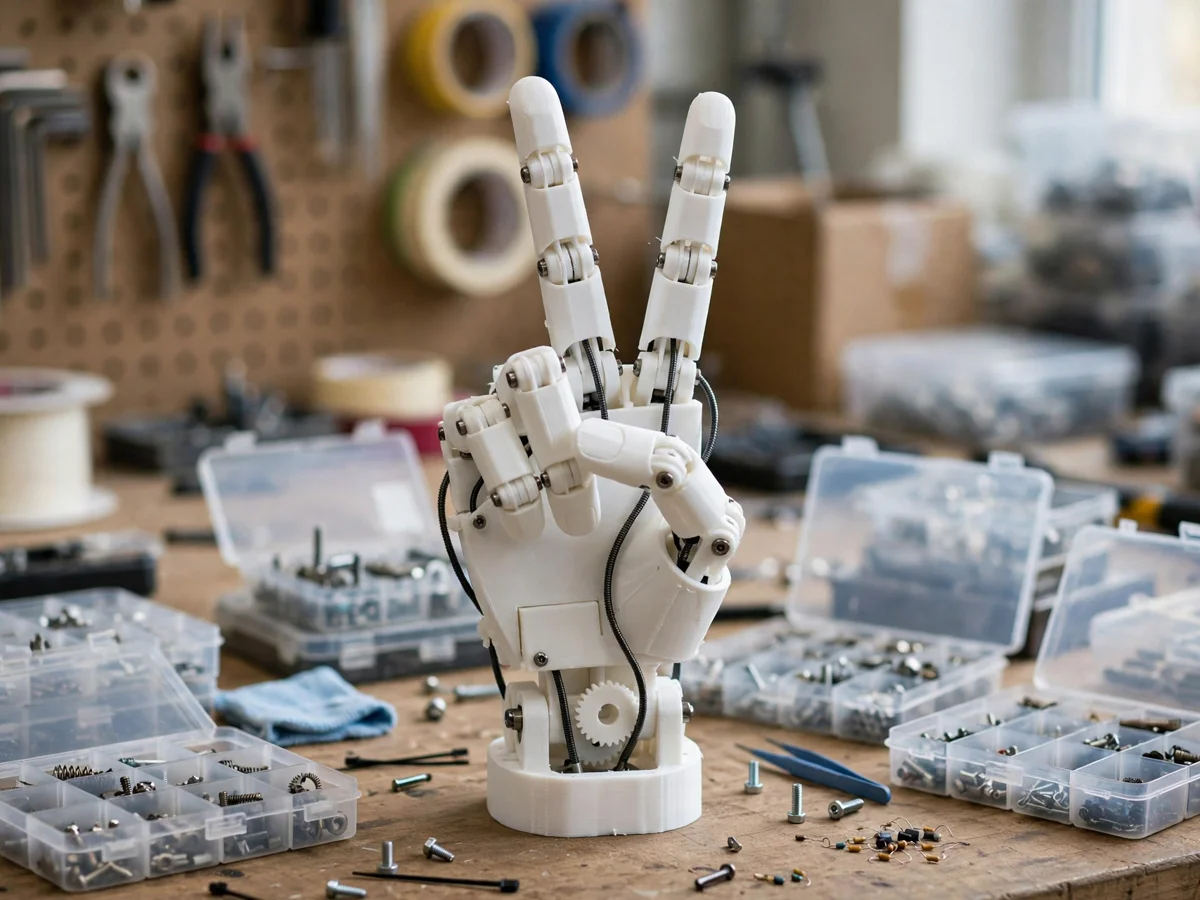
A robotic hand that copies a human hand is one of the clearest demonstrations of human-machine control: the operator moves, and the machine follows. This project builds that system at tabletop scale: flex sensors on a glove report how far each finger has curled, an Arduino converts those readings into servo angles, and five servo motors move the fingers of a 3D-printed robotic hand to match. The demonstration is deliberately simple to check — the operator opens their hand and the robot hand opens, a finger points and the robot finger points, two fingers rise and the robot hand shows the same gesture, and the hand closes and the robot hand closes into a fist.
How it works
- The operator wears the sensor glove, with one flex sensor along each finger reporting how far that finger has curled.
- The Arduino reads all five bend values repeatedly while the demonstration runs.
- Each bend value is mapped to a servo angle: a straight finger maps to an extended robot finger, and a curled finger maps to a closed robot finger.
- The five servo motors drive the linkage wires for the matching robot fingers, so each robot finger follows its glove finger.
- When the operator opens their hand, the bend values fall and the servos extend the robot fingers into an open hand.
- When the operator points, holds up two fingers, or closes their hand, the robot hand shows the same gesture, and the loop keeps tracking every further movement.
Tech stack:
- Arduino controller board · bend reading and servo control
- Flex sensors · finger bend measurement on the glove
- Sensor glove · five-finger bend input worn by the operator
- Servo motors · one per finger driving the robot hand
- 3D-printed robotic hand · five articulated fingers on a stand
- Linkage wiring · servo to finger motion transfer
- Gesture mapping logic · bend value to servo angle conversion
- 5 V controller supply · controller and sensor power
| Parameter | Value |
|---|---|
| Input | Sensor glove with one flex sensor per finger · five bend channels (design target) |
| Controller | Arduino board reading bend values and driving five servos (design target) |
| Output | 3D-printed five-finger robotic hand on a stand · servo-driven fingers (design target) |
| Gestures | Open hand · pointing finger · two fingers up · closed fist (design target) |
| Response | Continuous read-and-drive loop · robot hand tracks the operator's hand (design target) |
| Power | 5 V supply for controller and servos · bench demonstration power (design target) |
| Not included | Touch sensing · grip force feedback · prosthetic fitting · autonomous gestures · voice control (not in this build) |
Project features
- [Glove bend sensing] Flex sensors on each finger of the glove change as the finger curls, so the system reads the operator's hand shape directly instead of using buttons or a joystick. Implemented in the base prototype.
- [Arduino gesture mapping] The Arduino reads all five bend values repeatedly and maps each one to a servo angle, so every finger of the robot hand has its own matching channel. Implemented in the base prototype.
- [Five-servo finger drive] Five servo motors, one per finger, pull the linkage wires that curl and extend the robot hand's fingers. Implemented in the base prototype.
- [Real-time mirroring] The read-and-drive loop runs continuously, so the robot hand tracks the operator's hand while the demonstration runs rather than replaying a fixed sequence. Implemented in the base prototype.
- [Multiple distinct gestures] The demonstration covers more than one gesture: open hand, pointing finger, two fingers up, and closed fist, so the mapping is proven finger by finger, not on a single pose. Implemented in the base prototype.
- [Tabletop 3D-printed hand] The robot hand is a 3D-printed five-finger model on a stand, sized for a bench demonstration and a viva table. Implemented in the base prototype.
What is included
- Working prototype: Arduino board, sensor glove with five flex sensors, five servo motors, 3D-printed five-finger robotic hand on a stand, and linkage wiring, assembled and tested
- Firmware for bend-value reading, gesture mapping, and five-servo drive, with a calibration step for open and curled finger extremes
- Demonstration procedure, including performing the gesture sequence (open hand, pointing finger, two fingers up, closed fist) and showing the robot hand mirroring each one
- Circuit and wiring documentation with labelled connections for every sensor and servo
- Component list with the exact parts used in the build
- Project report PDF (background, flex sensing, gesture mapping, methodology, limitations)
- PPT presentation for final review
- Viva Q&A preparation document (flex sensor behaviour, mapping calibration, servo limits, gesture tracking)
Limitations & prerequisites
- The tabletop hand has no sense of touch or grip force: it cannot judge how hard it is holding anything, and the demonstration must not be presented as a gripping or handling device.
- Sensor calibration drifts as the glove flexes repeatedly, so gestures can look less exact late in a long demonstration, and the glove should be recalibrated before a viva run.
- The hand is a bench demonstration model: it is not a medical prosthetic, it carries no medical or safety certification, and it must not be fitted to a person or presented as an assistive device.
- The hand only copies the operator's hand: it does not recognise gestures on its own, decide what to do, or move without the glove, and the report must state that boundary plainly.
- Servo travel and linkage slack limit how tightly the fingers can curl and how fast they can move, so very fast or very subtle finger movements may not be mirrored exactly.
- The prototype is a tabletop demonstration: it is not a certified product, and it must not be fitted as the sole control for real machinery or used where a wrong movement could cause injury or damage.
Frequently Asked Questions
How does the robot hand know what gesture to copy?
Each finger of the glove carries a flex sensor whose value changes as the finger curls. The Arduino reads all five values, maps each one to a servo angle, and drives the matching robot finger, so the robot hand's shape follows the operator's hand shape.
Who is this project suitable for?
Electronics, Electrical, and IoT students, because it combines sensor interfacing, signal mapping, and servo driving into one demonstration with a result that is easy to verify in a viva: a robot hand that copies your gestures finger by finger.
Can the hand grip objects or feel what it touches?
No. This build has no touch sensors and no grip-force feedback, so it cannot judge how hard it holds anything. It is a gesture-mirroring demonstration, not a handling or prosthetic device.
Is this the same as a gesture-controlled robotic arm?
No. A robotic arm moves a gripper through space; this project is a five-finger hand that mirrors finger gestures. The control problem here is mapping five finger bends to five fingers, not moving an arm to a position.
Does the hand work without the glove?
Not in this build. The glove is the only input: without it there are no bend readings for the Arduino to map, so the hand holds its last position. Autonomous or camera-based gesture control would be a scope change, not a free addition.
Components & software requirements
- Arduino controller board · bend reading and servo control
- Flex sensors · finger bend measurement on the glove
- Sensor glove · five-finger bend input worn by the operator
- Servo motors · one per finger driving the robot hand
- 3D-printed robotic hand · five articulated fingers on a stand
- Linkage wiring · servo to finger motion transfer
- Gesture mapping logic · bend value to servo angle conversion
- 5 V controller supply · controller and sensor power
Delivery information
Built-to-order project. Delivery timeline is shared after order confirmation based on current queue.
Support terms
Complete documentation, setup guide, and viva preparation included. Support for setup and explanation provided.
Download free synopsis (PDF)
Enter your name and WhatsApp number — the synopsis PDF downloads immediately. We may send occasional project updates on WhatsApp; no spam.