
More project photos (2)
The problem
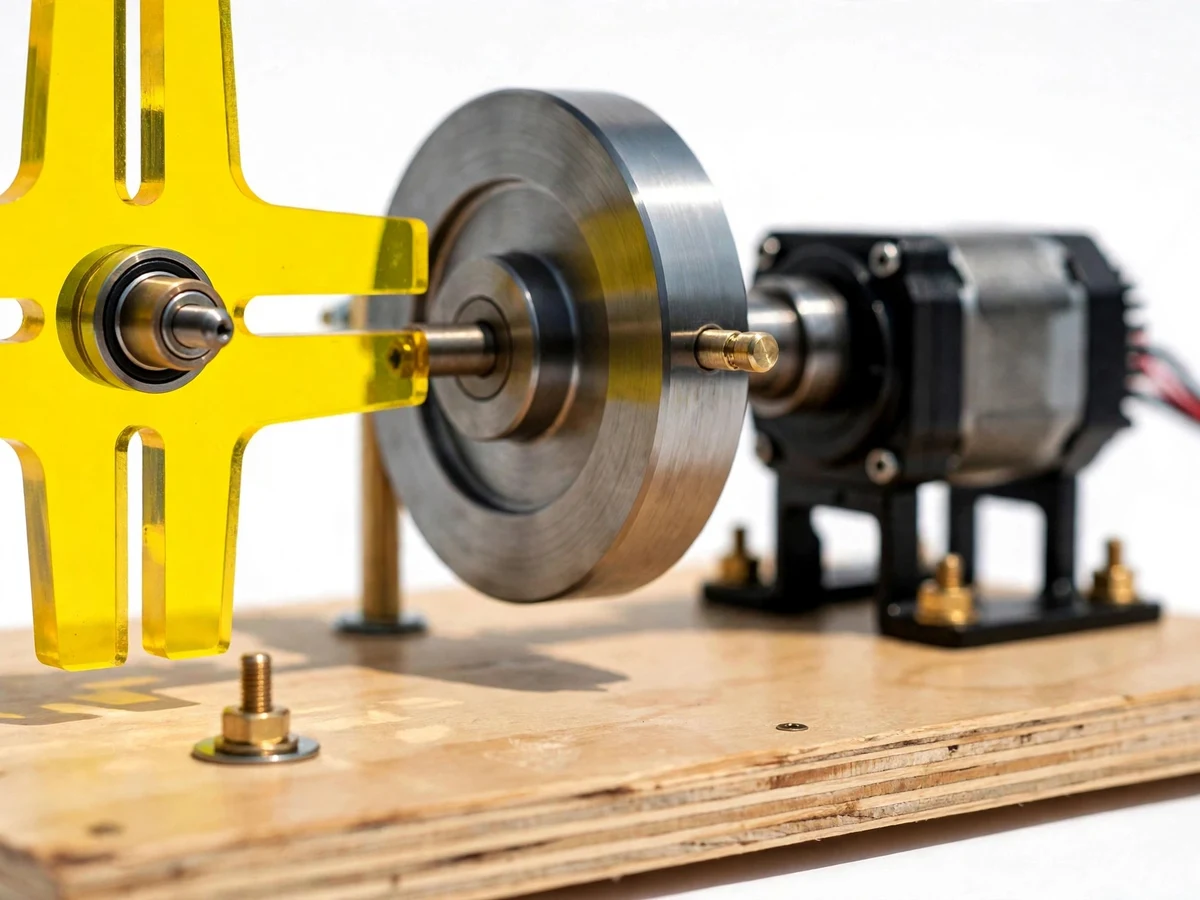
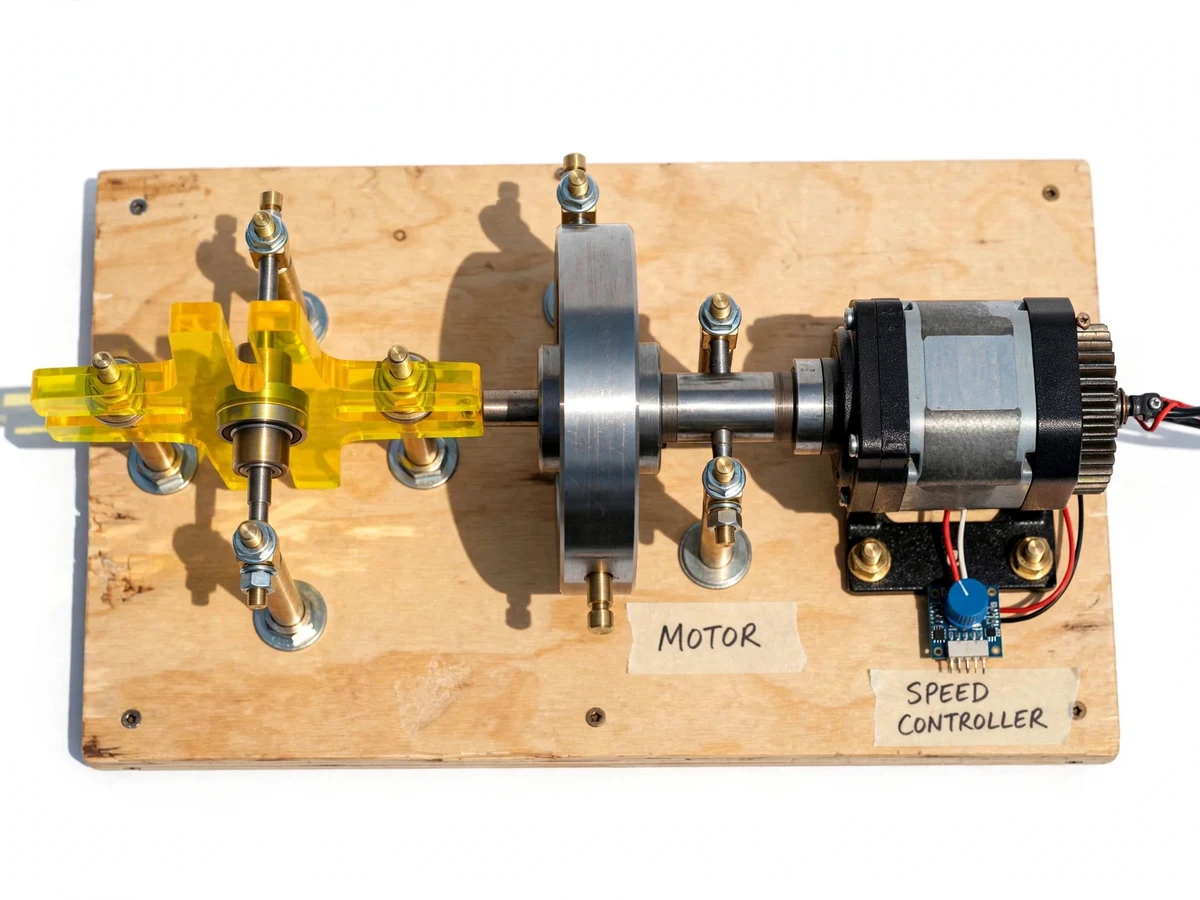
So much automation needs start-stop motion: an indexing table that pauses at each station, a film projector that holds each frame, a packaging machine that dwells while it seals. The Geneva mechanism is the classic answer — a drive wheel with a pin turns continuously, and each revolution kicks a slotted star wheel forward by exactly one step, with a clean dwell in between. It is pure geometry doing the work of a servo, and it appears in every theory-of-machines syllabus. But the engagement — the pin sliding into the slot, the locking arc holding the wheel during dwell — is hard to grasp from a textbook diagram. This rig makes it physical: a four-slot acrylic star wheel, a drive wheel with a single pin, a geared motor with speed control, all on a plywood base. The student watches the pin enter the slot, times the motion-vs-dwell phases, and connects the geometry to the indexing machines that use it.
How it works
- The geared DC motor turns the drive wheel continuously at the set speed.
- As the drive wheel rotates, its pin approaches a slot of the stationary star wheel and slides in.
- The pin pushes the slot wall, rotating the star wheel; with four slots, one full drive revolution advances the star wheel exactly one quarter-turn.
- The pin exits the slot; the drive wheel's locking arc then engages the star wheel's concave edge, holding it fixed — the dwell.
- The cycle repeats: each drive revolution produces one indexed step followed by a dwell.
- The student times several cycles with a stopwatch to measure the motion-vs-dwell ratio and compares it with the geometric expectation.
- Varying the speed controller changes the indexing rate without changing the motion-dwell geometry — a key insight the student verifies.
Tech stack:
- 4-slot Geneva star wheel (laser-cut/ shaped acrylic)
- Drive wheel with steel drive pin and locking arc
- Geared DC motor with speed controller
- Plywood base with standoffs and bearings
- Steel shafts and fasteners
- Stopwatch for timing measurements
- 12 V DC power supply
| Parameter | Value |
|---|---|
| Mechanism | External Geneva, 4 slots |
| Indexing | 90 degrees of star-wheel rotation per drive revolution |
| Drive | Geared DC motor, continuous rotation |
| Speed | Adjustable via controller (design); student measures RPM |
| Star wheel | Acrylic, 4 slots with concave locking edges |
| Dwell | True dwell between steps via locking arc |
| Measured values | Motion-dwell timing and indexing rate measured by student |
Project features
- [Working 4-slot Geneva drive] Drive pin engages the star wheel slots: one quarter-turn per drive revolution with a true dwell between steps.
- [Visible pin-and-slot engagement] The acrylic star wheel and open layout let the student watch the pin enter, drive and exit the slot.
- [Geared motor drive] A geared DC motor provides the steady input rotation; a speed controller varies the indexing rate.
- [Locking arc dwell] The drive wheel's locking arc holds the star wheel stationary during dwell — the mechanism's signature behavior.
- [Motion-dwell measurement] The student times the moving vs dwell phases and compares with the geometric design ratio.
- [Adjustable speed] The controller varies drive RPM so the student can study indexing at slow (visible) and faster rates.
- [Indexing application study] The report connects the rig to real indexing applications: rotary tables, assembly machines, film transport.
What is included
- Working Geneva mechanism rig (star wheel, drive wheel, motor, controller, base)
- Fabrication and assembly documentation with part drawings
- Timing measurement procedure and data sheet template
- Project report PDF (Geneva theory, geometry, methodology, measurements)
- PPT presentation for final review
- Viva Q&A preparation document (intermittent motion, dwell, locking, indexing applications)
- Setup and demonstration guide
Limitations & prerequisites
- A teaching model in acrylic and plywood — not rated for industrial loads or speeds; the pin and slots wear if run hard.
- Timing measurements are manual (stopwatch) with student error; the procedure uses multiple cycles to average.
- Four slots only — other slot counts change the motion-dwell ratio and are a possible extension, not part of the base build.
- The motor speed controller is open-loop; indexing rate is set, not servo-controlled.
- Backlash in the hobby-grade gearing adds small timing scatter, which the student observes and reports.
Frequently Asked Questions
What does the Geneva mechanism do?
It converts continuous rotation into intermittent indexed motion. Each full turn of the drive wheel advances the 4-slot star wheel exactly one quarter-turn, with a dwell (standstill) between steps.
What is the locking arc for?
During the dwell, the drive wheel's raised locking arc sits against the star wheel's concave edge and holds it still — so the wheel can't drift between steps. It is the part that makes the dwell a true standstill.
Where is this used in real machines?
Rotary indexing tables, assembly machines, film projectors and packaging equipment — anywhere a process needs precise start-stop positioning without a servo.
How does the student measure the motion-dwell ratio?
With a stopwatch over several cycles: time the star wheel's moving phase vs its dwell phase, then compare with the ratio the slot geometry predicts.
What are the main limitations?
Teaching-grade materials and loads, manual timing, four slots only, open-loop speed control, and some gear backlash.
Is this project suitable for a final-year project?
Yes — for Mechanical programs. It demonstrates intermittent-motion mechanisms, kinematic geometry and experimental timing, all strong viva material. Suitable for B.E./B.Tech final-year projects in Mechanical engineering.
Components & software requirements
- 4-slot Geneva star wheel (laser-cut/ shaped acrylic)
- Drive wheel with steel drive pin and locking arc
- Geared DC motor with speed controller
- Plywood base with standoffs and bearings
- Steel shafts and fasteners
- Stopwatch for timing measurements
- 12 V DC power supply
Delivery information
Built-to-order project. Delivery timeline is shared after order confirmation based on current queue.
Support terms
Complete documentation, setup guide, and viva preparation included. Support for setup and explanation provided.