
More project photos (2)
The problem
The GATE Exam Preparation Tracker is an Android app (Kotlin, Jetpack Compose, Room) built for GATE aspirants who lose track of where their preparation actually stands. Most aspirants prepare from scattered notes, coaching PDFs and test-series portals, then discover their weak subjects only weeks before the exam — when little time remains to fix them. This project closes that loop: a syllabus tracker records every completed topic across 11 subjects and 65 topics (design target), every mock test is logged with score, accuracy and time-per-question, and per-subject analytics over the last 10 mocks (design target) surface exactly which subjects drag the total down. A spaced-repetition revision queue ranks completed topics by forgetting-curve gap, so revision always targets what is closest to being forgotten. Streaks and daily study targets keep the routine consistent, all offline-first in Room — no account, no cloud, no subscription. The result is one honest dashboard: what is done, what is weak, and what to revise today.
Logs completed topics and mock-test attempts.
Follow the working sequence
How it works
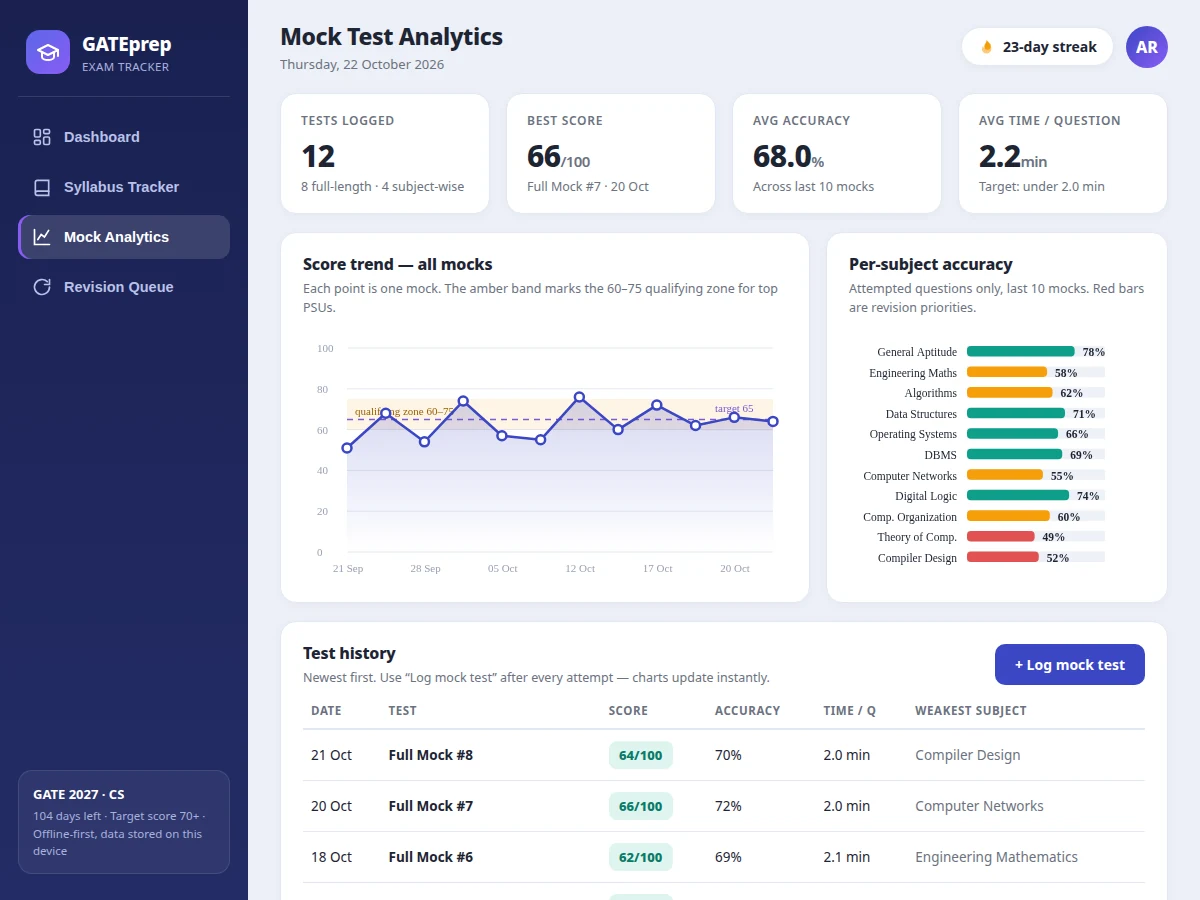
Preparation flows through the app in three stages: log, analyze, schedule. The aspirant logs two kinds of events — completed syllabus topics (tap a checkbox, timestamped) and mock-test attempts (test name, score out of total marks, accuracy percentage, minutes per question, weakest subject). The analyze stage aggregates the last 10 logged mocks (design target) into per-subject accuracy over attempted questions only, plots every score on a trend chart against a 65-mark target line, and tracks average time-per-question against a 2-minute goal. The schedule stage maintains the spaced-repetition queue: each completed topic has a last-revised date and a memory interval; the queue score is elapsed days minus interval, so the most overdue topic — the one closest to being forgotten — always ranks first. Marking a topic revised resets its last-revised date and doubles its interval, pushing it down the queue. The dashboard compresses the whole state into four numbers: day streak, target hours, syllabus percentage and average mock score.
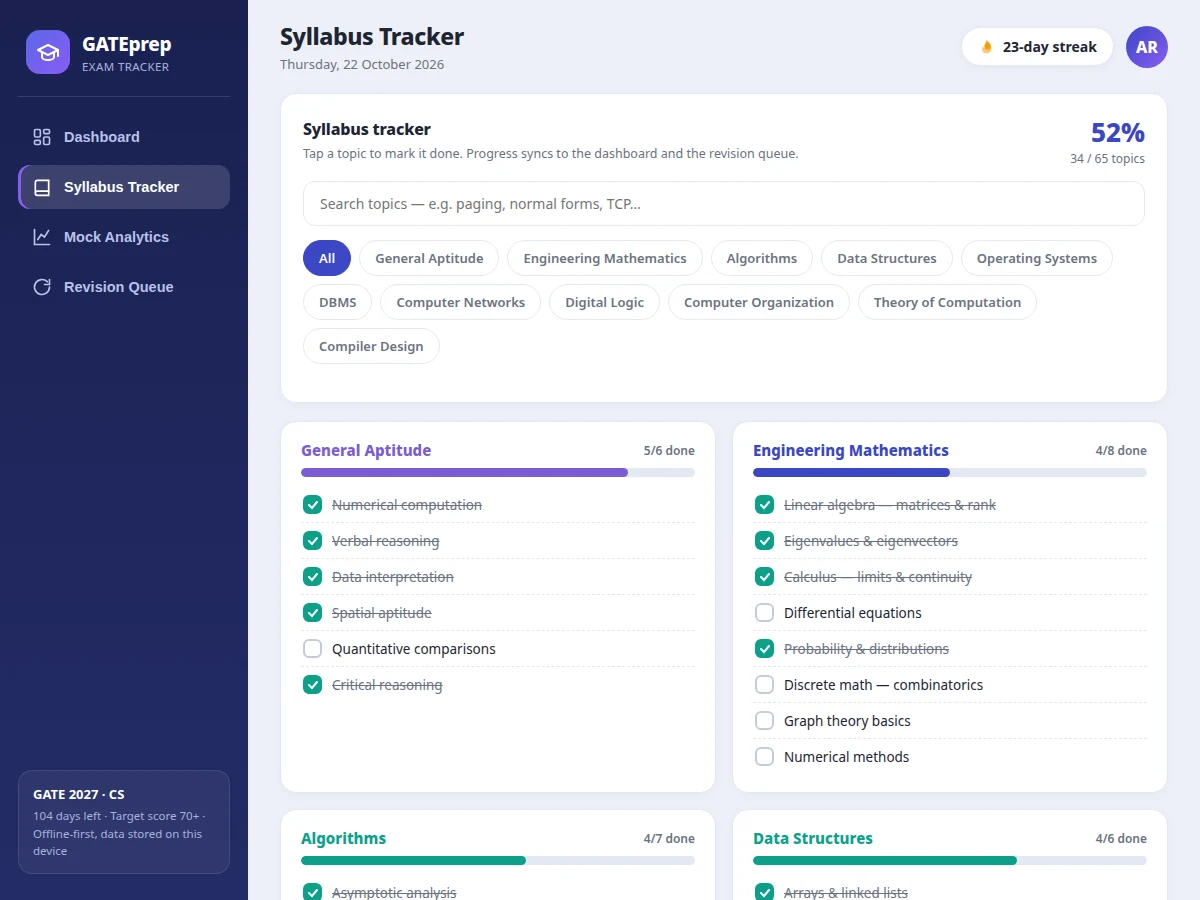
- The aspirant checks off completed topics in the syllabus tracker; each check is timestamped and stored in Room.
- After every mock test, the aspirant logs the test name, score, accuracy, time-per-question and weakest subject through the log-mock form.
- The analytics engine aggregates the last 10 logged mocks (design target) into per-subject accuracy over attempted questions.
- The score-trend chart plots every mock against the 65-mark target line with the qualifying-zone band.
- The revision queue scores each completed topic as (days since last revision − current interval) and ranks the largest gaps first.
- Marking a topic revised resets its last-revised date and doubles its interval (SM-2 style), re-ordering the queue.
- The dashboard combines streak, today's target hours, syllabus percentage and average mock score into one screen.
Tech stack:
- Kotlin
- Jetpack Compose · Material 3
- Room (SQLite) on-device database
- MPAndroidChart (score & accuracy charts)
- WorkManager (revision reminders)
- Kotlin Coroutines · Flow
- Navigation Compose
- Git
| Parameter | Value |
|---|---|
| Platform | Android 8.0 (API 26) and above (design target) |
| Language & UI | Kotlin · Jetpack Compose with Material 3 |
| Local database | Room (SQLite), on-device only |
| Tracked subjects | 11 (design target: General Aptitude + 10 GATE CS subjects) |
| Tracked topics | 65 (design target) |
| Analytics window | Last 10 logged mocks (design target) |
| Target line | 65 marks on the score-trend chart (design target) |
| Time-per-question goal | Under 2.0 minutes (design target) |
| Streak rule | 1 or more logged study sessions per calendar day (design target) |
| Revision scoring | Overdue gap = elapsed days since last revision − current interval (design target) |
| Interval update | Doubles after each successful revision, SM-2 style, capped at 60 days (design target) |
| Demo | Single-file HTML stand-in of the Android UI; runs offline after download |
Project features
The app is organized around four capabilities that work as one loop. The syllabus tracker holds 11 subjects and 65 topics (design target) — General Aptitude, Engineering Mathematics and ten core GATE CS subjects — with tap-to-complete checkboxes, per-subject progress bars and topic search. The mock-test logger records every attempt with score, accuracy, time-per-question and weakest subject, and the analytics engine turns the last 10 mocks (design target) into a score-trend chart with a 65-mark target line plus per-subject accuracy bars that flag revision priorities in red. The spaced-repetition queue is the most distinctive mechanism: each completed topic carries a memory interval that doubles after every successful revision (SM-2 style), and the queue ranks topics by the gap between days since last revision and the current interval — the largest overdue gap sits on top. Study streaks and a daily hours target wrap the loop in routine.
- [Syllabus tracker — 11 subjects, 65 topics] Tap-to-complete topic checklists with per-subject progress bars, topic search and subject filters. Progress syncs live to the dashboard and feeds the revision queue. (Implemented)
- [Mock-test logging] Log every attempt with test name, score out of total marks, accuracy percentage, minutes per question and weakest subject. New entries update all charts instantly. (Implemented)
- [Score-trend analytics] A trend chart plots every logged mock against a 65-mark target line, with a qualifying-zone band, so score trajectory is visible at a glance. (Implemented)
- [Per-subject accuracy bars] Accuracy over attempted questions only, computed across the last 10 mocks (design target); the weakest subjects render in red as revision priorities. (Implemented)
- [Spaced-repetition revision queue] Completed topics are ranked by forgetting-curve gap (elapsed days since last revision minus current memory interval); marking a topic revised doubles its interval and re-orders the queue. (Implemented)
- [Study streaks & daily targets] A day streak counts consecutive days with at least one logged study session, and a daily hours target with a progress ring keeps the routine measurable. (Implemented)
- [Offline-first Room storage] Syllabus state, mock log and revision intervals persist in an on-device Room database — every screen works with no network. (Implemented)
- [PDF progress report] Optional: export a one-page summary (syllabus %, score trend, weakest subjects) for mentors or coaching review. (Optional customization, quoted separately)
What is included
- Complete Android source code (Kotlin, Jetpack Compose, Room)
- Room database schema with the seeded 11-subject / 65-topic GATE CS syllabus
- Analytics module (score trends, per-subject accuracy, time-per-question)
- Spaced-repetition revision scheduler with forgetting-curve queue logic
- Working interactive demo of the app UI
- Setup and build instructions
- Project report PDF (background, architecture, methodology, limitations)
- PPT presentation for final review
- Viva Q&A preparation document
Limitations & prerequisites
- The seeded syllabus covers GATE CS plus General Aptitude; other papers (EE, ME, CE) need their own topic lists — offered as optional customization.
- Revision intervals are a study-planning heuristic, not a validated model of memory; the report states this explicitly.
- Analytics need several logged mocks before trends are meaningful — the 10-mock window is a design target, not a guarantee.
- No question bank or mock papers ship with the app; it tracks and analyzes the aspirant's own attempts.
- Streaks count logged study sessions, not verified study hours — honest logging is on the user.
- Offline-first by design: no cloud sync or multi-device support in the base build.
- Chart rendering for very large mock histories (100+ entries) was not profiled; the design target is a single aspirant's preparation season.
Frequently Asked Questions
Is this project suitable for a final-year project?
Yes — for Computer Science, IT and Electronics & Communication programs. It demonstrates real Android development in Kotlin with Jetpack Compose, on-device persistence using Room, data visualization of mock-test analytics, and a scheduling heuristic for spaced repetition, all supported by a complete report, PPT and viva Q&A kit. The topic is relatable to every examiner — everyone understands exam preparation — which makes the viva conversation natural, and the optional extensions (other GATE papers, cloud sync, question-bank import) give easy discussion points.
Does the app use AI or machine learning?
No — and that is a deliberate, honest design choice. Every number the app shows is deterministic statistics: averages, per-subject accuracy over attempted questions, and trend lines, while the revision queue uses a forgetting-curve heuristic with SM-2-style interval doubling rather than any trained model. There is no dataset, no training phase and no accuracy claim anywhere in the project. This keeps the viva clean: there is no model to defend, only algorithms and data structures the student fully understands — Room entities, aggregation queries and a priority queue.
Does it work without the internet?
Yes. The app is offline-first by design: the syllabus, topic states, mock-test log and revision intervals all live in a Room database on the device, and every screen — dashboard, analytics charts and revision queue — renders from local data with no network call. This also means no account, no login and no cloud costs. Cloud sync across devices is available as optional customization, not part of the base build.
Can it track GATE papers other than Computer Science?
The base build ships with the GATE CS topic list — General Aptitude, Engineering Mathematics and ten core CS subjects, 65 topics in total (design target). Papers like EE, ME or CE need their own subject and topic lists, which is offered as optional customization. The tracking engine itself is paper-agnostic: subjects and topics are rows in the Room database, so swapping the seed data is a data change rather than a code change — a solid viva talking point about the schema design.
How is the revision queue different from a simple to-do list?
A to-do list shows tasks in the order they were written; this queue re-orders itself every day by forgetting-curve gap. Each completed topic carries a last-revised date and a memory interval that doubles after every successful revision, and the queue ranks topics by elapsed days minus interval — so the topic the aspirant is closest to forgetting always sits on top. This is the project's quotable mechanism: revision is scheduled by predicted forgetting, not by recency. The demo's Revision Queue screen shows the ordering live, with overdue, due and on-track tags.
What exactly do I receive with this project?
The complete Android source code (Kotlin, Jetpack Compose, Room), the database schema with the seeded 11-subject topic list, the analytics and revision-scheduler modules, a working interactive demo of the app UI, setup instructions, the project report PDF, a review PPT and a viva Q&A document. The project is built-to-order, so the report documents the final shipped build. Optional additions — cloud sync, other GATE papers, PDF progress reports — can be quoted separately.
Components & software requirements
- Kotlin
- Jetpack Compose · Material 3
- Room (SQLite) on-device database
- MPAndroidChart (score & accuracy charts)
- WorkManager (revision reminders)
- Kotlin Coroutines · Flow
- Navigation Compose
- Git
Delivery information
Built-to-order project. Delivery timeline is shared after order confirmation based on current queue.
Support terms
Complete documentation, setup guide, and viva preparation included. Support for setup and explanation provided.
Download free synopsis (PDF)
Enter your name and WhatsApp number — the synopsis PDF downloads immediately. We may send occasional project updates on WhatsApp; no spam.