
More project photos (2)
The problem
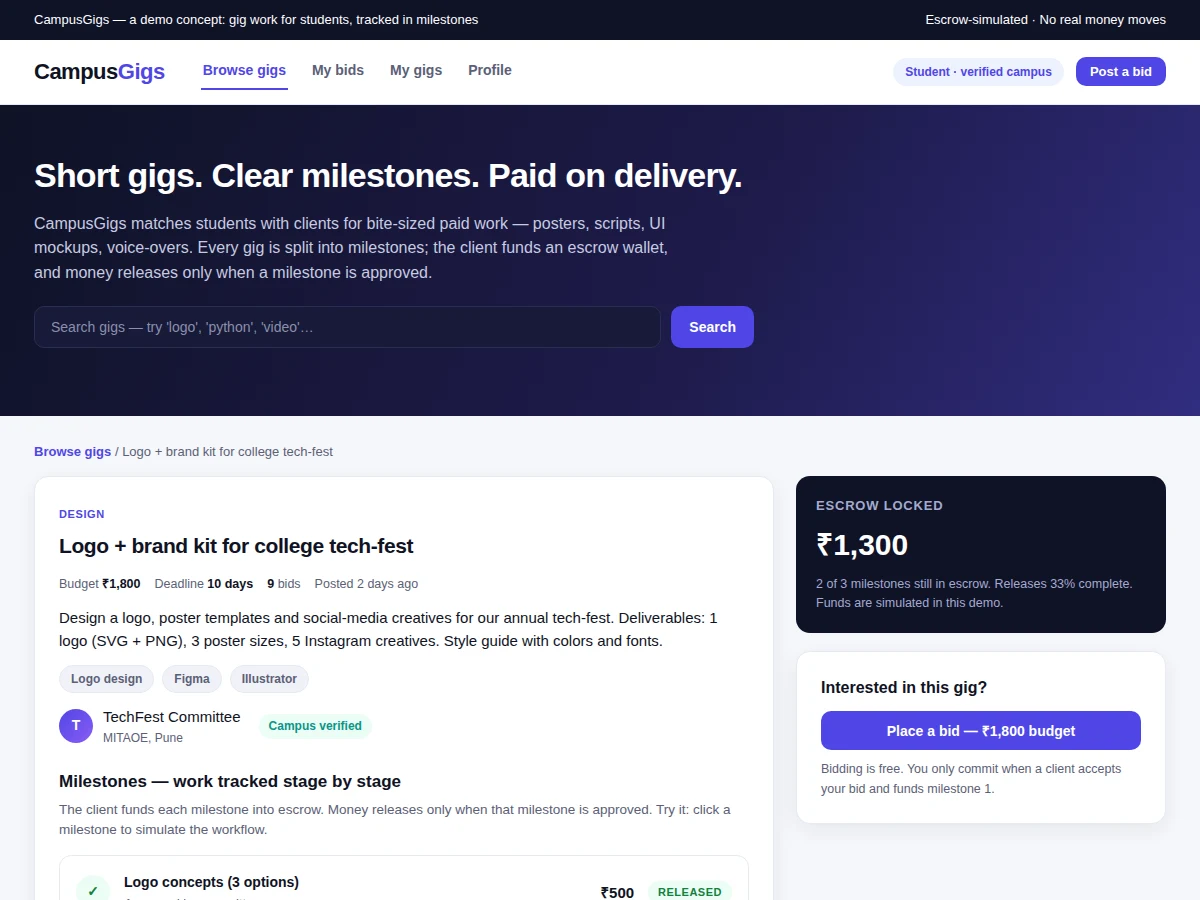
College students routinely pick up small paid work — fest posters, data-cleaning scripts, reel edits, UI mockups — through WhatsApp groups and word of mouth. These informal deals have no structure: scope is vague, payment depends on trust, and there is no record of who delivered what. General freelance platforms exist but are built for professionals, with fees and competition that shut students out. This project builds a campus-first gig marketplace that replaces that chaos with short gigs broken into milestones. A client posts a gig, students bid with price and timeline, and once a bid is accepted each milestone is funded into an escrow-style wallet; money releases only when the client approves the delivered milestone. Per-gig ratings build a public track record per student, and dispute flagging freezes a contested milestone amount. It is deliberately not a job board — there are no full-time roles or employer dashboards here, only short gigs tracked milestone by milestone.
Posts a gig with budget, deadline, skills and a milestone breakdown, and funds milestone amounts.
Follow the working sequence
How it works
- A client registers, posts a gig with budget, deadline, skills and a milestone breakdown, and funds milestone 1 into the escrow-style wallet.
- Students browse or search gigs and place bids with their price, timeline and a short pitch; the client shortlists and accepts one bid.
- The accepted gig becomes an active contract; the student works on milestone 1 and marks it submitted with the deliverable attached.
- The client reviews the deliverable and either approves it — releasing the milestone amount from escrow — or requests changes, keeping the amount locked.
- Both sides repeat steps 3–4 for each milestone until the gig completes; either side can flag a dispute at any milestone to freeze its amount.
- On completion, client and student rate each other per gig; ratings, reviews and completion stats update on the public profile.
Tech stack:
- Node.js · Express.js (REST API)
- MySQL (relational database)
- HTML5 · CSS3 · JavaScript ES6+ (frontend)
- JWT (session authentication)
- Multer (deliverable file uploads)
- Nodemailer (email notifications)
- Chart.js (earnings & stats dashboards)
- Razorpay (optional: live payment gateway, not in base build)
| Parameter | Value |
|---|---|
| Platform | Responsive web app (desktop + mobile browser) |
| User roles | 3 (student freelancer, client, campus moderator) |
| Milestones per gig | Configurable; typically 2–4 (design) |
| Database | MySQL with approximately 12 tables (expected) |
| Authentication | JWT-based login with role-based access |
| Escrow flow | Simulated wallet in base build; real gateway optional |
| File uploads | Deliverables up to approximately 25 MB per file (configurable) |
| Deployment | Shared hosting or VPS with Node.js + MySQL (expected) |
Project features
- [Gig posting & bidding] Clients post gigs with budget, deadline, skills and deliverables; students place bids with their own price, timeline and pitch. Bid status (pending, shortlisted, accepted) is visible to both sides.
- [Milestone-based work tracking] Every gig is divided into milestones with individual amounts. Each milestone moves through funded → in progress → submitted → approved/released, so both sides always know exactly which stage the work is at.
- [Simulated escrow payment flow] The client funds milestone amounts into an escrow-style wallet and money releases only on client approval. Real money movement is simulated in the built version; connecting a live payment gateway is an optional customization.
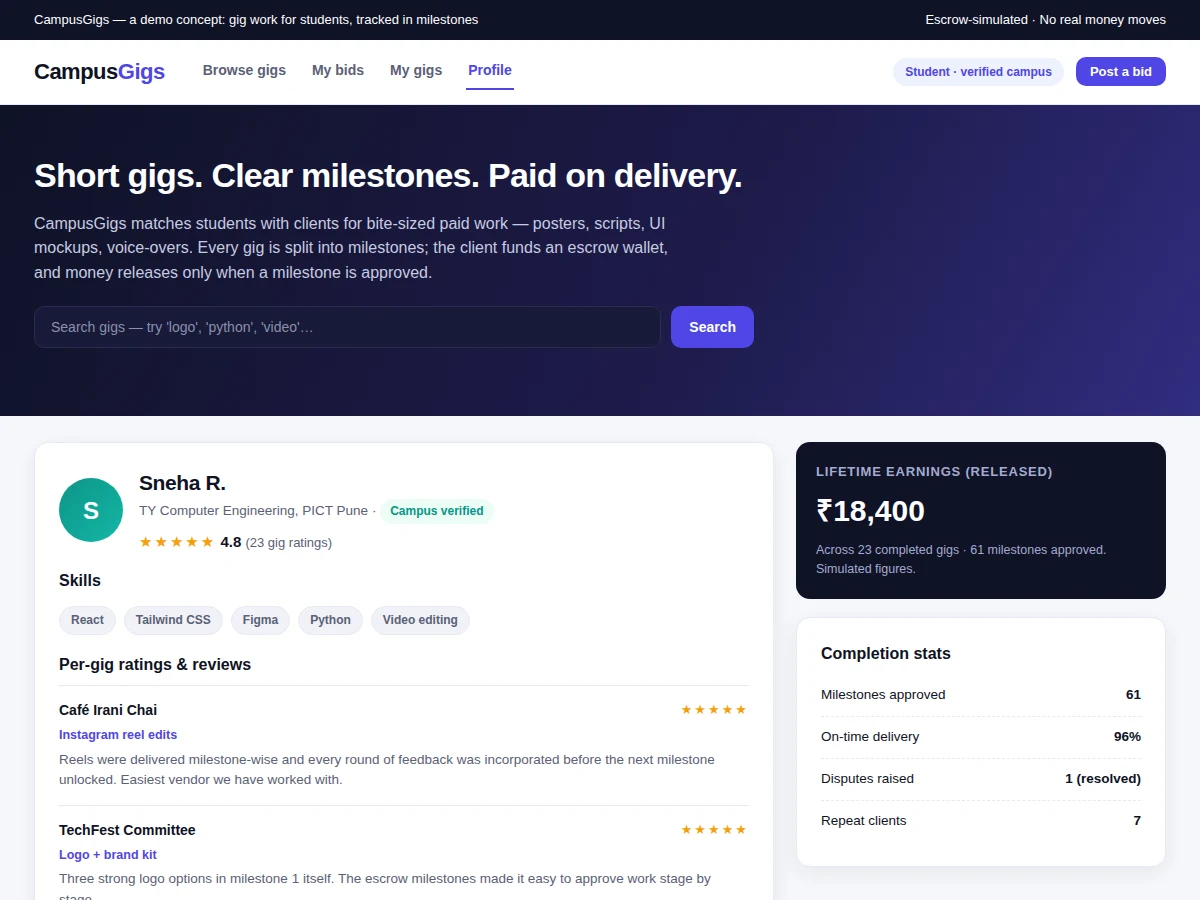
- [Per-gig ratings & reviews] After each gig, both sides leave a star rating and a written review attached to that specific gig, building a verifiable per-project track record on the student's profile.
- [Dispute flagging] Either side can flag a milestone; the contested amount stays frozen in the escrow wallet until both sides agree or a campus moderator resolves it.
- [Campus-verified profiles] Student profiles carry college, branch and year plus a campus-verification badge, skills, completion stats (milestones approved, on-time rate) and lifetime released earnings.
- [Gig search & category filters] Full-text search plus filters for category (Design, Web dev, Programming, Writing, Media), budget range and deadline, so students find relevant gigs quickly.
What is included
- Complete web app source code (frontend + Node.js/Express backend)
- MySQL database schema with seed data (sample gigs, bids, milestones, reviews)
- Setup and deployment instructions (local + shared hosting)
- Project report PDF (background, system design, ER diagram, milestone/escrow workflow, testing)
- PPT presentation for final review
- Viva Q&A preparation document (marketplace design, escrow logic, JWT auth, database design)
- Demo guidance: scripted walkthrough of bid → milestone → release → rating flow
Limitations & prerequisites
- The base build simulates the escrow wallet; no real money moves until a live payment gateway is integrated (optional customization).
- Identity verification is campus-badge based (college email/domain check), not a government ID KYC flow.
- Dispute resolution in the base build is manual moderation; there is no automated arbitration.
- The platform is designed for short gigs (days to weeks); it is not built for long-term contracts or hourly billing.
- Real-time chat between client and student is a simple message thread per gig, not a full chat system.
- Email notifications need valid SMTP credentials, which are not included.
Frequently Asked Questions
How is this different from a job board?
A job board lists full-time roles with employer dashboards and application tracking. This is a gig marketplace: short freelance tasks between students and clients, tracked milestone by milestone, with per-gig payments released on approval and per-gig ratings — no full-time hiring anywhere in the system.
Is the escrow payment real money?
Not in the base build. The escrow wallet is a simulated ledger that demonstrates the fund → approve → release flow honestly. A live Razorpay/Stripe integration is available as an optional customization for buyers who need real payments.
What roles does the system support?
Three: student freelancers (bid, deliver milestones), clients (post gigs, fund escrow, approve work) and a campus moderator (resolve disputes, verify campus badges).
Can it be customized?
Yes — realistic options include a live payment gateway, a mobile app, real-time chat upgrades, an admin analytics dashboard, or college-specific branding and verification rules.
Does it work without internet?
No — it is a web app with a server database, so both students and clients need internet access to browse, bid and track milestones.
Is this project suitable for a final-year project?
Yes — for Computer Science, IT and Web Development programs. It demonstrates REST API design, relational database modeling, authentication, payment-flow logic, role-based access and a complete multi-role web application.
Components & software requirements
- Node.js · Express.js (REST API)
- MySQL (relational database)
- HTML5 · CSS3 · JavaScript ES6+ (frontend)
- JWT (session authentication)
- Multer (deliverable file uploads)
- Nodemailer (email notifications)
- Chart.js (earnings & stats dashboards)
- Razorpay (optional: live payment gateway, not in base build)
Delivery information
Built-to-order project. Delivery timeline is shared after order confirmation based on current queue.
Support terms
Complete documentation, setup guide, and viva preparation included. Support for setup and explanation provided.
Download free synopsis (PDF)
Enter your name and email — the synopsis PDF downloads immediately. We may send occasional project updates; no spam, unsubscribe anytime.