
More project photos (2)

The problem
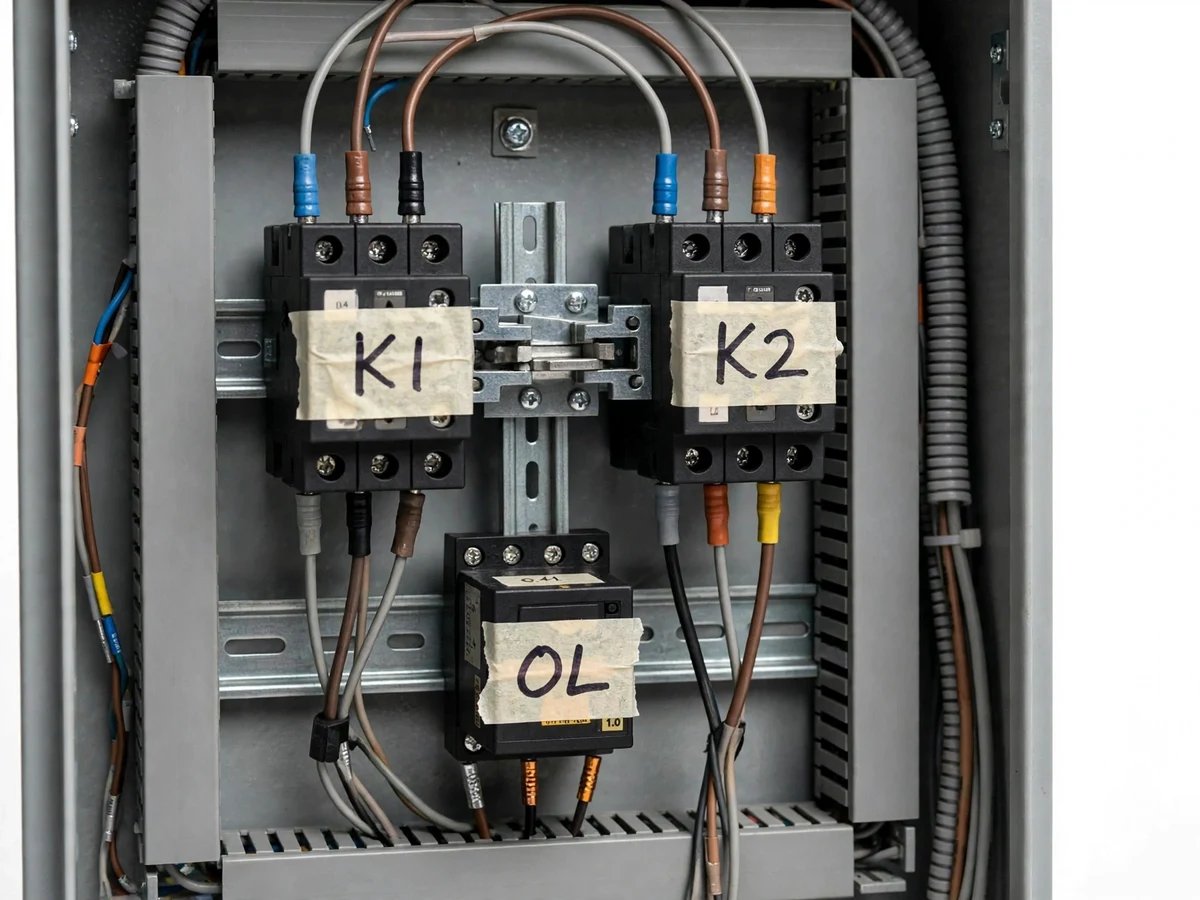
Reversing a three-phase motor means swapping two phases — and if the forward and reverse contactors ever close together, the result is a dead phase-to-phase short across the supply. Every industrial reversing starter therefore uses two independent safeguards: electrical interlocking, where each contactor's coil circuit passes through the other's normally-closed auxiliary contact, and a mechanical interlock block that physically prevents both armatures from pulling in. Students draw these circuits in exams but rarely wire one, so the difference between the power circuit and the control circuit — and why both interlocks exist — stays abstract. This project builds the complete panel on a steel enclosure: two contactors with a mechanical interlock kit, overload relay, phase-failure relay, push-button station, and a small three-phase motor (or motor simulator) so direction reversal is visible. The student wires both circuits, tests that the interlocks genuinely block simultaneous closure, and documents the whole starter for the viva.
How it works
- Pressing FORWARD energizes contactor K1 through the STOP button, the overload relay's NC contact, the phase-failure relay contact and K2's NC auxiliary (electrical interlock).
- K1 closes, connecting the motor to the supply in R-Y-B order; its NO auxiliary seals the coil in, and its NC auxiliary opens in K2's coil circuit, electrically blocking reverse.
- The mechanical interlock block simultaneously prevents K2's armature from physically pulling in even if its coil were energized.
- Pressing STOP (required before direction change, per the panel procedure) drops K1; pressing REVERSE then energizes K2, which connects the motor with two phases swapped, reversing rotation.
- Attempting to press REVERSE while K1 is energized does nothing — the electrical interlock holds K2's coil open, which the demo verifies live.
- A sustained overload trips the thermal relay, opening the control circuit for both directions until manual reset.
- Loss of any supply phase trips the phase-failure relay, dropping the control supply and stopping the motor regardless of direction.
Tech stack:
- 2× 3-pole power contactors with mechanical interlock kit
- Thermal overload relay (adjustable)
- Phase-failure / single-phasing preventer relay
- Push-button station (forward / reverse / stop / emergency stop)
- Auxiliary contact blocks (NO + NC) for seal-in and interlocking
- Direction indicator lamps + panel wiring on steel enclosure
- Small three-phase induction motor for demonstration
- 230 V AC control circuit, 415 V three-phase power circuit (demo scale)
| Parameter | Value |
|---|---|
| Starter type | DOL forward-reverse, dual contactor |
| Motor | Small 3-phase induction motor, approximately 0.25–0.5 HP (design) |
| Interlocking | Electrical (cross-wired NC aux) + mechanical block |
| Overload relay | Adjustable, set to motor FLC at commissioning |
| Phase protection | Phase-failure relay, drops control on any phase loss |
| Control voltage | 230 V AC single-phase derived (design) |
| Enclosure | Steel panel, approximately 50 × 40 cm (design target) |
| Direction change | Via STOP — direct reversal is interlocked out |
Project features
- [Dual contactor power circuit] Two 3-pole contactors wired so the reverse contactor swaps two phases — the classic reversing-starter power circuit, built with proper lugs and ferrules.
- [Electrical interlocking] Each contactor coil circuit is wired through the other contactor's NC auxiliary contact, so an energized contactor electrically blocks the opposing coil.
- [Mechanical interlock block] A factory interlock kit physically couples the two contactors, preventing simultaneous armature closure even if the control wiring failed.
- [Thermal overload relay] Mounted on the forward contactor, tripping both directions on sustained overcurrent with manual reset.
- [Phase-failure relay] Drops the control supply if any supply phase is lost, protecting the motor against single-phasing in either direction.
- [Push-button station] Green FORWARD, green REVERSE and red STOP buttons with a mushroom-head emergency stop, plus direction indicator lamps.
- [Demonstration motor] A small three-phase induction motor (or lamp-based phase simulator) makes rotation direction visible during the demo.
What is included
- Complete wired forward-reverse starter panel with interlocked contactors
- Demonstration motor with visible rotation direction
- Power + control circuit wiring diagrams (drawn to industrial convention)
- Interlock verification test procedure (proving both interlocks block simultaneous closure)
- Starter theory note (DOL, reversing, interlock necessity, overload coordination)
- Project report PDF (background, starter theory, panel design, wiring, tests)
- PPT presentation for final review
- Viva Q&A preparation document (interlocking, power vs control circuit, overload setting, single-phasing)
Limitations & prerequisites
- DOL starting at demo power levels — the panel demonstrates the reversing-starter logic, not soft-starting or VFD control of large motors.
- Direction change requires pressing STOP first (standard safe practice); direct forward-to-reverse changeover without stopping is intentionally not provided.
- Demonstrated on a small motor at bench scale; contactor and cable sizing for larger motors follows the same procedure, covered in the report.
- The phase-failure relay protects against supply-side phase loss; it does not detect a phase lost downstream of the contactor.
- Overload relay setting must be matched to the connected motor's full-load current at commissioning — the procedure is supplied, not pre-certified.
Frequently Asked Questions
Why are two interlocks needed — isn't one enough?
They guard against different failures. The electrical interlock blocks the opposing coil through control wiring; the mechanical block physically stops both armatures closing if the wiring is wrong or a contact welds. Industry practice demands both because a simultaneous closure is a phase-to-phase short.
What happens if you press REVERSE while the motor runs forward?
Nothing — the electrical interlock (K1's NC auxiliary open in K2's coil circuit) plus the mechanical block prevent K2 from energizing. The panel procedure requires STOP first, and the demo proves the block works live.
How does swapping two phases reverse the motor?
Reversing any two of the three supply phases reverses the rotating magnetic field's direction, so the rotor follows it the other way. The reverse contactor's power wiring does exactly this swap.
What is the difference between the power circuit and the control circuit?
The power circuit carries motor current through the contactor main contacts; the control circuit is the low-current coil/push-button/relay logic that decides which contactor closes. The report's diagrams keep them on separate sheets, as in industry drawings.
Why is there a phase-failure relay as well?
A motor that loses one supply phase (single-phasing) draws heavy current in the remaining phases and burns out; the relay drops the whole starter on any phase loss, in either direction.
Is this project suitable for a final-year project?
Yes — for Electrical Engineering programs. It is the standard industrial reversing starter built and wired by the student, with real interlock logic to demonstrate and defend. Suitable for B.E./B.Tech final-year projects in Electrical Engineering.
Components & software requirements
- 2× 3-pole power contactors with mechanical interlock kit
- Thermal overload relay (adjustable)
- Phase-failure / single-phasing preventer relay
- Push-button station (forward / reverse / stop / emergency stop)
- Auxiliary contact blocks (NO + NC) for seal-in and interlocking
- Direction indicator lamps + panel wiring on steel enclosure
- Small three-phase induction motor for demonstration
- 230 V AC control circuit, 415 V three-phase power circuit (demo scale)
Delivery information
Built-to-order project. Delivery timeline is shared after order confirmation based on current queue.
Support terms
Complete documentation, setup guide, and viva preparation included. Support for setup and explanation provided.