
More project photos (2)
The problem
Every year, final-year students propose project topics to their departments, and in most colleges this happens over WhatsApp chats, phone calls and paper forms. The same or near-identical topics get proposed by multiple groups because nobody compares new proposals against earlier ones; faculty feedback lives in scattered messages and gets repeated for every batch; and the HOD has no way to see how many ideas are pending, approved or rejected without chasing coordinators for manual counts. The result is duplicated topics, lost feedback and weeks of coordination overhead each semester.
This project replaces that chaos with a structured PHP/MySQL portal. Students submit ideas through one form — title, domain, tech stack, team, guide, abstract — and the system checks each title against earlier submissions, flagging duplicates before faculty see the proposal. Faculty work through a filtered review queue, recording approve, reject or request-changes decisions with mandatory written feedback. Every decision lands in a timestamped audit trail, and the HOD gets a live dashboard: submission counts, domain distribution, recent decisions, and an allocation lock that freezes submissions when topic allocation begins.
Submits the project idea and reads faculty feedback on the decision.
Follow the working sequence
How it works
- A student logs in and submits a project idea through the structured form; the server validates it and stores it in the ideas table.
- On submission, the duplicate check compares the proposed title against all stored titles using token-based similarity and records a flag when a stored title exceeds the configurable threshold.
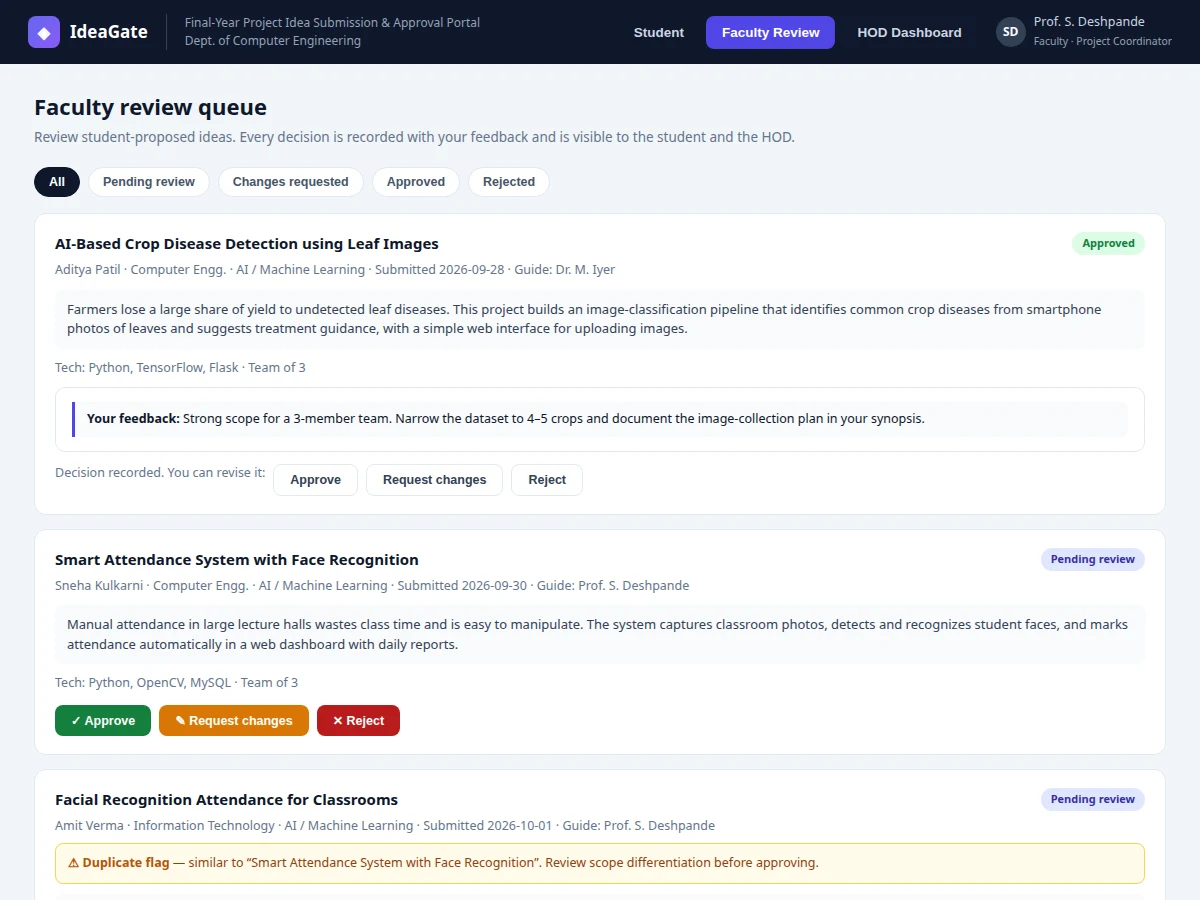
- The idea appears in the faculty review queue with its status filter, abstract, tech stack, team details and any duplicate warning.
- A faculty member opens the idea, reads the details, and records a decision — approve, reject or request changes — with mandatory written feedback, which is appended to the audit trail with a timestamp.
- The student receives an email notification (via the configured SMTP) and sees the decision plus feedback under their submissions; "request changes" returns the idea to the student for revision and resubmission.
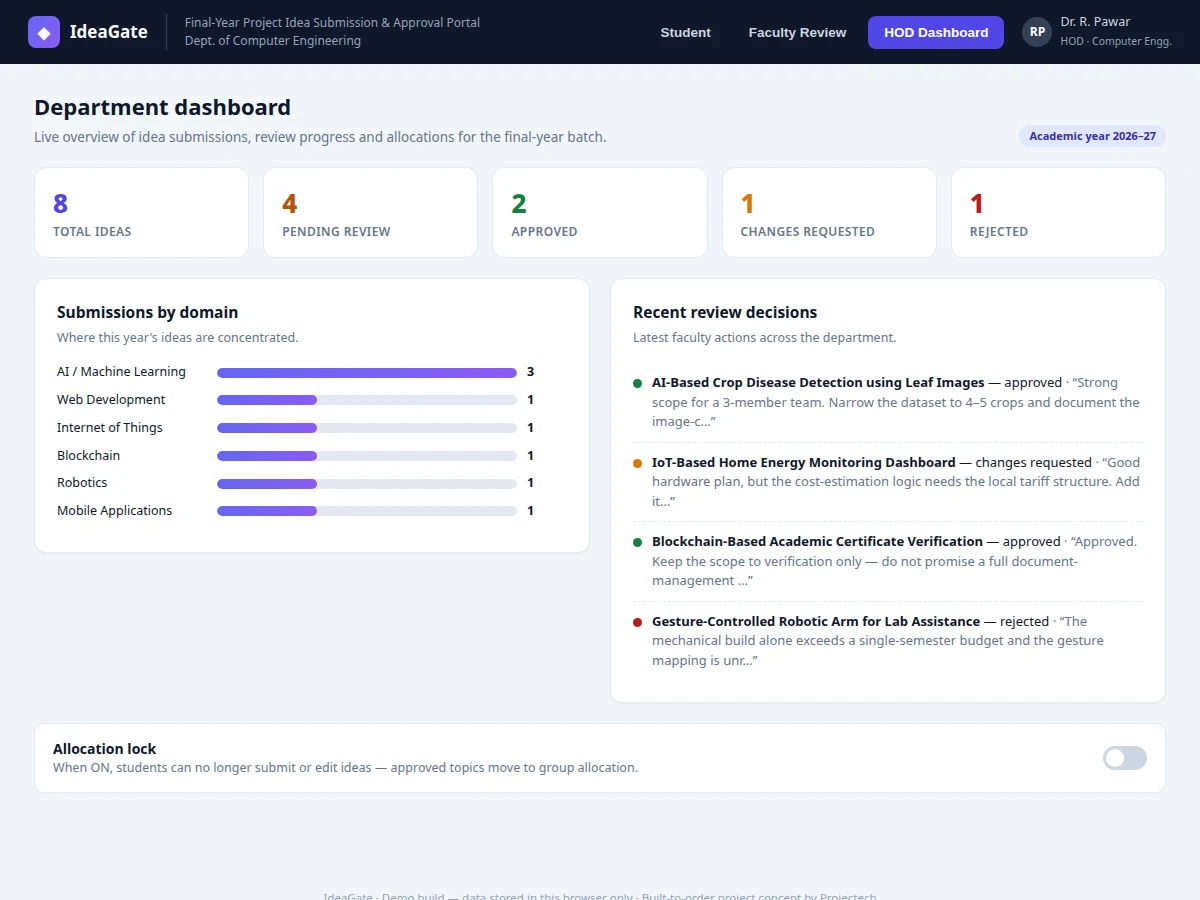
- The HOD dashboard aggregates the same tables into live counters, the domain-wise chart and the recent-decisions timeline; enabling the allocation lock disables the student submission form and approved topics move to group allocation.
Tech stack:
- PHP 8 (application logic, server-side rendering)
- MySQL 8 (relational storage: users, ideas, decisions, notifications)
- HTML5, CSS3, JavaScript (frontend, no build step)
- Apache or Nginx (hosting web server)
- SMTP (configurable email notifications)
- Responsive CSS layout (desktop-first, usable on tablets)
| Parameter | Value |
|---|---|
| Platform | PHP 8 web application (LAMP stack) |
| Database | MySQL 8, full schema (.sql) supplied |
| Roles | 3 — student, faculty, HOD; enforced server-side |
| Duplicate check | Title-token similarity against stored titles; threshold configurable (demo default approximately 0.45) |
| Notifications | Email via configurable SMTP; credentials required for delivery |
| Decision audit trail | Every decision stored with reviewer, timestamp and feedback |
| Hosting | Needs a PHP/MySQL host (college server or shared hosting); approximately 100 MB disk space (expected) |
| Browsers | Modern Chrome, Edge or Firefox (expected) |
| Build step | None — plain PHP, HTML, CSS and JavaScript |
Project features
- [Student idea submission form (implemented)] One structured form capturing title, domain, tech stack, team size, team members, preferred guide and abstract, with client- and server-side validation — replacing informal WhatsApp proposals.
- [Automatic duplicate-title check (implemented)] Every submission is compared against stored titles using token-based similarity; a warning flags possible duplicates to the student at submission time and to faculty on the review card. Detection is title-similarity based, not semantic — genuinely similar wording with different words will not be caught.
- [Faculty review queue (implemented)] Filterable queue (all / pending / approved / rejected / changes requested) showing each idea's title, student, department, domain, abstract and duplicate flag, with one-click decision actions.
- [Decisions with mandatory feedback (implemented)] Approve, reject and request-changes actions each require written feedback; the decision, reviewer, timestamp and feedback are appended to a permanent audit trail visible to the student and the HOD.
- [HOD dashboard with allocation lock (implemented)] Live counters, domain-wise submission distribution, a recent-decisions timeline, and a toggleable allocation lock that disables student submissions when topic allocation begins.
- [Role-based authentication (implemented)] Separate student, faculty and HOD logins; each role sees only its own views, enforced server-side in every request.
- [Email notifications via configurable SMTP (implemented, configurable)] Students are emailed on every decision. The SMTP host, credentials and sender address are college-configurable; without valid credentials, notifications are queued but not delivered.
What is included
- Complete PHP/MySQL source code for all three roles
- Database schema (.sql) with seed structure
- Setup and deployment guide (hosting, DB import, SMTP configuration)
- Project report PDF (background, requirements, database design, methodology, screenshots)
- PPT presentation for final review
- Viva Q&A preparation document (PHP/MySQL concepts, authentication, RBAC, audit-trail design, duplicate-detection logic)
Limitations & prerequisites
- Needs a PHP/MySQL host to run — hosting and domain costs are not part of the software itself.
- Email notifications require the college's SMTP credentials; without them, notifications are queued but never delivered.
- Duplicate detection is title-similarity based, not semantic: a reworded copy of an existing title will not be flagged.
- The review workflow is linear — one decision per idea at a time; multi-reviewer voting or parallel approvals are not in the base build.
- No payment gateway, SMS gateway or mobile app is included in the base project.
- The allocation lock is a manual HOD toggle; it does not schedule itself to a date automatically.
- The demo concept stores its sample data in the browser; the delivered project uses MySQL for all persistence.
Frequently Asked Questions
Is the database included?
Yes. The project ships with a complete MySQL schema (.sql file) covering users, ideas, decisions and notifications, plus the setup guide for importing it on any PHP/MySQL host.
Does the project have an admin panel?
Yes — the HOD dashboard is the admin view: live submission counters, domain-wise distribution, a recent-decisions timeline across the department, and the allocation-lock toggle.
Can it be hosted on our college server?
Yes. It is a plain PHP 8 + MySQL 8 application with no build step and no exotic dependencies, so it deploys on any standard LAMP host; approximately 100 MB of disk space is expected to be enough.
Is payment gateway integration included?
No — this portal has no payments at all. Ideas are submitted and reviewed for free inside the department, so no gateway is needed or included.
Can more roles or modules be added?
Yes. Realistic additions include a guide-allocation workflow that assigns approved topics to faculty, an abstract-similarity report for faculty, or a reviewer-voting step — these are quoted as customizations, not part of the base build.
Is this project suitable for a final-year project?
Yes — for Computer Science and IT programs. It demonstrates role-based authentication, CRUD workflows, relational database design, an audit-trail pattern, and a genuinely useful departmental workflow, all of which make strong viva material. Suitable for B.E./B.Tech final-year projects in Computer Science and Information Technology.
Components & software requirements
- PHP 8 (application logic, server-side rendering)
- MySQL 8 (relational storage: users, ideas, decisions, notifications)
- HTML5, CSS3, JavaScript (frontend, no build step)
- Apache or Nginx (hosting web server)
- SMTP (configurable email notifications)
- Responsive CSS layout (desktop-first, usable on tablets)
Delivery information
Built-to-order project. Delivery timeline is shared after order confirmation based on current queue.
Support terms
Complete documentation, setup guide, and viva preparation included. Support for setup and explanation provided.
Download free synopsis (PDF)
Enter your name and email — the synopsis PDF downloads immediately. We may send occasional project updates; no spam, unsubscribe anytime.