
More project photos (3)
The problem
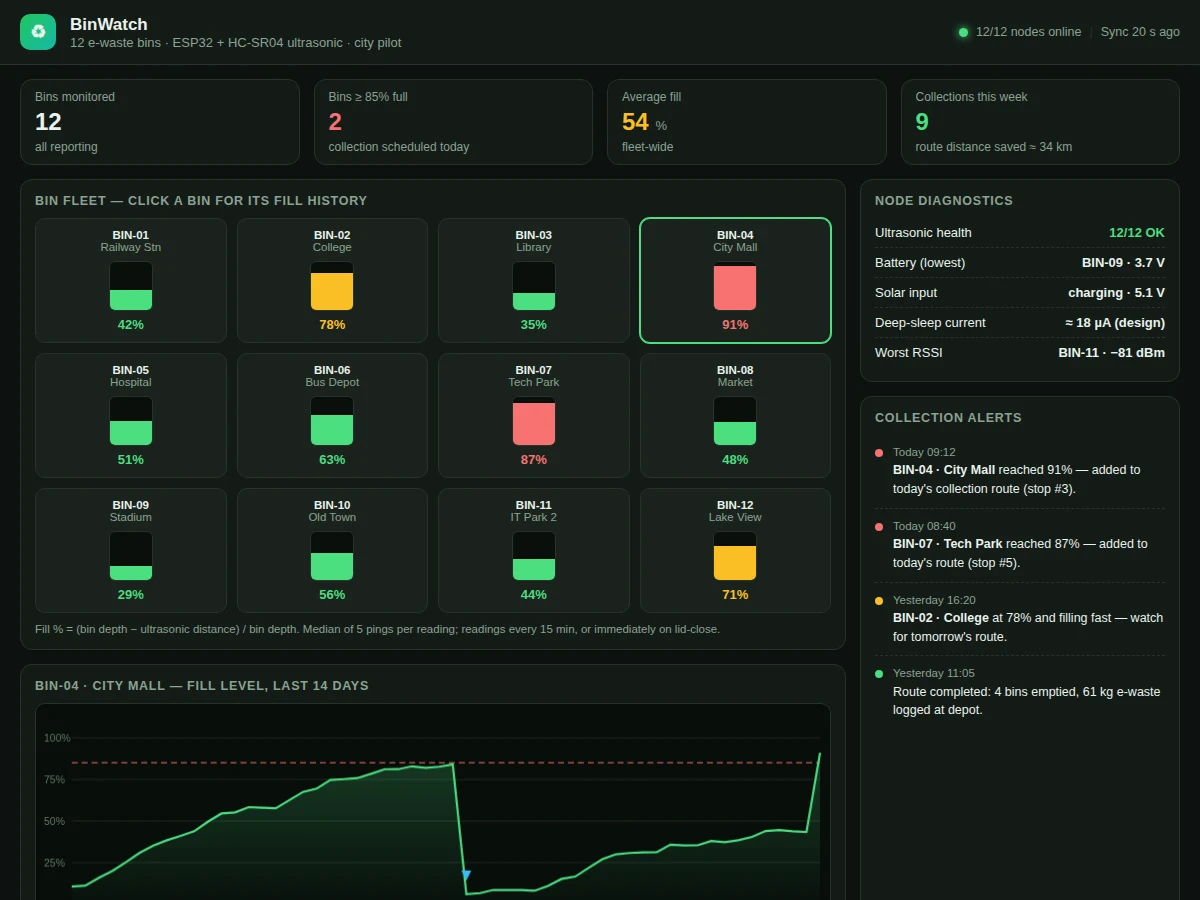
E-waste collection runs on fixed routes: trucks visit every bin on schedule whether it is empty or overflowing, wasting fuel on empty stops while full bins spill hazardous material. The missing piece is fill-level visibility. This project puts a low-power sensor node on each bin. An HC-SR04 ultrasonic module mounted over the bin measures the distance to the waste surface; the ESP32 takes the median of 5 pings, converts it to fill % = (bin depth − distance) / bin depth, and reports every 15 minutes — or immediately when the lid closes. Between readings the node sleeps at roughly 18 µA (design target), powered by a small solar panel charging the battery, so it runs maintenance-free. A local LCD shows the live state (FILL: 72%, Dist: 3.8 cm). The BinWatch dashboard shows the whole fleet — 12 bins in the demo — with fill bars, node diagnostics, collection alerts ("BIN-04 · City Mall reached 91% — added to today's route"), and a 14-day fill history per bin.
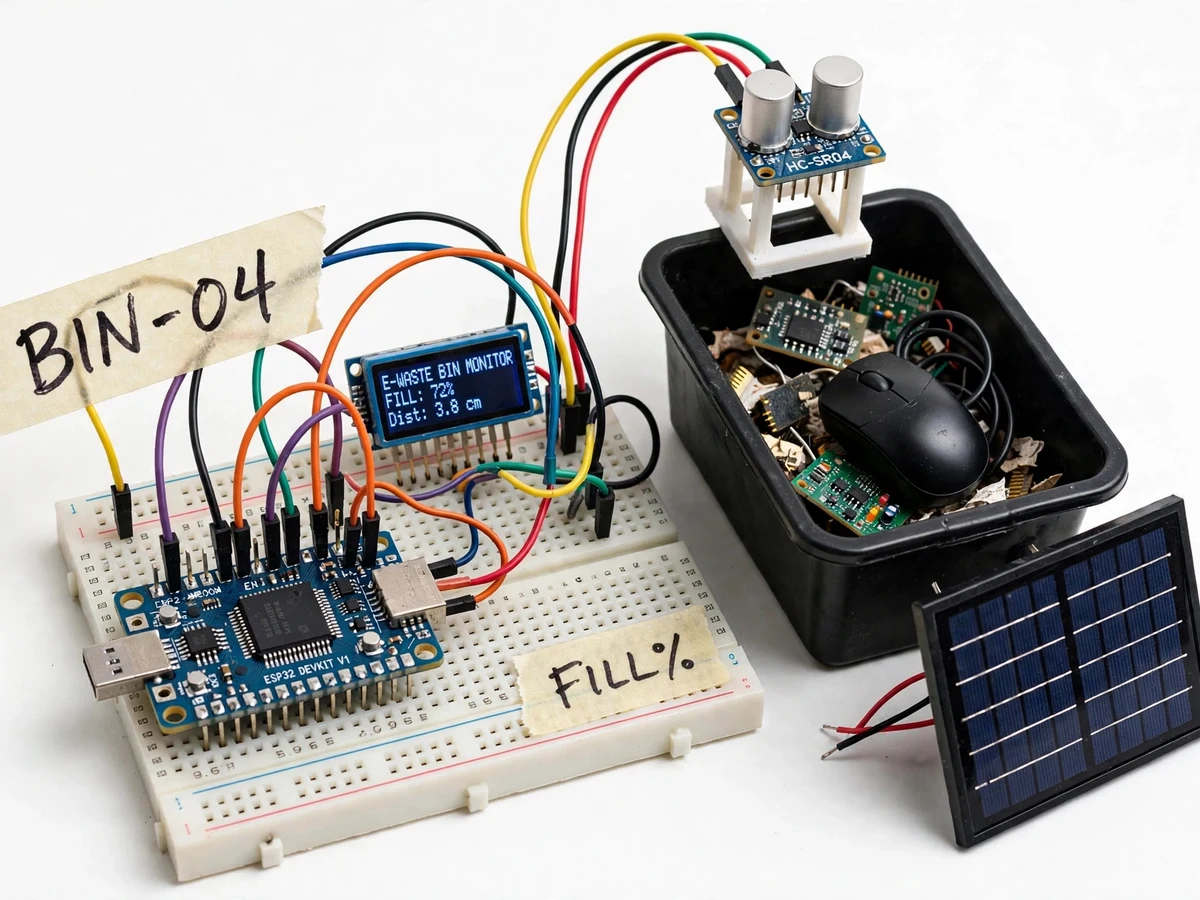
Ultrasonic ranger mounted above the bin opening.
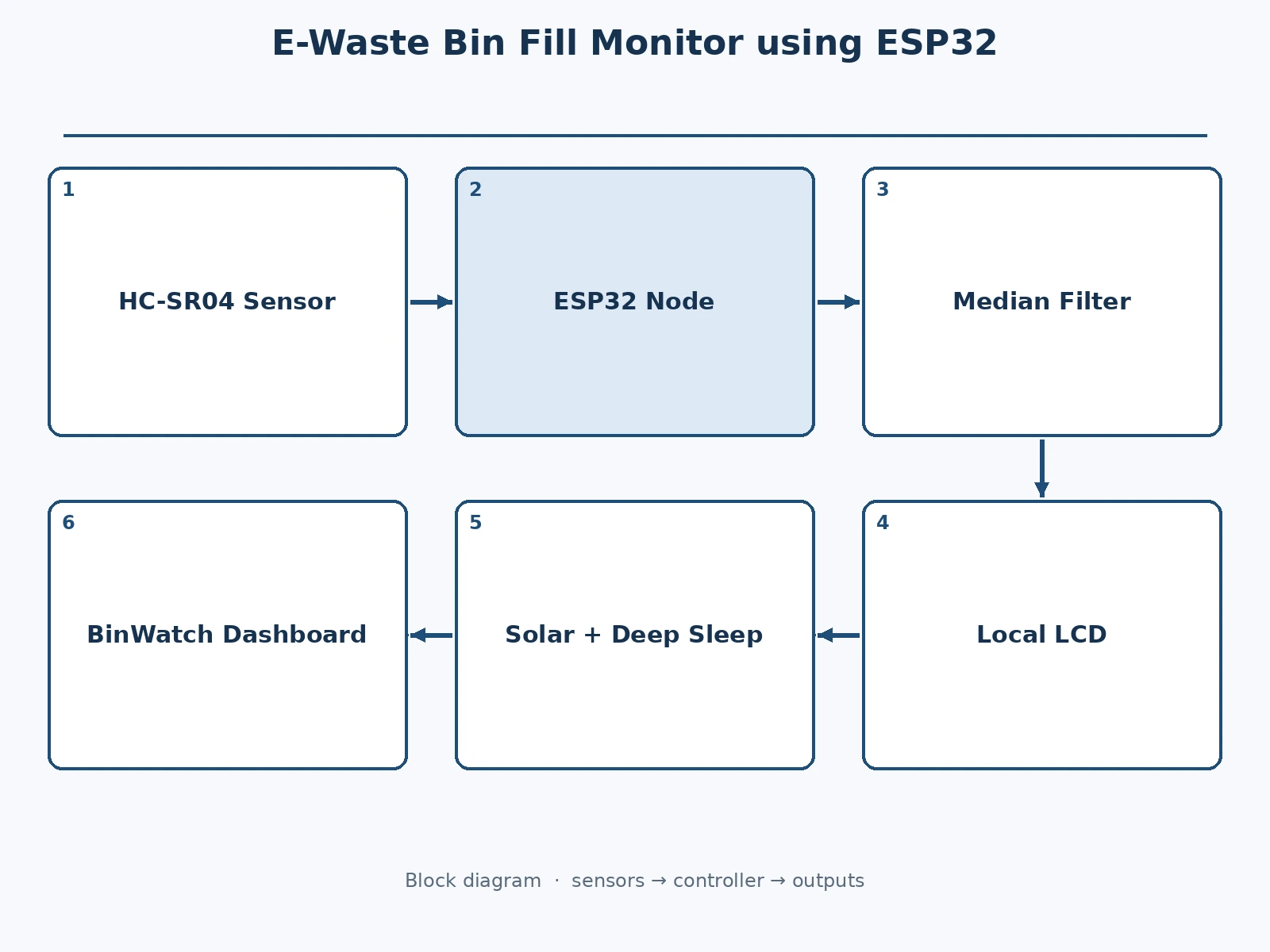
Follow the working sequence
How it works
- The HC-SR04, mounted on a stand above the bin opening, fires 5 ultrasonic pings; the ESP32 takes the median distance to reject outliers from uneven waste surfaces.
- Fill % is computed as (bin depth − median distance) / bin depth; the local LCD updates to show the fill % and raw distance.
- The node reports on a 15-minute schedule, and additionally wakes to report immediately when the lid-close switch triggers.
- Between readings the ESP32 enters deep sleep (~18 µA design target); the solar panel trickle-charges the battery, with charge voltage shown in diagnostics.
- The dashboard renders the fleet: fill bars per bin, 14-day history on click, node diagnostics, and alerts when bins cross the 85% collection threshold.
- Collection alerts feed a daily route — the demo shows route distance saved (34 km) and e-waste logged at the depot (61 kg) as the operational payoff.
Tech stack:
- ESP32 firmware (deep sleep, median filtering)
- HC-SR04 ultrasonic sensor
- Solar panel + battery charging
- Lid-close switch
- 16×2 LCD (local fill display)
- Fleet dashboard (fill bars, history, diagnostics)
- MQTT/HTTP telemetry
- Git
| Parameter | Value |
|---|---|
| Controller | ESP32 DevKit v1 |
| Fill sensor | HC-SR04 ultrasonic (datasheet 2 cm–400 cm range) |
| Fill formula | (bin depth − median distance) / bin depth, median of 5 pings |
| Reporting | Every 15 min + immediate on lid-close (design behavior) |
| Power | Solar panel + battery; deep sleep ~18 µA (design target) |
| Local display | LCD: fill %, distance in cm |
| Dashboard | Fleet fill bars, 14-day history, diagnostics, alerts |
| Demo fleet | 12 e-waste bins (Railway Stn, College, Library, City Mall, …) |
Project features
- [Ultrasonic fill sensing] HC-SR04 measures distance to the waste surface; fill % computed as (bin depth − distance) / bin depth from the median of 5 pings per reading.
- [Lid-close reporting] Readings every 15 minutes plus an immediate report when the lid closes — the moment the fill level actually changed.
- [Solar + deep sleep] Small solar panel with charging; node sleeps between readings at ~18 µA deep-sleep current (design target) for maintenance-free operation.
- [Local LCD] Live fill % and distance on the node's display (E-WASTE BIN MONITOR, FILL: 72%, Dist: 3.8 cm).
- [Fleet dashboard] 12 bins with live fill bars (green/yellow/red), click any bin for its 14-day fill history.
- [Node diagnostics] Ultrasonic health, lowest battery, solar input voltage, deep-sleep current and worst RSSI — the maintenance view for the whole fleet.
- [Collection alerts] Bins crossing 85% are auto-added to today's collection route; fast-filling bins get watch warnings.
What is included
- Complete ESP32 bin-node prototype (HC-SR04, solar panel, LCD, lid switch, wiring diagram)
- Low-power firmware (deep sleep, median filtering, telemetry)
- Fleet dashboard (fill bars, history, diagnostics, collection alerts)
- Installation guide (sensor mounting, bin-depth calibration, solar sizing)
- Project report PDF (background, ultrasonic theory, power budget, methodology)
- PPT presentation for final review
- Viva Q&A preparation document (HC-SR04, deep sleep, solar, MQTT)
Limitations & prerequisites
- Ultrasonic readings depend on a reasonably flat waste surface; tangled cables and large items create uneven surfaces — the median-of-5 filter mitigates but does not eliminate this.
- The ~18 µA deep-sleep figure is a design target for the power budget; the built node's achieved sleep current depends on the regulator and peripherals used.
- The dashboard figures (fleet fills, route savings, 61 kg logged) are illustrative simulation data from the demo app, not measurements from deployed bins.
- The HC-SR04's 2 cm minimum range means very full bins read at the sensor's blind zone; the bin-depth calibration must account for this offset.
- Solar charging assumes reasonable daylight at the bin location; shaded indoor bins need mains or larger batteries.
Frequently Asked Questions
How is fill level measured?
An HC-SR04 ultrasonic sensor above the bin measures the distance to the waste surface; fill % = (bin depth − distance) / bin depth, using the median of 5 pings to reject outliers from uneven waste.
Why report on lid-close?
The fill level only changes when waste is added — the lid closing is that moment. Immediate reporting on lid-close keeps the dashboard current without wasting power on pointless 15-minute reads of an unchanged bin.
How does it stay powered?
A small solar panel charges the battery while the ESP32 deep-sleeps (~18 µA design target) between readings — no mains wiring at the bin.
What does the dashboard do with the data?
Fleet fill bars with 14-day history per bin, node diagnostics (battery, solar, signal), and collection alerts: bins over 85% are auto-added to today's route so trucks skip empty stops.
How accurate is ultrasonic fill sensing?
As a design target, ±1–2 cm on a flat surface (HC-SR04 resolution); uneven e-waste surfaces add noise, which is why the firmware uses median-of-5 filtering and the bin depth is calibrated at install.
Is this project suitable for a final-year project?
Yes — for IoT & Embedded, Electronics and Computer Science programs. It combines ultrasonic sensing, ultra-low-power design, solar energy and a fleet dashboard around a real smart-city waste problem. Suitable for B.E./B.Tech final-year projects in IoT & Embedded Systems, Electronics and Computer Science.
Components & software requirements
- ESP32 firmware (deep sleep, median filtering)
- HC-SR04 ultrasonic sensor
- Solar panel + battery charging
- Lid-close switch
- 16×2 LCD (local fill display)
- Fleet dashboard (fill bars, history, diagnostics)
- MQTT/HTTP telemetry
- Git
Delivery information
Built-to-order project. Delivery timeline is shared after order confirmation based on current queue.
Support terms
Complete documentation, setup guide, and viva preparation included. Support for setup and explanation provided.
Download free synopsis (PDF)
Enter your name and WhatsApp number — the synopsis PDF downloads immediately. We may send occasional project updates on WhatsApp; no spam.