
More project photos (2)
The problem
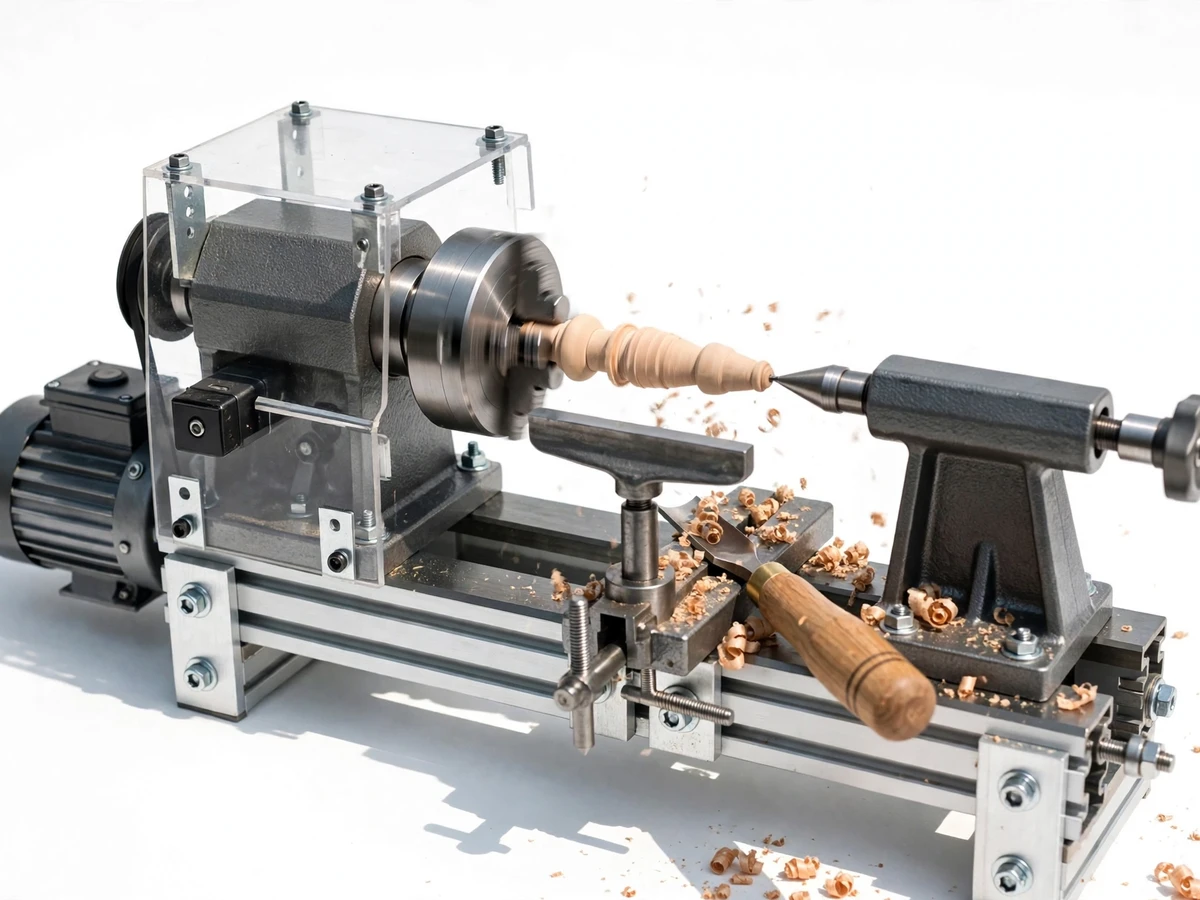
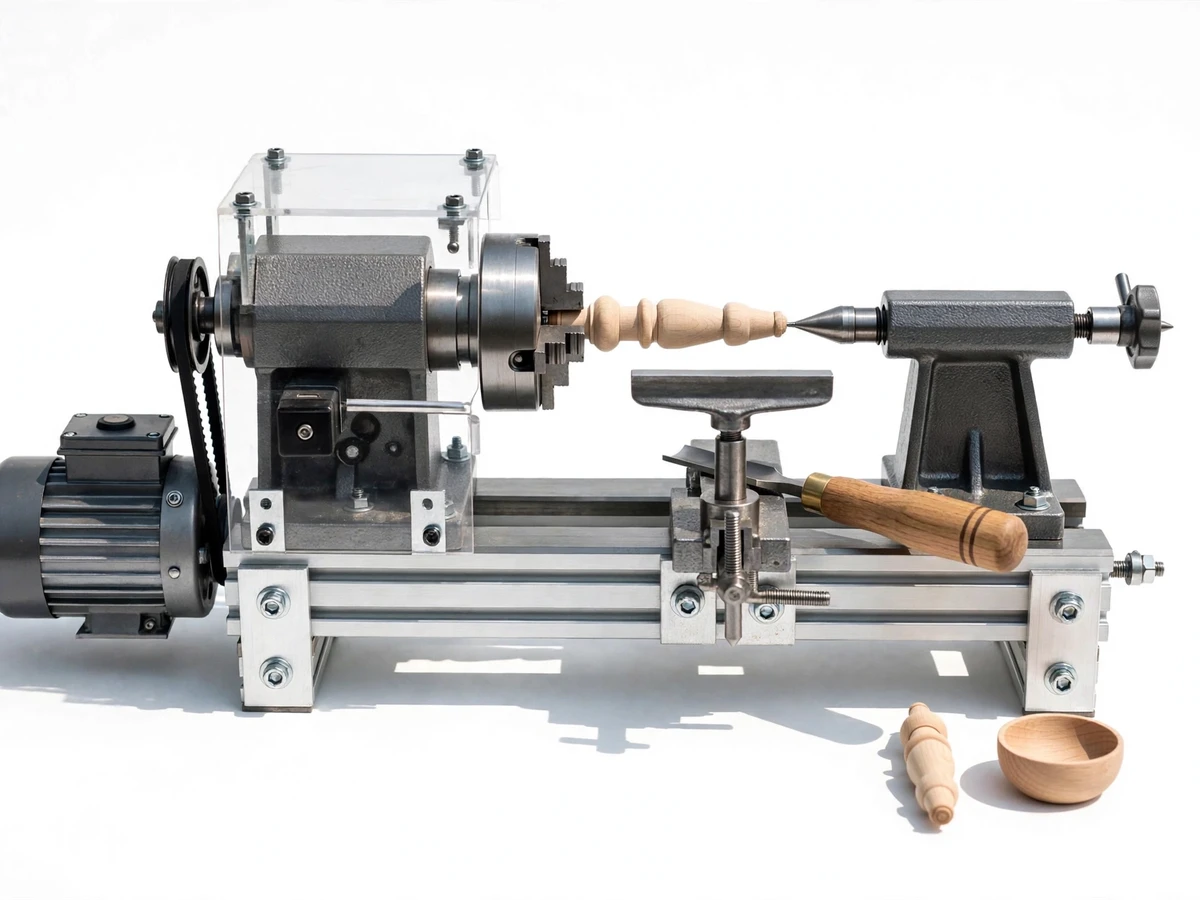
College workshops and home builders who want to learn wood turning face a practical gap: full-size lathes are large, costly, and sized for production work, while classroom demonstrations rarely let a student mount a blank, set a tool rest, and shape a piece from start to finish. The DIY Mini Lathe Machine for Wood Turning answers that gap with a small bench-top machine that holds a short softwood blank between a powered chuck and a tailstock centre, spins it at a controlled speed, and lets a hand-held chisel supported on an adjustable tool rest cut the rotating surface into a round, profiled shape. A belt drive with stepped pulleys sets the spindle speed, a transparent guard covers the belt, and the whole machine sits on a bench, so turning, facing, and simple profiling can be practised safely at teaching scale with softwood only.
Single-phase motor powers the drive.
Follow the working sequence
How it works
The DIY Mini Lathe Machine for Wood Turning shapes wood by spinning the workpiece against a fixed cutting edge. An electric motor drives a belt over stepped pulleys, and the belt turns the headstock spindle and the three-jaw chuck that grips one end of a softwood blank. The tailstock centre supports the free end, so the blank rotates on a single axis between chuck and centre. With the machine running, the operator rests a hand-held turning chisel on the adjustable tool rest and advances its edge slowly into the spinning surface. Each pass peels away a thin curl of wood, and repeated passes, with the tool rest repositioned along the bed, reduce the diameter and form beads, coves, tapers, and a smooth round profile before the finished piece is sanded and removed.
- A seasoned softwood blank is cut square, its ends are marked for centre, and the blank is mounted between the chuck and the tailstock centre.
- The tailstock is slid along the bed, the centre is pressed into the blank end, and the tailstock is locked so the blank sits firmly on one axis.
- The tool rest is positioned close to the blank surface, level with the centre height, and locked before the motor is switched on.
- The belt is set on the pulley step for the chosen speed band, the motor is started, and the blank is allowed to reach steady rotation.
- The operator rests the chisel on the tool rest, advances the edge slowly into the spinning wood, and takes light roughing passes to make the blank round.
- Finer passes with the tool rest repositioned along the bed shape beads, coves and tapers, and the surface is checked with callipers between passes.
- The motor is stopped, the finished piece is sanded while still mounted or after removal, and the piece is released by withdrawing the tailstock centre.
Builder note: during the prototype build, the single most common fault was a tool rest set even slightly above centre height, which made the chisel dig in and chatter instead of cutting cleanly. The build guide therefore sets the tool-rest top edge at centre height before every first pass, and checks it again after the rest is moved along the bed. In first-principles terms, turning works because the workpiece rotates while the cutting edge stays fixed: the spinning surface is carried past a stationary edge, so one continuous shearing cut peels the wood into a round form.
Tech stack:
- Mild steel bed frame
- Single-phase induction motor
- Belt drive with stepped pulleys
- Three-jaw chuck
- Tailstock with live centre
- Adjustable tool rest
- High-speed steel turning chisels
- Transparent belt guard
| Parameter | Value |
|---|---|
| Machine type | Bench-top wood turning lathe (educational build) |
| Overall bed length | Approximately 600 mm |
| Distance between centres | Approximately 300 mm (design target) |
| Maximum workpiece diameter | Approximately 100 mm (design target) |
| Maximum workpiece length | Approximately 300 mm (design target) |
| Chuck | 80 mm three-jaw chuck |
| Spindle speed | Approximately 600–1800 rpm in 3 belt steps (design target) |
| Motor | Approximately 250 W single-phase induction motor (design target) |
| Power supply | 230 V AC single-phase mains supply |
| Tool rest | Adjustable height and bed position |
| Workpiece material | Seasoned softwood blanks only |
| Footprint | Approximately 650 mm × 250 mm (design target) |
Project features
The DIY Mini Lathe Machine for Wood Turning centres on four capabilities that together make small-scale wood turning teachable. A belt-driven spindle turns the workpiece at a stepped, selectable speed, so roughing cuts and finer finishing passes can use different speeds. A three-jaw chuck at the headstock end and a pointed tailstock centre at the other end hold a short softwood blank firmly on one axis, so the blank spins true instead of wobbling. An adjustable tool rest gives the turning chisel a steady support close to the work, which controls the cut and reduces chatter. A compact bench-top frame with a transparent belt guard keeps the build small, stable, and guarded, so the machine fits a workshop bench and a teaching demonstration. The guard and the bench-top size also mean the machine can be demonstrated in a classroom without a full workshop bay.
- [Belt-Drive Spindle — Implemented] A motor drives the headstock spindle through a belt and stepped pulleys, giving stepped spindle speeds for roughing and finishing passes on softwood blanks.
- [Three-Jaw Chuck Holding — Implemented] An 80 mm three-jaw chuck grips one end of the blank and centres it on the spindle axis, so the workpiece rotates concentrically during turning.
- [Tailstock Centre Support — Implemented] A sliding tailstock with a pointed centre supports the free end of the blank and locks on the bed, which limits flex and vibration on longer pieces.
- [Adjustable Tool Rest — Implemented] A height- and position-adjustable tool rest supports the turning chisel close to the work surface, giving the operator steady control over each cutting pass.
- [Guarded Bench-Top Frame — Implemented] A rigid bed frame carries the headstock, tool rest and tailstock, and a transparent guard covers the belt drive so rotating drive parts are shielded during operation.
- [Stepped Speed Selection — Configurable] The belt can be moved between pulley steps to change the spindle speed band, and the pulley set can be configured at build time for the softwood sizes in the specification.
- [Faceplate Turning Option — Optional Customization] A faceplate for short, wide blanks can be added separately on request; it is not part of the base chuck-and-centre build.
What is included
- Complete bench-top mini lathe machine with motor, belt drive, chuck, tailstock and tool rest
- Set of high-speed steel turning chisels for roughing, shaping and parting
- Transparent belt guard and eye-protection guidance
- Component list with sizes and fastener details
- Assembly, alignment and tool-rest setting guide
- Operating and safety instruction sheet
- Project report PDF (background, design, working, results discussion, limitations)
- PPT presentation for final review
- Viva Q&A preparation document (turning process, speed selection, holding methods, safety)
Limitations & prerequisites
- Softwood blanks only, up to approximately 300 mm long and approximately 100 mm in diameter (design target); metal turning and hardwood production work are out of scope.
- The machine is an educational bench-top build, not a workshop production lathe, and it must not be used for industrial workpieces or continuous production runs.
- Surface finish depends on blank seasoning, chisel sharpness and light passes; green or knotty timber can tear, vibrate or catch.
- Spindle speed is set in 3 stepped belt positions only (design target range approximately 600–1800 rpm); continuously variable electronic speed control is not included in the base build.
- Eye protection must be worn during every cut, loose clothing and gloves must be kept away from rotating parts, and the belt guard must stay fitted during operation.
- The build needs a stable bench, a 230 V AC mains point, and basic workshop supervision for first-time operators.
- Accuracy of turned diameters depends on operator technique and calliper checks between passes; no measured tolerance is claimed.
Frequently Asked Questions
What can the mini lathe turn?
The mini lathe turns small seasoned softwood blanks into round and profiled pieces such as spindles, handles, small bowl blanks held on the faceplate option, and practice profiles. It is sized for teaching and demonstration pieces up to approximately 300 mm long and approximately 100 mm in diameter as a design target, and it is not built for metal, hardwood production work, or large furniture parts.
How does the spindle speed change?
The spindle speed changes by moving the drive belt between stepped pulley positions, which gives three speed bands across an approximate 600–1800 rpm design-target range. Lower steps suit larger diameters and roughing passes, while higher steps suit smaller diameters and finer finishing passes, and the belt is always moved with the motor switched off.
How is the workpiece held safely?
The workpiece is held between the three-jaw chuck at the headstock end and the pointed tailstock centre at the other end, with the tailstock locked on the bed before cutting starts. That two-point support keeps the blank on one axis, limits flex, and lets the operator check that the blank spins true by hand before switching the motor on.
What safety precautions apply during turning?
Eye protection must be worn for every cut, the transparent belt guard must stay fitted, and loose clothing, jewellery and gloves must be kept away from rotating parts. Cuts are taken as light passes with the chisel firmly supported on the tool rest, the tool rest is set at centre height, and the motor is stopped before measuring, sanding adjustments, or changing the workpiece.
Can the lathe be customized for a college requirement?
The lathe can be customized within its softwood teaching scope, for example with a faceplate option, a different chuck size, or a revised bed length agreed at build time. Changes that would turn the build into a metal lathe or a production machine are not offered, because the frame, motor and guarding are sized for small softwood teaching work only.
Is this project suitable for a final-year project?
The mini lathe suits Mechanical Engineering and Production Engineering programmes, where it demonstrates machine design, belt-drive speed selection, workpiece holding, cutting-tool geometry, and workshop safety. It gives a working machine plus measurable build content — alignment checks, speed steps, and turned sample pieces — for a report, a demonstration, and a viva discussion.
Components & software requirements
- Mild steel bed frame
- Single-phase induction motor
- Belt drive with stepped pulleys
- Three-jaw chuck
- Tailstock with live centre
- Adjustable tool rest
- High-speed steel turning chisels
- Transparent belt guard
Delivery information
Built-to-order project. Delivery timeline is shared after order confirmation based on current queue.
Support terms
Complete documentation, setup guide, and viva preparation included. Support for setup and explanation provided.
Download free synopsis (PDF)
Enter your name and WhatsApp number — the synopsis PDF downloads immediately. We may send occasional project updates on WhatsApp; no spam.