
More project photos (2)
The problem
Village milk collection centers still run on paper registers: each farmer's morning and evening milk is weighed, a fat test and SNF/CLR reading is taken, and the numbers are written down by hand. At the end of every 10-day cycle, the operator manually totals liters per farmer, looks up the rate from the cooperative's fat/SNF chart, multiplies, subtracts advances, and writes payment slips — hundreds of arithmetic steps where a single misplaced decimal underpays a farmer or loses the center money. Disputes are common because there is no entry-wise history to check. This project replaces the register with an Android app: every collection is entered once with its fat, SNF and CLR readings, the rate is computed from a configurable two-axis fat/SNF chart, and the 10-day billing, ledgers and payment slips are generated from the same data — so the numbers always reconcile and every payment can be traced back to its entries.
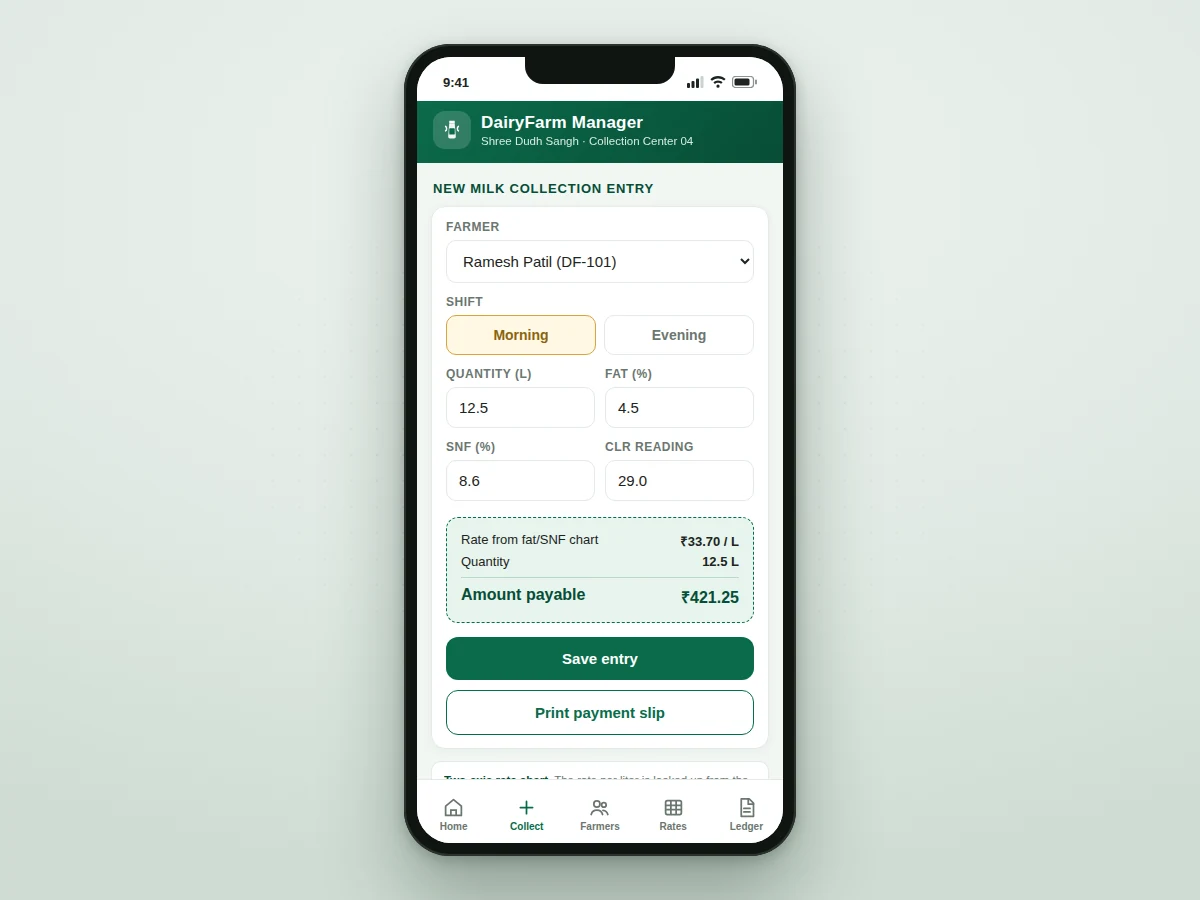
Registers each farmer once and records every shift's collection with quantity, fat percent, SNF percent and CLR reading.
Follow the working sequence
How it works
- The operator registers each farmer once (name, village, phone, animal count); records are stored in the on-device Room/SQLite database with a unique farmer ID.
- Every shift, the operator opens the collection screen, picks the farmer, selects morning or evening, and enters quantity (0.1 L resolution), fat %, SNF % and the CLR reading from the analyzer.
- The app computes the rate per liter from the configured fat/SNF chart — for example, fat 4.5% and SNF 8.6% at the default chart gives ₹33.70/L — and shows the payable amount before saving.
- The entry is saved with a timestamp into the farmer's ledger; the dashboard updates today's totals, shift split and weighted average fat/SNF immediately.
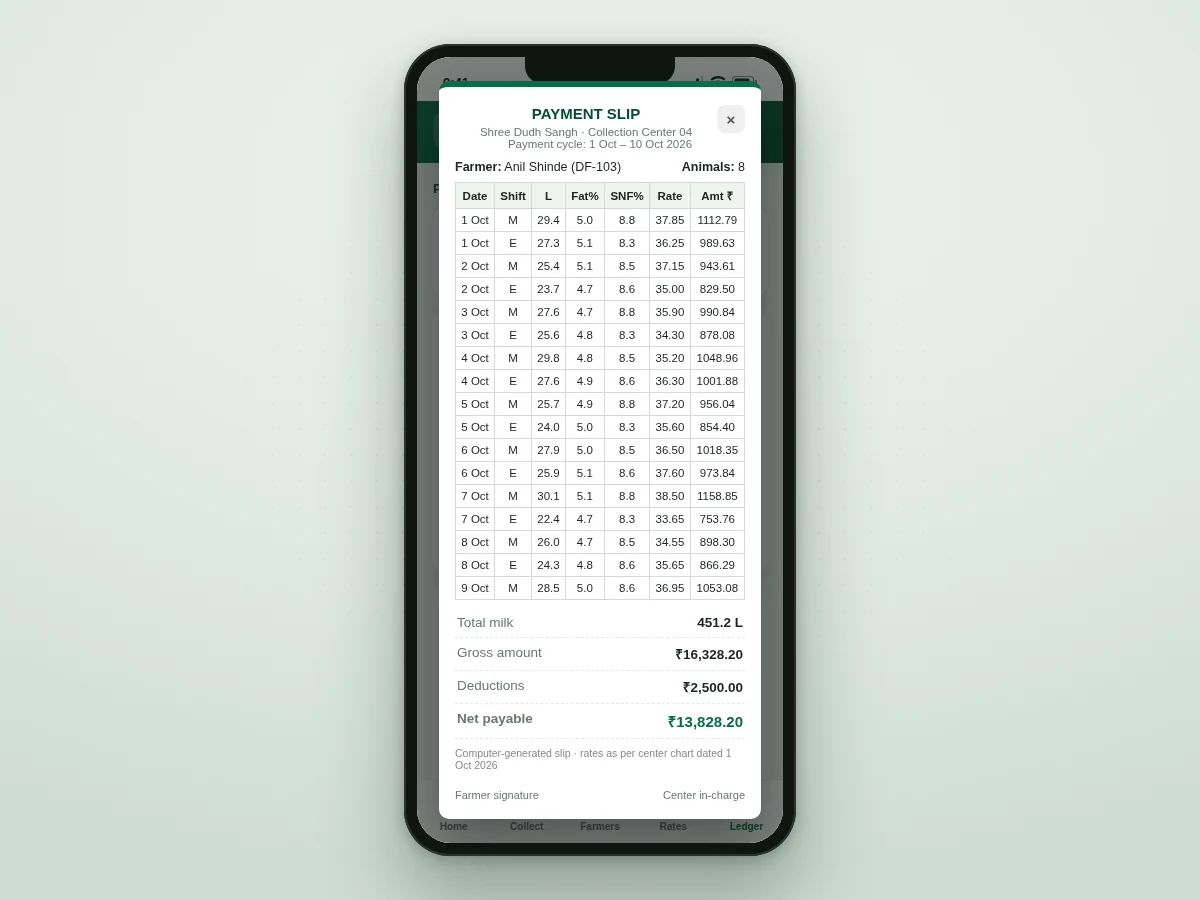
- At the end of the 10-day cycle, the app aggregates each farmer's entries: total liters, quantity-weighted average fat/SNF, gross amount, minus recorded deductions (feed advances), giving the net payable.
- The operator generates the payment slip per farmer — printed on paper or sent by SMS — with the full entry-wise breakdown so the farmer can verify every line.
Tech stack:
- Kotlin (Android)
- Android Studio
- Room · SQLite (on-device database)
- Material Design 3 UI components
- Android Print Framework (payment slips)
- SMSManager API (SMS slips)
- MPAndroidChart (collection trend charts)
- Git
| Parameter | Value |
|---|---|
| Platform | Android 8.0 (API 26) and above (minimum supported, design target) |
| Language | Kotlin (100% of app code) |
| Database | Room over SQLite, on-device only (no server in base build) |
| Rate formula | rate/L = base + (fat − refFat) × fatPremium + (SNF − refSNF) × snfPremium |
| Default chart | Base ₹30.00/L at reference fat 4.0% / SNF 8.5%; fat premium ₹6.50 per %, SNF premium ₹4.50 per % (design target, editable) |
| Payment cycle | 10 days (configurable) |
| Entry resolution | Quantity to 0.1 L; fat/SNF to 0.1 % |
| Farmer capacity | Expected: a few hundred farmer records on-device (design target 500) |
| Entry save time | Under 1 second on a mid-range device (expected, not measured) |
| Connectivity needed | None for entry, ledger and billing; SIM with balance needed for SMS slips |
| Cloud sync | Not implemented (future scope) |
Project features
- [Shift-wise milk collection entry] The operator selects a farmer and records each collection with quantity (1-decimal liters), fat %, SNF % and CLR reading, tagged to the morning or evening shift with an automatic timestamp. Invalid readings are rejected at entry so bad data never enters the ledger.
- [Fat/SNF two-axis rate chart (configurable)] The rate per liter is computed as base rate + (fat − reference fat) × fat premium + (SNF − reference SNF) × SNF premium — the same two-axis method dairy cooperatives use. The base rate, premiums and reference values are all editable, so the app matches any union's chart.
- [Automatic payment computation (implemented)] Every saved entry immediately shows its amount (liters × chart rate); cycle totals use quantity-weighted average fat and SNF, so a farmer's big and small pours are weighted correctly.
- [10-day payment-cycle billing (configurable)] At cycle close the app totals each farmer's liters, computes gross amount, subtracts recorded deductions such as feed advances, and produces the net payable. The cycle length (default 10 days) is configurable.
- [Per-farmer ledger (implemented)] Every entry is stored against the farmer with date, shift, readings, rate and amount; tapping a farmer opens the full cycle history — the audit trail that settles payment disputes.
- [Payment slips: print and SMS (implemented)] A payment slip with the entry-wise breakdown, totals, deductions and net payable is generated on-device — printable through the Android Print Framework or sent as an SMS to the farmer's registered number (needs a SIM with balance).
- [Offline-first local database] All records live in an on-device Room/SQLite database, so the app works through full network outages at rural centers. Cloud sync and multi-device backup are NOT implemented in the base build — they are documented future scope.
What is included
- Complete Android app source code (Kotlin) with the collection, ledger, rate-chart and billing modules
- Room/SQLite database schema and migration-ready data layer
- Configurable fat/SNF rate-chart module with default chart values
- Demo dataset (sample farmers, 10-day cycle entries) for testing and demonstration
- Build and setup guide for Android Studio
- Project report PDF (background, requirements, design, implementation, testing)
- PPT presentation for final review
- Viva Q&A preparation document (Android components, Room, rate-chart logic, offline design)
Limitations & prerequisites
- Cloud sync and multi-device backup are NOT implemented — records live only on the device, so a lost or reset phone loses data unless the user exports a manual backup.
- Milk analyzer hardware integration (e.g. automatic fat/SNF capture) is optional and not in the base build — readings are typed in manually.
- The rate chart is cooperative-specific: the default chart is a design target and the student must configure it to their local union's actual chart before real use.
- SMS slips need a working SIM with balance and runtime SMS permission; printing needs a compatible printer via the Android Print Framework.
- Built for a single collection center; multi-center aggregation and supervisor dashboards are future scope.
- The screenshots and demo figures are illustrative app data, not measured results from a live center.
Frequently Asked Questions
Is this project suitable for a final-year project?
Yes — for Computer Science, IT and mobile application development programs. It demonstrates Android app architecture, local database design with Room, real domain logic (the fat/SNF rate chart), offline-first design, and a complete billing workflow a student can explain end to end in the viva.
Which language is the app written in — Java or Kotlin?
Kotlin, built in Android Studio with modern Android practices (Room for persistence, Material Design 3 UI). The code is commented and structured so a student can walk through it in the viva.
Does the app work without internet?
Yes, fully. Entry, ledgers, rate calculation and billing all run on the on-device database with zero connectivity — designed for rural collection centers. Only SMS slips need a mobile network, and cloud sync is not part of the base build.
How exactly is the payment calculated?
Each entry's rate per liter comes from the two-axis fat/SNF chart: base rate plus premiums for fat and SNF above (or below) reference values. The cycle total uses quantity-weighted average fat/SNF, then subtracts recorded deductions like feed advances to give net payable.
Can it be customized to my local dairy union's rates?
Yes — the base rate, fat premium, SNF premium and reference values are all editable in the rate settings, so the app can mirror any cooperative's chart. Cycle length and deduction types are configurable too.
What will I receive with the project?
The complete Kotlin source code, Room database schema, configurable rate-chart module, demo dataset, Android Studio build guide, project report PDF, review PPT and a viva Q&A document.
Components & software requirements
- Kotlin (Android)
- Android Studio
- Room · SQLite (on-device database)
- Material Design 3 UI components
- Android Print Framework (payment slips)
- SMSManager API (SMS slips)
- MPAndroidChart (collection trend charts)
- Git
Delivery information
Built-to-order project. Delivery timeline is shared after order confirmation based on current queue.
Support terms
Complete documentation, setup guide, and viva preparation included. Support for setup and explanation provided.
Download free synopsis (PDF)
Enter your name and email — the synopsis PDF downloads immediately. We may send occasional project updates; no spam, unsubscribe anytime.