
More project photos (2)
The problem
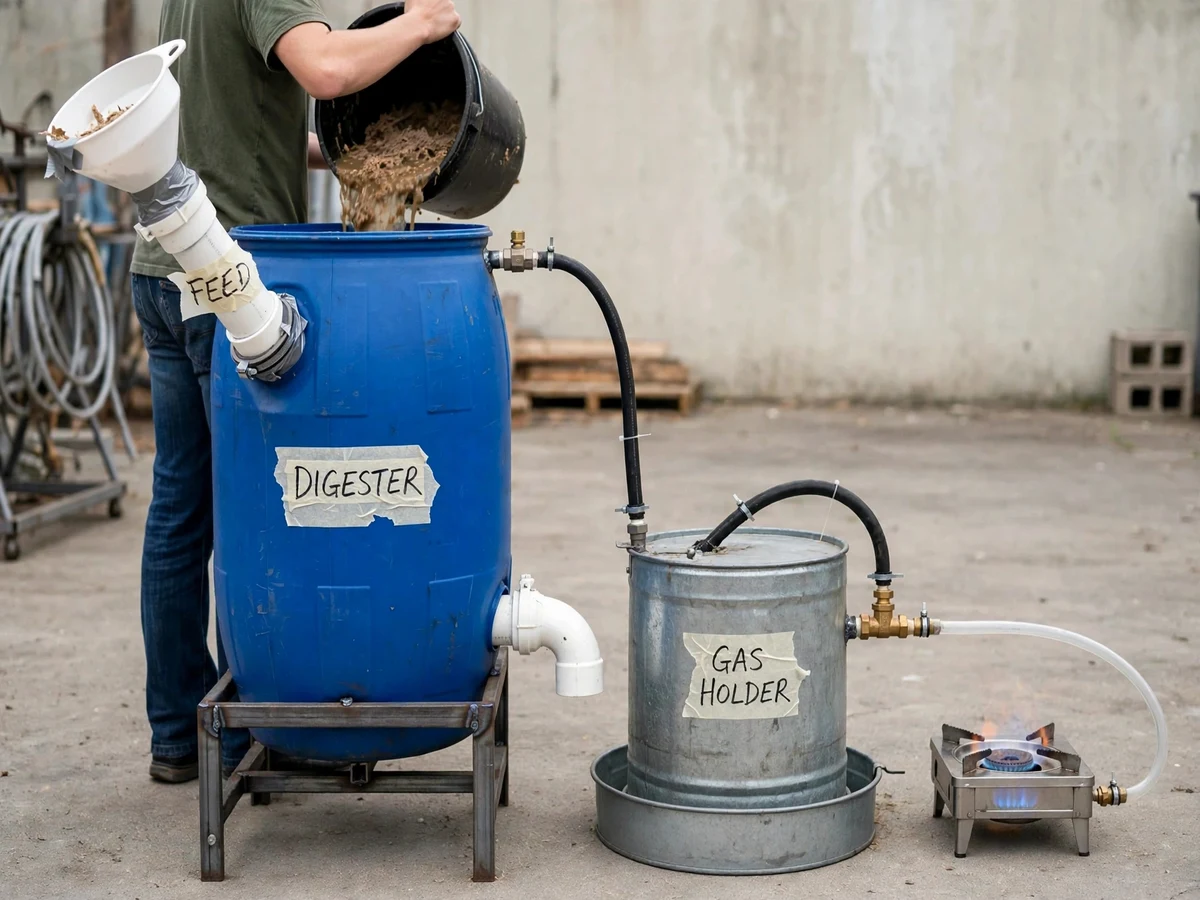
Indian households throw away tonnes of kitchen waste every day, most of it reaching landfills where it rots and releases methane straight into the atmosphere, while the same families buy LPG cylinders for cooking. Anaerobic digestion connects these two facts: the same waste, sealed in an oxygen-free vessel with the right bacteria, breaks down into biogas — a methane-rich fuel that burns cleanly on a stove — and the leftover slurry becomes organic fertilizer. The catch is that a digester is a living system: it needs a balanced feedstock, a mesophilic temperature window, stable pH and weeks of patience before the methanogen culture establishes. This project builds a compact, demonstrable version of that system — a 200L HDPE drum digester with an inlet feed pipe, an outlet slurry pipe, a floating-drum gas holder for storage, a valved gas line and a low-pressure stove burner — sized for a student build and a convincing viva demonstration.
Sorts and pulps the kitchen waste, seeds the drum and feeds it daily.
Follow the working sequence
How it works
- Kitchen waste is sorted (bones, plastic, large fibers and excess oily waste removed), pulped into a fine slurry and diluted approximately 1:1 with water (design guidance); the slurry is poured through the inclined inlet pipe into the sealed drum.
- The drum is seeded with active slurry — approximately 10–20% of the digester volume (design guidance), from an operating biogas plant or fresh cattle-dung slurry — to introduce the methanogen culture, since a sterile start produces no gas.
- With the lid gasketed shut, oxygen is excluded and anaerobic digestion begins: bacteria hydrolyse and acidify the organics, then methanogens convert the acids into biogas (textbook digestion stages: hydrolysis, acidogenesis, methanogenesis).
- The mesophilic window of approximately 30–38°C (textbook typical) is targeted by placing the digester in sun or shade as the season demands; the thermometer strip lets the student track it through the day.
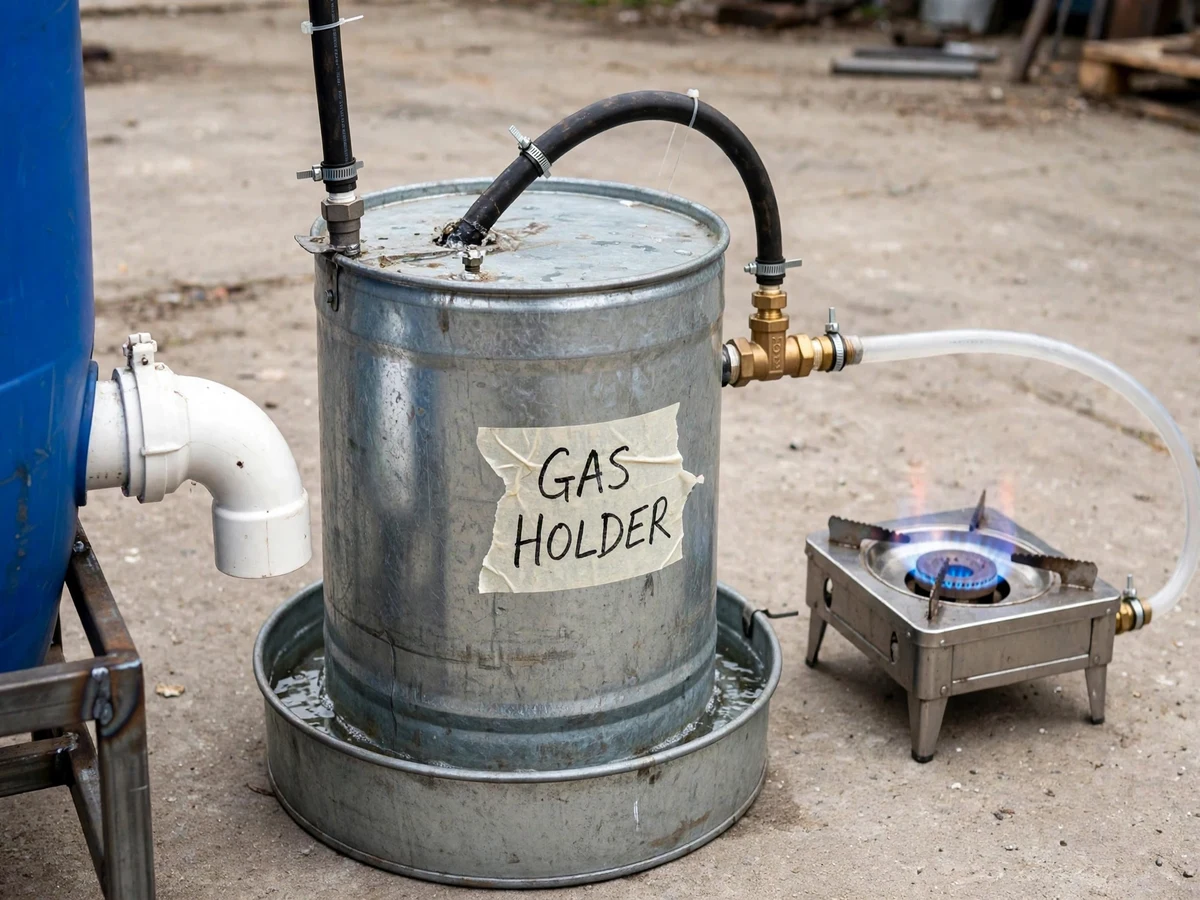
- Biogas — approximately 55–65% methane, remainder mostly CO₂ with trace H₂S (textbook typical composition, not a measured claim) — collects under the floating drum, which rises as stored volume grows.
- Opening the gas valve sends low-pressure gas through the pipeline to the stove burner; the flame is struck away from the holder and adjusted for the blue biogas flame (textbook biogas flame).
- Each day's fresh feed displaces an equal volume of digestate through the outlet pipe — a slurry rich in plant nutrients (design expectation) collected as fertilizer; steady daily feeding maintains the approximately 30–40 day retention (textbook typical, design target).
Tech stack:
- 200L HDPE drum with gasketed lid (digester vessel)
- Welded steel stand (drum support)
- Inverted floating steel drum (gas holder)
- PVC pipes and fittings (inlet feed pipe, outlet slurry pipe)
- Brass gas valve and plastic gas pipeline
- Low-pressure single-burner biogas stove burner
- pH paper strips and thermometer strip (process monitoring)
- Manual pulping procedure (feedstock preparation)
| Parameter | Value |
|---|---|
| Digester vessel | 200 L HDPE drum, gasketed sealed lid (design size) |
| Process | Single-stage anaerobic digestion, mesophilic |
| Operating temperature | Approximately 30–38°C (textbook typical range; design guidance) |
| Retention time | Approximately 30–40 days (textbook typical for kitchen waste; design target) |
| Biogas composition | Approximately 55–65% methane, remainder CO₂ with trace H₂S (textbook typical; not a measured claim) |
| Gas storage | Floating drum, approximately 150 L (design target) |
| Feed | Pulped kitchen waste diluted ~1:1 with water (design guidance); fed daily |
| Seed slurry | Active inoculum, ~10–20% of digester volume (design guidance) |
| pH window | Approximately 6.8–7.5 (textbook optimal; monitored with pH paper strips) |
| Gas line | Brass control valve + plastic pipeline to the stove burner |
| Burner | Low-pressure single-burner biogas stove, blue flame (design) |
Project features
- [200L HDPE digester vessel] A standard 200-litre HDPE drum serves as the sealed anaerobic reactor, mounted on a welded steel stand with a gasketed lid — corrosion-proof, light, and easy for a student team to source and fabricate.
- [Inlet feed pipe] An inclined PVC feed pipe with a funnel lets pulped kitchen-waste slurry (diluted approximately 1:1 with water, design guidance) be poured in without opening the digester, keeping the process anaerobic.
- [Outlet slurry pipe] A second PVC pipe on the opposite side discharges displaced digestate as enriched organic fertilizer — completing the visible waste-to-fuel-to-fertilizer loop.
- [Floating-drum gas holder] An inverted floating drum sits over the digester and rises as biogas accumulates; its height gives the student a visible, readable measure of stored gas (approximately 150 L of storage, design target).
- [Valved gas line with stove burner] A brass gas outlet valve and pipeline feed a low-pressure single-burner stove that burns biogas with its characteristic blue flame (textbook biogas flame), completing the waste-to-cooking demonstration.
- [pH and temperature guidance] A laminated operating chart and procedure keep the slurry in the textbook-healthy window — pH approximately 6.8–7.5 (textbook optimal) and the mesophilic 30–38°C range (textbook typical) — monitored with paper strips and a thermometer strip.
- [Optional: flame trap] As an optional customization, a simple water-seal flame trap can be fitted on the gas line for an extra safety margin; it is not part of the base build.
- [Future scope: pressure gauge and temperature logging] A U-tube water manometer for gas pressure and a logged temperature probe are planned extensions, documented as future scope in the report — not part of the base build.
What is included
- Working prototype: 200L HDPE digester on steel stand, floating-drum gas holder, feed and slurry pipes, valved gas line, biogas stove burner
- Fabrication and assembly drawings for the complete rig
- Feedstock preparation and daily feeding procedure manual
- pH/temperature operating chart and startup schedule (seed-slurry guidance, weeks-long culture establishment timeline)
- Safety manual: soapy-water leak-check procedure, ventilation rules, flame discipline
- Component list with the exact parts used in the build
- Project report PDF (anaerobic-digestion theory, design, methodology, operating procedure, textbook data tables)
- PPT presentation for final review
- Viva Q&A preparation document (digestion chemistry, mesophilic range, retention time, gas safety)
Limitations & prerequisites
- Methane is flammable and biogas carries trace H₂S: the digester is an outdoor or well-ventilated-area appliance only, with a soapy-water leak check before every run and no open flame near the holder — non-negotiable safety rules.
- Startup takes weeks: the methanogen culture establishes slowly, and the digester produces little or no burnable gas until it does — stated here as a design limitation, not a defect.
- Gas yield varies strongly with feedstock mix, temperature and feeding discipline — no fixed m³/day figure is promised; the page quotes textbook ranges only, and the student measures their own output.
- A 200L drum is demonstration scale: it supports the viva and a household-scale study, not a family's full cooking demand — full kitchen replacement needs a much larger plant.
- Oily food waste, bones, large fibers and excess citrus upset digestion and must be limited; the feedstock guide lists what goes in and what stays out.
- Ambient winter temperatures can fall below the mesophilic range and slow gas production; the build manual covers sun placement and insulation, not heating.
- This is an academic prototype, not a certified gas appliance — the burner is never left unattended, and the safety manual is read before first ignition.
Frequently Asked Questions
How much cooking gas will it produce?
Output varies strongly with feedstock mix, temperature and feeding discipline, so no fixed figure is promised. Textbook literature typically reports food-waste biogas potential of roughly 0.3–0.6 m³ per kg of volatile solids destroyed — the delivered build claims no measured figure; the student logs their own gas production across the approximately 30–40 day retention study (textbook typical retention).
Why does it not produce gas from day one?
Methanogens are slow-growing bacteria — the culture needs weeks to establish in a fresh digester, which is why the build includes a seed-slurry procedure (approximately 10–20% of digester volume, design guidance) and a realistic startup schedule in the operating chart.
Is a biogas digester safe as a college project?
Yes, when built and operated per the safety manual: outdoor or ventilated placement only, soapy-water leak checks before every run, no open flame near the gas holder, and an optional water-seal flame trap as a customization. Methane's flammability and the trace H₂S in biogas are respected, not hidden.
What kitchen waste can go into it?
Vegetable peels, fruit waste and leftover cooked food in moderation work well after pulping and 1:1 dilution with water (design guidance). Bones, plastic, large fibers, excess oil and excess citrus stay out — the feedstock guide in the build manual lists both columns.
Can the gas holder explode?
The floating drum is a low-pressure holder, not a pressure vessel: it simply rises as gas accumulates, storing gas at only a few millibars (design) — the real hazards are gas leaks and open flame near the holder, and both are covered by mandatory rules in the safety manual.
Is this project suitable for a final-year project?
Yes — for Mechanical, Energy and Environmental Engineering programs. It demonstrates anaerobic-digestion chemistry, real mechanical fabrication (drum, stand, floating holder, piping), process monitoring (pH, temperature, retention schedule) and genuine renewable-energy relevance, with operating data the student collects themselves for the report. Suitable for B.E./B.Tech final-year projects in Mechanical, Energy and Environmental Engineering.
Components & software requirements
- 200L HDPE drum with gasketed lid (digester vessel)
- Welded steel stand (drum support)
- Inverted floating steel drum (gas holder)
- PVC pipes and fittings (inlet feed pipe, outlet slurry pipe)
- Brass gas valve and plastic gas pipeline
- Low-pressure single-burner biogas stove burner
- pH paper strips and thermometer strip (process monitoring)
- Manual pulping procedure (feedstock preparation)
Delivery information
Built-to-order project. Delivery timeline is shared after order confirmation based on current queue.
Support terms
Complete documentation, setup guide, and viva preparation included. Support for setup and explanation provided.
Download free synopsis (PDF)
Enter your name and email — the synopsis PDF downloads immediately. We may send occasional project updates; no spam, unsubscribe anytime.