
More project photos (2)
The problem
Switching appliances by hand is a small annoyance that becomes a genuine accessibility and convenience problem for elderly people, people with limited mobility, and anyone managing loads across rooms. Commercial home-automation hubs solve this, but they hide the working behind proprietary apps and cost far more than a student needs to spend to learn the principle. This project builds the same idea from first principles: an Android phone talks to an Arduino over Bluetooth, and the Arduino drives a 4-channel relay module that switches real loads. Along the way the builder works with wireless serial communication, relay isolation, optocoupler interfacing, load-current awareness and — most importantly — safe mains wiring practice. The demo board with low-voltage bulbs lets the student prove every command path works before a certified electrician connects the relay contacts to 230V appliances, which is exactly the discipline a real installation would require.
Android phone running a Bluetooth terminal app; the user taps single-character commands.
Follow the working sequence
How it works
- The HC-05 Bluetooth module pairs with an Android phone and opens a serial port connection at 9600 baud (default, datasheet).
- The user sends a single-character command from a Bluetooth terminal app — for example, a toggle, on, or off character for channel 1.
- The Arduino Uno reads the incoming byte on its hardware serial port and matches it against the command table in firmware.
- The matched digital pin is driven low (the relay board uses active-low optoisolated inputs), energizing the relay coil for that channel.
- The relay's COM/NO contacts close, completing the load circuit — switching the appliance on or off.
- The Arduino immediately transmits the updated 4-channel state back over Bluetooth, and the phone display reflects which loads are on.
- Timer channels are checked each loop: when a channel's preset interval has elapsed, the firmware switches it off automatically and reports the change.
Tech stack:
- Arduino Uno (ATmega328P, 16 MHz, 5V logic)
- HC-05 Bluetooth module (Bluetooth 2.0+EDR, 3.3V logic)
- 4-channel 5V relay module (optoisolated, active-low)
- Arduino IDE with Embedded C/C++ firmware
- Bluetooth SPP serial protocol (9600 baud)
- Android Bluetooth terminal app (command sender)
- Breadboard + jumper-wire prototyping
- 5V demo bulbs for safe-logic verification
| Parameter | Value |
|---|---|
| Controller | Arduino Uno, ATmega328P @ 16 MHz, 5V logic (datasheet) |
| Bluetooth module | HC-05, Bluetooth 2.0+EDR, Class 2 — approximately 10 m open-air range (datasheet/typical) |
| Module logic level | 3.3V TX/RX pins (datasheet); powered from 3.6–6V (datasheet) |
| Relay contacts | 10A 250VAC / 10A 30VDC per channel (datasheet) |
| Coil current | Approximately 70 mA per energized channel (datasheet typical) |
| Channels | 4 independent, active-low optoisolated inputs |
| Command baud rate | 9600 baud default (datasheet) |
| Switching response | Under 1 s from phone tap to relay click (design target) |
| Demo loads | 2 × 5V DC bulbs on breadboard |
| Power supply | 5V 2A DC adapter for relay board (expected) |
| Timer preset | Default 30 min auto-off, configurable in firmware |
Project features
- [4-channel relay control] Each of the 4 relay channels switches one appliance independently. Contacts are rated 10A 250VAC per channel (datasheet), switched through optoisolators so the Arduino logic side stays isolated from the load side.
- [Bluetooth SPP command link] The HC-05 presents a Bluetooth Serial Port Profile link at 9600 baud (default, datasheet). A single-character command per channel (toggle/on/off) keeps the protocol simple enough to debug with any Bluetooth terminal app.
- [All-on / all-off master commands] Two dedicated commands drive all four channels at once, useful as a master switch demonstration and for showing how broadcast commands are parsed separately from channel commands.
- [Auto-off timer mode] A configurable channel can switch itself off after a preset interval (default 30 minutes, configurable in firmware), demonstrating timed-load control like a geyser or room heater use case.
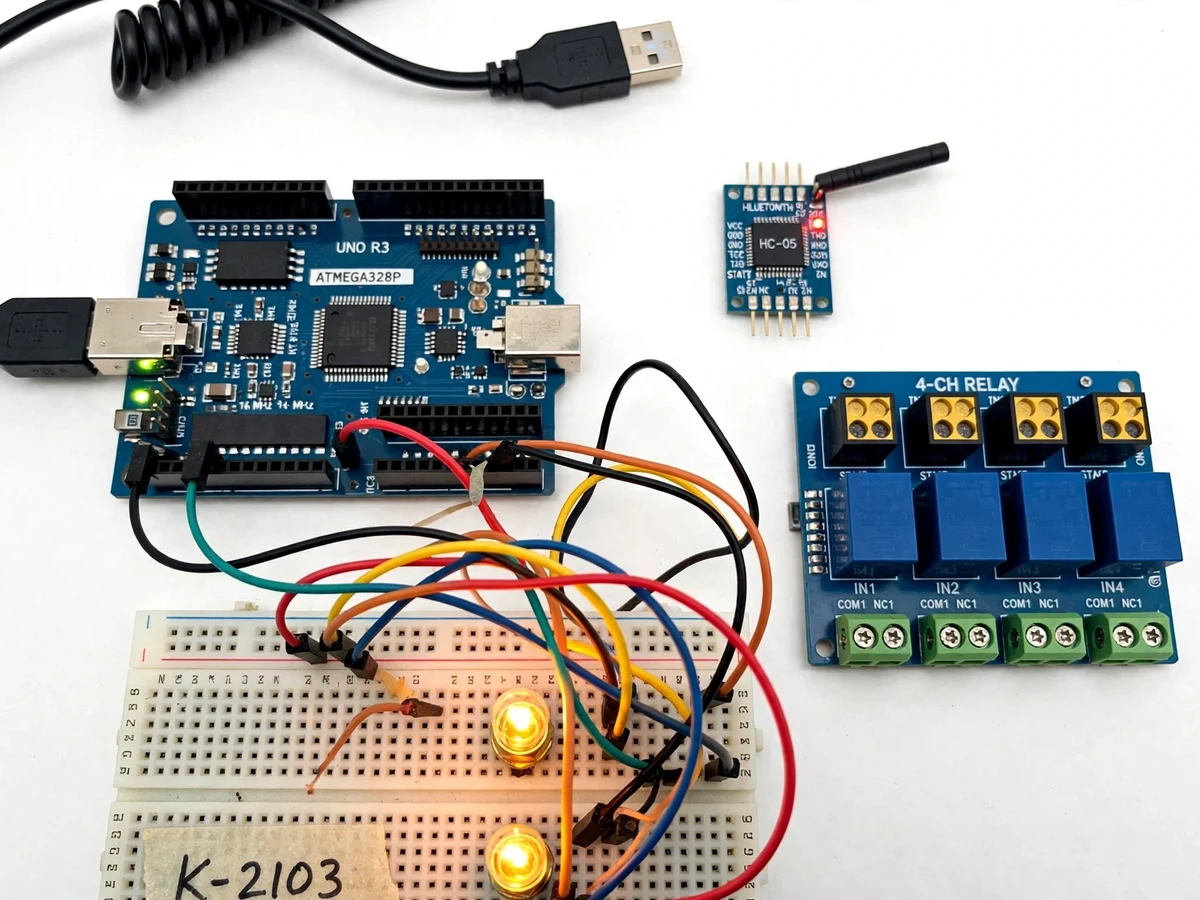
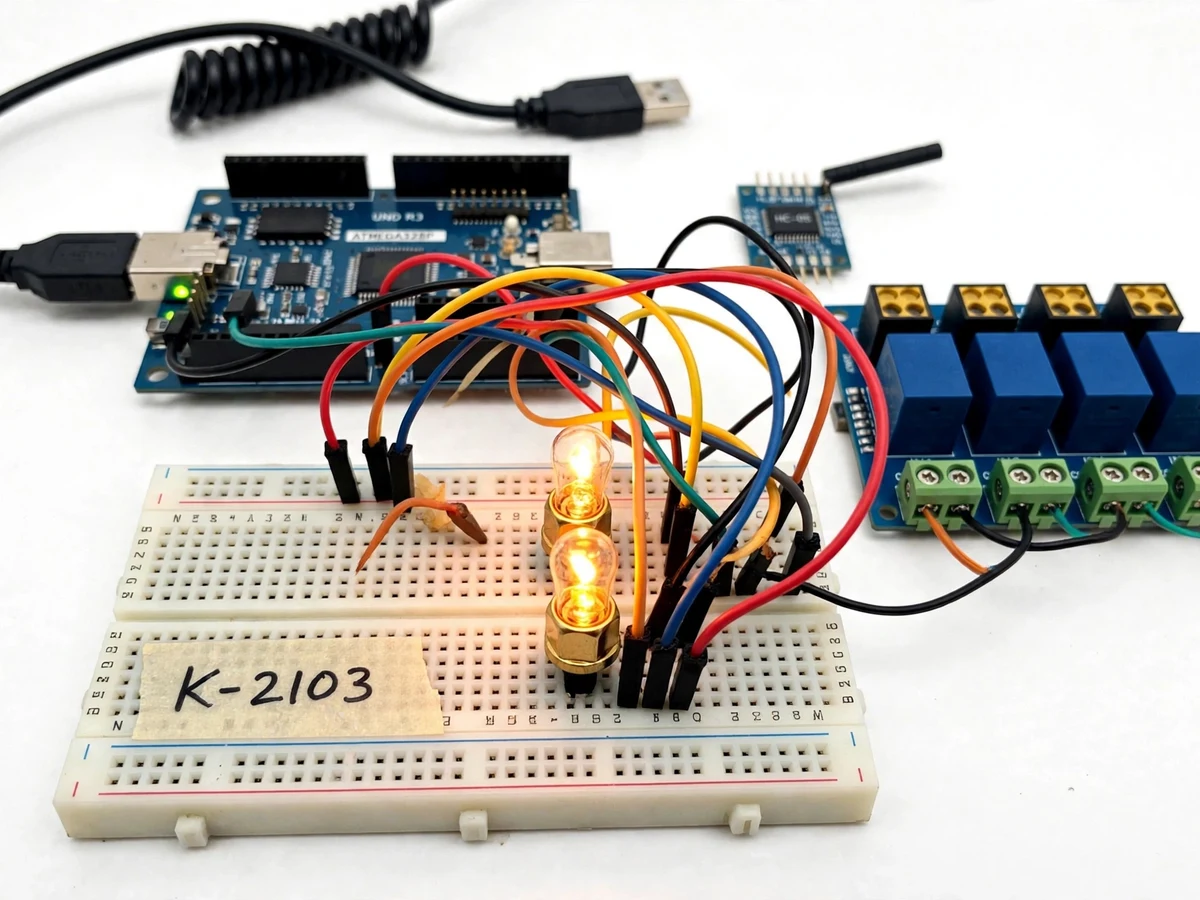
- [5V safe-demo mode] Two 5V demo bulbs on the breadboard mirror two of the relay channels, so the whole command chain is verified at safe voltage before any 230V wiring is considered.
- [Relay state feedback] After every command the Arduino echoes the channel states back over Bluetooth, so the phone screen always shows which relays are currently on — no silent state drift.
- [Fail-safe power-on state] Firmware initializes all channels to OFF at power-up, so a reset or blackout never energizes an appliance unexpectedly.
Optional customizations (developed on request, not part of the base build): Wi-Fi/ESP32 cloud version, voice control, additional channels, PIR-based motion switching. These are future scope, not implemented in the base project.
What is included
- Working prototype: Arduino Uno, HC-05 module, 4-channel relay module, breadboard with demo bulbs, wired and tested
- Complete Arduino firmware (commented Embedded C++) with command table and timer logic
- Wiring/schematic documentation: Bluetooth-to-Arduino and relay-load wiring diagrams
- Component list with specifications and sourcing notes
- Bluetooth pairing and command reference guide
- Mains-wiring safety sheet (what must be done by a certified electrician)
- Project report PDF (background, methodology, working, results)
- PPT presentation for final review
- Viva Q&A preparation document (Bluetooth SPP, relay isolation, optocouplers, AC switching safety)
- Build-progress updates over WhatsApp until delivery
- Expected build timeline: 2–4 weeks from confirmed order (expected)
Limitations & prerequisites
- Bluetooth Class 2 range is approximately 10 m in open air (datasheet/typical) — walls and furniture reduce it further; this is room-scale control, not remote-from-anywhere.
- 230V mains wiring must be done by a certified electrician; the shipped prototype demonstrates logic at 5V and the buyer must follow the safety sheet exactly.
- Relay contacts are mechanical (datasheet typical life around 100,000 operations) — not suited to rapid or continuous high-frequency switching.
- Inductive loads (fans, motors) stress contacts more than resistive loads; keep such loads conservative and derated well below the 10A contact rating.
- The base build has no internet, cloud, or voice control — remote operation beyond Bluetooth range is future scope (ESP32/Wi-Fi variant available as a customization).
- The Arduino Uno runs exactly 4 channels in this build; scaling beyond that needs additional relay boards and firmware changes.
- This is an academic prototype, not a certified home-electrical product — it provides no overload or short-circuit protection by itself.
Frequently Asked Questions
Which controller and communication module are used?
An Arduino Uno (ATmega328P) as the controller and an HC-05 Bluetooth 2.0+EDR module for the wireless link at 9600 baud. Both are standard, inexpensive and well-documented, so viva questions on serial communication and relay driving have clear, official answers.
How do I control the appliances from my phone?
Pair any Android Bluetooth terminal app with the HC-05, connect, and send single-character commands — toggle, on, or off per channel, plus all-on and all-off. The Arduino echoes the live relay states back, so the app shows exactly which loads are on.
Can this switch real 230V home appliances?
The relay contacts are rated 10A 250VAC per channel (datasheet), so they can switch real appliances. However, all mains wiring must be done by a certified electrician inside an insulated enclosure. The shipped prototype demonstrates everything safely at 5V on demo bulbs first.
Does it work without the internet?
Yes — Bluetooth needs no internet, Wi-Fi router or cloud account. The trade-off is range: approximately 10 m (datasheet/typical), reduced by walls. If you need control from anywhere, an ESP32 Wi-Fi variant can be developed as a customization.
Can the number of channels or features be increased?
Yes. More relay boards can be added with firmware changes, and timed, motion-triggered or voice modes are realistic customizations. The base build deliberately ships with 4 channels to keep the viva explanation clean; additions are scoped and priced separately.
Is this project suitable for a final-year project?
Yes — for Electrical and Electronics programs (and E&TC). It demonstrates wireless serial communication, optoisolated relay driving, load switching, mains-safety practice and embedded firmware, all testable in a live demo with honest, quantified limitations.
Components & software requirements
- Arduino Uno (ATmega328P, 16 MHz, 5V logic)
- HC-05 Bluetooth module (Bluetooth 2.0+EDR, 3.3V logic)
- 4-channel 5V relay module (optoisolated, active-low)
- Arduino IDE with Embedded C/C++ firmware
- Bluetooth SPP serial protocol (9600 baud)
- Android Bluetooth terminal app (command sender)
- Breadboard + jumper-wire prototyping
- 5V demo bulbs for safe-logic verification
Delivery information
Built-to-order project. Delivery timeline is shared after order confirmation based on current queue.
Support terms
Complete documentation, setup guide, and viva preparation included. Support for setup and explanation provided.
Download free synopsis (PDF)
Enter your name and email — the synopsis PDF downloads immediately. We may send occasional project updates; no spam, unsubscribe anytime.