
More project photos (2)
The problem
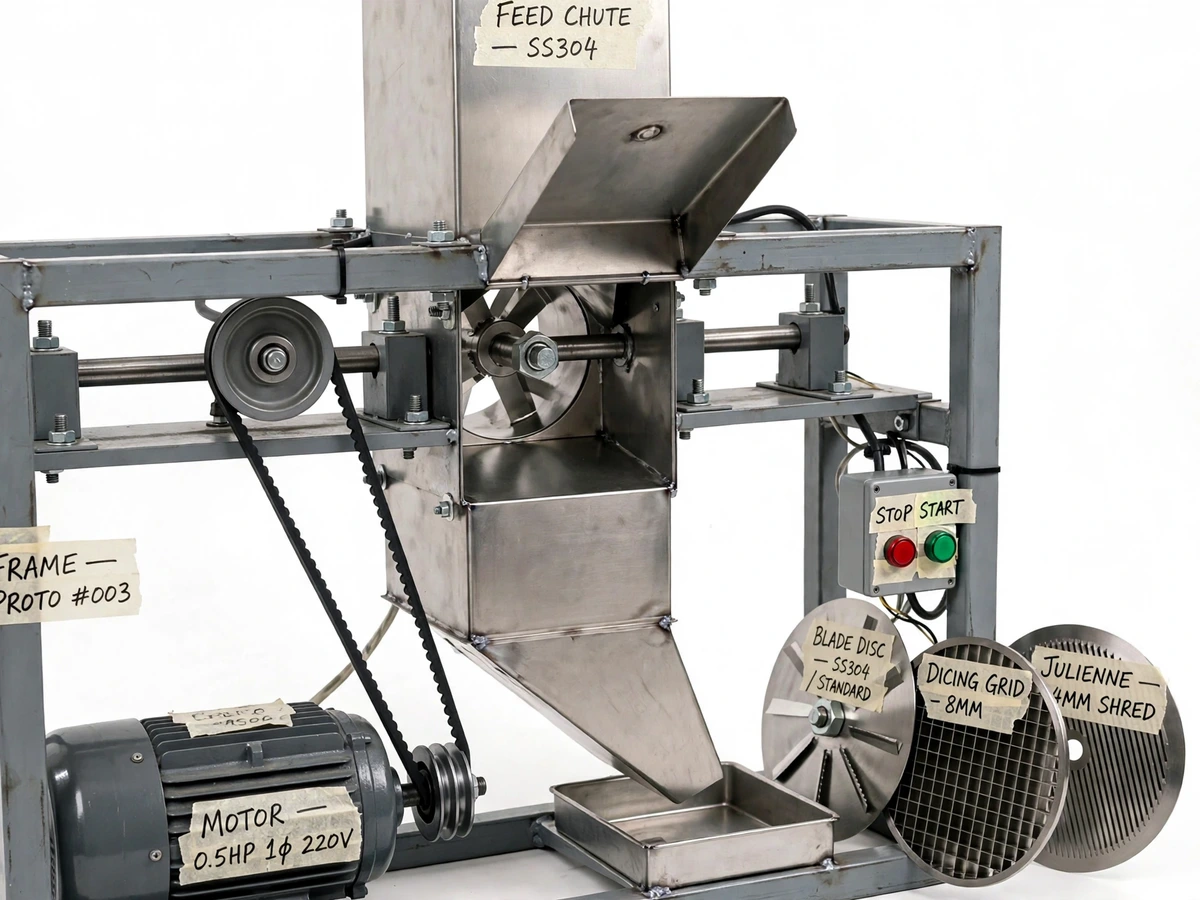
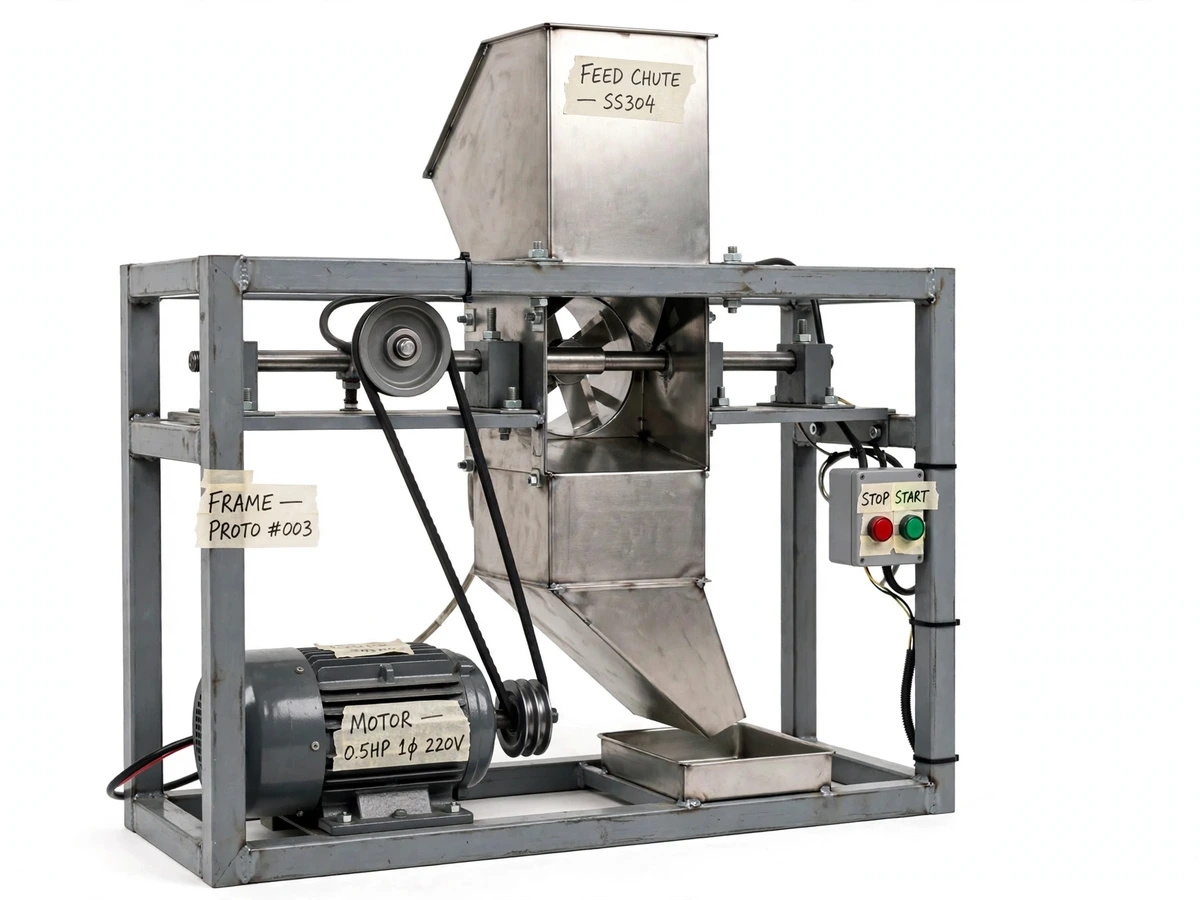
The Automatic Vegetable Cutting Machine with Interchangeable Blades is a student-built mechanical prototype that turns a 0.5 HP single-phase induction motor into high-volume vegetable processing through quick-change food-grade SS304 blade discs. One machine slices, dices and juliennes — the operator swaps a single disc in under two minutes (design target) instead of buying three machines. Hostel messes and canteens still cut most vegetables by hand: it is slow, thickness varies piece to piece, and knives cause kitchen injuries. Commercial multi-cut machines solve this but cost as industrial equipment and lock the buyer into one cut profile. This build answers at student scale: a belt-driven cutter shaft at roughly 300–400 rpm, a vertical SS304 gravity feed chute with a food pusher that keeps hands from the blades, a lid safety interlock that cuts power when the chamber opens, and overload protection for the motor. Every figure here is a labeled design target or datasheet value — nothing is presented as measured.
Build note from the design documentation: the food pusher rides the feed chute with a small side clearance — tight enough that small vegetables cannot slip past it unsheared, loose enough that it never binds on oversized or swollen produce. The same discipline runs through the blade discs: all food-contact parts are SS304 with a documented wash-down procedure between uses, because a food machine that cannot be cleaned is a failed design. The abstract PDF carries the full fabrication drawings, the blade-change procedure and the commissioning checklist the buyer runs on their own build.
How it works
The cutting cycle is a power chain. A 0.5 HP motor at about 1440 rpm (datasheet) drives the cutter shaft at roughly 300–400 rpm through a V-belt reduction near 4:1. The operator drops vegetables into the SS304 feed chute and adds the food pusher — gravity and the pusher's weight press produce onto the disc. The disc shears each piece at the feed opening: the slicing disc shaves uniform slabs, the dicing grid scores then cross-cuts cubes, the julienne disc shreds strips; cut pieces fall to the tray. Changing cut means stopping the machine, opening the interlocked lid and swapping the disc on its single lock-nut — under two minutes by design. The governing principle is worth quoting: throughput in a disc cutter is not a motor spec — it is the product of disc radius, shaft speed and blade passes per revolution, which is why the changeover disc set, not the 0.5 HP motor, is this machine's real specification.
- Load washed, peeled vegetables into the vertical SS304 feed chute and place the food pusher on top; keep hands clear of the chamber.
- Close the lid — the interlock microswitch closes and enables the contactor — then press START.
- The 0.5 HP motor (~1440 rpm, datasheet) drives the cutter shaft at ~300–400 rpm through the ~4:1 V-belt reduction (design targets).
- Gravity and the pusher feed produce onto the spinning disc, which shears slices, dice or juliennes depending on the mounted disc; cut pieces fall through the discharge chute into the tray.
- Press STOP after the batch; open the lid only after the disc stops — the interlock prevents running with the chamber open.
- To change cut profile: stop, open lid, undo one lock-nut, swap the disc, re-tighten — under 2 minutes (design target) — then wash down all food-contact parts before the next run.
Tech stack:
- 0.5 HP single-phase induction motor (~1440 rpm · 230 V 50 Hz · datasheet)
- V-belt + cast-iron pulley reduction (~4:1 · cutter shaft ~300–400 rpm design target)
- Food-grade SS304 blade discs (slicing 2–10 mm · 8 mm dicing grid · 4 mm julienne)
- SS304 gravity feed chute + food pusher + discharge chute + collection tray
- Lid interlock microswitch in series with contactor coil
- Thermal overload relay + DOL starter with start/stop push buttons
- MS square-tube welded frame with anti-vibration mounts
- Keyed cutter shaft on pillow-block bearings
| Parameter | Value |
|---|---|
| Motor | 0.5 HP single-phase induction motor, ~1440 rpm, 230 V 50 Hz (datasheet) |
| Speed reduction | V-belt and pulleys, ratio approximately 4:1 (design target) |
| Cutter shaft speed | ~300–400 rpm (design target) |
| Blade discs | 3 discs: slicing (2–10 mm adjustable gap), 8 mm dicing grid, 4 mm julienne shredding — food-grade SS304 (design targets) |
| Blade changeover | Under 2 minutes, single lock-nut on keyed hub (design target) |
| Throughput | ~60–80 kg/hr on fresh vegetables (design target — buyer-verified during commissioning, not a measured claim) |
| Feed chute | SS304 square tube, approximately 100 × 100 mm opening (design target) |
| Frame | MS square tube, approximately 25 × 25 mm, welded, with anti-vibration mounts (design target) |
| Overall size | Approximately 600 × 450 × 900 mm (design target) |
| Protection | Lid interlock microswitch (series with contactor coil) + thermal overload relay sized to motor full-load current |
| Power supply | 230 V single-phase 50 Hz mains; no battery option in the base build |
Project features
The machine's capability stack is four deep. First, the quick-change blade system: three food-grade SS304 discs — a slicing disc with adjustable blade gap, an 8 mm dicing grid and a 4 mm julienne shredding disc — mount on one keyed cutter hub, so the whole cut profile changes with a single lock-nut in under two minutes (design target). Second, the belt-drive power train: a 0.5 HP single-phase motor at about 1440 rpm drives the cutter shaft at roughly 300–400 rpm through a V-belt reduction near 4:1, trading speed for the torque that dense root vegetables demand. Third, the gravity feed system: a vertical SS304 chute with a weighted food pusher feeds produce hands-free onto the disc. Fourth, the safety layer: a lid interlock microswitch wired in series with the contactor coil, plus a thermal overload relay on the motor, so opening the chamber or overloading the cut always kills power.
- [Quick-change SS304 blade discs] (implemented) Three food-grade SS304 discs — slicing, 8 mm dicing grid, 4 mm julienne shredding — mount on a single keyed hub; one lock-nut changes the cut profile in under 2 minutes (design target).
- [Belt-drive speed reduction] (implemented) A 0.5 HP single-phase motor (~1440 rpm, datasheet) drives the cutter shaft at ~300–400 rpm through a V-belt reduction of approximately 4:1, trading speed for cutting torque.
- [Gravity feed chute + food pusher] (implemented) A vertical SS304 chute feeds vegetables onto the disc by gravity while the pusher keeps hands clear of the cutting zone and maintains feed pressure.
- [Lid safety interlock] (implemented) A microswitch on the chamber lid is wired in series with the contactor coil — opening the lid drops power to the motor immediately.
- [Motor overload protection] (implemented) A thermal overload relay sized to the motor's full-load current trips on sustained overload, protecting the windings during jams.
- [Adjustable slice thickness] (configurable) The slicing disc's blade gap adjusts from 2 to 10 mm (design target) with a shim setting, documented in the commissioning checklist.
- [SS304 discharge chute + tray] (implemented) Cut produce exits through an SS304 discharge chute into a removable collection tray for hygienic handling.
- [Extra blade profiles] (optional customization) Additional discs — wavy-chip, grating or custom dicing grids — can be fabricated to order; they are not part of the base three-disc set.
What is included
- Working prototype: MS frame, 0.5 HP motor, belt drive, SS304 chamber/chutes/tray, 3 blade discs, interlock + overload protection
- Fabrication drawings (frame, shaft, chute, blade discs) with the blade-change procedure
- Wiring diagram for the DOL starter, interlock and overload relay
- Component list with Indian supplier sourcing notes for the motor, SS304 sheet, pulleys, belt, contactor and overload relay
- Commissioning checklist the buyer runs: belt tension, shaft alignment, interlock test, overload trip test, throughput trial procedure
- Blade wash-down and maintenance procedure for all food-contact parts
- Project report PDF (design calculations, fabrication method, safety analysis, honest throughput methodology)
- PPT presentation for final review
- Viva Q&A preparation document (belt-drive design, blade geometry, food-grade material choice, safety interlocks)
Limitations & prerequisites
- Throughput of ~60–80 kg/hr is a design target, not a measured result — actual output depends on vegetable type, operator feed rate and blade sharpness; the commissioning checklist includes a buyer-run throughput trial.
- This is an academic prototype, not a certified food-processing machine — food-contact parts are SS304, but it carries no FSSAI, CE or food-safety certification.
- Sized for fresh vegetables only — hard produce such as mature coconut, frozen blocks or sugarcane will stall or damage the blade discs and are excluded.
- Blade edges dull with use; resharpening or replacement is routine maintenance, not a defect — the maintenance procedure covers it.
- A belt-driven prototype produces noticeable noise and vibration; it is a lab/demonstration machine, not a quiet commercial appliance (expected).
- Requires 230 V single-phase mains at the installation point; the base build has no battery or portable option.
- All food-contact parts must be washed down between uses per the cleaning procedure; water must be kept clear of the motor, belt and starter panel.
Frequently Asked Questions
How do the interchangeable blades work?
Each blade disc mounts on the same keyed cutter hub with a single lock-nut: the slicing disc shaves uniform slabs with an adjustable 2–10 mm gap, the dicing grid scores and cross-cuts 8 mm cubes, and the julienne disc shreds 4 mm strips. Swapping discs changes the entire cut profile — stop, open the interlocked lid, undo one nut, swap the disc and re-tighten in under two minutes (design target). All three discs are food-grade SS304 and included in the base build; extra profiles like wavy-chip or grating discs can be fabricated to order.
What throughput can I expect?
60–80 kg/hr of fresh vegetables is the design target — stated honestly, not a measured result, because no two builds see identical feed rates, produce density or blade sharpness. Dense root vegetables cut slower than soft produce, and operator feed rhythm matters. The commissioning checklist includes a buyer-run throughput trial so the figure is verified on the student's own machine, and the report documents the method rather than claiming a result.
Is it food-safe?
All food-contact parts — blade discs, feed chute, discharge chute and collection tray — are food-grade SS304, and the build ships with a documented wash-down procedure for cleaning between uses. Honest boundary: SS304 contact surfaces are necessary but not sufficient — the machine is an academic prototype with no FSSAI or CE food-safety certification, so it is positioned for demonstration and student-scale use, not commercial food production.
Is this project suitable for a final-year project?
Yes — for Mechanical engineering programs (and Production/Manufacturing where offered). It demonstrates belt-drive power transmission design, shaft and bearing sizing, sheet-metal fabrication in SS304, food-grade material selection, and machine safety through interlocks and overload protection — all at a build scale a student team can actually fabricate. Every figure on the page is labeled honestly as a design target or datasheet value, which is exactly the discipline examiners probe in a viva.
What power supply does it need?
A standard 230 V single-phase 50 Hz mains connection at the installation point — the 0.5 HP induction motor, DOL starter, contactor and overload relay are all single-phase. No three-phase supply is needed and there is no battery option in the base build. The buyer-run commissioning checklist includes verifying supply voltage before first start.
Can it be customized?
Yes, within honest mechanical limits: extra blade profiles (wavy-chip, grating, different dicing grids), a larger feed chute, or a higher-rated motor for denser produce can be built to order. What cannot change is physics — throughput still depends on disc speed and feed rate, and the interlock plus overload protection stay mandatory on every variant.
Components & software requirements
- 0.5 HP single-phase induction motor (~1440 rpm · 230 V 50 Hz · datasheet)
- V-belt + cast-iron pulley reduction (~4:1 · cutter shaft ~300–400 rpm design target)
- Food-grade SS304 blade discs (slicing 2–10 mm · 8 mm dicing grid · 4 mm julienne)
- SS304 gravity feed chute + food pusher + discharge chute + collection tray
- Lid interlock microswitch in series with contactor coil
- Thermal overload relay + DOL starter with start/stop push buttons
- MS square-tube welded frame with anti-vibration mounts
- Keyed cutter shaft on pillow-block bearings
Delivery information
Built-to-order project. Delivery timeline is shared after order confirmation based on current queue.
Support terms
Complete documentation, setup guide, and viva preparation included. Support for setup and explanation provided.
Download free synopsis (PDF)
Enter your name and WhatsApp number — the synopsis PDF downloads immediately. We may send occasional project updates on WhatsApp; no spam.