
More project photos (2)
The problem
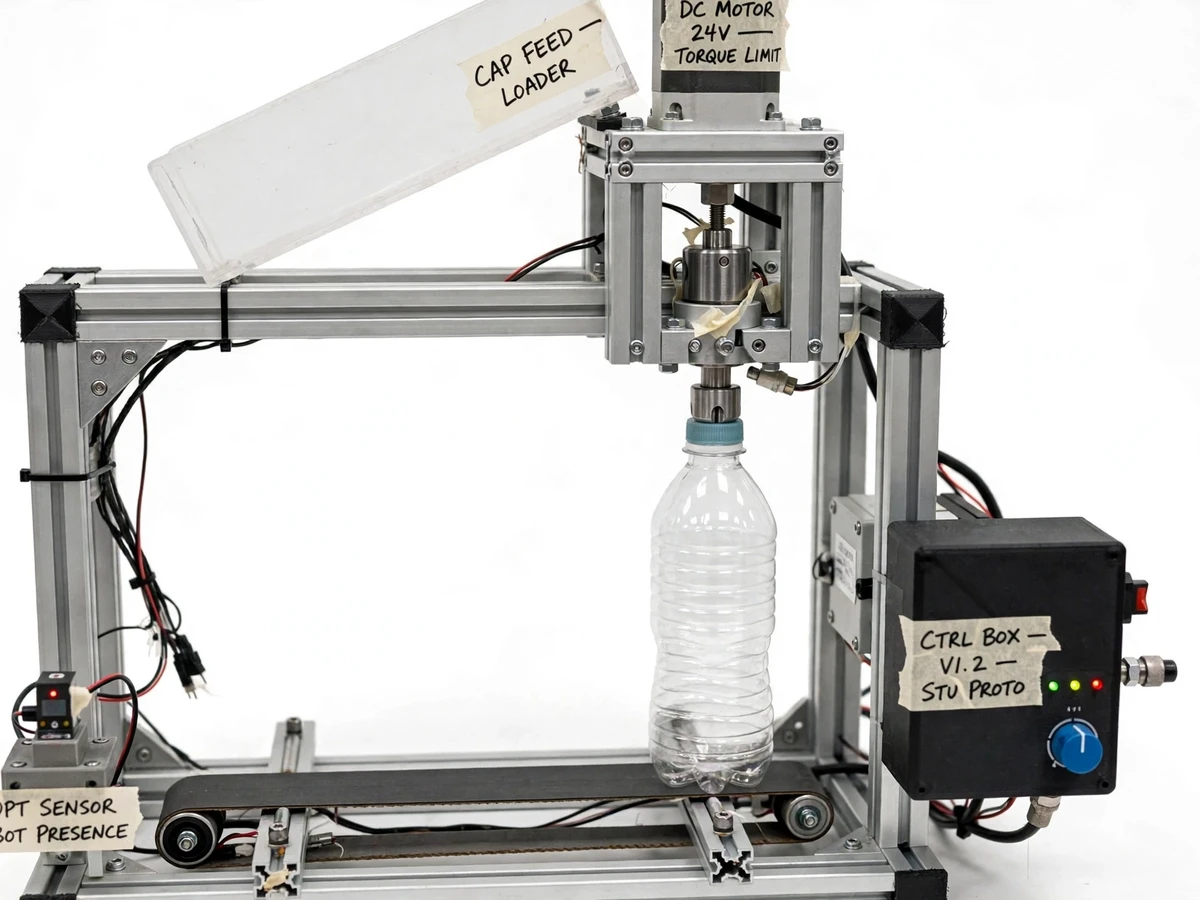
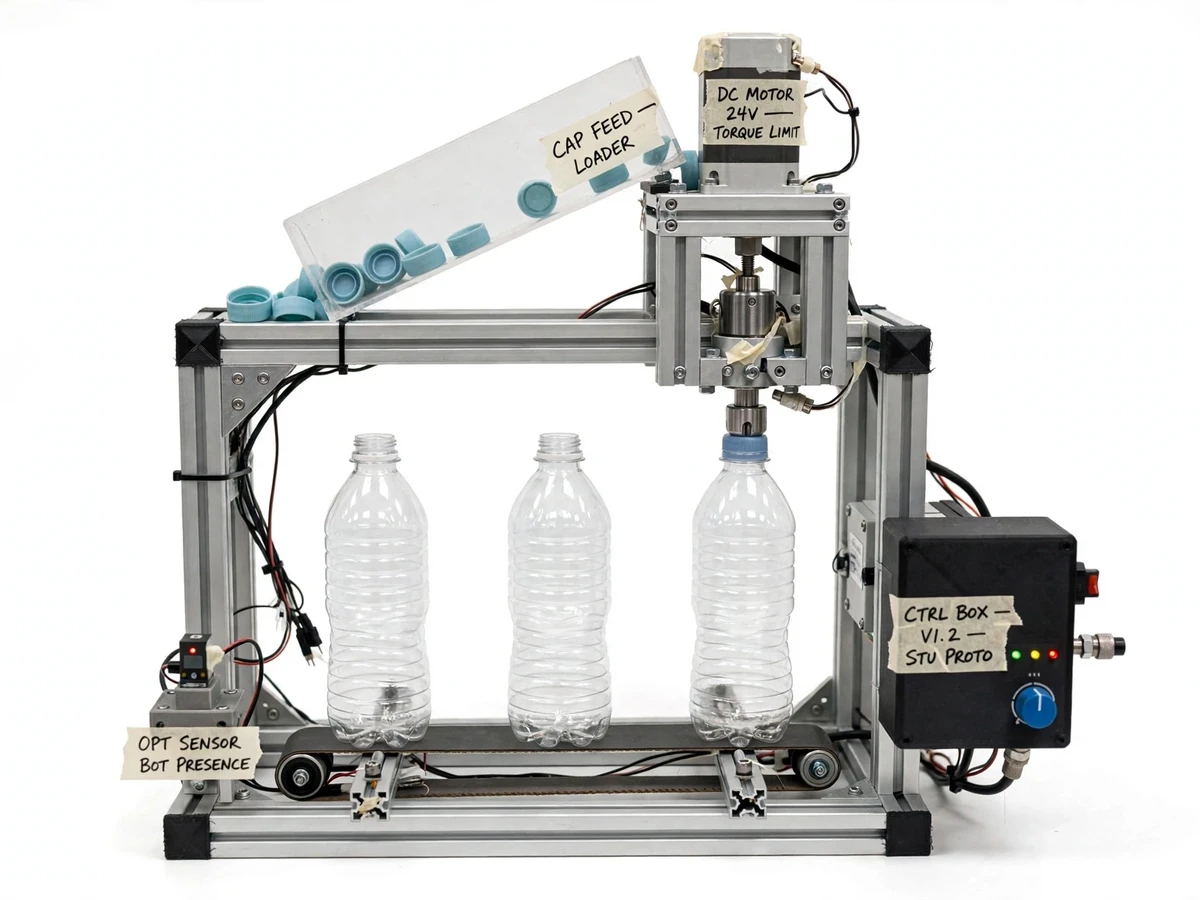
Small workshops and college labs that fill bottles in small batches still cap most bottles by hand. Hand capping is slow, tiring and inconsistent: one operator grips a cap harder than the next, so some bottles leak while others are so tight that threads strip or thin caps crack when opened. The Automatic Bottle Capping Machine with Torque Control answers that inconsistency with a bench-scale machine that moves each bottle into position, places a cap, and tightens it only to a set torque limit before releasing it. A conveyor carries bottles to the capping station, a sensor confirms a bottle is present, a feeder chute presents a cap, and a current-sensing drive stops the capping head as soon as motor current reaches the torque threshold. The result is a repeatable cap on every bottle in the batch, without the guesswork of hand tightening, at a scale and cost a small shop or a student team can actually build and maintain.
A short belt that carries bottles into and out of the capping station.
Follow the working sequence
How it works
A bottle enters on the conveyor, a cap is placed on its mouth, the torque-limited head tightens the cap to the set limit, and the finished bottle leaves on the belt. The conveyor indexes the bottle into the capping station and the presence sensor confirms it is in position before anything moves. The feeder presents a cap over the bottle mouth, the head lowers, grips the cap and spins it down the thread while the controller watches motor current. When current reaches the torque threshold, the head stops and lifts, the conveyor indexes the bottle out, and the missing-cap check confirms a cap is present before the next bottle arrives. If no cap is detected, the machine flags the bottle and pauses so the operator can correct it. The whole cycle then repeats for each bottle without the operator touching a cap.
- The operator loads empty bottles on the infeed end of the conveyor and fills the cap feeder with matching caps.
- The conveyor indexes one bottle into the capping station and the optical sensor confirms a bottle is present.
- The feeder presents a single cap above the bottle mouth and the head lowers to grip the cap.
- The geared DC motor spins the chuck while the controller monitors motor current continuously.
- When motor current reaches the set torque threshold, the controller stops the head and lifts it clear of the cap.
- The conveyor indexes the finished bottle out and the missing-cap check confirms a cap is present.
- If a bottle leaves without a cap, the fault light shows and the machine pauses for the operator to correct it.
- The operator sets head height and torque limit again only when the bottle or cap size changes.
Tech stack:
- Aluminium extrusion frame with belt conveyor
- Geared DC motor with capping chuck
- Current sensor for torque-limit detection
- Microcontroller-based control board
- Optical bottle-presence sensor
- Gravity cap feeder chute
- 24 V DC power supply with control box
- Indicator lights and torque-setting knob
| Parameter | Value |
|---|---|
| Machine type | Bench-scale automatic bottle capper (prototype scale) |
| Bottle height range | 150 mm to 300 mm (design target) |
| Bottle diameter | Up to 90 mm (design target) |
| Cap diameter | 28 mm (design target, standard PET cap size) |
| Torque range | 0.8 N·m to 1.5 N·m (design target, adjustable) |
| Capping head speed | Approximately 60 rpm (design target) |
| Throughput | Approximately 8 bottles per minute (design target) |
| Conveyor length | Approximately 600 mm (design target) |
| Drive | Geared DC motor, 24 V DC (datasheet value) |
| Torque method | Motor current sensing with set threshold (design approach) |
| Power input | 230 V AC mains through 24 V DC supply (design target) |
| Footprint | Bench-scale, approximately 900 mm long (design target) |
Project features
The strongest capabilities of this build are its torque-limited capping head, its indexed conveyor with bottle-presence sensing, its adjustable head height for different bottle sizes, and its missing-cap handling. The torque-limited head is the heart of the machine: instead of spinning a cap for a fixed time, the drive watches motor current and stops at the set limit, so soft and stiff caps alike finish at the same tightness. The conveyor indexes one bottle at a time into the capping station and waits for the sensor before the head moves, which keeps spacing steady and prevents dry runs. Height adjustment lets the same machine serve short and tall bottles, and the missing-cap check catches the one failure a busy operator is most likely to miss. Together these give a small-batch line that an operator can run, adjust and fault-find without specialist tooling.
- [Torque-limited capping head — implemented] A geared DC motor drives the chuck through a current sensor; the controller stops the head when motor current reaches the torque threshold set by a knob, so tightening ends at a repeatable limit rather than after a fixed time.
- [Indexed conveyor with bottle-presence sensing — implemented] The belt moves one bottle at a time into the capping station and only starts a capping cycle when the optical sensor confirms a bottle is present, which prevents empty cycles and keeps bottle spacing steady.
- [Cap feeder and placement — implemented] A gravity chute feeds caps one at a time to the placement position above the bottle mouth, so the operator only refills the feeder instead of handling every cap by hand.
- [Adjustable head height — implemented] The capping head rides on a height-adjustable mount, so the machine can be set up for short and tall bottles within its size range without rebuilding the frame.
- [Missing-cap detection and flagging — implemented] A check after the capping station flags a bottle that leaves without a cap, using an indicator light and a pause, so an uncapped bottle is caught on the line rather than in a packed box.
- [Torque setting and status indicators — implemented] A front-panel knob sets the torque limit and indicator lights show running, capping and fault states, giving the operator a clear view of what the machine is doing at a glance.
- [Reject pusher for uncapped bottles — optional] An optional side pusher can divert a flagged uncapped bottle off the line automatically, offered as an add-on for buyers who want hands-off rejection.
- [Vision-based cap inspection — future scope] A camera check for tilted or cross-threaded caps is future scope only; it is not part of the delivered build and would need its own lighting, mounting and testing work.
What is included
- Bench-scale bottle capping machine with conveyor, cap feeder and torque-limited capping head
- Control box with torque-setting knob, indicator lights and fault pause
- Calibration guide for setting torque limit and head height for a new bottle or cap size
- Operator checklist for daily start-up, feeder refill and cleaning
- Project report PDF (background, mechanism design, torque control logic, testing procedure)
- PPT presentation for final review
- Viva Q&A preparation document (torque, current sensing, indexing, cap handling)
Requirements
- A bench or table that can hold the machine footprint, plus a nearby mains power outlet for the power supply.
- Sample bottles and caps in the sizes the buyer wants to run, supplied before final calibration so torque and head height can be set on real parts.
- A clean, dry indoor workspace for assembly, calibration and demonstration runs.
Limitations & prerequisites
- This is a prototype-scale machine for small shops and labs; it is not a food-grade production line and carries no food-safety certification.
- Bottles and caps must be cleaned manually; the machine has no washing, filling or sealing stage.
- Throughput is a design target of approximately 8 bottles per minute; it is not a measured production rate and will vary with bottle size and operator handling.
- Only one cap size can run at a time; changing cap size needs a feeder and chuck adjustment plus recalibration.
- The torque band is a design target of 0.8 N·m to 1.5 N·m; the buyer must verify the setting on their own bottles and caps before any real batch.
- Very soft, damaged or out-of-tolerance caps may still seat unevenly and need manual inspection.
Timeline
- Week 1 to week 2: frame, conveyor and capping-head assembly with wiring and control box build.
- Week 3 to week 4: torque calibration, sensor setup and trial runs on buyer-supplied bottles and caps.
- Week 5 to week 6: final checks, documentation handover and dispatch preparation.
Support
- Support covers assembly guidance, torque and height calibration walkthrough, and fault-finding for the delivered build during its handover period.
- Calibration help is given for the bottle and cap sizes supplied before final calibration; a new size needs a fresh calibration run.
Frequently Asked Questions
How does torque control work in this machine?
Torque is limited by motor current, not by a fixed timer. The geared DC motor spins the capping chuck while the controller watches motor current, and when current reaches the threshold set by the front-panel knob, the controller stops the head and lifts it. In practice, this gives a repeatable limit across a batch, because a fixed timer would over-tighten stiff caps and under-tighten free-spinning ones.
Why must torque be capped at all?
Too little torque leaves a cap loose enough to leak in storage or transport, while too much torque strips bottle threads or cracks thin plastic caps. A capped torque limit keeps every bottle in the batch inside the same safe band. The builder note behind this design is simple: current sensing gives a repeatable limit where a fixed timer cannot, because current rises with the resistance the cap meets.
What bottle and cap sizes can it handle?
The machine is designed for bottles from 150 mm to 300 mm tall and up to 90 mm in diameter, with 28 mm caps as the design-target size. Head height adjusts across that bottle range, so short and tall bottles can run on the same frame. Other cap sizes need a feeder and chuck adjustment plus a fresh torque calibration before running.
What happens if a cap is missing?
A bottle that leaves the capping station without a cap is flagged immediately, with a fault light and a machine pause so the operator can correct it. This check exists because an uncapped bottle is easy to miss in a busy batch and costly to find later. An optional reject pusher can divert flagged bottles automatically, but it is an add-on rather than part of the standard build.
Can this machine run a food production line?
No, it is a prototype-scale machine for small shops, labs and student demonstration only, and it carries no food-safety certification for commercial production use. Bottles and caps must be cleaned manually, and there is no washing, filling or sealing stage. A buyer who needs a certified food line should treat this build as a mechanism demonstrator and a small-batch helper, not as production equipment.
Is this project suitable for a final-year project?
Yes, it fits Mechanical Engineering programmes well, because it combines mechanism design, motor selection, sensor-based control and hands-on calibration in one working machine. The torque-limit logic, conveyor indexing and missing-cap handling each give clear material for the report and the viva discussion. The build also gives a complete calibration record the student can present and defend.
Components & software requirements
- Aluminium extrusion frame with belt conveyor
- Geared DC motor with capping chuck
- Current sensor for torque-limit detection
- Microcontroller-based control board
- Optical bottle-presence sensor
- Gravity cap feeder chute
- 24 V DC power supply with control box
- Indicator lights and torque-setting knob
Delivery information
Built-to-order project. Delivery timeline is shared after order confirmation based on current queue.
Support terms
Complete documentation, setup guide, and viva preparation included. Support for setup and explanation provided.
Download free synopsis (PDF)
Enter your name and WhatsApp number — the synopsis PDF downloads immediately. We may send occasional project updates on WhatsApp; no spam.