
More project photos (2)
The problem
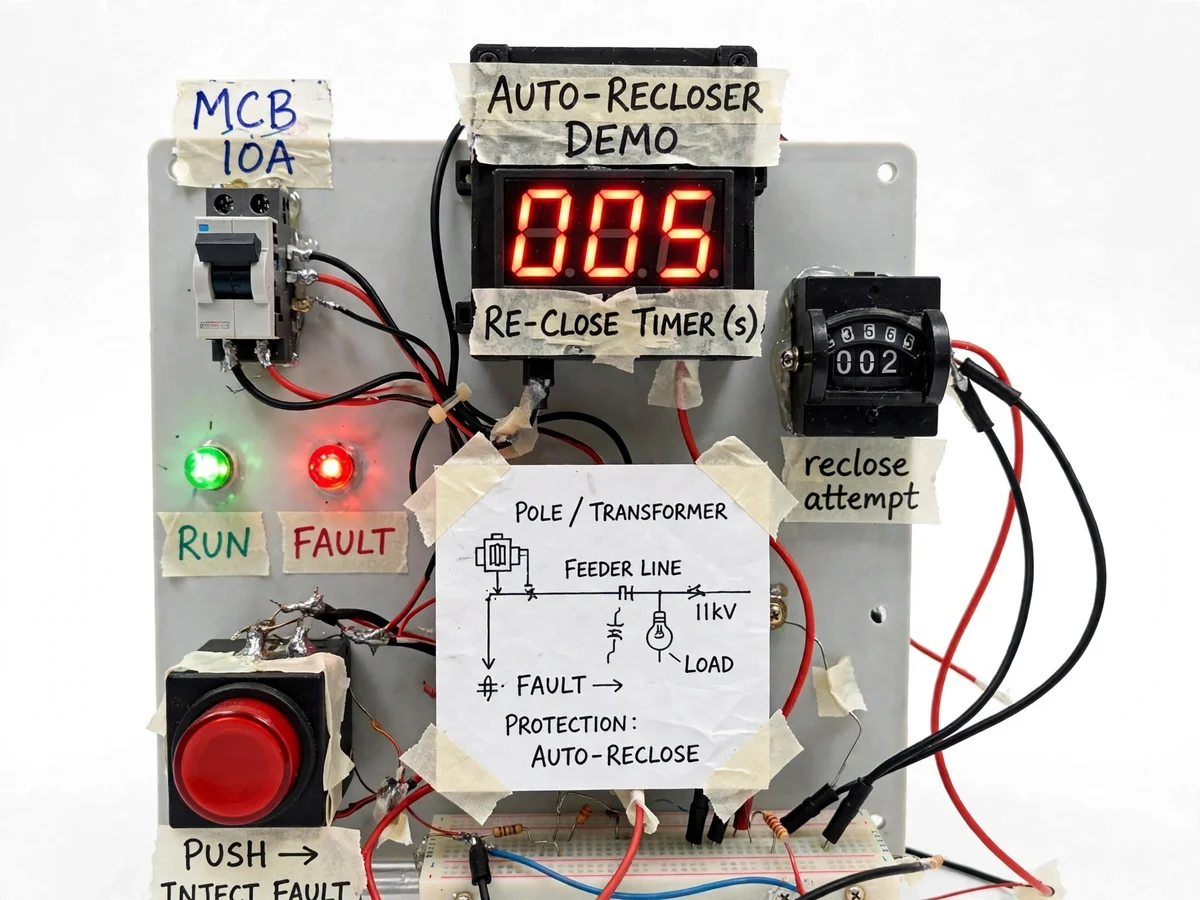
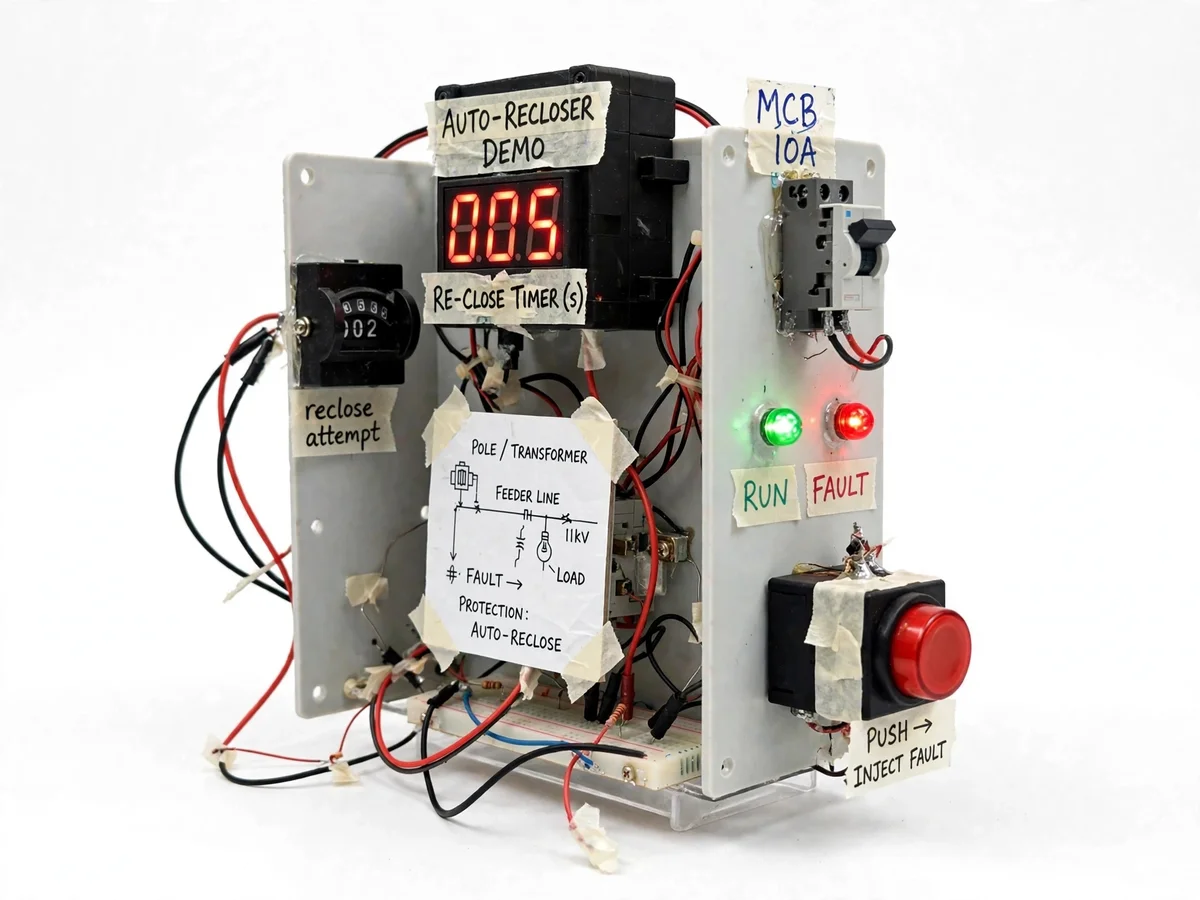
Most faults on overhead distribution lines are transient — a lightning surge, a branch brushing the conductor, a bird across phases — and they clear themselves within a fraction of a second. Tripping the feeder and leaving it dead for a manual patrol would punish every customer for a fault that no longer exists. The auto-recloser exists for exactly this: it trips on fault current, waits a short dead time, and recloses automatically. If the fault has gone, supply is restored in seconds; if it persists, the recloser tries again a set number of times and then locks out, leaving the faulted section dead for the crew. This project models that behavior on a bench panel. A contactor plays the reclosing breaker; a timer-relay sequence implements trip, adjustable dead time, and reclose; a counter tracks the shot number; a toggle selects transient or permanent fault; and lamps plus a single-line mimic show RUN, FAULT, RECLOSE and LOCKOUT states. The student injects faults and watches the full sequence play out — including the difference a permanent fault makes.
How it works
- With the feeder healthy, the breaker contactor is closed and the green RUN lamp glows; the shot counter reads zero.
- The student presses the fault-injection button, simulating a fault on the feeder — the trip logic opens the breaker and the FAULT lamp lights.
- The dead-time timer starts counting; the panel is quiet except for the FAULT lamp while the set dead time elapses.
- At dead-time expiry the logic issues the first reclose: the contactor closes and the RECLOSE lamp flashes. With the toggle on transient, the fault has cleared and the unit returns to RUN, resetting the counter.
- With the toggle on permanent, the fault is still present — the unit trips again immediately, waits the dead time, and recloses a second and third time, the counter advancing each shot.
- After the third unsuccessful reclose the logic drives to LOCKOUT: the breaker stays open, the LOCKOUT lamp lights, and only the manual reset button can re-arm the unit.
- The student repeats the sequence with different dead-time settings and records the observed timing for the report.
Tech stack:
- Auto-reclose protection theory
- Breaker trip and close control
- Timer relay logic
- Reclose sequence design
- Fault simulation
- Status indication circuits
- Feeder single-line diagrams
- Electrical panel wiring
| Parameter | Value |
|---|---|
| Breaker model | Contactor, 230 V / 10 A class (design) |
| Dead time | Adjustable 1–10 s (design) |
| Reclose attempts | 3 shots, then lockout (design) |
| Fault injection | Push button with transient/permanent toggle (design) |
| Status lamps | RUN / FAULT / RECLOSE / LOCKOUT (design) |
| Control supply | 12 V DC for logic (design) |
| Attempt counter | Digital panel counter (design) |
| Mimic | Labeled feeder single-line with LEDs (design) |
Project features
- [Reclosing breaker model] A contactor rated for the model feeder acts as the reclosing breaker, with its coil driven by the trip/reclose logic.
- [Adjustable dead-time timer] The dead time between trip and reclose is settable from 1 to 10 seconds (design), so the student can observe its effect on the sequence.
- [Three-shot attempt counter] A digital counter tracks reclose attempts; after the third unsuccessful reclose the logic drives to lockout.
- [Fault injection with transient/permanent toggle] A push button injects the fault, and a toggle selects whether it clears itself (transient) or stays (permanent) — the two cases the recloser discriminates.
- [Lockout indication] A dedicated lamp and a manual reset push button reproduce the lockout-and-reset behavior of real units.
- [Feeder single-line mimic] A labeled mimic diagram with LEDs shows the feeder, breaker state and fault point, so the sequence reads like a control-room panel.
- [Status lamps] RUN, FAULT, RECLOSE and LOCKOUT lamps make every logic state visible at a glance.
What is included
- Bench panel with reclosing breaker contactor, timers, counter and lamps
- Fault-injection button with transient/permanent selector
- Feeder single-line mimic diagram with LED indication
- Manual reset and dead-time adjustment controls
- Wiring and schematic diagram of the trip/reclose logic
- Project report PDF (background, recloser theory, sequence analysis, observations)
- PPT presentation for final review
- Viva Q&A preparation document (dead time, shots, lockout, transient vs permanent)
Limitations & prerequisites
- This is a low-voltage bench model; real auto-reclosers are pole-mounted medium-voltage devices with vacuum interrupters.
- The breaker is a contactor, not a vacuum interrupter — actual arc interruption physics is not demonstrated.
- Dead times are in seconds for classroom observation; real reclosers operate in cycles.
- Permanent-fault discrimination is simplified to the toggle; real units use fault-current and sequence-coordination logic.
- The model demonstrates protection logic only — it is not field equipment and is not rated for any real feeder duty.
Frequently Asked Questions
What is an auto-recloser?
A circuit breaker with built-in control that trips on fault and automatically recloses after a set dead time. Because most overhead-line faults are transient, the first reclose usually restores supply — no patrol, no manual switching.
Why reclose automatically instead of waiting?
Speed. A transient fault clears itself in milliseconds; automatic reclosure restores customers in seconds. Waiting for a crew to patrol a healthy line would turn a momentary fault into a long outage.
What is dead time?
The intentional delay between the breaker tripping and reclosing. It gives the fault arc time to de-ionize so the reclose lands on a cleared line; too short and the arc restrikes, too long and customers wait unnecessarily.
What is the difference between transient and permanent faults?
A transient fault (lightning, branch contact) disappears on its own; a permanent fault (broken conductor, failed insulator) stays. The recloser clears the first kind automatically and locks out on the second — the model demonstrates both with its toggle.
What is lockout?
The state after the set number of reclose attempts all meet a persistent fault. The breaker stays open and must be reset manually, so a crew investigates before supply is restored. It is the recloser's way of saying "this fault is real."
Is this project suitable for a final-year project?
Yes — for Electrical Engineering programs. It demonstrates feeder protection philosophy, reclose sequencing and fault discrimination in an operable model. Suitable for B.E./B.Tech final-year projects in Electrical Engineering.
Components & software requirements
- Auto-reclose protection theory
- Breaker trip and close control
- Timer relay logic
- Reclose sequence design
- Fault simulation
- Status indication circuits
- Feeder single-line diagrams
- Electrical panel wiring
Delivery information
Built-to-order project. Delivery timeline is shared after order confirmation based on current queue.
Support terms
Complete documentation, setup guide, and viva preparation included. Support for setup and explanation provided.