
More project photos (3)

The problem
Precision landing is the skill that separates a toy drone from a useful one — delivery, inspection and surveying drones all need to come down exactly where intended, but GPS alone wanders by metres, far too coarse for a small pad. This project solves it the classic robotics way: a ring of 940 nm infrared LEDs marks the landing pad, and a downward-facing IR sensor array on the drone sees the beacon through a daylight filter that blocks most ambient light. The flight controller runs a staged landing sequence — acquire the beacon at altitude, center over it while descending, then cut to a gentle touchdown — while the ground station streams telemetry and draws the approach path on a top-down plot. The student gets a real mechatronics project: sensor integration, control loops, state-machine flight logic and data analysis of their own test flights. Because wind, lighting and tuning dominate landing performance, the kit claims no landing accuracy figure — the buyer flies the documented test plan and reports their own touchdown-error statistics.
Takes off manually and monitors the console; can take over on the RC transmitter instantly.
Follow the working sequence
How it works
- The IR beacon pad is placed in a clear area and powered; the ground-station console confirms the beacon ring is healthy.
- The drone takes off manually (or via a short scripted climb) to the acquisition altitude and the auto-land mode is engaged.
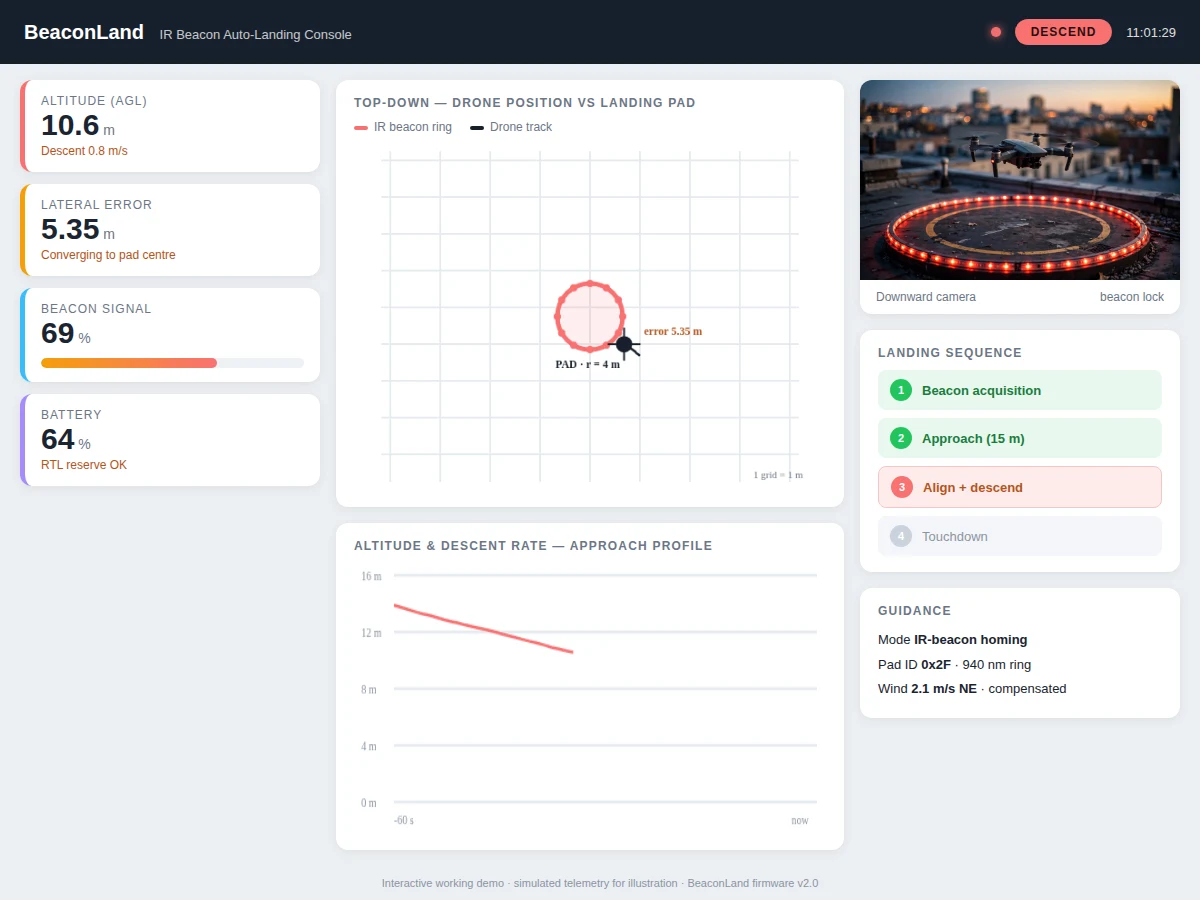
- The downward IR array scans for the 940 nm signature; on lock, the controller centers the drone over the pad while holding altitude.
- The staged descent begins: the drone descends at the configured rate, re-centering continuously as the beacon grows stronger in the sensor view.
- Below the final altitude the descent slows for a gentle touchdown; the console logs the touchdown coordinates relative to pad center.
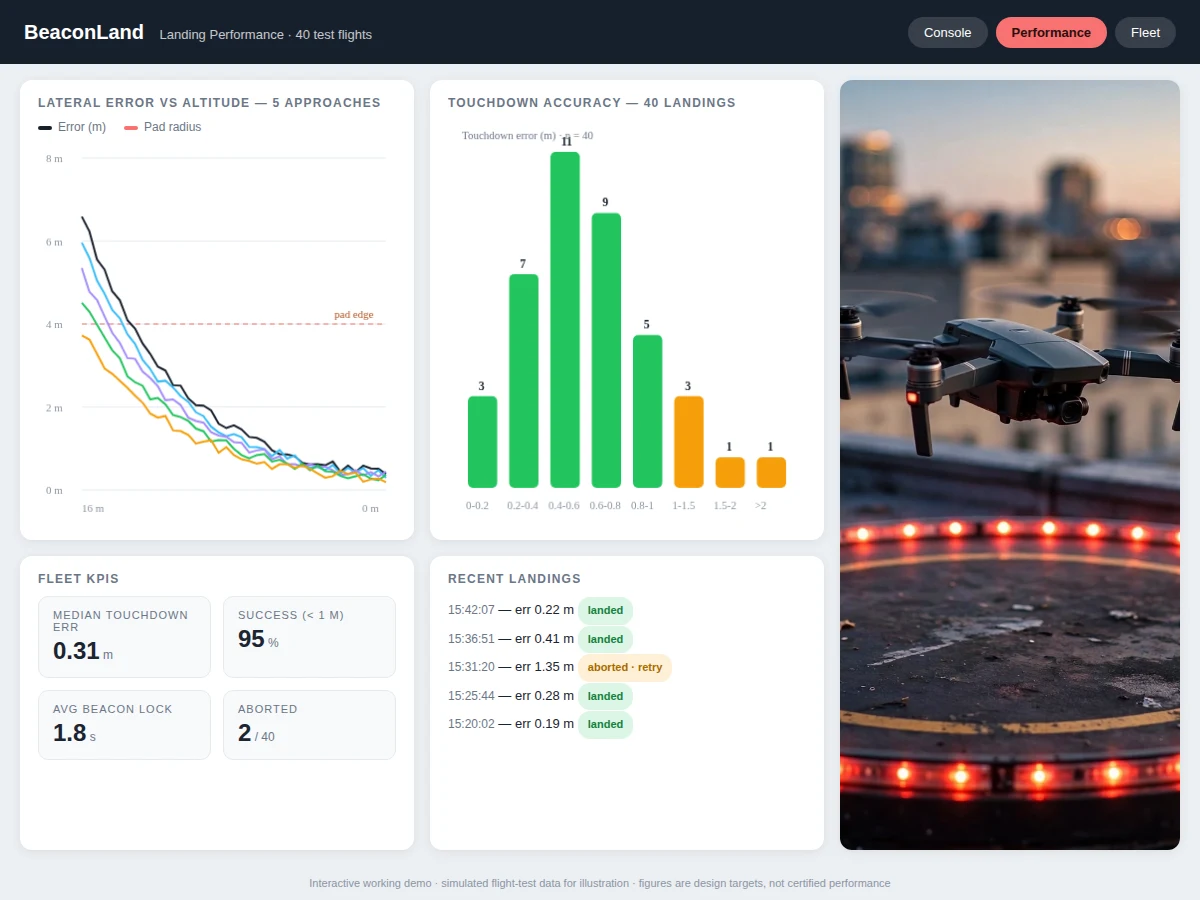
- The student repeats the documented test plan across lighting and wind conditions, and the analytics page converts the logs into error statistics for the report.
Tech stack:
- 450 mm quadcopter frame, brushless motors, flight controller with custom landing firmware
- Downward-facing IR sensor array with 940 nm bandpass daylight filter
- IR beacon pad (940 nm LED ring, health-monitoring circuit, battery/mains power)
- 2.4 GHz RC link with instant manual override
- AutoLand ground-station console (telemetry, top-down guidance plot, log analysis)
- Flight-log toolchain (CSV export, touchdown-error and approach-path analytics)
| Parameter | Value |
|---|---|
| Airframe | 450 mm quadcopter, approx. 1.2 kg AUW (typical) |
| Beacon | 940 nm IR LED ring, daylight-filtered detection |
| Landing logic | Staged state machine: acquire, center, descend, touchdown |
| Console | Live telemetry + top-down guidance plot + log analytics |
| Override | Instant RC manual takeover, logged as event |
| Flight time | Approx. 12–15 min per pack (typical, calm air) |
| Accuracy | Measured by buyer per test plan; no figure pre-claimed |
| Operating area | Open ground, clear of people and obstacles |
| Output | Live console, flight logs, touchdown-error statistics |
Project features
- [IR beacon landing pad] A ring of 940 nm IR LEDs with a daylight-blocking filter marks the pad; invisible to the eye, bright to the drone's downward sensor.
- [Staged auto-landing sequence] The flight controller runs acquire → center → descend → touchdown states, with beacon-loss fallback to position hold — the state machine the student explains in the viva.
- [Live landing console] The ground station shows altitude, descent rate, beacon lock strength and a top-down plot of the drone converging on the pad in real time.
- [Landing performance analytics] Flight logs become touchdown-error histograms, approach-path traces and success-rate tables — the results chapter, from the student's own flights.
- [Manual override] The pilot can take over instantly on the RC transmitter at any point; the console flags the handover event in the log.
- [Beacon health monitoring] The pad reports LED-ring current draw so a failed emitter is caught before a flight, not during one.
- [Tunable guidance gains] Approach speed, centering aggressiveness and final-descent rate are parameters the student tunes across test flights and documents.
What is included
- Working auto-landing quadcopter (frame, motors, flight controller with landing firmware, IR sensor array)
- IR beacon landing pad with health monitoring
- AutoLand console source code (ground station + analytics, documented)
- Project report PDF (guidance design, IR sensing, control states, buyer's flight-test results)
- PPT presentation for final review
- Viva Q&A preparation document (PID/state machines, IR optics, flight dynamics, sensor fusion basics)
- Flight-test plan and safety checklist (pre-flight, test matrix, log template)
Limitations & prerequisites
- This is a student research platform, not a certified autonomous aircraft: flights must follow the drone regulations in force locally (in India, DGCA norms including Nano-category rules and no-fly zones), and the buyer is responsible for compliance.
- No landing accuracy is pre-claimed: wind, sunlight, beacon alignment and tuning dominate results, and the report presents the buyer's own measured statistics.
- The IR beacon is affected by strong direct sunlight and reflective surfaces; the test plan includes lighting conditions as a variable, not an excuse.
- Outdoor testing needs calm weather and a clear area; the drone must never be flown over people, roads or buildings.
- Spare propellers and basic LiPo safety practice are required; batteries are consumables with finite cycle life.
- GPS-denied or indoor flight is outside the documented scope.
Frequently Asked Questions
How accurate is the landing?
That is what your test flights measure. The analytics page computes touchdown error from your own logs — expect the number to vary with wind and light, and report it honestly.
Can it land at night?
The IR beacon works in darkness, but night flying has additional regulatory and safety constraints; the documented test plan covers daylight conditions.
What happens if the beacon is lost mid-descent?
The state machine falls back to position hold and waits for re-acquisition; if lock is not recovered, the pilot takes over manually.
Do I need a drone license?
Regulatory requirements depend on your country and the drone's weight category. In India, check current DGCA rules for your category and fly only where permitted. The safety checklist covers the basics but is not legal advice.
Can the guidance gains be tuned?
Yes — approach speed, centering gain and descent rate are exposed parameters, and tuning them across flights is one of the best report experiments.
Is this project suitable for a final-year project?
Yes — for Mechanical, Mechatronics, Electronics and Robotics programs. It demonstrates sensing, control, state-machine design and experimental validation of a real flying robot. Suitable for B.E./B.Tech final-year projects in Mechanical, Mechatronics, Electronics and Robotics.
Components & software requirements
- 450 mm quadcopter frame, brushless motors, flight controller with custom landing firmware
- Downward-facing IR sensor array with 940 nm bandpass daylight filter
- IR beacon pad (940 nm LED ring, health-monitoring circuit, battery/mains power)
- 2.4 GHz RC link with instant manual override
- AutoLand ground-station console (telemetry, top-down guidance plot, log analysis)
- Flight-log toolchain (CSV export, touchdown-error and approach-path analytics)
Delivery information
Built-to-order project. Delivery timeline is shared after order confirmation based on current queue.
Support terms
Complete documentation, setup guide, and viva preparation included. Support for setup and explanation provided.
Download free synopsis (PDF)
Enter your name and WhatsApp number — the synopsis PDF downloads immediately. We may send occasional project updates on WhatsApp; no spam.