
More project photos (2)

The problem
Small workshops and hobby founders need a way to melt aluminium for small castings, but electric crucible furnaces draw several kilowatts and commercial gas furnaces cost far more than a student budget allows. This aluminium melting furnace answers that need with a steel-drum body lined with ceramic-fiber refractory, fired by a burner that runs on used engine oil — a fuel that garages give away for free. Oil drip-feeds into a preheated vaporizing tube, where it vaporizes and burns with forced air from a blower; the flame heats the refractory lining, which soaks up the heat and radiates it to a graphite crucible charged with aluminium scrap. Once the crucible passes aluminium's 660 °C melting point, about 2–3 kg of scrap — cans, extrusion offcuts or old parts — becomes pourable metal for ingots, plates or simple sand-mould parts. The lid, lifting bail and long crucible tongs make charging and pouring a manageable one-person job.
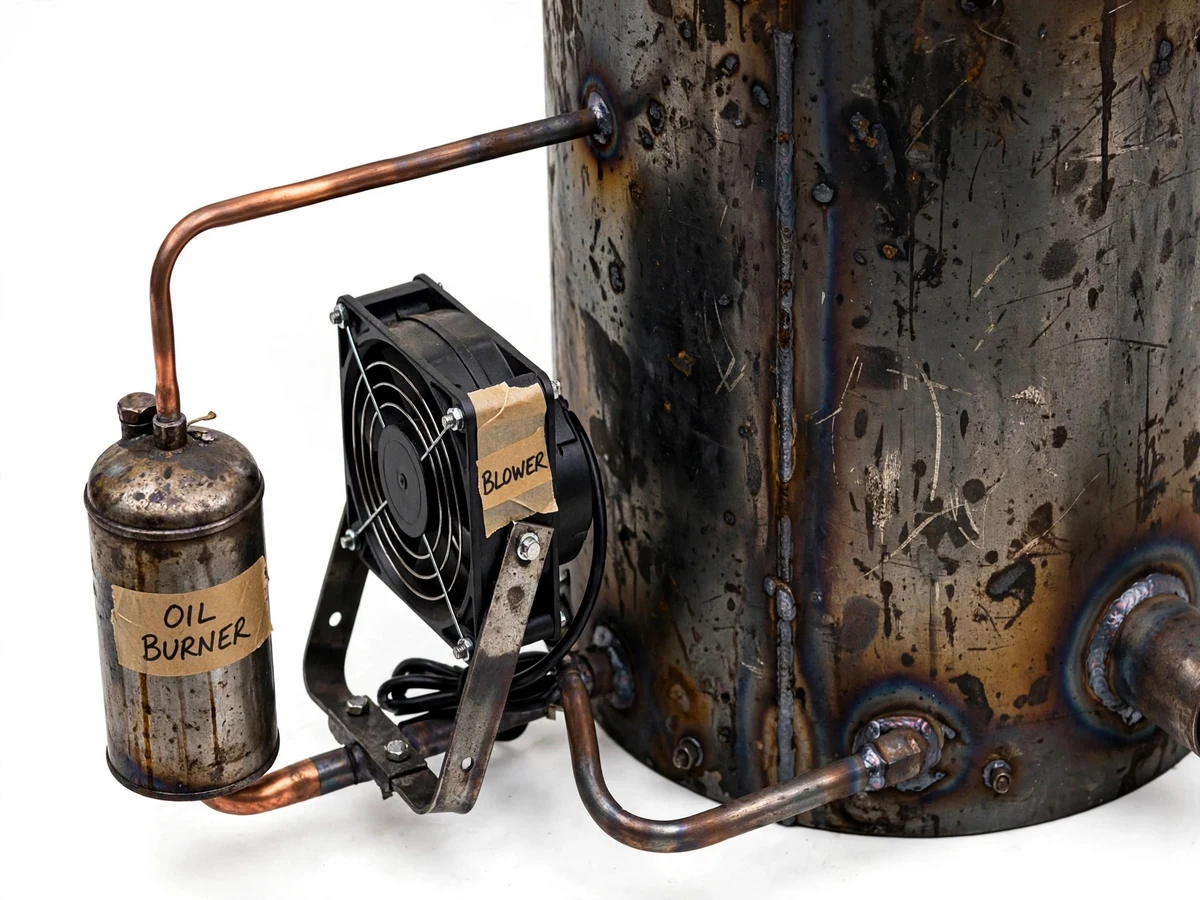
The drum body is lined with 25 mm of ceramic-fiber blanket (1260 °C grade) sealed with a refractory wash, sized so the chamber reaches the roughly 900 °C soak the melt needs while the steel shell stays manageable. The burner is the heart of the build: a gravity drip-feed oil tank with a needle valve, a preheated steel vaporizing tube, and a blower that supplies the air the oil needs to burn with a short, hot, nearly smokeless flame at steady state. A first-principles point that drives the burner design: waste engine oil only burns cleanly when atomized, and a drip feed onto a hot surface vaporizes it — which is why this burner uses a preheated vaporizing tube instead of a spray nozzle. And a builder note from the build: a 25 mm ceramic-fiber lining plus a 10 mm refractory wash survives about 40 melts before re-lining, and the single biggest life factor is keeping the burner flame off the crucible wall. Because the fuel is waste oil, each melt costs almost nothing in consumables; because the construction is steel, copper tube and blanket, every material is locally sourced.
Holds filtered used engine oil. A needle valve sets the drip rate from lean preheat to full melt burn.
Follow the working sequence
How it works
Used oil is too thick to atomize in a spray, so this burner vaporizes it instead. Filtered oil drip-feeds through a needle valve into a preheated steel vaporizing tube, where heat flashes it into vapour; a 12 V blower drives air through the tube, and the vapour–air mix burns at the tube's mouth with a short, hot flame. The flame enters the drum chamber tangentially, swirling around the crucible, and the ceramic-fiber lining soaks up the heat, pushing the chamber toward roughly 900 °C. The graphite crucible, preheated empty on its firebrick pedestal, holds the aluminium scrap; as the soak continues, the charge passes aluminium's 660 °C melting point and slumps into liquid metal. Dross is skimmed off, the crucible is lifted out with the tongs, and the metal pours into a preheated ingot or sand mould. About 2–3 litres of oil go into one melt — the whole run comes down to oil flow and air.
- Filter the used engine oil through a fine mesh and fill the drip tank; set the furnace up outdoors on level ground, clear of flammables, with a sand bucket and fire extinguisher (Class D type) at hand.
- Charge the graphite crucible with clean aluminium scrap — cans, extrusion offcuts, old parts — and seat it on the firebrick pedestal inside the furnace with the lid on.
- Light the burner: open the needle valve to a slow drip, preheat the vaporizing tube briefly, then start the blower so the oil vaporizes and catches with a steady flame.
- Tune oil flow and blower speed for a short, nearly smokeless flame; the flame swirls around the crucible while the refractory lining soaks the chamber heat toward roughly 900 °C.
- Hold the soak until the charge fully melts (design target: about 30–45 minutes for a 2–3 kg charge), then skim the dross off the liquid surface with the skimmer.
- Lift the lid, grip the crucible with the long tongs, and pour into a preheated ingot mould or sand mould; seat the crucible back on the pedestal and shut the burner down.
- Cool the furnace with the lid on; log the melt — charge weight, oil used, lining condition — in the log sheet provided.
Tech stack:
- Steel drum furnace body
- Ceramic-fiber blanket · 1260 °C grade
- Graphite crucible
- Vaporizing-tube oil burner
- 12 V DC forced-draft blower
- Copper drip-feed plumbing
- Arc welding · angle grinder
- Sand mould · ingot mould
| Parameter | Value |
|---|---|
| Crucible melt capacity | Approximately 2–3 kg of aluminium per run (design target) |
| Aluminium melting point | 660 °C (datasheet value) |
| Chamber temperature | Approximately 900 °C (design target) |
| Refractory lining | 25 mm ceramic-fiber blanket, 1260 °C grade (datasheet) |
| Lining life | Approximately 40 melts before re-lining (builder note, design target) |
| Fuel | Filtered used engine or vegetable oil (buyer-supplied) |
| Oil consumption | Approximately 2–3 L per full melt (design target) |
| Blower | 12 V DC, approximately 50 W (expected) |
| Furnace body | Approximately 20 L steel drum (expected) |
| Melt time | Approximately 30–45 min for a 2–3 kg charge (design target) |
Project features
The four things this build gets right are the burner, the insulation, the melt capacity and the handling kit. The waste-oil burner is the core engineering: oil drip-feeds into a preheated steel vaporizing tube where it flashes into vapour and burns with forced air, giving a short hot flame on used engine or vegetable oil — no gas cylinders, no high-voltage coils, almost zero fuel cost. The furnace body is a steel drum lined with 25 mm of ceramic-fiber blanket (1260 °C grade) sealed with a refractory wash, so the chamber holds the roughly 900 °C soak the melt needs while the outside stays workable. The graphite crucible melts about 2–3 kg of aluminium scrap per run — enough for ingots, mounting plates and small sand-cast parts. The handling kit — hinged lid, lifting bail and long crucible tongs — makes charging and pouring a controlled one-person job, which is what turns a metal box into a usable foundry tool.
- [Vaporizing waste-oil burner] Drip-feed oil tank with needle valve, preheated steel vaporizing tube and 12 V forced-air blower; burns filtered used engine or vegetable oil with a short, nearly smokeless flame at steady state.
- [Refractory-lined drum furnace] Steel drum lined with 25 mm ceramic-fiber blanket (1260 °C grade) plus refractory wash; the chamber reaches the soak needed to melt aluminium while the shell stays manageable.
- [Graphite crucible · 2–3 kg melt capacity] Melts about 2–3 kg of aluminium scrap per run — cans, extrusion offcuts or old parts — into pourable metal past the 660 °C melting point.
- [Controlled pour kit] Hinged lid, lifting bail and long crucible tongs for safe charging and pouring by one operator with proper PPE.
- [Gravity drip-feed fuel control] Needle-valve oil flow control tunes the flame from a lean preheat to a full melt burn without any electronics.
- [Wash-coated, re-lineable lining] The refractory wash seals the fiber and takes the flame's edge; re-lining and wash patching are covered as normal consumable maintenance.
- [Complete safety documentation] Written operating procedure covering outdoor-only use, PPE, allowed and banned alloys, fire control and a first-melt checklist.
What is included
- Steel drum furnace with ceramic-fiber lining and refractory wash
- Waste-oil burner assembly: drip tank with needle valve, vaporizing tube, 12 V blower and flame pipe
- Graphite crucible with lifting bail
- Long crucible tongs, hinged lid, firebrick pedestal and dross skimmer
- Ingot mould and sand-mould starter kit (flask, parting sand, rammer)
- PPE set: face shield, aluminized gloves, leather apron, safety glasses
- Written operating procedure, safety checklist and melt log sheet
- Project report PDF (background, combustion design, refractory sizing, methodology, results)
- PPT presentation for final review
- Viva Q&A preparation document
- Build drawings with dimensions and material list
Limitations & prerequisites
- Outdoor use only: the burner smokes at startup and produces combustion gases — never operate indoors, under a roof or near flammable stores.
- Full PPE is mandatory every run — face shield, aluminized gloves, leather apron; molten aluminium above 660 °C causes instant deep burns.
- Aluminium and aluminium alloys only: NEVER melt magnesium or zinc alloys — magnesium can ignite, and zinc fumes cause metal fume fever; brass and bronze exceed the design temperature and are out of scope.
- Fuel discipline: filtered used engine or vegetable oil only — never chlorinated solvents, brake fluid or petrol-contaminated oil, which give toxic fumes and fire risk.
- About 2–3 L of oil and 30–45 min per 2–3 kg charge: this is a small-batch teaching foundry, not a production furnace.
- The lining is a consumable: about 40 melts before re-lining, and the refractory wash needs patching if the flame is aimed at it.
- Castings are for non-structural, low-load parts only — no pressure vessels, engine internals or safety-critical components.
- Check local fire and waste-oil regulations before operating — some areas restrict open-flame oil burning.
Frequently Asked Questions
What can the furnace melt?
Aluminium and aluminium alloys only — about 2–3 kg per run, from scrap like cans, extrusion offcuts or old parts. Magnesium alloys must never go in because magnesium can ignite, zinc alloys produce toxic zinc-oxide fumes that cause metal fume fever, and brass or bronze need temperatures this furnace is not designed to reach. The report documents the allowed-alloy list with the metallurgical reasoning.
Why waste oil instead of LPG or electric?
Used engine oil is free from garages, needs no cylinder rental or deposit, and requires no high-power electrical connection, so the furnace runs anywhere outdoors. The vaporizing-tube burner is designed specifically for thick oil that cannot be sprayed, and a full melt takes about 2–3 litres of it. The trade-off is honest: startup smokes briefly and every run happens outdoors.
How smoky is the burner?
There is visible smoke for the first few minutes while the vaporizing tube heats up, but at steady state a tuned flame is nearly smokeless. The needle valve and blower speed let the operator lean the flame until the smoke clears, which is also the hottest and most efficient burn. If the flame smokes at steady state, the documented procedure treats it as a tuning fault to fix, not a normal condition.
Is the build safe for a student to operate?
Yes, provided the written procedure is followed: outdoor setup on level ground, full PPE every run, the allowed-alloy list respected, and a sand bucket plus Class D extinguisher at hand. The kit ships with an operating checklist and a first-melt supervision recommendation, and the report's safety section is written to satisfy examiners' questions, not just tick a box.
Is this project suitable for a final-year project?
Yes — for Mechanical Engineering programs. It demonstrates combustion and heat transfer, refractory material selection, sheet-metal fabrication and real foundry practice, all in one build. The report covers the theory behind the burner and lining design, and the viva kit prepares the student to defend every number on the specifications table.
Components & software requirements
- Steel drum furnace body
- Ceramic-fiber blanket · 1260 °C grade
- Graphite crucible
- Vaporizing-tube oil burner
- 12 V DC forced-draft blower
- Copper drip-feed plumbing
- Arc welding · angle grinder
- Sand mould · ingot mould
Delivery information
Built-to-order project. Delivery timeline is shared after order confirmation based on current queue.
Support terms
Complete documentation, setup guide, and viva preparation included. Support for setup and explanation provided.
Download free synopsis (PDF)
Enter your name and WhatsApp number — the synopsis PDF downloads immediately. We may send occasional project updates on WhatsApp; no spam.