
More project photos (3)
The problem
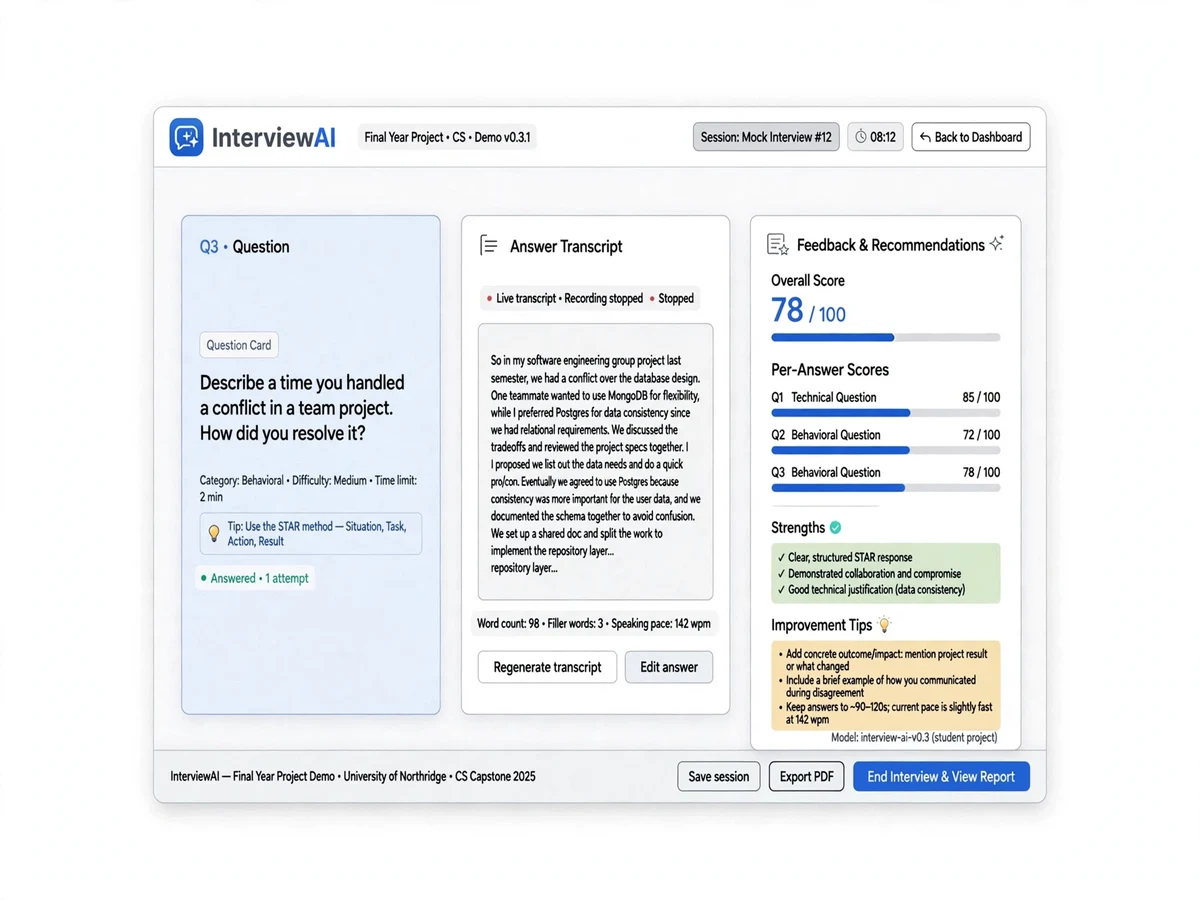
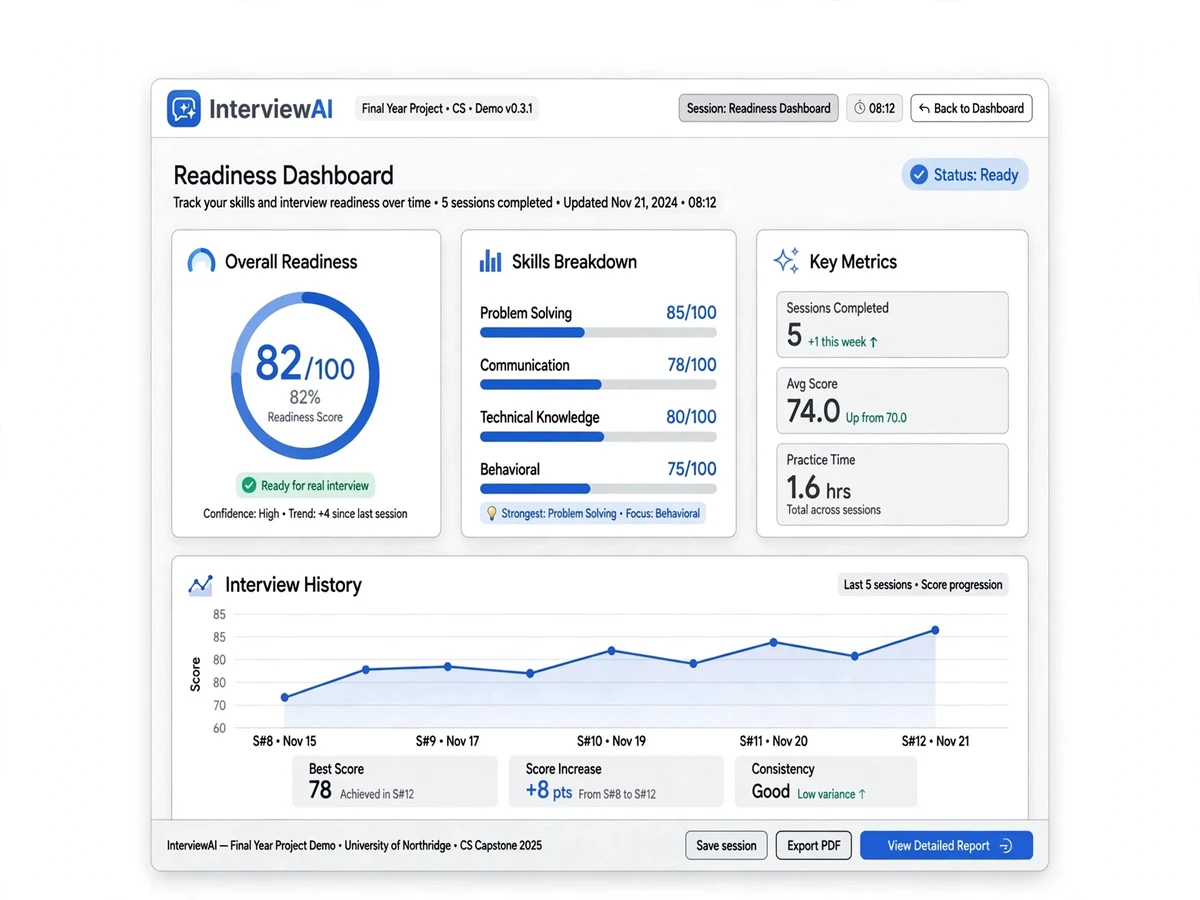
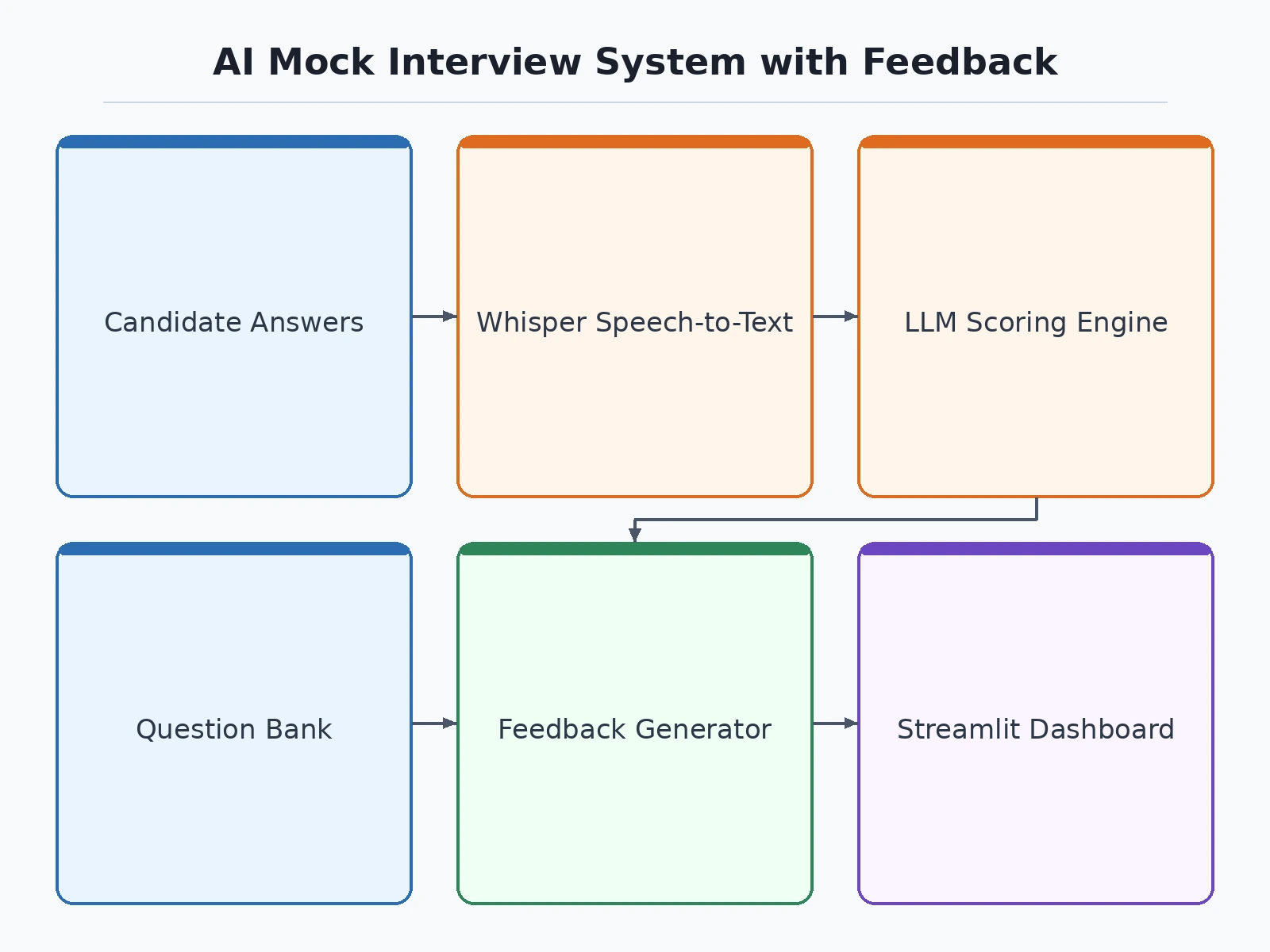
The AI Mock Interview System with Feedback is a final-year project that plays the role of a real interviewer: it asks technical and HR questions, listens to your spoken answers, transcribes them with speech recognition, and scores each answer on content accuracy, confidence and communication using a large language model. InterviewAI — the Streamlit app at its heart — then shows a dashboard with per-question scores, concrete improvement tips and an overall readiness meter, so students walk into placement season prepared instead of anxious.
Campus placements are where theory meets pressure: students who know the answers still freeze, ramble or miss the point under interview stress. A system that lets them rehearse with instant, honest, rubric-based feedback — any number of times, at zero cost — is both technically rich and instantly demoable in a viva.
This is a built-to-order project: the question banks, scoring rubric and feedback prompts are configured for your build, and the full pipeline ships with documentation you can defend question by question.
Picks a round, answers questions by speaking.
Follow the working sequence
How it works
- The student picks a round (technical or HR), a topic and a difficulty level.
- InterviewAI asks a question — displayed on screen and optionally read aloud.
- The student answers by speaking; Whisper transcribes the audio to text in real time.
- The transcript, question and rubric are sent to the LLM, which scores the answer on content, confidence and communication and writes specific feedback.
- The dashboard updates: per-question scores, improvement tips, a model answer for comparison, and the overall readiness meter.
Project features
- AI-conducted mock interviews — technical (DSA, DBMS, OS, CN, projects) and HR rounds
- Speech-to-text pipeline (Whisper / speech recognition) transcribes spoken answers in real time
- LLM-based scoring rubric: content accuracy, depth, confidence, clarity and communication
- Per-question scorecards with strengths, weaknesses and model-answer comparisons
- Personalized improvement tips generated after every session
- Readiness meter — an aggregate score tracking progress across sessions
- Question bank with difficulty levels and topic tags; add your own questions
- Session history and progress charts in the Streamlit dashboard
- Text-input mode for quiet environments (no microphone needed)
What is included
- Full Python source code (Streamlit app + pipeline), well-commented
- Configured question bank (technical + HR, multiple difficulty levels)
- LLM scoring-rubric prompt templates (tunable)
- Project report PDF (problem statement, architecture, pipeline, results, conclusion)
- PPT presentation for final review
- Viva Q&A preparation document (LLM evaluation, STT pipeline, rubric design questions)
- Setup guide (API keys, microphone configuration, running the app)
FAQs
- Is this AI interview project suitable for a final-year CSE/IT review? Yes — it combines speech processing, prompt engineering, LLM-based evaluation and a full-stack dashboard. Examiners can probe the STT pipeline, rubric design, and how you handle LLM hallucinations, and the viva Q&A covers all of it.
- Do I need to pay for the LLM API? The system needs an API key, but a free-tier key or a small pay-as-you-go balance is plenty for development, demos and your review. The setup guide walks through key configuration.
- How does the scoring actually work? Each answer is evaluated against a structured rubric prompt — content accuracy, depth, confidence, clarity, communication, each scored 1–10 — and the LLM returns scores plus written justification and tips. You can show examiners the exact prompt templates.
- What if there's no microphone during the demo? Text-input mode lets you type answers instead of speaking — the same scoring and feedback pipeline runs on typed text. Many students demo this way in noisy review halls.
- Can I add my own questions? Yes — the SQLite question bank is fully editable. Add company-specific questions (TCS NQT, Infosys, product companies) with topic tags and difficulty levels, which is a strong personalization story for your review.
- Does it really help with placements? That's the pitch: unlimited, judgment-free mock interviews with instant rubric-based feedback and a readiness meter that tracks improvement across sessions. It's the rare final-year project your juniors will actually want to use.
Advantages
- A full interview loop: AI-conducted technical (DSA, DBMS, OS, CN, projects) and HR rounds with real-time speech-to-text transcription of spoken answers.
- LLM-based scoring rubric across content accuracy, depth, confidence, clarity and communication — per-question scorecards with strengths, weaknesses and model-answer comparisons.
- Personalized improvement tips generated after every session, plus a readiness meter that tracks progress across sessions.
- Customizable question bank with difficulty levels and topic tags (add your own questions), with session history and progress charts in the Streamlit dashboard.
- Text-input mode for quiet environments where a microphone is not practical.
Disadvantages
- Requires an LLM API key (usage-based cost); a free-tier or campus key is enough for demos and reviews.
- Speech recognition accuracy drops with heavy background noise or strong accents — text mode is the fallback.
- Scoring quality depends on the underlying LLM; feedback should be treated as coaching guidance, not an official assessment.
- Needs an internet connection for transcription (cloud Whisper) and LLM calls.
Limitations & prerequisites
- Requires an LLM API key (usage-based cost); a free-tier or campus key is enough for demos and reviews.
- Speech recognition accuracy drops with heavy background noise or strong accents — text mode is the fallback.
- Scoring quality depends on the underlying LLM; feedback should be treated as coaching guidance, not an official assessment.
- Needs an internet connection for transcription (cloud Whisper) and LLM calls.
Components & software requirements
- Python 3, Streamlit (InterviewAI dashboard)
- OpenAI Whisper / SpeechRecognition (speech-to-text pipeline)
- LLM API (GPT-class model) for scoring and feedback generation
- pydub / sounddevice (audio capture and preprocessing)
- pandas, Plotly (session history, progress charts)
- SQLite (question bank and session storage)
- python-dotenv (API key management)
| Parameter | Value |
|---|---|
| Interview modes | Technical (DSA, DBMS, OS, CN, projects), HR |
| Input | Voice (microphone) or typed text |
| Transcription | Whisper / speech recognition, real-time |
| Scoring dimensions | Content accuracy, depth, confidence, clarity, communication (1–10 each) |
| Feedback | Per-question tips + model answer + session summary |
| Dashboard | Streamlit — scores, readiness meter, history charts |
| Storage | SQLite question bank (expandable), session logs |
| Deliverables | Source code, report PDF, PPT, viva Q&A |
Download free synopsis (PDF)
Enter your name and WhatsApp number — the synopsis PDF downloads immediately. We may send occasional project updates on WhatsApp; no spam.
Koshti et al. (2025), Journal of Engineering Research and Reports, vol. 27, no. 5