
More project photos (3)
The problem
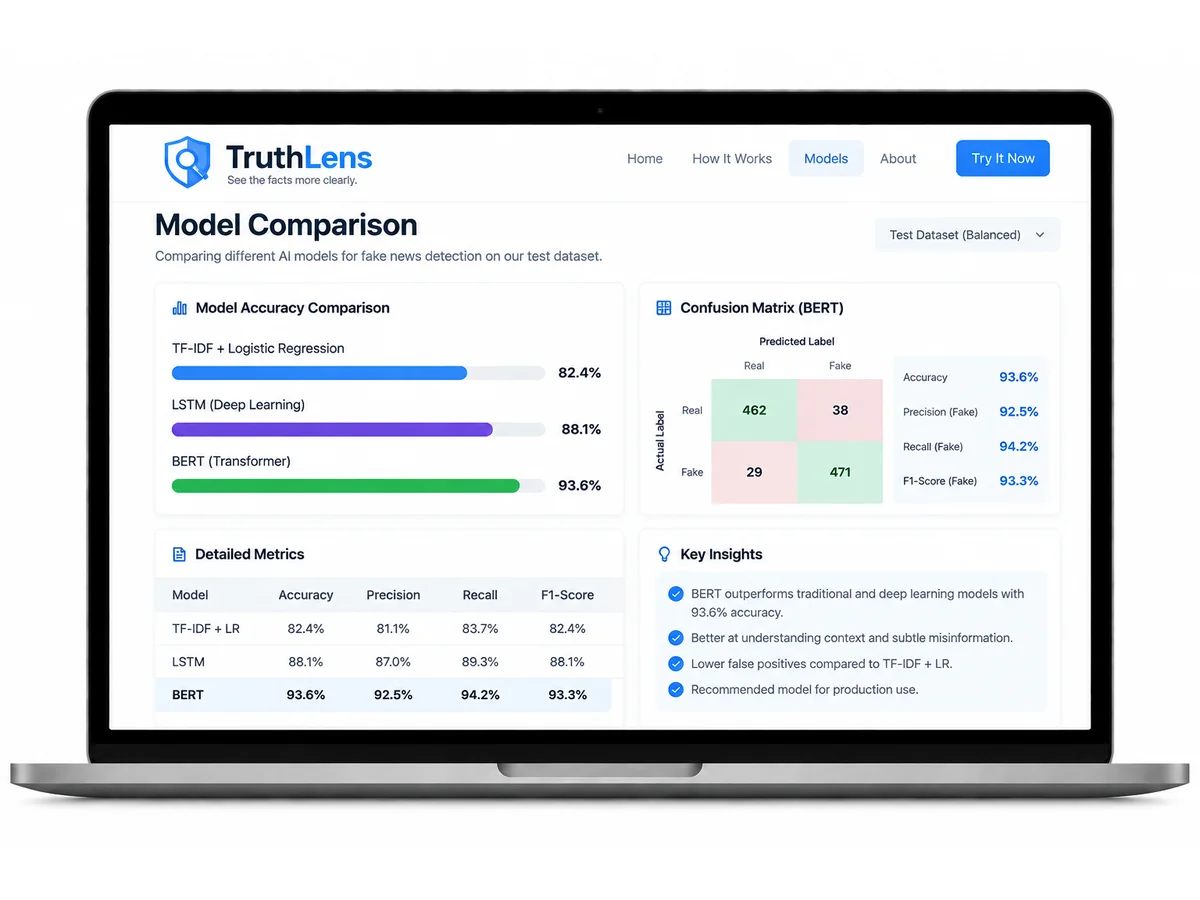
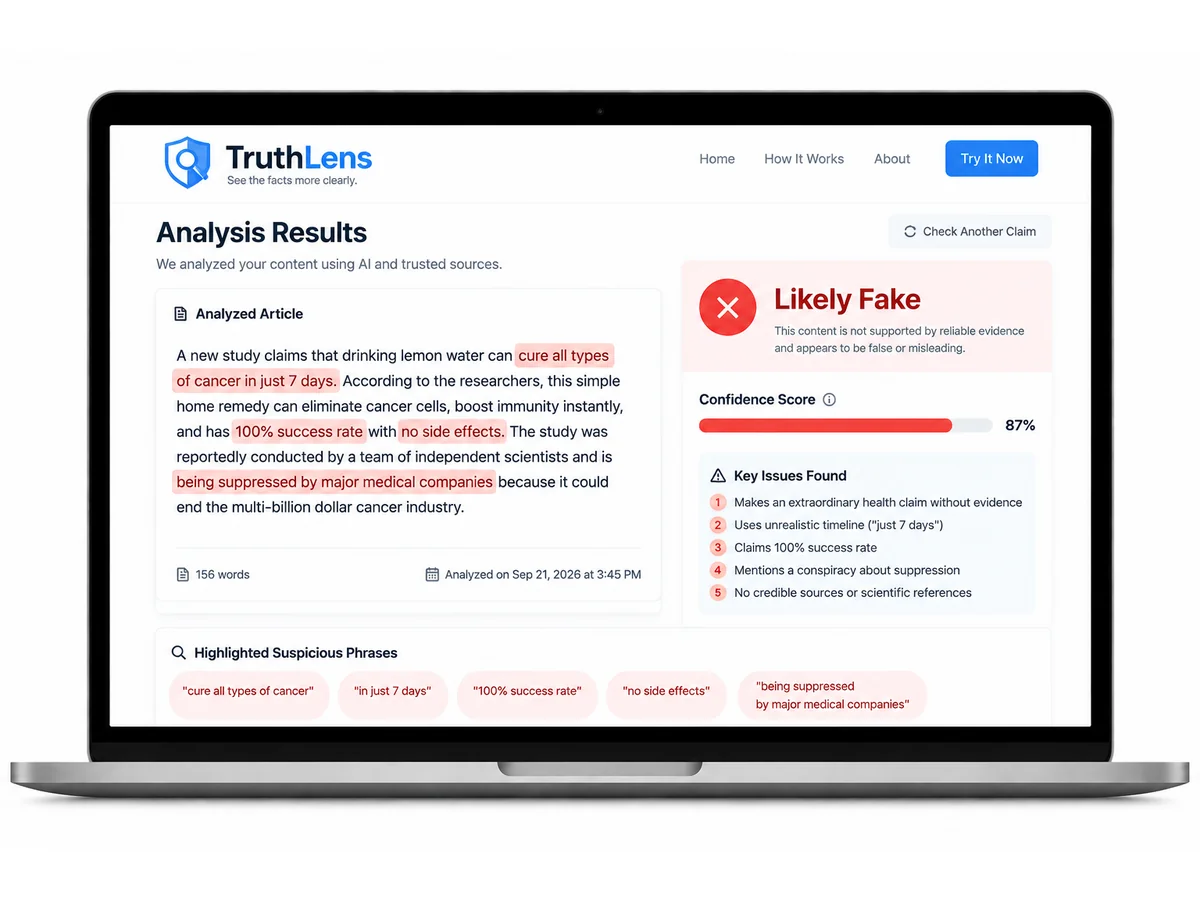
Fake news spreads faster than the truth — studies show false stories can reach thousands of people within hours on social media. This project builds a working solution: a machine learning system that reads a news article and tells you whether it's likely real or fake, using natural language processing. It is a complete fake news detection using machine learning project that doesn't stop at a notebook — it includes a deployed TruthLens web app where anyone can paste article text and get an instant verdict with a confidence score. The heart of the project is a fair, honest model comparison. A classical TF-IDF + Logistic Regression baseline goes head-to-head with an LSTM sequence model and a fine-tuned transformer (BERT/DistilBERT) baseline, all trained and evaluated on the same labeled news dataset with a proper train/validation/test split. You get real metrics — accuracy, precision, recall, F1 — and a real story to tell in your viva about why different models perform the way they do.
Pastes a news article into the TruthLens app for an instant verdict.
Follow the working sequence
How it works
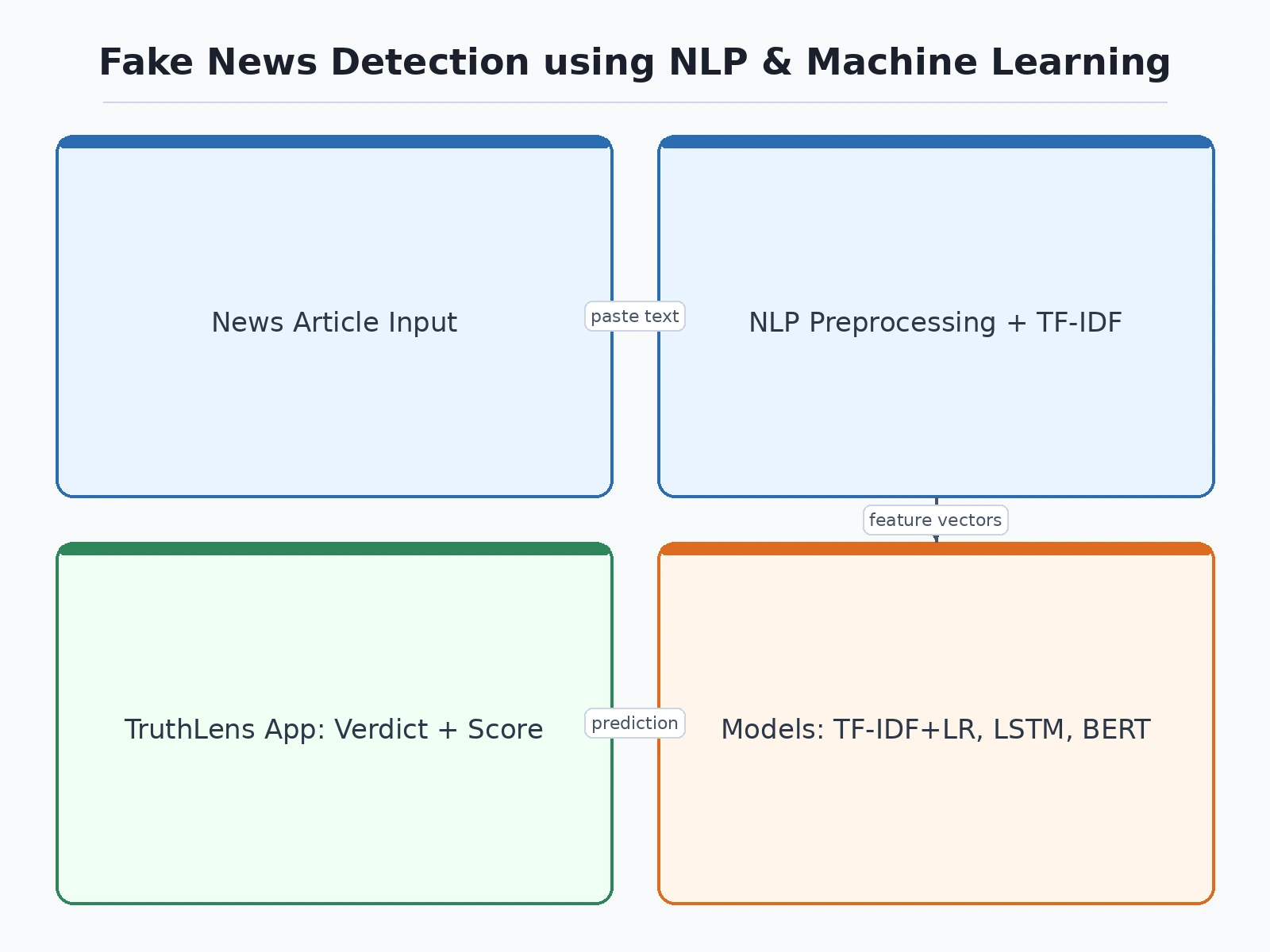
- Data preparation — a labeled dataset of real and fake news articles is cleaned: lowercased, tokenized, stripped of stopwords, URLs and noise, then lemmatized
- Feature engineering — for the classical model, text is converted to TF-IDF vectors that weight the words most characteristic of fake vs real writing
- Training — the Logistic Regression baseline trains in minutes; the LSTM learns word sequences via embedding layers; the transformer is fine-tuned with a classification head
- Evaluation — all three models are scored on a held-out test set with accuracy, precision, recall, F1-score, and ROC-AUC
- Deployment — the best model is served through the TruthLens Flask web app: paste an article, and it returns a verdict plus a confidence score in under a second
Project features
- Paste-and-check web app: paste any news article into the TruthLens app and get a real/fake verdict with a confidence percentage instantly
- Three-model comparison: TF-IDF + Logistic Regression baseline vs LSTM neural network vs fine-tuned transformer (BERT/DistilBERT)
- Complete NLP pipeline: tokenization, lowercasing, stopword removal, lemmatization, and TF-IDF feature extraction built from scratch
- Confusion matrices and classification reports for every model, with visualizations you can drop straight into your report
- Live model-switching in the TruthLens app: compare predictions from the baseline and deep models on the same article
- Trained model files included — no GPU needed to run the app
- REST-style prediction flow inside the Flask app, ready to demo and extend
What is included
- Full source code (preprocessing, training notebooks, and the TruthLens Flask app)
- Trained model files for all three approaches — ready to run, no training required
- Labeled dataset access guide and preprocessing scripts
- Project report (PDF) with methodology, model comparison tables, and result analysis
- Presentation (PPT) for your project demo and review
- Viva Q&A document covering NLP concepts, model choices, and likely examiner questions
- README with setup, training, and deployment instructions
Advantages
- Paste-and-check web app gives an instant real/fake verdict with a confidence percentage for any article pasted into the TruthLens app.
- Three-model comparison (TF-IDF + Logistic Regression vs LSTM vs fine-tuned BERT/DistilBERT) with confusion matrices and classification reports ready for the report.
- Complete NLP pipeline built from scratch — tokenization, lowercasing, stopword removal, lemmatization and TF-IDF — strong viva material.
- Live model-switching in the app lets the examiner compare baseline and deep-model predictions on the same article.
- Pre-trained model files are bundled, so the app runs with no GPU needed.
- REST-style prediction flow inside the Flask app is ready to demo and extend.
Disadvantages
- Accuracy depends on the training data's domain — articles from topics not covered in the dataset may classify less reliably.
- Satire, opinion pieces and partially-true articles sit in a grey zone the binary classifier was not designed for.
- Very short texts (headlines only) give the model less signal than full articles.
- Transformer fine-tuning is slow on CPU, so the project ships pre-trained weights to sidestep retraining at demo time.
Limitations & prerequisites
- Accuracy depends on the training data's domain — articles from topics not covered in the dataset may classify less reliably
- Satire, opinion pieces, and partially-true articles sit in a grey zone the binary classifier wasn't designed for
- Very short texts (headlines only) give the model less signal than full articles
- Transformer fine-tuning benefits from a GPU; on CPU it is slow, so we ship the pre-trained weights with the project
Components & software requirements
- Python, scikit-learn, NLTK, TensorFlow/Keras, Transformers (Hugging Face), Flask, HTML/CSS/JavaScript, pandas, NumPy, Matplotlib/Seaborn
Download free synopsis (PDF)
Enter your name and WhatsApp number — the synopsis PDF downloads immediately. We may send occasional project updates on WhatsApp; no spam.