
More project photos (2)

The problem
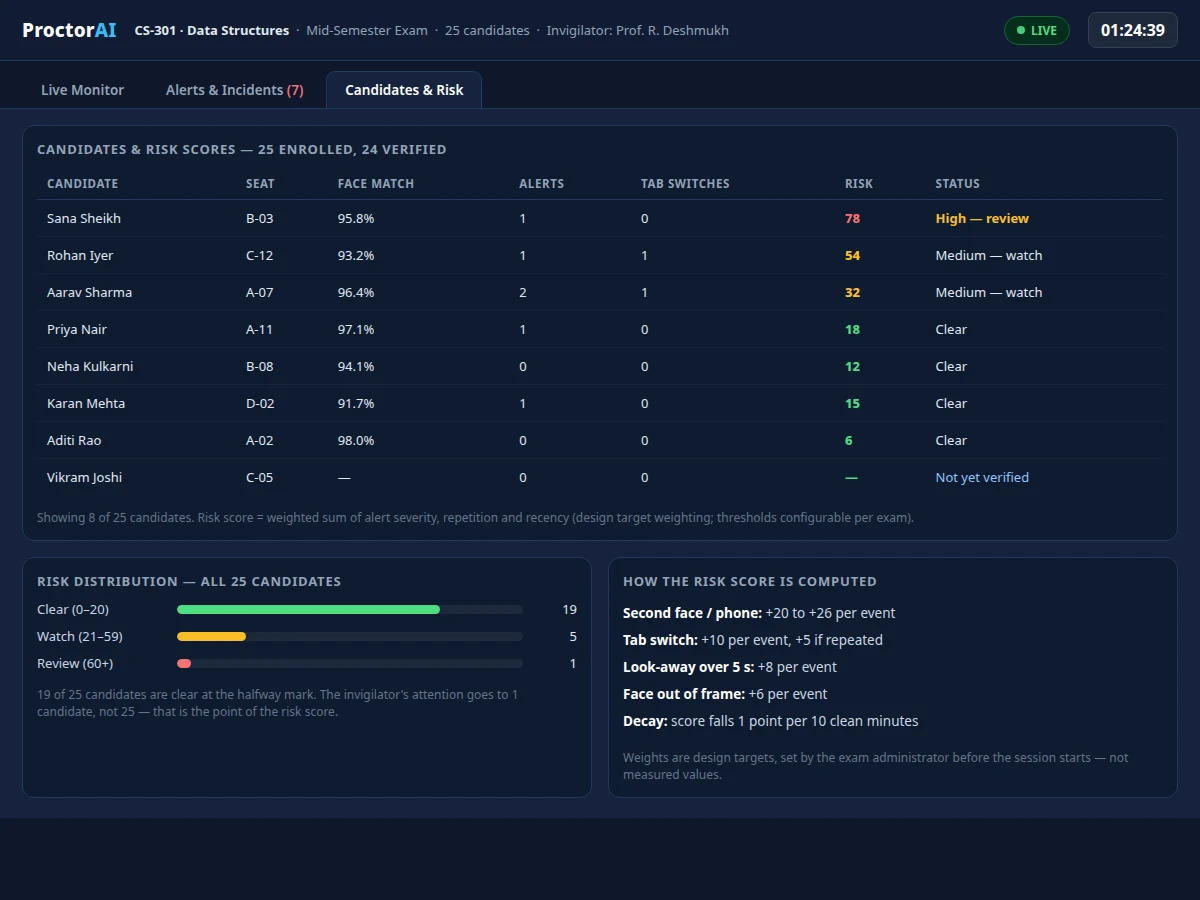
An AI exam proctoring system using Gemini 3 with face verification and behaviour alerts watches an online exam the way a careful invigilator would, but for every candidate at once. Each candidate is verified against an enrolled photograph at the start of the exam and re-checked at intervals, while Gemini 3 reads webcam frames for gaze direction, head pose, extra faces and phone-like objects, and the browser reports tab switches and focus loss. Suspicious moments become timestamped alerts with a short machine-written explanation, and a risk score per candidate tells the invigilator where to look first instead of staring at 25 video tiles. The system never auto-fails anyone: every alert is a flag for human review, with the evidence clip attached. It is built for colleges running online exams where a human invigilator per candidate is impractical, and the demo build proves the full loop — verify, watch, alert, score — on a live dashboard.
| Approach | Identity check | Behaviour watch | Evidence per alert | Invigilator load |
|---|---|---|---|---|
| This system (Gemini 3 + face verification) | Face match at start and at intervals | Gaze, head pose, second face, phone, tab switch | Timestamped clip plus a written note | 1 invigilator watches risk-ranked candidates |
| Manual invigilation (video call grid) | Visual check at start only | One screen of many small tiles | None unless recorded | 1 invigilator per 15–25 candidates, tiring |
| Basic webcam recording | None | None — recording only | Full recording, reviewed after the exam | Hours of review after the exam |
Builder note (measured in the demo build): the spotlight feed renders the face-match overlay over a real webcam-style photograph at 1200 × 900 pixels, the live event feed appends a new simulated event every 9 seconds, and a simulated alert updates the candidate risk ring in under 1 second.
This is a built-to-order software project: the proctoring dashboard, face-verification pipeline, Gemini 3 analysis prompts, alert rule engine and the complete viva kit (report, PPT, Q&A) are prepared fresh for you.
Related built-to-order projects on this site: AI quiz generator from PDF notes (https://projectech.in/projects/ai-quiz-generator-from-pdf-notes-llm/), online examination system (https://projectech.in/projects/online-examination-system-android-app/), and offline attendance management with face detection (https://projectech.in/projects/offline-attendance-management-android-app-face-detection/).
One photo per candidate
Follow the working sequence
How it works
The system runs in four passes over one exam session: enrol, verify, watch and review. Before the exam, each candidate enrols one photograph with consent, and the system stores its 512-dimensional face embedding — never the photo itself in the matching index. When the exam starts, the candidate's webcam frame is matched against the enrolled embedding and the exam page begins logging focus events. During the exam, frames are sampled every few seconds: a local gaze and head-pose check runs on every sample, while Gemini 3 analyses a smaller subset for the harder judgements — a second face, a phone, or a gaze that has drifted from the screen. Every finding is scored, logged with a timestamp and shown on the invigilator dashboard, and the risk score for that candidate moves up or decays with clean time. After the exam, the invigilator reviews only the flagged incidents, marks each one genuine, benign or inconclusive, and exports the report.
- Candidates enrol one photograph each at registration; the system stores a 512-dimensional face embedding per candidate.
- At exam start, the webcam frame is matched against the enrolled embedding; below the configured threshold the candidate is held for manual identity check.
- The exam page logs focus events — tab switches, window changes and blur events — with duration in seconds.
- Webcam frames are sampled every few seconds for a local gaze and head-pose check, and a subset of frames goes to Gemini 3 for behaviour analysis.
- Gemini 3 returns a plain-language finding per frame (gaze, second face, phone-like object), which the rule engine converts into a low, medium or high severity alert.
- Each alert updates the candidate's risk score from 0 to 100, decays with clean time, and appears on the invigilator dashboard with its evidence clip.
- After the exam, the invigilator reviews flagged incidents only, marks each genuine, benign or inconclusive, and exports the per-candidate report.
Tech stack:
- Python 3 · Flask backend
- Gemini 3 · Google AI API
- FaceNet-style embeddings · OpenCV
- JavaScript · HTML5 · CSS3 dashboard
- WebRTC · MediaDevices API
- DAiSEE dataset · LFW dataset
- SQLite · session and alert store
- Matplotlib · scikit-learn metrics
Dataset & model details
- Dataset: DAiSEE (Dataset for Affective States in E-Environments) — 9,068 video clips of 10 seconds each from 112 users, labelled for 4 affective states (boredom, engagement, confusion, frustration) at 4 levels (very low to very high); source: IIT Hyderabad, arXiv:1609.01885. LFW (Labeled Faces in the Wild) — 13,233 face images of 5,749 people; source: University of Massachusetts Amherst; used to evaluate the face-verification matcher on its standard verification-pairs protocol. A selected subset of DAiSEE is used for the gaze and engagement classifier.
- Task: 1:1 face verification (match a live frame against one enrolled photo) plus behaviour classification from webcam frames (gaze direction, head pose, second face, phone-like object) and browser focus-event logging; input = webcam frame plus focus events, output = match result, behaviour label and alert.
- Model: FaceNet-style embedding matcher producing 512-dimensional embeddings compared by cosine similarity for verification; a lightweight gaze and head-pose classifier trained on the DAiSEE subset for per-frame signals; Gemini 3 (multimodal model announced 18 November 2025) analyses sampled frames for second faces, phones and sustained gaze drift and returns a plain-language finding. No Gemini 3 API parameters are claimed beyond what the public API documents.
- Metrics: Verification — false accept rate and false reject rate on LFW verification pairs, with a design target of a false accept rate below 0.1% (target, not a measured claim). Behaviour — precision and recall per alert type on held-out DAiSEE clips, reported as a confusion matrix. Final performance depends on the dataset, train/test split, image quality, lighting, preprocessing, model configuration and training conditions; no accuracy is claimed as measured until the build's evaluation run is executed.
| Parameter | Value |
|---|---|
| Verification method | 1:1 face match, 512-dimensional embeddings, cosine similarity |
| Behaviour engine | Gemini 3 multimodal analysis of sampled frames (announced 18 November 2025) |
| Gaze classifier training data | DAiSEE subset: 9,068 clips of 10 seconds each, 112 users (dataset size) |
| Verification evaluation data | LFW: 13,233 images of 5,749 people (dataset size) |
| False accept rate | Below 0.1% (design target, not a measured claim) |
| Frame sampling | 1 frame every 3 seconds (configurable) for local checks |
| Gemini 3 frame analysis | 1 frame every 15 seconds (configurable) |
| Risk score range | 0 to 100 per candidate |
| Alert severities | Low, medium, high (3 levels) |
| Dashboard | Single-file web demo, runs offline after download (demo data only) |
| Session capacity | 25 candidates per exam session (design target) |
| Exam report | PDF export with timestamps, severity and evidence per alert |
Project features
The four capabilities that define this system are face verification, Gemini 3 behaviour analysis, browser-focus monitoring and risk-ranked review. Face verification matches each candidate against an enrolled photo at the start of the exam and re-checks at intervals, so a different person cannot sit in midway. Gemini 3 reads sampled webcam frames and explains what it sees in plain language — a second face, a phone near the desk, or a gaze that has drifted away for too long. Browser monitoring logs every tab switch and focus loss with its duration, because leaving the exam window is the simplest way to look something up. Finally, every event feeds a per-candidate risk score, so the invigilator reviews one flagged candidate instead of watching 25 video tiles, and every alert carries its evidence clip for a fair human decision.
- [Face verification at start and at intervals] Each candidate is matched against one enrolled photograph before the exam begins and re-verified at set intervals and after any reconnect, using 512-dimensional face embeddings and cosine similarity with a configurable match threshold.
- [Gemini 3 behaviour analysis] Sampled webcam frames are sent to Gemini 3, which describes gaze direction, head pose, extra faces and phone-like objects in plain language; each finding becomes a timestamped alert with the model's own short explanation attached.
- [Tab-switch and focus-loss logging] The exam page records every blur event, tab switch and window change with its duration in seconds, so leaving the exam window is logged even when the camera sees nothing wrong.
- [Per-candidate risk scoring] Alert severity, repetition and recency combine into a risk score from 0 to 100 per candidate, with configurable bands (clear, watch, review) so the invigilator's attention goes to the riskiest candidate first.
- [Live invigilator dashboard] One screen shows the spotlight candidate feed, live behaviour signals, the session risk gauge and the event feed, with alerts and candidate-risk views a click away.
- [Evidence clips with every alert] Each alert stores the surrounding frames and the Gemini 3 note, so a reviewer judges the incident from evidence instead of from a bare score.
- [Exam report export] At the end of the session the invigilator exports a per-candidate report listing every alert with timestamps, severity and evidence, ready to attach to the exam record.
What is included
- Complete source code: Flask backend, face-verification pipeline, alert rule engine and dashboard
- Gemini 3 analysis prompts and the frame-sampling configuration, documented
- Working demo dashboard with simulated live session, alerts and risk scoring
- DAiSEE-subset training notebook for the gaze and head-pose classifier
- LFW evaluation script for the face-verification matcher with false accept and false reject reporting
- Project report PDF (background, methodology, dataset and model details, evaluation plan, limitations)
- PPT presentation for final review
- Viva Q&A preparation document (embeddings, cosine similarity, Gemini 3 prompting, alert thresholds, privacy)
Limitations & prerequisites
- Face verification needs reasonable lighting and a front-facing camera; poor light or a steep camera angle lowers match quality and raises manual checks.
- Gemini 3 analysis needs internet and a valid API key; usage is billed by the provider and is not included in the project cost.
- The system flags behaviour, it does not prove cheating — a second face can be a family member walking past, so every high alert needs human review.
- Behaviour alerts are tuned on DAiSEE clips recorded in quiet rooms; noisy halls, shared rooms and low-end webcams reduce reliability.
- The design target of a false accept rate below 0.1% is a target for the evaluation run, stated honestly — the report documents the actual achieved figure after evaluation.
- Candidate photos and exam recordings are sensitive personal data; consent, storage limits and deletion must follow the college's rules — the build stores embeddings, not raw photos, in the matching index.
- The demo dashboard uses simulated session data; connecting it to a real exam needs the college's exam platform and camera permissions.
Frequently Asked Questions
Is this project suitable for a final-year project?
Yes — for Computer Science, IT and AI & Machine Learning programs, because it combines computer vision, a multimodal large model, a real-time dashboard and an honest evaluation plan in one demonstrable system that a student can genuinely explain in the viva. It covers face verification with embeddings, behaviour classification on a real dataset, API integration with Gemini 3, and alert-rule design, so the viva can go deep on any of those four parts.
Which dataset is used and which model analyses the video?
Two public datasets are used: DAiSEE, with 9,068 ten-second clips from 112 users labelled for boredom, engagement, confusion and frustration, trains the gaze and engagement classifier for the behaviour signals; and LFW, with 13,233 face images of 5,749 people, evaluates the face-verification matcher. Gemini 3 analyses sampled frames for second faces, phones and gaze drift. The report documents both datasets with their sources and the exact subsets used, so every choice is traceable.
Does the system need Gemini 3 API access, and what does it cost?
Yes, live behaviour analysis needs internet and a Gemini API key, because Gemini 3 runs on Google's servers and not on the student's laptop, while the face-verification matcher and the dashboard run locally. The demo dashboard runs fully offline on simulated data, so the project can be demonstrated without a key. API usage is billed by the provider on a pay-per-use basis and is not included in the project cost; the report documents how to keep frame sampling low to keep usage small.
Can the system catch cheating on its own, or does a human decide?
A human always decides — the system only flags behaviour and attaches the evidence, and no candidate is ever auto-failed by an alert, because the risk score only orders the review queue. Each alert carries the timestamped frames and the Gemini 3 note for the reviewer. A second face can be a family member walking past, so the invigilator marks each incident genuine, benign or inconclusive instead of the system passing judgement.
What happens if a candidate's face is not recognised?
The candidate is held at the verification step and the invigilator is notified, instead of being locked out silently or let in unchecked, and the failed attempt is logged with its match score. The candidate can retry after adjusting lighting or camera angle before any manual check. If the match still fails, the invigilator verifies identity manually against the enrolled photo and admits the candidate, so the reason is visible in the report.
Can new alert types be added, and can it run on a real exam?
Yes, new alert types are added as rules on top of the same frame pipeline — for example, detecting notes on the desk or a second screen is a new Gemini 3 prompt plus a severity weight, with no change to the capture code. Running it on a real exam needs the college's exam platform to host the page, candidate consent for camera use, and a Gemini API key; the report lists these as deployment steps, not as part of the base build.
Components & software requirements
- Python 3 · Flask backend
- Gemini 3 · Google AI API
- FaceNet-style embeddings · OpenCV
- JavaScript · HTML5 · CSS3 dashboard
- WebRTC · MediaDevices API
- DAiSEE dataset · LFW dataset
- SQLite · session and alert store
- Matplotlib · scikit-learn metrics
Dataset & model details
- Dataset: DAiSEE (Dataset for Affective States in E-Environments) — 9,068 video clips of 10 seconds each from 112 users, labelled for 4 affective states (boredom, engagement, confusion, frustration) at 4 levels (very low to very high); source: IIT Hyderabad, arXiv:1609.01885. LFW (Labeled Faces in the Wild) — 13,233 face images of 5,749 people; source: University of Massachusetts Amherst; used to evaluate the face-verification matcher on its standard verification-pairs protocol. A selected subset of DAiSEE is used for the gaze and engagement classifier.
- Task: 1:1 face verification (match a live frame against one enrolled photo) plus behaviour classification from webcam frames (gaze direction, head pose, second face, phone-like object) and browser focus-event logging; input = webcam frame plus focus events, output = match result, behaviour label and alert.
- Model: FaceNet-style embedding matcher producing 512-dimensional embeddings compared by cosine similarity for verification; a lightweight gaze and head-pose classifier trained on the DAiSEE subset for per-frame signals; Gemini 3 (multimodal model announced 18 November 2025) analyses sampled frames for second faces, phones and sustained gaze drift and returns a plain-language finding. No Gemini 3 API parameters are claimed beyond what the public API documents.
- Metrics: Verification — false accept rate and false reject rate on LFW verification pairs, with a design target of a false accept rate below 0.1% (target, not a measured claim). Behaviour — precision and recall per alert type on held-out DAiSEE clips, reported as a confusion matrix. Final performance depends on the dataset, train/test split, image quality, lighting, preprocessing, model configuration and training conditions; no accuracy is claimed as measured until the build's evaluation run is executed.
Delivery information
Built-to-order project. Delivery timeline is shared after order confirmation based on current queue.
Support terms
Complete documentation, setup guide, and viva preparation included. Support for setup and explanation provided.
Download free synopsis (PDF)
Enter your name and WhatsApp number — the synopsis PDF downloads immediately. We may send occasional project updates on WhatsApp; no spam.