
More project photos (3)
The problem
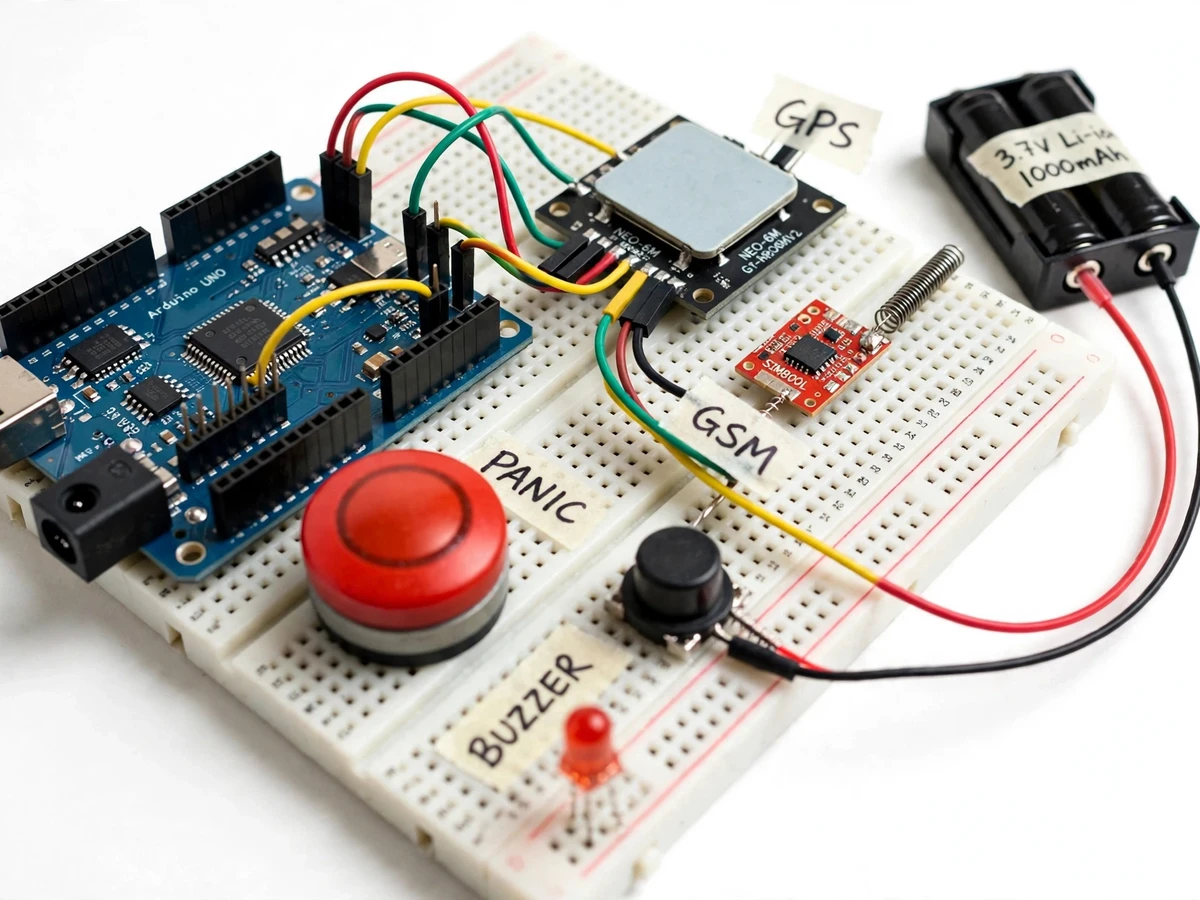
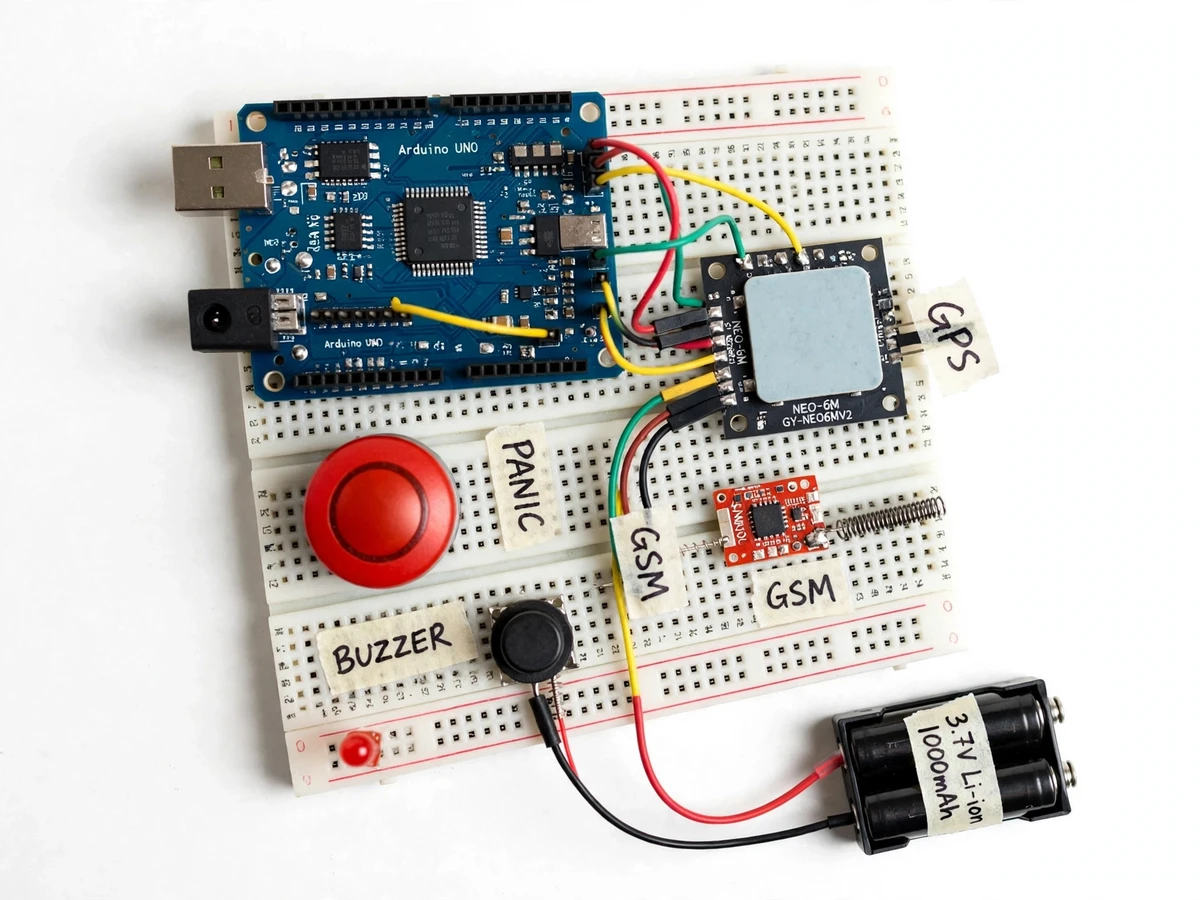
Women Safety Device using GPS and GSM Module is a panic-alert prototype built on an Arduino Uno: when the wearer presses the red panic button, the NEO-6M GPS module reads the latitude and longitude, and the SIM800L GSM module sends that position as a Google Maps link by SMS to preset emergency contacts and calls the first contact, while a buzzer and red LED alert people nearby. The device exists because a phone is often unreachable in the first seconds of an unsafe situation — locked, in a bag, or taken away — while a single dedicated button can be pressed without looking at a screen. It sends the location automatically, so contacts get an exact map link even if the wearer cannot speak. The build demonstrates GPS parsing, GSM AT-command control and power design for a 2 A transmit burst, and it is an academic prototype, not a certified security product or a replacement for emergency services.
Wearer presses and holds the red panic button for about 2 seconds.
Follow the working sequence
How it works
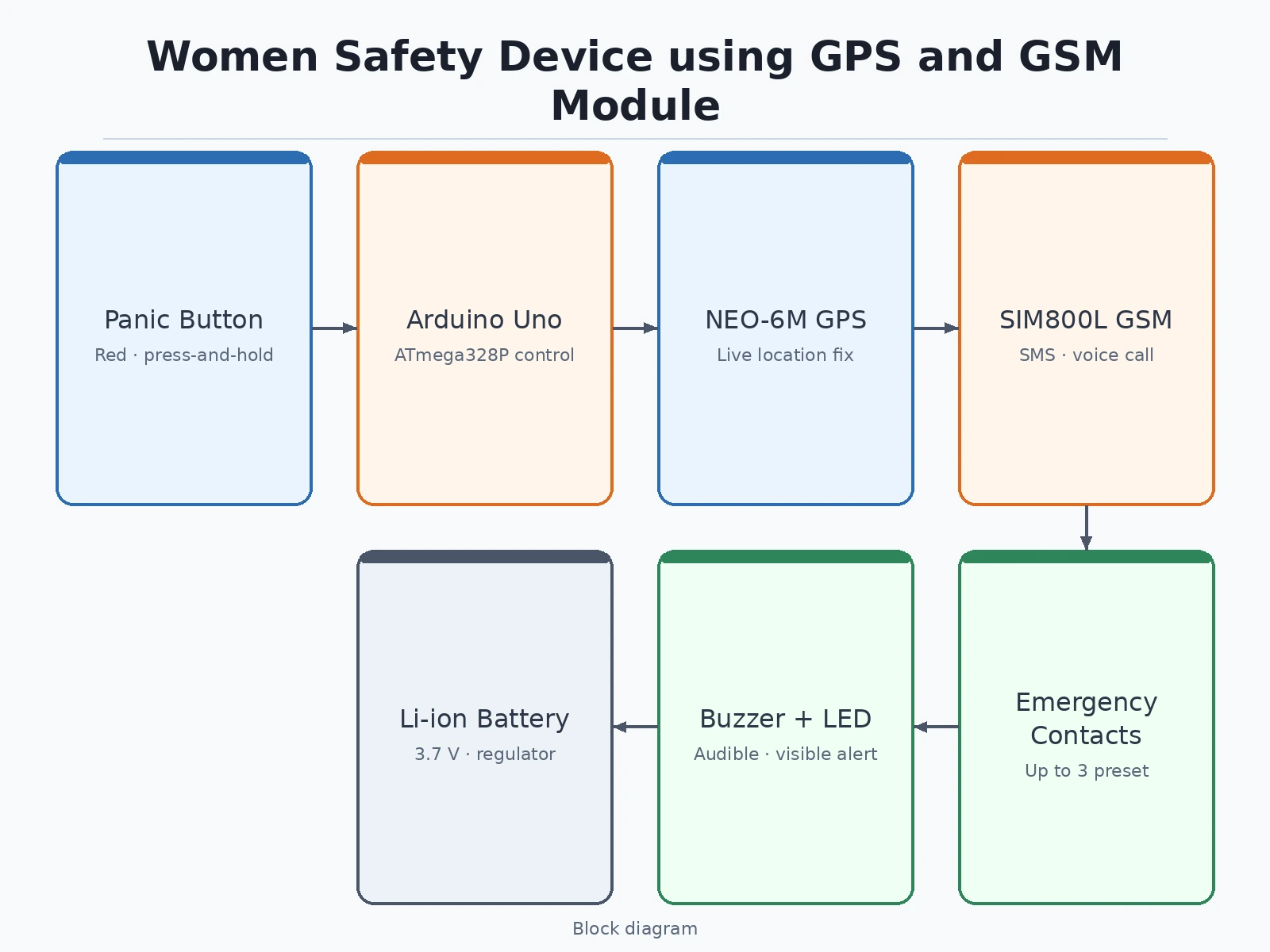
From button press to alert, the chain runs in four stages: the Arduino detects the panic press, reads the latest GPS fix from the NEO-6M, formats the latitude and longitude into a Google Maps link, and commands the SIM800L to send that link by SMS to every preset contact and then call the first one, while the buzzer and LED fire locally. The GPS module runs continuously from power-on, so a fix is usually already available when the button is pressed. The GSM module needs a valid SIM with balance and network coverage, and the whole alert depends on a stable 4.0 V supply that can deliver the module's 2 A transmit burst. Builder note from the build: powering the SIM800L from the Arduino 5 V pin made it reset on every SMS attempt; a dedicated LM2596 buck converter set to 4.0 V with a 1000 µF capacitor across VCC and GND made SMS sending reliable.
- On power-on, the Arduino boots, the NEO-6M GPS module starts acquiring satellites, and the SIM800L GSM module registers on the mobile network; a status LED shows the device is armed.
- The firmware continuously parses NMEA sentences from the GPS module and keeps the latest valid latitude and longitude in memory, updating once per second (1 Hz, datasheet default).
- The wearer presses and holds the red panic button for approximately 2 seconds (design target); firmware debouncing rejects brief accidental bumps.
- The Arduino formats the current coordinates into a Google Maps link (https://maps.google.com/?q=latitude,longitude) inside a short alert message.
- The SIM800L sends the SMS to each preset contact in turn using AT commands, then places a voice call to the first contact in the list.
- At the same time, the buzzer sounds and the red LED flashes for approximately 30 seconds (design target) to alert people nearby, and the device returns to armed standby after the alert cycle.
Tech stack:
- Arduino Uno (ATmega328P)
- NEO-6M GPS module
- SIM800L GSM module
- Arduino IDE · C/C++ firmware
- TinyGPS++ library (NMEA parsing)
- AT commands (SMS · voice call)
- 3.7 V Li-ion battery · LM2596 buck converter
- Google Maps location link
| Parameter | Value |
|---|---|
| Controller | Arduino Uno, ATmega328P, 16 MHz clock (datasheet value) |
| GPS module | NEO-6M, 50 channels, GPS L1 C/A code (datasheet value) |
| GPS position accuracy | 2.5 m CEP (datasheet value, open sky) |
| GPS tracking sensitivity | -161 dBm (datasheet value) |
| GPS update rate | 1 Hz default, 5 Hz maximum (datasheet value) |
| GPS cold start | 27 s typical (datasheet value, open sky) |
| GSM module | SIM800L, quad-band 850/900/1800/1900 MHz (datasheet value) |
| GSM supply voltage | 3.4–4.4 V, 4.0 V recommended (datasheet value) |
| GSM peak current | Approximately 2 A during transmission bursts (datasheet value) |
| Alert output | SMS with Google Maps link to up to 3 preset contacts (design target) |
| Follow-up call | Voice call to first contact after SMS round (implemented) |
| Panic button | Momentary push-button, press-and-hold approximately 2 s (design target) |
| Local alert | Buzzer + red LED for approximately 30 s (design target) |
| Battery | 3.7 V Li-ion, 1000 mAh (design target) |
| Standby runtime | Approximately 8–12 hours (design target; varies with GPS lock and alert frequency) |
| SMS delivery | Expected within a few seconds to about 1 minute after a GPS fix (expected, depends on GSM network coverage; not a measured claim) |
Project features
The device's strongest capabilities are its one-press alert, its automatic live-location SMS, and its local deterrent: pressing the panic button triggers the full alert chain without any phone, app or screen, the SMS carries a Google Maps link built from the live GPS fix so contacts can navigate straight to the wearer, and the buzzer and LED make the alert audible and visible to people nearby at the same moment. A fourth capability is the follow-up voice call to the first emergency contact, which turns a silent text alert into a live conversation when the wearer can speak. Contacts are stored in firmware, so the device works as a standalone unit once configured, and the battery-powered design means it keeps working away from mains power. Every feature below is implemented in the base build; optional additions such as fall detection or a mobile app are listed separately and are not claimed as included.
- [One-press panic alert] A large red momentary push-button, debounced in firmware with a press-and-hold of approximately 2 seconds (design target) to prevent accidental triggers, starts the full alert chain with a single action and no phone or screen.
- [Live GPS location by SMS] The NEO-6M GPS module supplies latitude and longitude, which the firmware formats into a Google Maps link and sends by SMS to every preset emergency contact through the SIM800L.
- [Emergency voice call] After the SMS round, the SIM800L places a voice call to the first preset contact, so the alert becomes a live conversation when the wearer is able to speak.
- [Local buzzer and LED deterrent] A 5 V active buzzer and a red LED sound and flash for approximately 30 seconds (design target) after the button press, drawing the attention of people nearby.
- [Up to 3 preset contacts] Up to 3 emergency contacts (design target) are stored in firmware and can be changed by editing one clearly marked section of the code before upload.
- [Battery-powered wearable form] A 3.7 V Li-ion battery with a dedicated regulator powers the whole unit, so the device works in a pocket or bag with no mains connection and no phone nearby.
- [Fix-validity check] The firmware sends the alert only from a valid GPS fix; if no fix is ready when the button is pressed, it waits briefly and then sends the last known position, clearly marked as last known.
What is included
- Working women safety device prototype (Arduino Uno, NEO-6M GPS, SIM800L GSM, panic button, buzzer, LED, battery)
- Complete Arduino firmware source code with contact configuration section
- Circuit and wiring documentation with the SIM800L power-supply notes
- Component list with module part numbers
- Setup guide: SIM insertion, contact configuration, first-alert test procedure
- Project report PDF (background, GPS/GSM theory, methodology, results, limitations)
- PPT presentation for final review
- Viva Q&A preparation document (GPS fix, NMEA parsing, AT commands, GSM power design)
Limitations & prerequisites
- Needs GSM network coverage and a SIM card with SMS balance; without a signal the alert SMS cannot be sent.
- GPS needs a clear view of the sky; indoors, underground or between tall buildings the fix may be slow or unavailable.
- The SIM800L is a 2G-only module, and 2G networks are being phased out in some regions — check local carrier support before ordering.
- SMS delivery time depends on the mobile network and is not guaranteed to be instant.
- Location accuracy is 2.5 m CEP (datasheet value) outdoors; accuracy degrades near tall buildings and under tree cover.
- Standby runtime of approximately 8–12 hours (design target) depends on GPS lock, temperature and how often alerts are triggered.
- This is an academic safety-alert prototype, not a certified security product and not a replacement for emergency services (dial 112 in India).
Frequently Asked Questions
Which controller and modules does it use?
An Arduino Uno (ATmega328P) runs the firmware, a NEO-6M GPS module supplies the live position, and a SIM800L GSM module sends the SMS alerts and places the follow-up voice call. A red panic button, a buzzer, a red LED and a 3.7 V Li-ion battery complete the wearable unit.
What exactly do my emergency contacts receive?
Each preset contact receives an SMS containing a Google Maps link built from the wearer's live latitude and longitude, so they can tap it and navigate straight to the location. After the SMS round, the device calls the first contact, and the buzzer and LED alert people nearby at the same time.
Does it need a smartphone, an app or the internet?
No. The device works standalone once the contacts are stored in firmware — no smartphone, no app and no internet connection are needed. It only needs GSM network coverage and a SIM card with SMS balance, which is why it keeps working where a phone app would not.
What happens if there is no GPS fix or no mobile network?
The firmware waits briefly for a valid GPS fix and then sends the last known position, clearly marked as last known, rather than sending nothing. If there is no GSM network at all, the SMS cannot go out, so the buzzer and LED still fire locally and the alert is retried when coverage returns.
Can this project be customized?
Yes. Realistic customizations include adding more emergency contacts, a fall-detection sensor, a vibration motor, a smaller enclosure for wearability, or a companion app for contact management. Each is an optional addition developed on request and is not part of the base build.
Is this project suitable for a final-year project?
Yes, for Electronics and Telecommunication, Electrical and Computer Engineering programs. It demonstrates embedded C programming, GPS NMEA parsing, GSM AT-command control, power-supply design for a 2 A transmit burst, and a complete safety-alert system with honest limitations for the viva.
Components & software requirements
- Arduino Uno (ATmega328P)
- NEO-6M GPS module
- SIM800L GSM module
- Arduino IDE · C/C++ firmware
- TinyGPS++ library (NMEA parsing)
- AT commands (SMS · voice call)
- 3.7 V Li-ion battery · LM2596 buck converter
- Google Maps location link
Delivery information
Built-to-order project. Delivery timeline is shared after order confirmation based on current queue.
Support terms
Complete documentation, setup guide, and viva preparation included. Support for setup and explanation provided.
Download free synopsis (PDF)
Enter your name and WhatsApp number — the synopsis PDF downloads immediately. We may send occasional project updates on WhatsApp; no spam.