
More project photos (3)
The problem
Parkinson's disease changes how a person moves from hour to hour: tremor comes and goes, movements slow down, and involuntary movements appear, often in patterns that a single clinic visit cannot capture. Doctors and researchers therefore value continuous, objective movement records taken at home over days and weeks, and that need is why wrist-worn symptom monitors have become a serious product category. In late October 2026 Empatica launched WellPD, an FDA-cleared and CE-marked wrist device with a companion app that tracks tremor, dyskinesia, bradykinesia, sleep and activity, and summarises them daily, weekly and monthly, with shipping from 23 November 2026. This student project translates that headline honestly to lab scale: a wrist unit that samples motion, scores a tremor index only when the hand is verifiably still, times a finger-tap test as a slowness proxy, and plots both against manually logged dose times, so a student can demonstrate fluctuation over a day without claiming any medical capability.
How it works
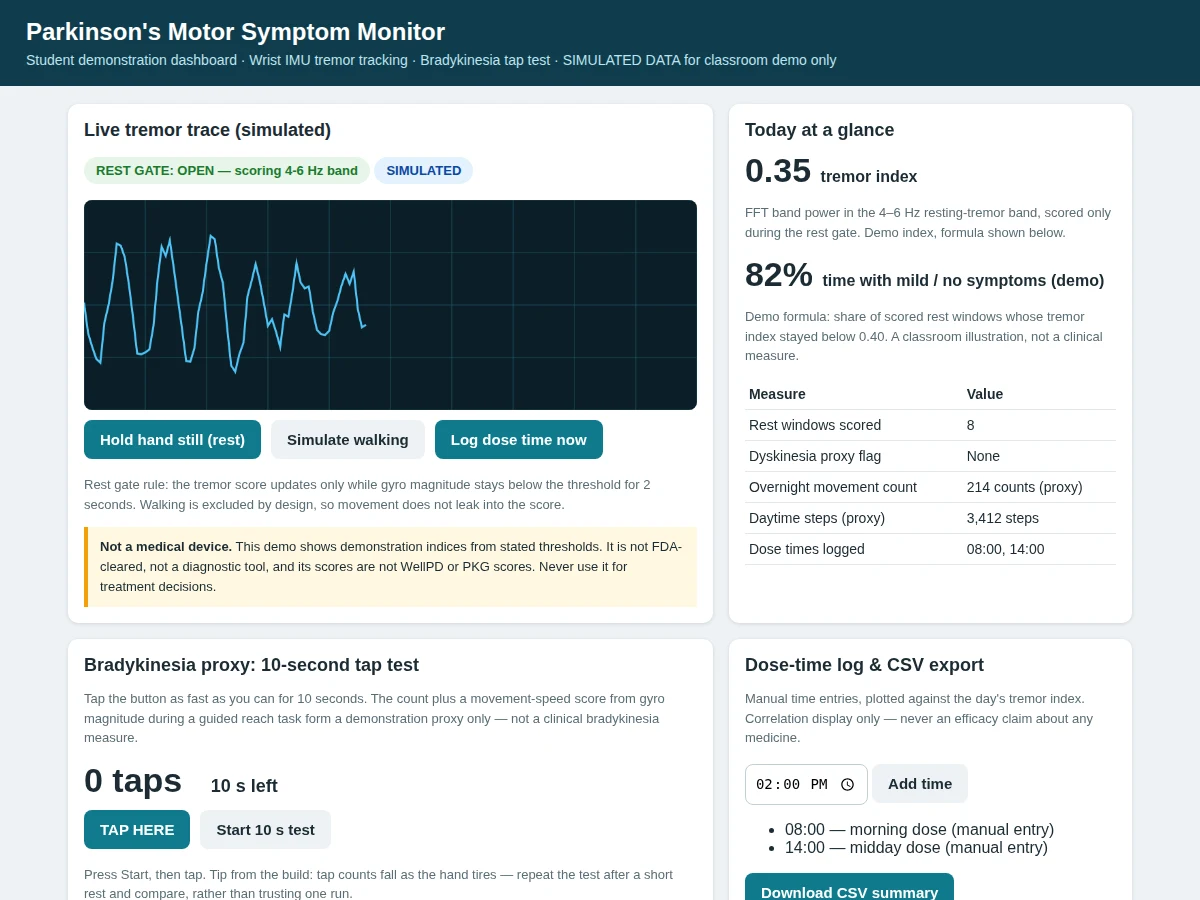
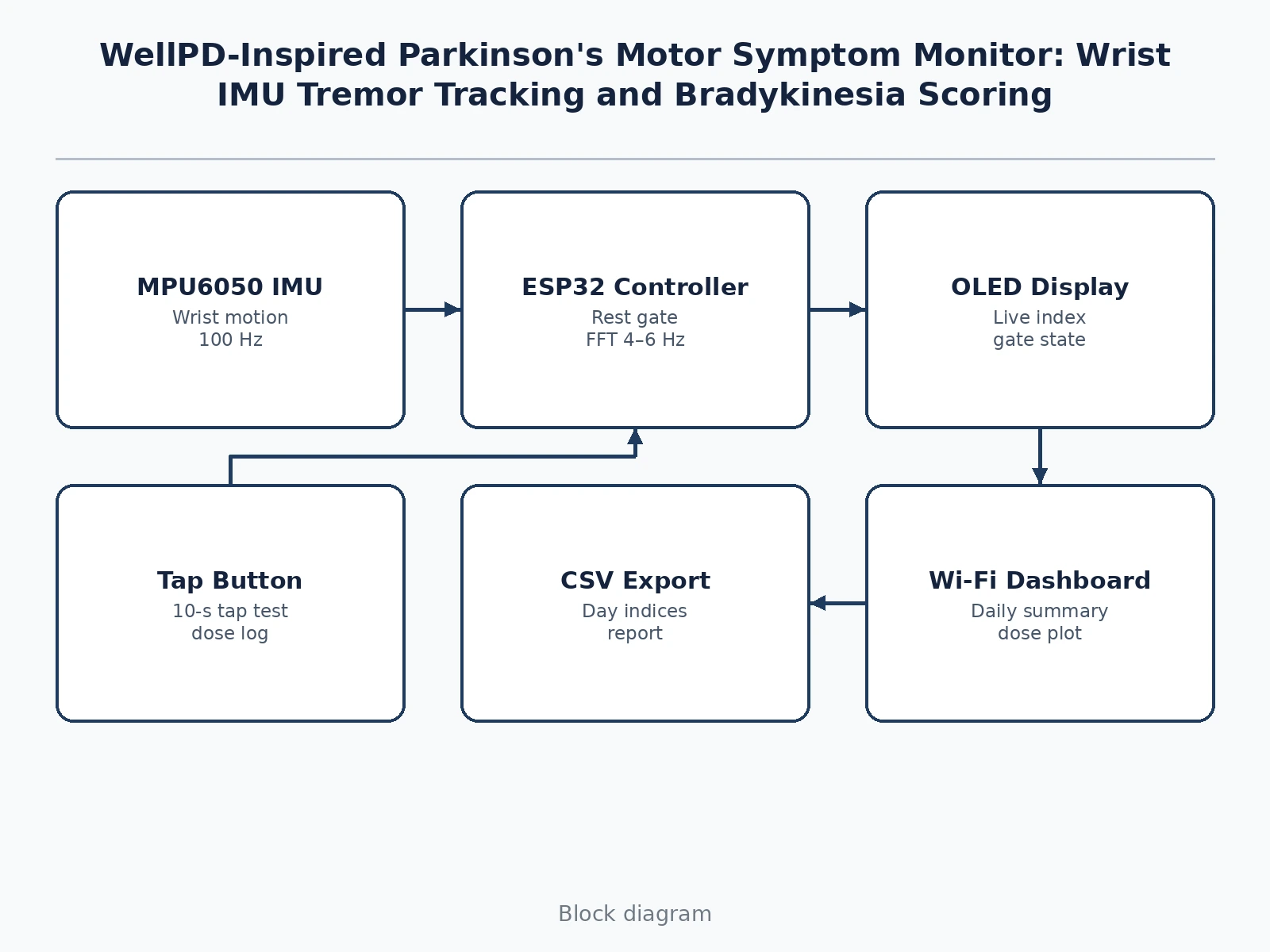
The end-to-end mechanism runs from wrist motion to a scored, explainable daily record in four guarded stages, each with a stated rule an examiner can test. First, the MPU6050 streams acceleration and rotation to the ESP32 at a 100 Hz design target, and the firmware watches gyro magnitude against a fixed threshold. Second, only when the hand has stayed below that threshold for 2 seconds does the rest gate open, and only then does the firmware compute FFT band power in the 4 to 6 Hz band and update the tremor index, so walking can never raise the resting score. Third, the wearer runs the two guided tasks: a 10-second tap test through the wrist button and a slow guided reach, which together produce the bradykinesia proxy numbers. Fourth, the ESP32 serves the dashboard over Wi-Fi with the live trace, daily summary, dyskinesia proxy flag, overnight log, and dose times together, exporting the day as CSV.
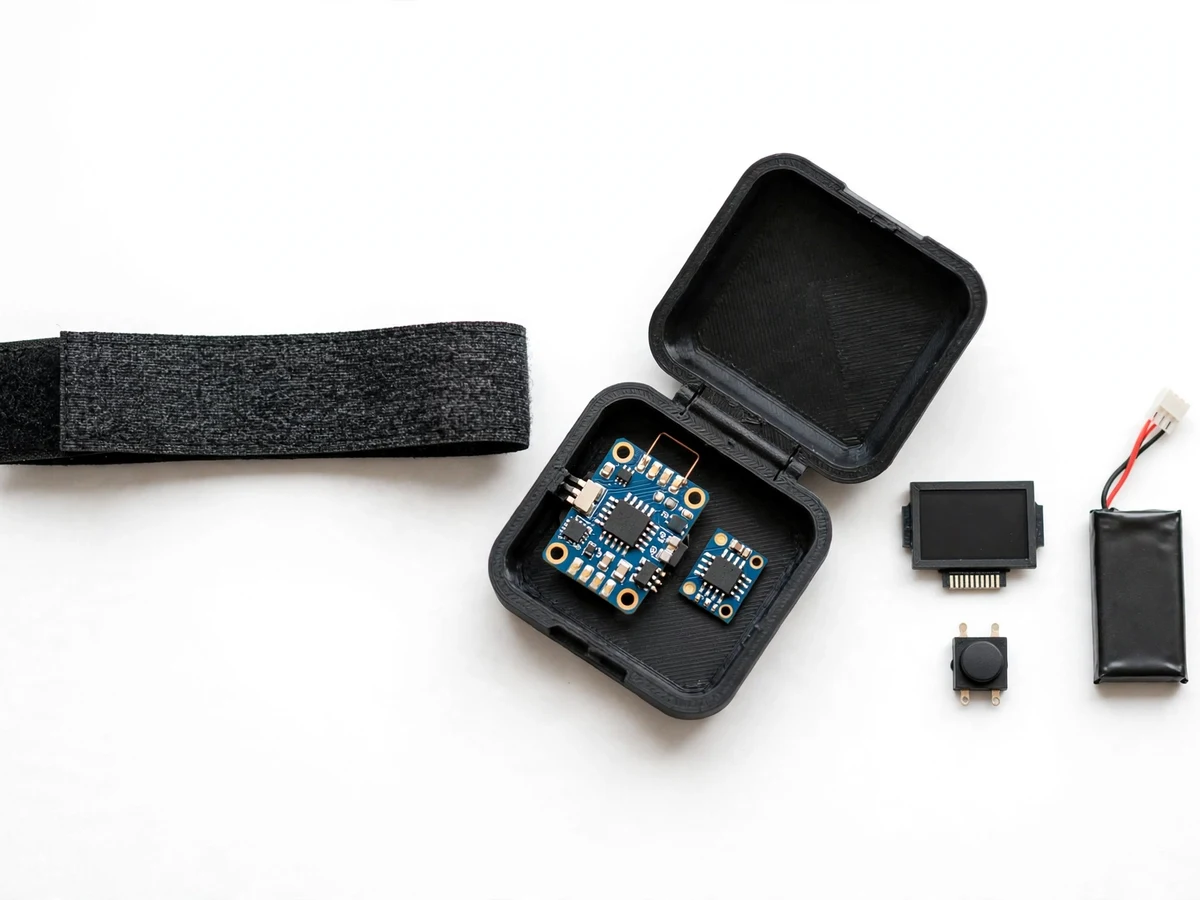
- The builder assembles the wrist unit: ESP32 board, MPU6050 module, small OLED, tap-test button, and Li-Po cell wired inside a 3D-printed-style enclosure on a wrist strap, and checks the I2C link and the OLED display.
- The builder calibrates the unit: the wearer sits with the hand still for the rest-gate check, walks a short distance to confirm walking closes the gate, and runs one tap test to confirm the button counts cleanly.
- For the rest-gated tremor demonstration, the builder holds the hand still until the dashboard rest-gate indicator opens, watches the tremor index update in the 4 to 6 Hz band, then walks to show the gate closing and the score freezing.
- For the bradykinesia proxy demonstration, the builder runs the 10-second tap test, records taps per 10 seconds, then performs the guided reach task and reads the movement-speed score from the dashboard.
- For the fluctuation demonstration, the builder logs two or three manual dose times across the session and shows the tremor curve plotted against those markers on the dashboard, describing it strictly as a correlation display.
- For the overnight proxy demonstration, the builder leaves the unit logging movement counts overnight or across a long still period, then reads the movement-count log and the daytime step count on the dashboard.
- The builder exports the day's CSV, points to the rest-window count, the tremor index values, the tap-test result, and the dose-time markers, and reports honestly in the report which windows were rest-gated and which segments were excluded as movement.
Tech stack:
- ESP32 · dual-core controller and Wi-Fi dashboard host
- MPU6050 IMU · 6-axis motion sensing for tremor and activity
- FFT band-power scoring · 4 to 6 Hz resting-tremor band analysis
- Rest-gate rule · 2-second still-hand gate before scoring
- OLED wrist display · live tremor index and rest-gate state
- Tap-test button · 10-second tap counting and dose-time logging
- Wi-Fi web dashboard · live trace and daily summary display
- CSV export · daily indices and dose-time markers for the report
| Parameter | Value |
|---|---|
| Build type | Hybrid wrist hardware plus web dashboard build · wrist unit plus Wi-Fi dashboard software (design target) |
| Controller | ESP32 · Xtensa dual-core 32-bit LX6 up to 240 MHz · 520 KB SRAM · Wi-Fi 802.11b/g/n (Datasheet value) |
| Motion sensor | MPU6050 · 3-axis accelerometer plus 3-axis gyroscope · 16-bit ADC per axis (Datasheet value) |
| Accelerometer range | Plus or minus 2 g · 4 g · 8 g · 16 g programmable full-scale ranges (Datasheet value) |
| Gyroscope range | Plus or minus 250 deg per s · 500 deg per s · 1000 deg per s · 2000 deg per s programmable full-scale ranges (Datasheet value) |
| Sampling rate | 100 Hz IMU sampling (design target) |
| Tremor band | 4 Hz to 6 Hz resting-tremor FFT band (design target) |
| Rest gate | Gyro magnitude below threshold for 2 seconds before scoring opens (design target) |
| Tap test | 10 seconds timed finger-tap test · taps per 10 seconds (design target) |
| Wrist display | Small OLED · live tremor index and rest-gate state (design target) |
| Battery | Single Li-Po cell · protected holder and supervised charging required (design target) |
| Dashboard | Wi-Fi web dashboard · live trace · daily summary · dose-time plot · CSV export (design target) |
| Demo calm index | Share of scored rest windows with tremor index below 0.40 · stated demo formula · not a clinical measure (design target) |
| Wear scope | One wrist only · one wearer per calibration (design target) |
| Trend reference | Empatica WellPD launched late October 2026 · FDA-cleared and CE-marked wrist device plus companion app · reported 11 g device weight · reported 14 days battery · reported shipping from 23 November 2026 · reported figures only · never claimed for this build |
| Builder note | On the bench prototype, a normal-pace walk raised gyro magnitude above the rest threshold within about 1 second and closed the gate, while a genuinely still hand opened it after the full 2 seconds, and tap counts fell on a repeat test done immediately after the first as the hand tired, so the report recommends a short rest between tap tests and treats a single tap count as unreliable · noted as a builder observation |
Project features
This monitor combines six demonstration measurements into one wrist unit and one dashboard, so the review story is a complete chain, not one reading. The wrist unit samples the MPU6050 sensor at a 100 Hz design target and streams the data to the ESP32, which runs the scoring rules. A rest gate guards the tremor score: the score updates only after the gyro magnitude has stayed below a fixed threshold for 2 seconds, so walking and arm swings cannot leak into a resting-tremor number. A tap test gives a second, independent proxy for slowness, counting finger taps in 10 seconds through the wrist button, while a guided reach task adds a movement-speed score from gyro magnitude. The dashboard turns those indices into a visible day: a live tremor trace, a daily summary with a stated demo formula for time with mild or no symptoms, dose-time markers plotted against the tremor curve, and a CSV export for the report.
- [Rest-gated tremor index] The ESP32 samples the MPU6050 at 100 Hz (design target) and computes FFT band power in the 4 to 6 Hz resting-tremor band, scored only while the rest gate is open after 2 seconds of still-hand gyro data, so walking does not contaminate the score — implemented in the base build.
- [Bradykinesia proxy tap test] A wrist button times a 10-second finger-tap test and reports taps per 10 seconds plus a movement-speed score from gyro magnitude during a guided reach task, both labelled demonstration proxies, never clinical bradykinesia measures — implemented in the base build.
- [Dyskinesia proxy flag] A simple involuntary-movement variability indicator during rest windows flags raised movement variability, explicitly labelled a proxy indicator and never a clinical dyskinesia measure — implemented in the base build.
- [Sleep and activity proxy log] Overnight movement counts and daytime step and activity counts from the IMU give an actigraphy-style proxy log, with no sleep staging and no sleep-quality scoring claimed — implemented in the base build.
- [Medication-time log with fluctuation plot] Manually tapped dose times are plotted against the day's tremor index so a student can see fluctuation around dose times, as a correlation display only, never an efficacy claim about any medicine — implemented in the base build.
- [Live dashboard with daily summary] The Wi-Fi web dashboard shows a live tremor trace, a rest-gate indicator, a daily summary with a WellMove-style time-with-mild-or-no-symptoms demo index whose formula is stated on the page, and a CSV export of the day's indices — implemented in the base build.
- [On-wrist OLED and tap button] A small OLED shows the live tremor index and rest-gate state at a glance, and the tap-test button doubles as the dose-time log button, so the unit works standalone before the dashboard is opened — implemented in the base build.
- [Two-wrist comparison] Future scope only, not implemented: wearing a matched unit on each wrist and comparing tremor indices side by side, listed as an extension rather than a claimed feature, since the base build covers one wrist and one wearer per calibration.
What is included
- Complete fabricated wrist unit (ESP32 board, MPU6050 module, small OLED, tap-test button, Li-Po cell, 3D-printed-style enclosure, wrist strap)
- Wi-Fi dashboard software (live tremor trace, rest-gate indicator, tap test, dose-time log, daily summary, CSV export)
- Setup and calibration guide (rest-gate check procedure, walking-exclusion check, tap-test procedure, dose-time logging worksheet, CSV reading worksheet)
- Project report PDF (wearable symptom-monitoring background, rest-gate and FFT band design, proxy-index design, demonstration results, honest measurement limits)
- PPT presentation for final review
- Viva Q&A preparation document (resting tremor band choice, rest-gate design, proxy versus clinical measures, WellPD comparison limits, single-wrist limits, fluctuation-plot honesty)
Limitations & prerequisites
- Academic demonstration only, not a medical device: this prototype is not FDA-cleared, not CE-marked, not a diagnostic tool, and not clinically validated, and it must never be presented as medical equipment or used for treatment decisions.
- Scores are not WellPD or PKG scores: the tremor index, bradykinesia proxy, dyskinesia proxy flag, and calm index are demonstration indices from stated thresholds and formulas, and they must never be compared with clinical scores or quoted as a person's medical state.
- One wrist and one wearer per calibration: the build covers a single wrist, thresholds are set for one wearer at a time, and results do not transfer across people or wrists without recalibration.
- Needs still-hand rest periods: the tremor score exists only inside rest-gated windows, so a session with no still periods produces no tremor score, and that gap is a property of the design, not a fault to hide.
- Walking and exercise contaminate or exclude scores: movement closes the rest gate and freezes the tremor score, and activity counts during exercise are a rough proxy, not a validated activity measure.
- No sleep staging and no fall detection: overnight data is a movement-count log only, it cannot say how someone slept, and the unit claims no fall detection, no alerts, and no emergency function.
- No diagnosis and no treatment advice: the dose-time plot shows timing against tremor indices only, it cannot judge whether any medicine worked, and the report must say so wherever the plot appears.
- Bench electronics need supervision: the Li-Po cell needs a protected holder, correct polarity, and supervised charging, and the strap and enclosure need care around skin irritation and small parts.
Frequently Asked Questions
Is this a good choice for a final-year project?
Yes, for Electronics, Electrical, and IoT programs, because it combines embedded hardware, inertial sensing, digital signal processing, and a web dashboard into one testable measurement chain with a clear review thread around rest-gate design, FFT band scoring, and honest proxy limits. The review story is: why a rest gate is needed before any tremor number means anything, how an FFT band becomes a stated demo index, and where honest proxy measurement stops and clinical measurement would begin.
Is this a medical device or a Parkinson's diagnostic tool?
No, and the report says so plainly: this is an academic demonstration prototype, not an FDA-cleared device, not a diagnostic tool, and not clinically validated in any way, and its scores must never guide treatment or judge a person's medical condition. Its scores are demonstration indices built from stated thresholds, they are not WellPD or PKG scores, and they must never be used to judge a person's condition or to change any treatment.
How does the rest gate stop walking from corrupting the tremor score?
The firmware watches gyro magnitude continuously, and it only opens scoring after the hand has stayed below a fixed threshold for a full 2 seconds of still data, so no tremor number is ever computed from a moving hand at all. Walking raises gyro magnitude above that threshold within about 1 second on the bench prototype, which closes the gate and freezes the score, so a walking segment can never appear as resting tremor. The dashboard shows the gate state live, so an examiner can watch it open and close.
What does the tap test actually measure?
The tap test measures taps per 10 seconds through the wrist button plus a movement-speed score from gyro magnitude during a guided reach task, and both numbers together form a bradykinesia proxy only, never a clinical bradykinesia measure of any kind. It does not measure clinical bradykinesia, it is sensitive to fatigue and practice, and the report recommends a short rest between repeats and treats a single count as unreliable rather than quoting it as a result.
How is this different from Empatica WellPD?
WellPD is a commercial FDA-cleared and CE-marked wrist device with a companion app, reported at 11 g with a reported 14 days of battery, tracking tremor, dyskinesia, bradykinesia, sleep and activity with a WellMove summary measure, and shipping from 23 November 2026. This student build is none of those things: it is a single-wrist ESP32 and MPU6050 prototype with stated demo indices, no clearance, no validation, and no clinical measures, inspired by the WellPD idea rather than reproducing it.
Can it track sleep or detect falls?
No to both: overnight data is an actigraphy-style movement-count log only, with no sleep staging and no sleep-quality scoring, and the unit has no fall-detection algorithm, no alerts, and no emergency function of any kind, and neither limit is hidden in the report. Claiming either would turn an honest proxy log into a safety claim the build cannot support.
Components & software requirements
- ESP32 · dual-core controller and Wi-Fi dashboard host
- MPU6050 IMU · 6-axis motion sensing for tremor and activity
- FFT band-power scoring · 4 to 6 Hz resting-tremor band analysis
- Rest-gate rule · 2-second still-hand gate before scoring
- OLED wrist display · live tremor index and rest-gate state
- Tap-test button · 10-second tap counting and dose-time logging
- Wi-Fi web dashboard · live trace and daily summary display
- CSV export · daily indices and dose-time markers for the report
Delivery information
Built-to-order project. Delivery timeline is shared after order confirmation based on current queue.
Support terms
Complete documentation, setup guide, and viva preparation included. Support for setup and explanation provided.
Download free synopsis (PDF)
Enter your name and WhatsApp number — the synopsis PDF downloads immediately. We may send occasional project updates on WhatsApp; no spam.