
More project photos (3)
The problem
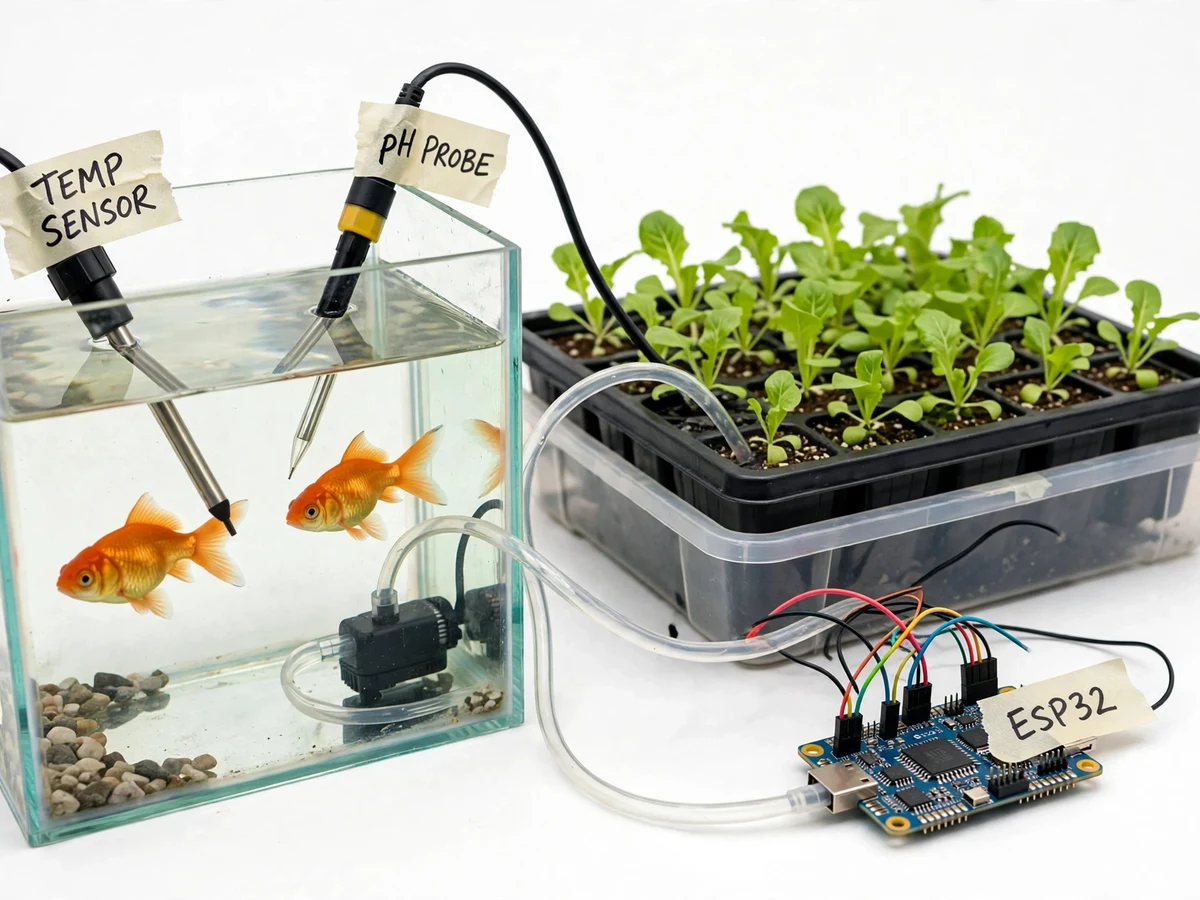
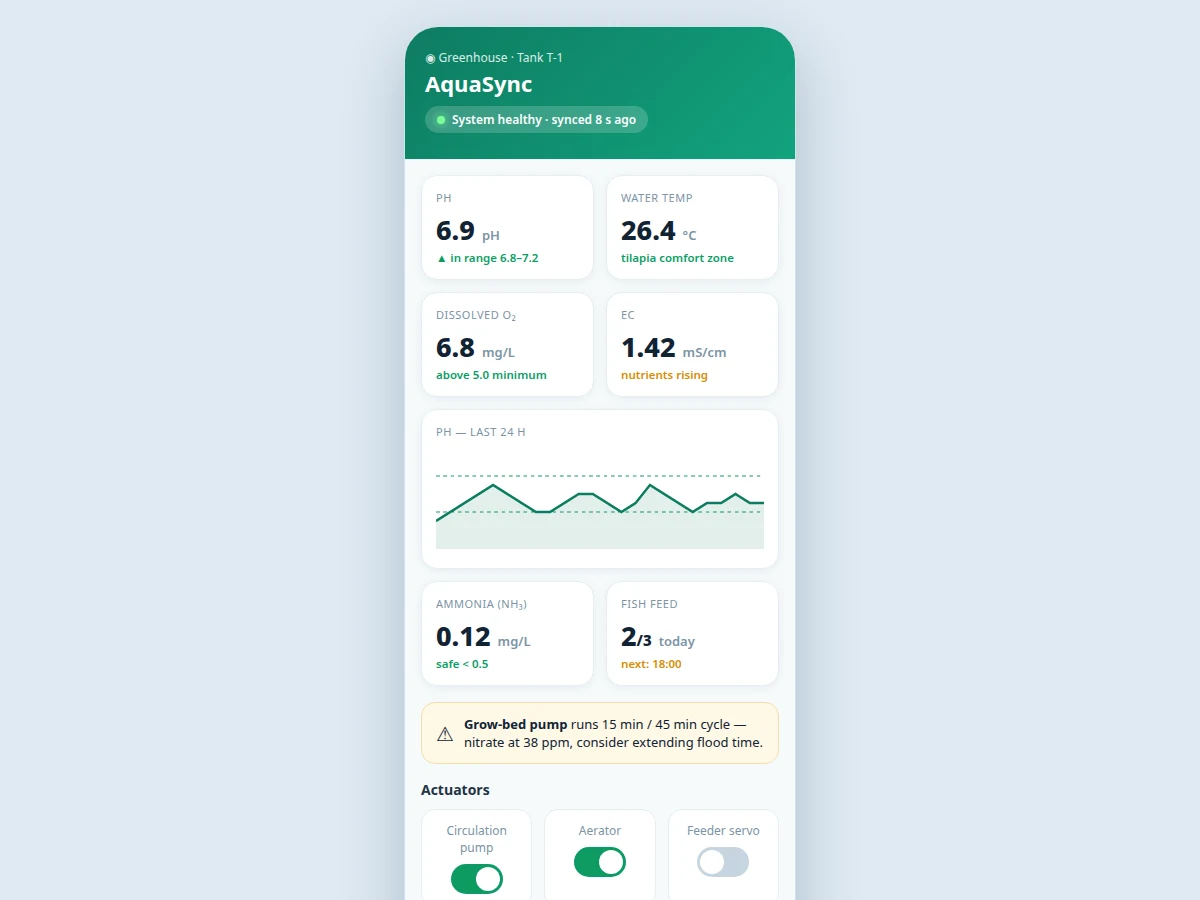
Aquaponics — fish and plants in one recirculating loop — fails silently. Fish excrete ammonia, bacteria convert it to nitrite then nitrate, plants absorb the nitrate; if the pH drifts, the temperature spikes, or the pump stops at night, fish stress and plants stall, and the student discovers it a day too late. Manual test kits mean the system is checked twice a day at best. This project instruments the loop with an ESP32: a pH probe, a waterproof temperature sensor, a dissolved-oxygen probe and an EC probe report continuously, and the controller drives the circulation pump, aerator and an automatic feeder servo. The mobile dashboard is the daily interface — live tiles for each parameter, a 24-hour pH trend against the safe band, feed logging, and actuator toggles. Threshold alerts (low dissolved oxygen, pH out of band, pump fault) turn a twice-daily chore into continuous supervision, and the logged data gives the report real curves to discuss: the daily pH swing, the oxygen dip after feeding, the EC climb between water changes.
pH, dissolved oxygen, temperature and EC probes sample the fish tank on a 30-second cycle.
Follow the working sequence
How it works
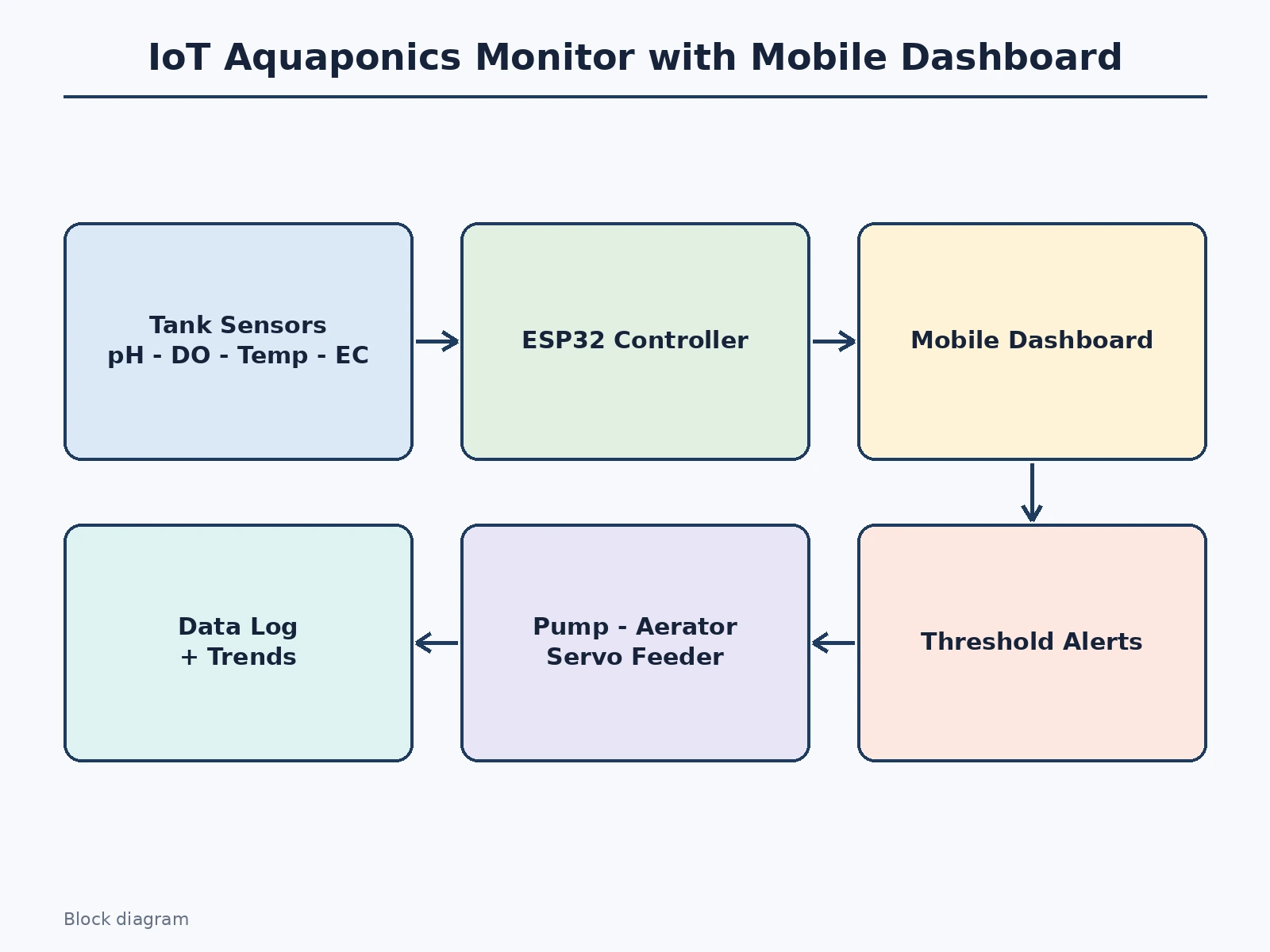
- The pH, temperature, DO and EC probes sample the fish tank on a 30-second cycle through the ESP32's ADC and digital interfaces.
- Each reading is checked against configured safe bands (pH 6.8–7.2, DO ≥ 5 mg/L, temperature 24–28 °C).
- The firmware runs the circulation pump on its flood/drain schedule and switches the aerator based on the DO reading, overriding the schedule if oxygen drops.
- The servo feeder dispenses at the configured times and the dashboard counts feeds per day.
- Readings are published over Wi-Fi to the mobile dashboard, which renders live tiles, the 24-hour pH trend and actuator states.
- Any parameter leaving its safe band raises a dashboard alert; a pump-current anomaly flags a possible pump fault.
- Logged data is exported for the report, showing daily cycles the student can explain in the viva.
Tech stack:
- ESP32 (Wi-Fi telemetry + control)
- pH probe with conditioning board
- DS18B20 waterproof temperature sensor
- Galvanic dissolved-oxygen probe
- EC/TDS probe
- Mobile-first HTML/CSS/JS dashboard
- Relay modules, submersible pump, feeder servo
| Parameter | Value |
|---|---|
| Controller | ESP32 development board |
| pH range | 0–14, safe band 6.8–7.2 (configurable) |
| Temperature | −55 to +125 °C sensor; DS18B20 ±0.5 °C (datasheet) |
| Dissolved oxygen | 0–20 mg/L probe range; alert below 5 mg/L |
| EC range | 0–20 mS/cm (design target) |
| Sampling | Every 30 s (configurable) |
| Pump cycle | 15 min on / 45 min off (configurable) |
| Dashboard | Mobile-first web UI, Wi-Fi local |
Project features
- [pH monitoring] Industrial-style pH probe with on-board conditioning, read every 30 s and plotted against the 6.8–7.2 safe band on the dashboard.
- [Water temperature] Waterproof DS18B20 sensor (±0.5 °C per datasheet) tracking the 24–28 °C tilapia comfort zone.
- [Dissolved oxygen] Galvanic DO probe monitoring the 5 mg/L minimum, with a low-oxygen alert that also forces the aerator on.
- [EC / nutrient tracking] EC probe following nutrient build-up between water changes, shown as a dashboard trend.
- [Scheduled actuation] Circulation pump on a flood-and-drain cycle, aerator tied to DO readings, and a servo feeder with configurable daily feed times.
- [Mobile dashboard] Live parameter tiles, 24-hour pH chart, feed counter, actuator toggles and threshold alerts in a phone-first UI.
- [Alert logic] pH out-of-band, DO below minimum, temperature excursion and pump-current anomaly each raise a dashboard alert.
- [Data logging] Timestamped readings stored for the report's trend analysis and calibration records.
What is included
- Working aquaponics sensor prototype (tank-side unit with all probes)
- ESP32 firmware (sensing, scheduling, alerts, Wi-Fi telemetry)
- Mobile dashboard web app
- pH/DO/EC calibration procedure with buffer solutions guide
- Wiring diagram and plumbing layout
- Project report PDF (background, aquaponics chemistry, sensor theory, methodology)
- PPT presentation for final review
- Viva Q&A preparation document (pH, DO, nitrogen cycle, EC, calibration)
Limitations & prerequisites
- pH and DO probes need regular calibration with buffer solutions; readings drift without it — the calibration procedure is part of the deliverables and the student's responsibility.
- Ammonia is tracked via pH/temperature context and safe-band logic, not a direct ammonia sensor (direct NH3 probes are costly and fragile; stated honestly).
- The feeder servo doses dry pellets; portion size is set mechanically and verified by the buyer.
- Wi-Fi range limits the dashboard to local network coverage unless the buyer adds cloud forwarding (noted as extension).
- The prototype monitors one tank and one grow bed; multi-tank scaling is future scope.
Frequently Asked Questions
Why does aquaponics need continuous monitoring?
Because the fish–bacteria–plant loop is chemically coupled: a pH swing locks out nutrients for plants and stresses fish, and low dissolved oxygen can kill fish in hours. Twice-daily manual tests miss these events; continuous sensing catches them.
How is the pH probe calibrated?
With pH 4.0, 7.0 and 10.0 buffer solutions using the included two/three-point procedure. The dashboard shows when the last calibration was done, and the report documents the calibration readings.
What does the EC reading tell me?
Electrical conductivity tracks dissolved nutrients. A steady climb between water changes is normal; a sudden jump suggests overfeeding or a dead zone in the grow bed.
Can it run the system automatically?
The pump schedule, DO-triggered aeration and timed feeding are automatic, with manual overrides on the dashboard. Chemical dosing (pH adjusters) stays manual — deliberately, since wrong auto-dosing kills fish.
What fish and plants is it sized for?
The safe bands target tilapia and leafy greens (lettuce, basil) — the standard student aquaponics combination. Bands are configurable for other species.
Is this project suitable for a final-year project?
Yes — for Electronics, Electrical and IoT programs. It combines analog sensing, control logic, a mobile dashboard and real chemistry the student must understand. Suitable for B.E./B.Tech final-year projects in Electronics, Electrical and IoT & Embedded Systems.
Components & software requirements
- ESP32 (Wi-Fi telemetry + control)
- pH probe with conditioning board
- DS18B20 waterproof temperature sensor
- Galvanic dissolved-oxygen probe
- EC/TDS probe
- Mobile-first HTML/CSS/JS dashboard
- Relay modules, submersible pump, feeder servo
Delivery information
Built-to-order project. Delivery timeline is shared after order confirmation based on current queue.
Support terms
Complete documentation, setup guide, and viva preparation included. Support for setup and explanation provided.
Download free synopsis (PDF)
Enter your name and WhatsApp number — the synopsis PDF downloads immediately. We may send occasional project updates on WhatsApp; no spam.