
More project photos (2)
The problem
Fish die in ponds for one common, invisible reason: dissolved oxygen crashes overnight when algae and stock respire and no photosynthesis replaces it. Farmers discover it at dawn, when the fish are already floating. Handheld DO meters exist but nobody stands at the pond at 3 a.m. The engineering gap is continuous monitoring with automatic response — a probe that never sleeps, an aerator that starts itself at the configured threshold, and a dashboard that shows the pond's daily oxygen rhythm so the farmer learns the pattern, not just the alarm. This project builds that on an ESP32: a DO probe, pH probe and waterproof temperature sensor in the pond, a relay driving the aerator, and a dashboard with live curves, threshold bands and an event log.
How it works
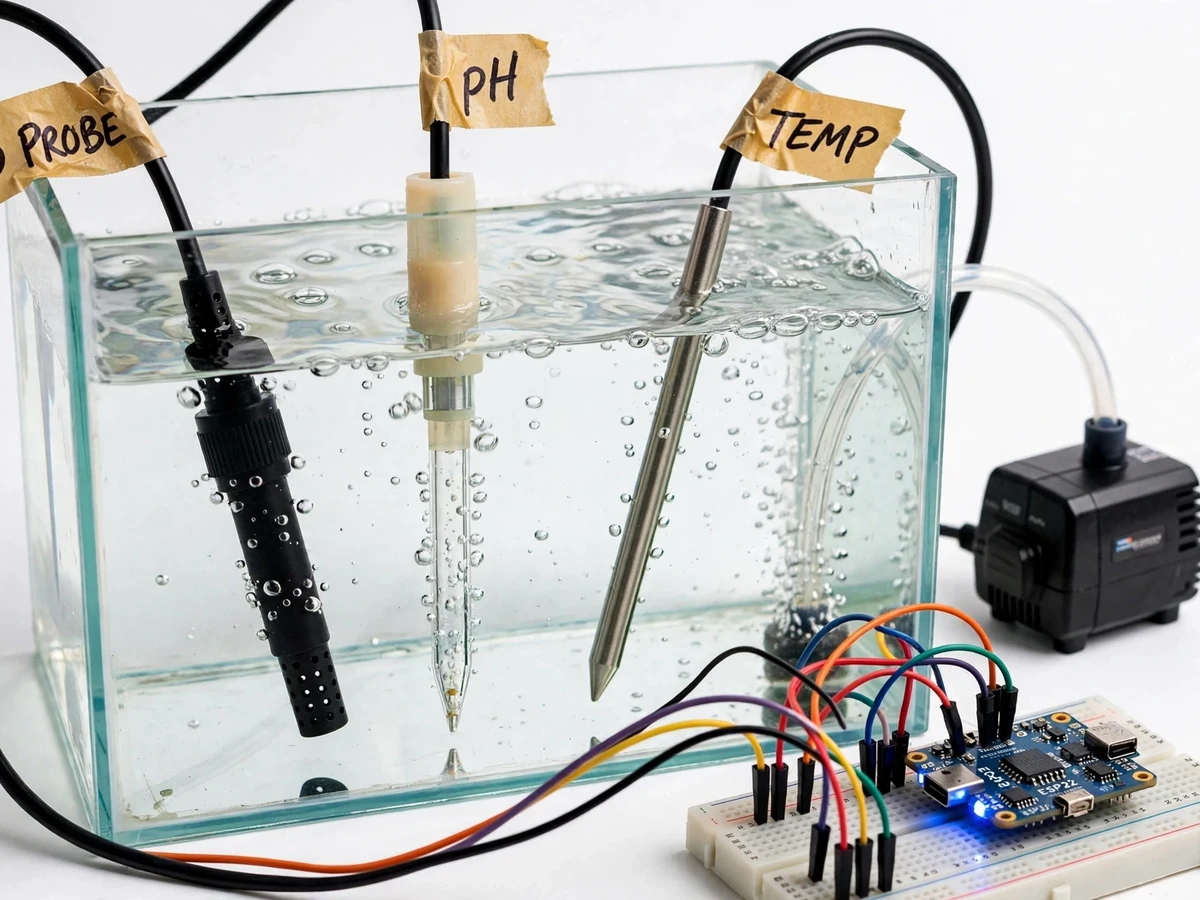
- The DO, pH and temperature probes sit in the pond (demo: aquarium tank) and the ESP32 samples them continuously.
- Firmware applies the buyer's calibration constants and checks each reading against configured safe bands.
- If dissolved oxygen drops below the start threshold, the aerator relay energizes; it releases only after oxygen recovers past the higher stop threshold (hysteresis).
- Every reading and every aerator state change publishes over Wi-Fi to the dashboard.
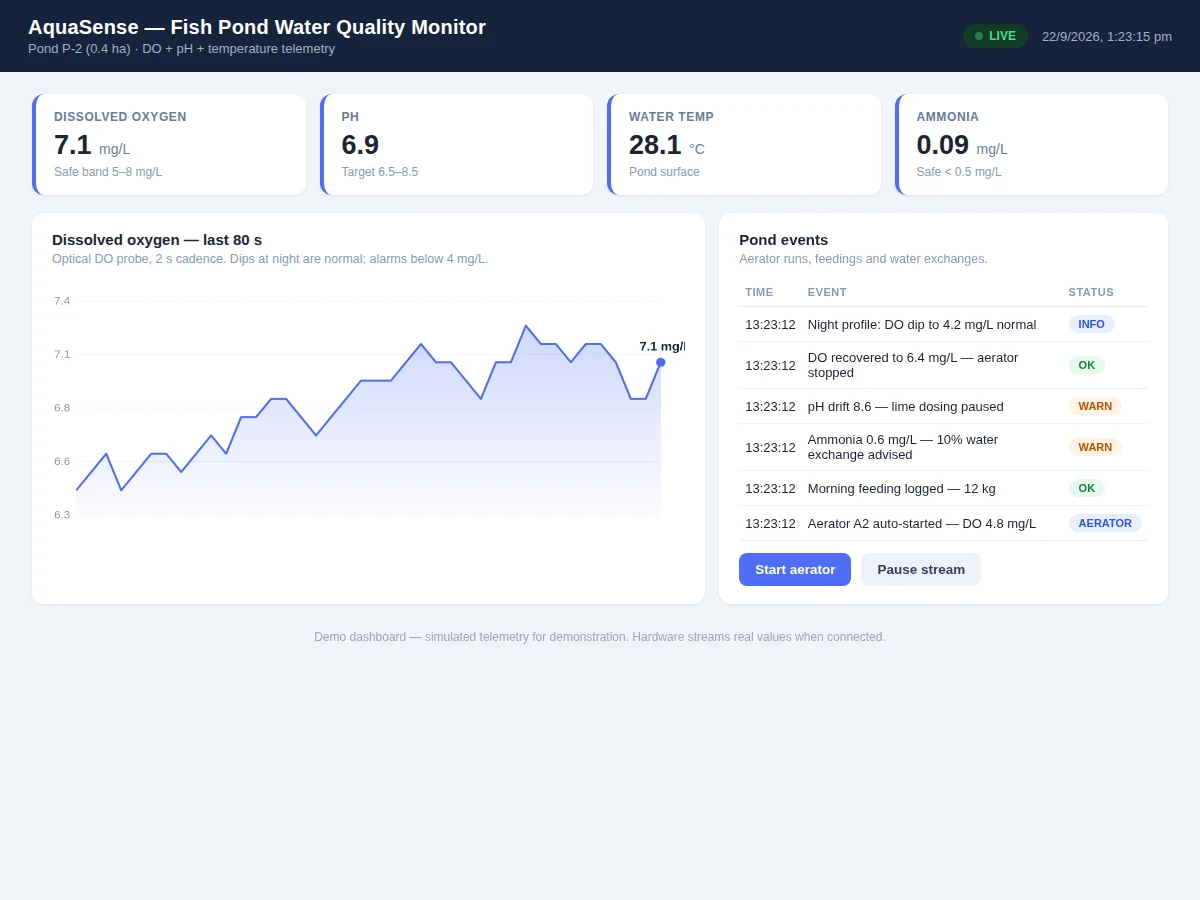
- The dashboard plots the curves with threshold bands and keeps the event log for the report.
- Ammonia is entered as a manual test-kit reading alongside, since no low-cost continuous ammonia probe is used — stated honestly.
Tech stack:
- ESP32 development board (Wi-Fi telemetry)
- Dissolved oxygen probe + transmitter board
- pH probe + interface board
- DS18B20 waterproof temperature sensor
- Relay module (aerator control)
- Aquarium air pump (demo aerator)
- Single-page pond dashboard (HTML/JS)
| Parameter | Value |
|---|---|
| Controller | ESP32, Wi-Fi dashboard sync |
| DO probe | Galvanic/optical probe with transmitter board; calibrated in air-saturated water at build |
| pH probe | Glass electrode with interface board; two-point buffer calibration at build |
| Temperature | DS18B20 waterproof; ±0.5 °C per datasheet |
| Aerator control | Relay-switched; start/stop thresholds with hysteresis (configurable) |
| Safe bands | DO 5–8 mg/L, pH 6.5–8.5 (typical aquaculture guidance, configurable) |
| Dashboard | Live curves, threshold bands, aerator state, event log |
| Demo | Aquarium tank; real pond deployment needs weatherproofing (future scope) |
Project features
- [Dissolved oxygen sensing] A DO probe measures oxygen continuously — the single most important pond parameter — with the safe band shown on the dashboard.
- [pH and temperature] A pH probe and waterproof temperature sensor complete the basic water-quality picture alongside DO.
- [Automatic aerator control] When DO falls below the configured threshold, the controller starts the aerator through a relay and stops it on recovery, with hysteresis to avoid chattering.
- [Pond-health dashboard] Live DO/pH/temperature curves, threshold bands, aerator state and a 24-hour rhythm view show the pond's daily cycle.
- [Night-dip profiling] The dashboard highlights the overnight oxygen dip, teaching the farmer when the pond is most vulnerable.
- [Event log] Aerator starts/stops, threshold crossings and sensor warnings are timestamped for the report.
- [Calibration procedure] DO and pH probes are calibrated by the buyer (air-saturated water and buffer solutions) with the steps documented.
What is included
- Working pond-monitor prototype (DO, pH, temperature probes, aerator relay, ESP32)
- Demo aquarium rig with air pump
- Complete firmware source code (sensing, calibration, aerator control, dashboard sync)
- Pond-health dashboard with curves and event log
- Circuit and wiring documentation
- Probe calibration procedures (buyer-run DO and pH calibration)
- Project report PDF (aquaculture water quality, control design, logged data from the buyer's run)
- PPT presentation for final review
- Viva Q&A preparation document (dissolved oxygen dynamics, pH, hysteresis control, calibration)
Limitations & prerequisites
- Probe accuracy depends entirely on the buyer's calibration run; uncalibrated readings are indicative only.
- DO probes drift and foul with biofilm — the report includes a cleaning schedule; it is not a fit-and-forget sensor.
- Ammonia, the other critical parameter, has no continuous low-cost probe here; it is a manual test-kit entry, stated honestly.
- Demonstrated on an aquarium; a real pond needs weatherproof enclosures, longer cables and lightning care — future scope.
- Aerator control is threshold-based, not a variable-speed drive.
Frequently Asked Questions
Why is dissolved oxygen the key parameter?
Fish breathe it directly from water, and it swings daily — high in the afternoon, lowest before dawn. A continuous probe catches the overnight crash that a daytime handheld reading misses.
How does the aerator control avoid flickering on and off?
Hysteresis: the aerator starts at the low threshold and stops only after oxygen recovers past a higher threshold, so it cannot chatter at the boundary.
Do the probes need calibration?
Yes — DO in air-saturated water and pH in buffer solutions, done by the buyer during the build. The procedure is part of the deliverables, and the report records the results.
Why is ammonia entered manually?
There is no affordable continuous ammonia probe at student scale, so the honest design uses periodic test-kit readings entered on the dashboard rather than faking a sensor.
Can this go straight into a real pond?
The sensing and control logic transfer directly, but the prototype needs weatherproofing and proper cable runs first — documented as future scope.
Is this project suitable for a final-year project?
Yes — for Electronics, Electrical and IoT & Embedded programs. It combines chemical sensing, calibration discipline, threshold control and telemetry around a real livelihood problem. Suitable for B.E./B.Tech final-year projects in Electronics, Electrical and IoT & Embedded Systems.
Components & software requirements
- ESP32 development board (Wi-Fi telemetry)
- Dissolved oxygen probe + transmitter board
- pH probe + interface board
- DS18B20 waterproof temperature sensor
- Relay module (aerator control)
- Aquarium air pump (demo aerator)
- Single-page pond dashboard (HTML/JS)
Delivery information
Built-to-order project. Delivery timeline is shared after order confirmation based on current queue.
Support terms
Complete documentation, setup guide, and viva preparation included. Support for setup and explanation provided.