
More project photos (3)
The problem
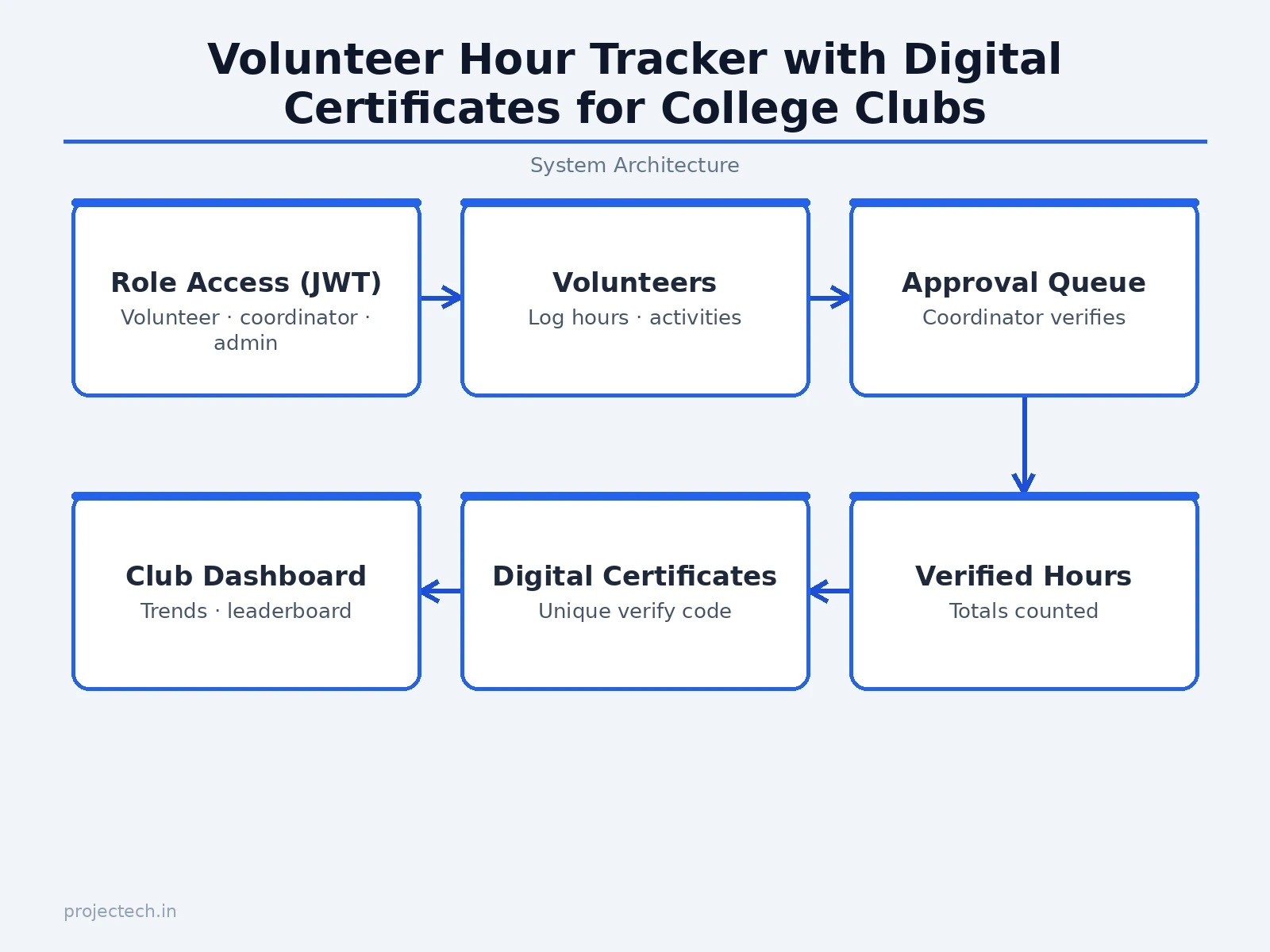
College NSS units and clubs run on volunteer labor, but the paperwork is stuck in registers and spreadsheets: hours are logged inconsistently, coordinators have no clean approval trail, and certificates at year-end are made manually in bulk — easy to forge, hard to verify. Students building "management system" projects often ship a CRUD demo with no real workflow behind it. This project models the actual process: a volunteer submits hours against a registered activity, the entry sits in a coordinator's verification queue as pending, approval converts it to verified hours, and only verified hours count toward the certificate threshold. Certificates carry unique verification codes backed by the database, so anyone can check authenticity. The dashboard turns the data into something a club actually uses — monthly trends, per-activity totals and a leaderboard.
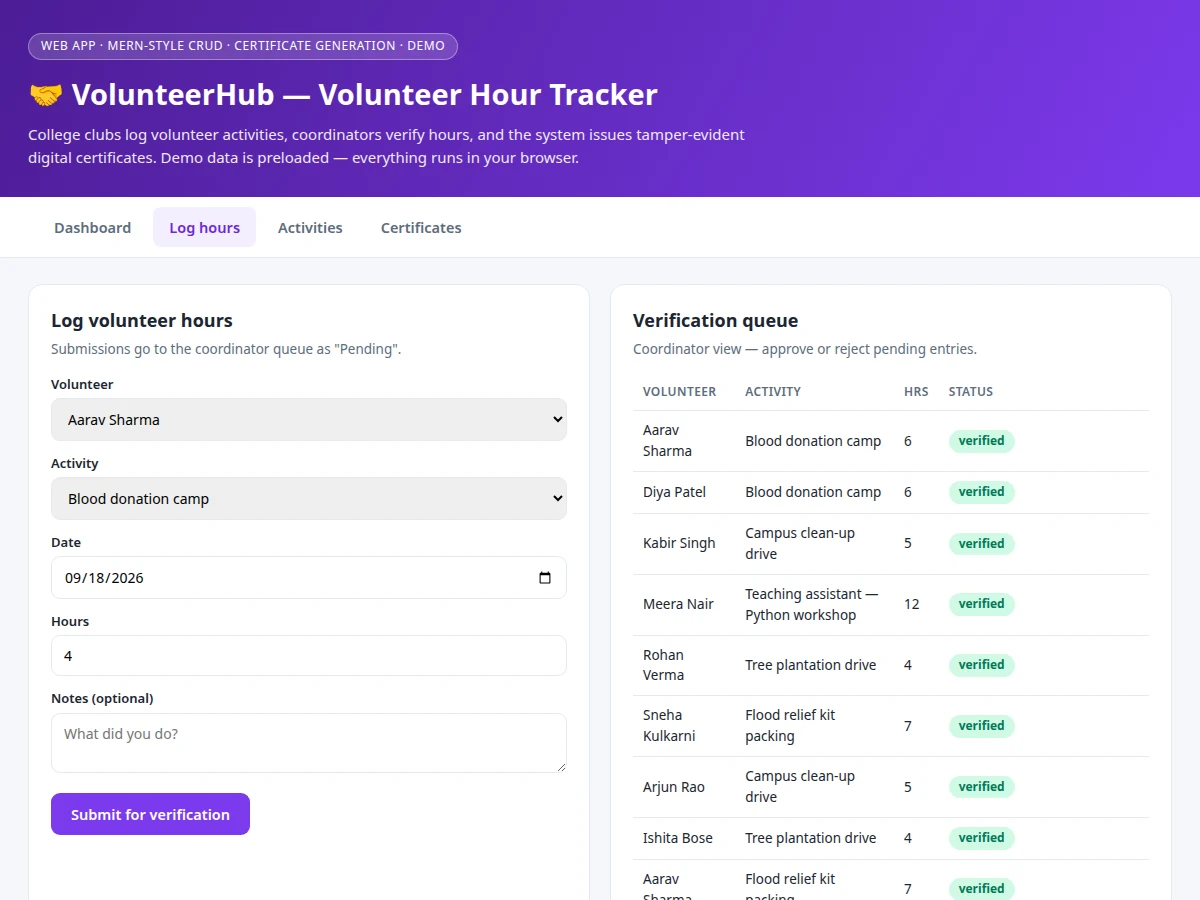
Logs hours against registered club activities; entries start as pending.
Follow the working sequence
How it works
- A coordinator registers club activities (name, date, venue, volunteer capacity) in the system.
- Volunteers log hours against an activity: date, hours worked and notes. The entry is stored with status "pending".
- Coordinators review the verification queue and approve or reject each entry; approvals move hours into the volunteer's verified total.
- The dashboard aggregates verified data: club totals, monthly trends, per-activity hours and the leaderboard update automatically.
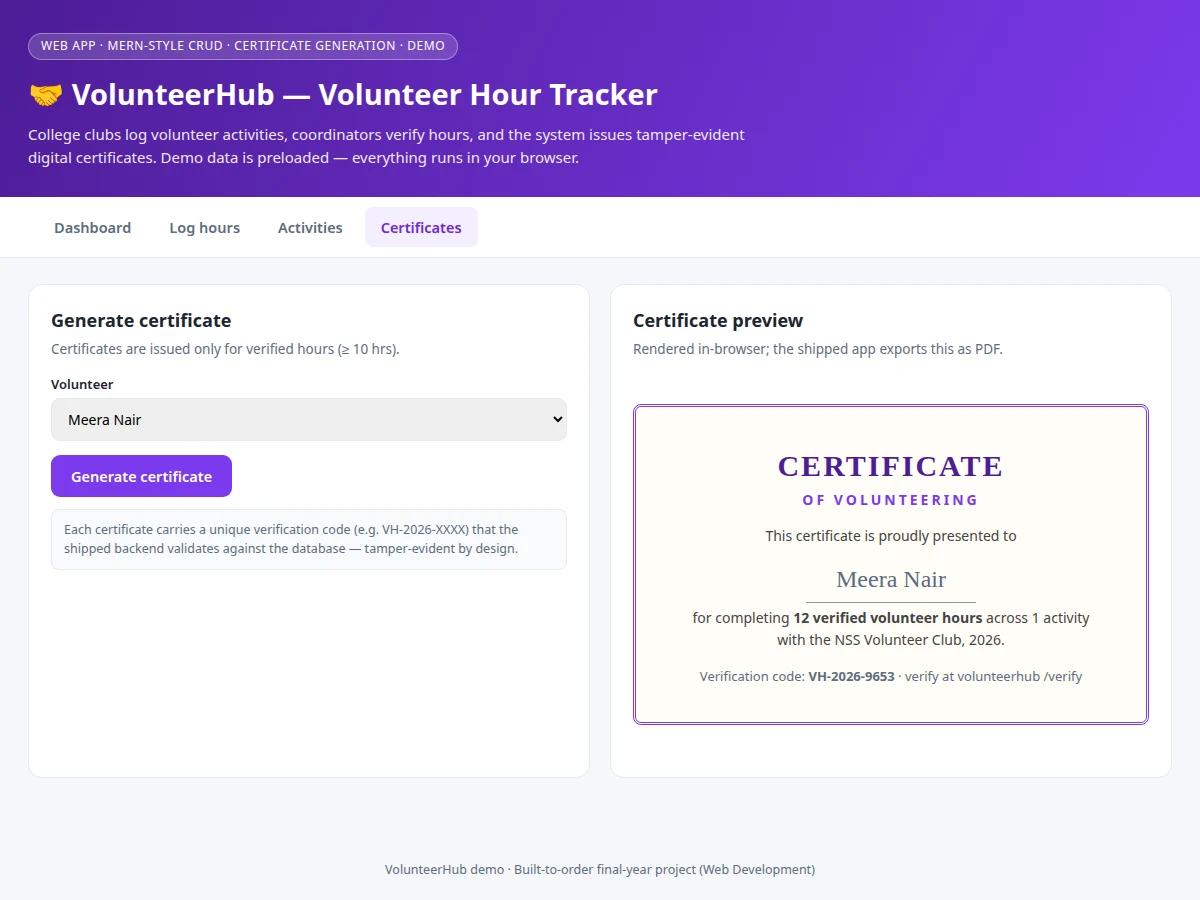
- When a volunteer's verified hours cross the certificate threshold (10 hours), a certificate is generated with their name, hours, activity count and a unique verification code.
- Anyone can verify a certificate by entering its code, which the backend checks against the database — forged codes simply do not validate.
Tech stack:
- React (frontend) + Node.js/Express (backend) — MERN-style architecture
- MongoDB (volunteers, activities, hour entries, certificates)
- JWT authentication with role-based access control
- Chart rendering for dashboard analytics
- PDF export for certificates (jsPDF / backend rendering)
- HTML/CSS/JavaScript interactive demo (single-file)
| Parameter | Value |
|---|---|
| Architecture | MERN-style: React frontend, Node/Express API, MongoDB |
| User roles | 3 (volunteer, coordinator, admin) |
| Certificate threshold | 10 verified hours (configurable) |
| Verification codes | Unique per certificate, database-backed |
| Demo | Single-file interactive web app, runs in browser |
| Deployment | Standard Node/Mongo hosting (procedure documented) |
Project features
- [Volunteer hour logging] Volunteers submit hours against registered club activities with date, duration and notes; entries enter the workflow as "pending".
- [Coordinator verification queue] Coordinators approve or reject each submission; only verified hours count toward totals and certificates, giving a real approval trail.
- [Digital certificates] Tamper-evident certificates generated for volunteers crossing the hours threshold, each with a unique verification code checkable against the database.
- [Club dashboard] Total verified hours, active volunteers, monthly hour-trend chart and a ranked leaderboard — the analytics a club committee actually wants.
- [Activity management] Register activities with date, venue and volunteer capacity; per-activity hour totals are computed automatically.
- [Role-based access] Volunteer, coordinator and admin roles with appropriate permissions, implemented with session/JWT authentication on the backend.
- [Working interactive demo] Preloaded with realistic club data — log hours, approve them in the queue, and generate a certificate end to end in the browser.
What is included
- Complete web application source (frontend + backend API + database schema)
- Interactive single-file demo with preloaded club data
- Database seed script with realistic sample data
- Certificate template with verification-code system
- Project report PDF (background, system design, ER diagrams, API documentation, testing)
- PPT presentation for final review
- Viva Q&A preparation document (authentication, role-based access, data modeling, REST design)
Limitations & prerequisites
- The demo runs entirely in the browser with in-memory data; the shipped backend uses a real MongoDB database as documented.
- Certificate verification in the demo is illustrative; the shipped backend validates codes against the database.
- Email/SMS notifications for approvals are listed as future scope, not implemented.
- The shipped app is a departmental/club-scale build, not hardened for internet-scale traffic — load testing is out of scope.
Frequently Asked Questions
What problem does this actually solve?
Volunteer hour tracking in college clubs is usually registers and spreadsheets: inconsistent logging, no approval trail, and manually-made certificates that are easy to forge. This system models the real workflow — log, verify, certify — with a verification code on every certificate.
How do the certificates prevent forgery?
Each certificate carries a unique code stored in the database. Verification means checking the code against the database; a forged certificate's code simply won't exist. The report explains this design.
Who verifies the hours?
Coordinators, through a verification queue where each pending entry can be approved or rejected. Only verified hours count toward totals and the certificate threshold.
What can the dashboard show?
Club-wide verified hour totals, active volunteer counts, a month-by-month hours trend chart, per-activity hour totals, and a ranked volunteer leaderboard.
Is there a mobile app?
Not as shipped — the web app is responsive and works on phones. A native app is listed as future scope.
Is this project suitable for a final-year project?
Yes — for Computer Science, IT and Web Development programs. It demonstrates full-stack development, authentication, role-based access, data modeling and a real multi-step workflow. Suitable for B.E./B.Tech final-year projects in Computer Science, IT and Web Development.
Components & software requirements
- React (frontend) + Node.js/Express (backend) — MERN-style architecture
- MongoDB (volunteers, activities, hour entries, certificates)
- JWT authentication with role-based access control
- Chart rendering for dashboard analytics
- PDF export for certificates (jsPDF / backend rendering)
- HTML/CSS/JavaScript interactive demo (single-file)
Delivery information
Built-to-order project. Delivery timeline is shared after order confirmation based on current queue.
Support terms
Complete documentation, setup guide, and viva preparation included. Support for setup and explanation provided.
Download free synopsis (PDF)
Enter your name and WhatsApp number — the synopsis PDF downloads immediately. We may send occasional project updates on WhatsApp; no spam.