
More project photos (2)

The problem
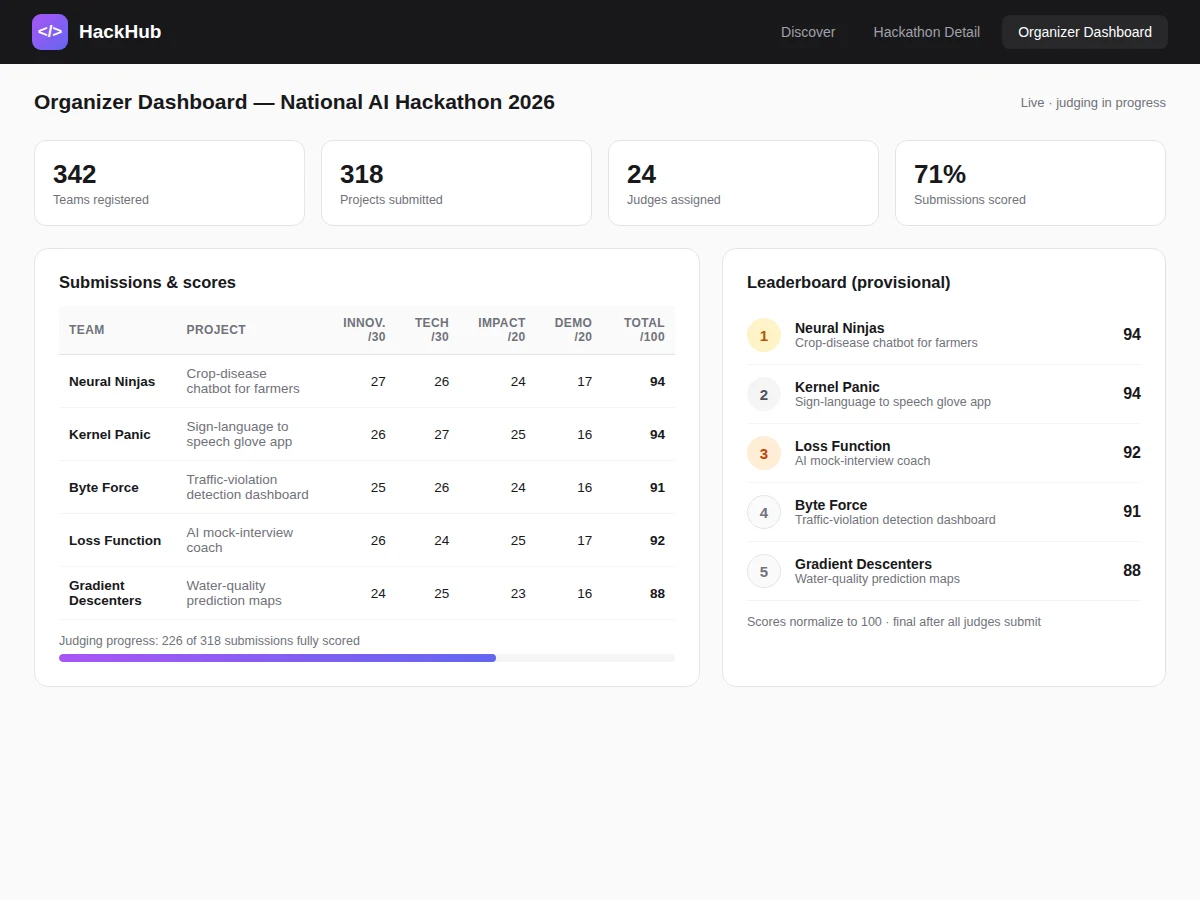
Hackathons have become the default way colleges and companies spot engineering talent, yet most are still run on a patchwork of Google Forms, spreadsheets and WhatsApp groups. Registrations get lost, judging criteria are applied inconsistently across judges, and participants never see where they stand. The engineering gap is a single system that owns the whole lifecycle: event publishing with timelines, team registration, project submission, structured judging and transparent results. This project builds exactly that as a full-stack web application — a discovery portal for hackers, a detail page per hackathon with timeline and prizes, and an organizer dashboard where judges score submissions against weighted criteria and a provisional leaderboard updates as scores come in. Because every role and workflow is modeled explicitly, the student can demo the complete journey in the viva.
How it works
- An organizer creates a hackathon: name, dates, mode, prize breakdown, timeline milestones and judging-criteria weights.
- Hackers discover events on the portal, form teams of 2–4 and register before the deadline.
- During the hack, teams build; at submission time they upload their project details, demo link and repository.
- The organizer assigns judges; each judge scores assigned submissions against the four weighted criteria.
- The leaderboard aggregates scores per the criteria weights and shows provisional rankings as judging progresses.
- When all scores are in, results are finalized and published with the prize distribution.
Tech stack:
- React (frontend SPA)
- Node.js + Express (REST API)
- PostgreSQL (relational schema)
- JWT authentication, role-based access
- Deployed as containerized services
| Parameter | Value |
|---|---|
| Architecture | Full-stack web app (SPA + REST API + RDBMS) |
| User roles | 3 (organizer, hacker, judge) |
| Judging criteria | 4 weighted (innovation 30, technical 30, impact 20, demo 20) |
| Seed data | 6 hackathons, 342-team flagship event (expected) |
| Auth | JWT with role-based route guards |
| API style | REST with JSON payloads |
| Demo | Interactive multi-view web demo |
Project features
- [Hackathon discovery portal] Searchable listing of upcoming hackathons with dates, mode, prize pools, team counts and theme tags.
- [Event detail pages] Per-hackathon timeline (registration → hack → judging → results), prize breakdown and judging-criteria weights.
- [Team registration] Teams register with member details, college and team size validated against event rules.
- [Project submission] Teams submit their build with description, demo video link and repository URL before the deadline.
- [Structured judging] Judges score each submission against weighted criteria (innovation, technical implementation, impact, demo) instead of a single gut-feel number.
- [Live provisional leaderboard] Rankings recompute as judges submit scores, with normalization notes for the organizer.
- [Role-based access] Separate organizer, hacker and judge views with appropriate permissions on every workflow.
What is included
- Complete frontend + backend source code
- Database schema with migrations and seed data
- REST API documentation
- Role-based access implementation (organizer/hacker/judge)
- Project report PDF (background, system design, database design, workflows)
- PPT presentation for final review
- Viva Q&A preparation document (full-stack architecture, auth, database design, scoring logic)
Limitations & prerequisites
- Judging assignment is manual by the organizer — automatic judge allocation is future scope.
- Payments for paid hackathons are out of scope; registration is free events only.
- Real-time updates use polling in the demo build; WebSocket push is listed as future scope.
- The leaderboard is provisional until all judges submit — final normalization rules are documented but organizer-confirmed.
- Email/SMS notifications are stubbed in the demo; production wiring is documented as future scope.
Frequently Asked Questions
What does the platform actually do?
It runs a hackathon's full lifecycle online: organizers publish events, hackers register teams and submit projects, judges score against weighted criteria, and a leaderboard tracks provisional rankings — replacing the usual forms-and-spreadsheets patchwork.
How are the three roles separated?
JWT-based authentication with role guards: hackers see discovery, registration and submission; judges see only their assigned submissions to score; organizers see everything including the dashboard and results controls.
How is the leaderboard computed?
Each submission's criterion scores are combined by the event's published weights (e.g. innovation 30 + technical 30 + impact 20 + demo 20 = 100). Rankings update as judges submit and are marked provisional until judging closes.
What is the database design?
Core tables for users, hackathons, teams, team members, submissions, criteria, scores and prizes, with foreign-key relationships the report diagrams in full — a strong viva artifact for database questions.
Can it handle paid hackathons?
Not as shipped — registration assumes free events. Payment-gateway integration is documented as future scope in the report.
Is this project suitable for a final-year project?
Yes — for Computer Science, IT and Web Development programs. It demonstrates full-stack development, database design, authentication and a real multi-role workflow. Suitable for B.E./B.Tech final-year projects in Computer Science, IT and Web Development.
Components & software requirements
- React (frontend SPA)
- Node.js + Express (REST API)
- PostgreSQL (relational schema)
- JWT authentication, role-based access
- Deployed as containerized services
Delivery information
Built-to-order project. Delivery timeline is shared after order confirmation based on current queue.
Support terms
Complete documentation, setup guide, and viva preparation included. Support for setup and explanation provided.