
More project photos (3)
The problem
Traditional home appliances require users to manually operate switches, which can be inconvenient and limits automation possibilities. Smart home systems provide a way to remotely control appliances and monitor environmental conditions from a single interface.
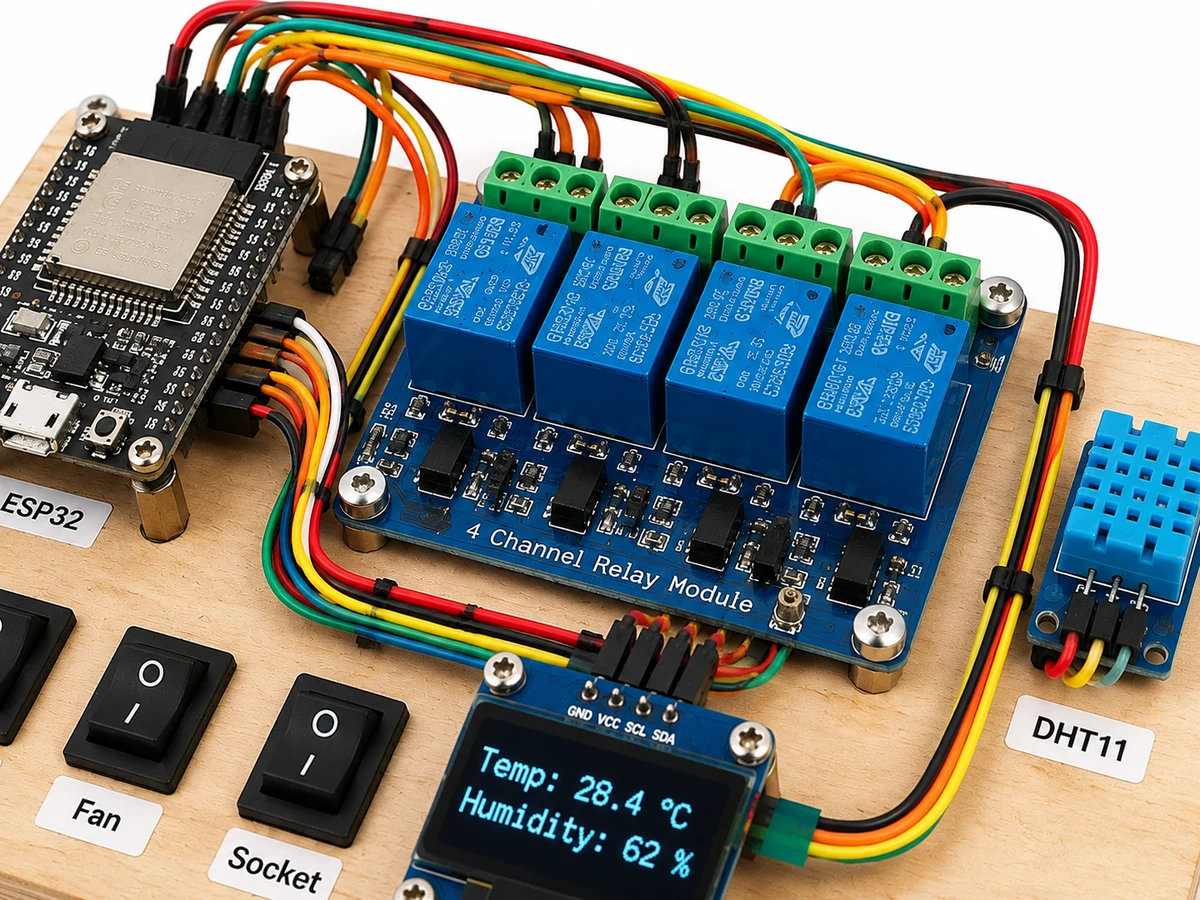
This project demonstrates an affordable IoT-based home automation approach using an ESP32 controller, allowing users to operate appliances through voice commands, mobile applications, and manual controls while monitoring room conditions.
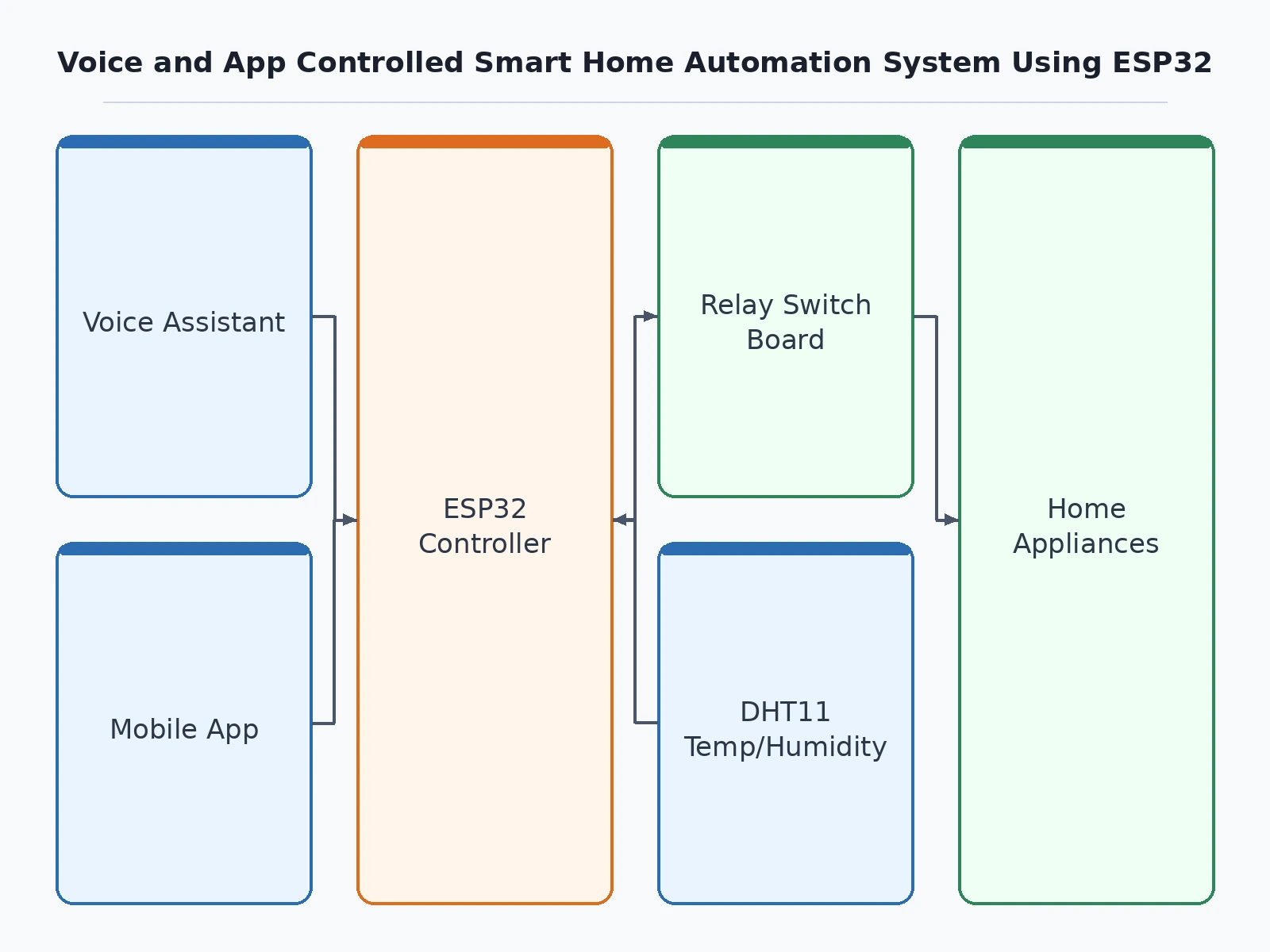
Issues voice commands or taps the mobile app to control appliances.
Follow the working sequence
How it works
- The ESP32 controller acts as the central processing unit of the smart home system.
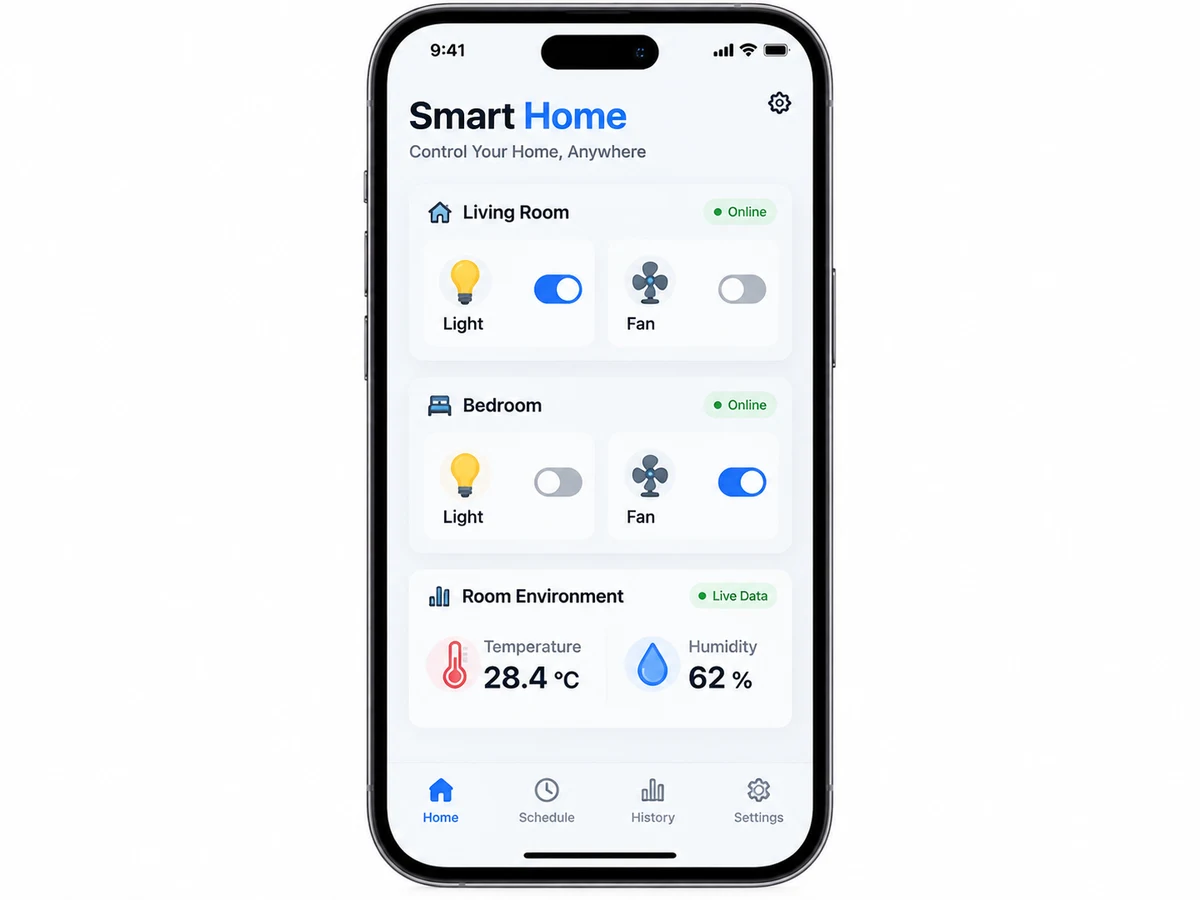
- User commands are received through a connected mobile application or supported voice assistant platform.
- The ESP32 processes the command and sends control signals to the relay module.
- The relay module switches connected appliances such as lights or fans ON/OFF.
- The DHT11 sensor continuously measures room temperature and humidity.
- Sensor data is displayed on the OLED screen and transmitted to the mobile interface.
- Manual switches provide local control if internet/app control is unavailable.
Project features
- Voice-based appliance control using smart assistant integration.
- Mobile application-based control of connected home appliances.
- ESP32-based IoT controller for wireless communication and automation.
- Real-time room temperature and humidity monitoring.
- OLED display for local system status and sensor information.
- Manual override switches for direct appliance control.
- Relay-based switching system for controlling multiple electrical loads.
- Expandable architecture for adding additional smart home devices.
What is included
- ESP32-based smart automation controller setup.
- Relay-based appliance switching module.
- Temperature and humidity monitoring system.
- OLED display interface for status monitoring.
- Manual override control switches.
- IoT application/software setup.
- Source code and project documentation.
- Basic guidance for project demonstration and viva preparation.
Advantages
- Dual control modes — voice commands via smart-assistant integration and a mobile app for appliances.
- ESP32-based IoT controller with wireless communication and automation.
- Real-time room temperature and humidity monitoring.
- Local OLED status display plus manual override switches for direct appliance control.
- Relay-based switching for multiple electrical loads with an expandable architecture for more devices.
Disadvantages
- Internet-based voice control may require third-party platform compatibility.
- Appliance control range depends on Wi-Fi network availability.
- Relay ratings limit the maximum connected electrical load.
- DHT11 provides basic environmental monitoring with limited accuracy.
- System reliability depends on a stable power supply; AC appliance wiring requires proper electrical safety measures.
Limitations & prerequisites
Limitations:
- Actual appliance control range depends on Wi-Fi network availability.
- Internet-based voice control may require third-party platform compatibility.
- Relay ratings limit the maximum connected electrical load.
- DHT11 sensor provides basic environmental monitoring and has limited accuracy.
- System reliability depends on stable power supply.
- AC appliance wiring requires proper electrical safety measures.
- Voice assistant integration details depend on the final software implementation.
Prerequisites:
- Basic knowledge of IoT systems and embedded programming.
- Understanding of ESP32 programming.
- Basic knowledge of electrical switching and safety practices.
- Wi-Fi connectivity for IoT features.
- Smartphone for mobile application control.
- Proper safety precautions while connecting AC appliances.
Components & software requirements
- ESP32 Development Board
- 4-Channel Relay Module
- DHT11 Temperature & Humidity Sensor
- OLED Display Module
- Manual Override Switches
- Embedded Firmware
- Mobile Application Interface
- Voice Assistant Integration (Google Assistant/Alexa) — Needs confirmation based on final implementation
Delivery information
Estimated delivery: Needs confirmation based on customization requirements, component availability, and final implementation scope.
Customisation options
- Increase number of controlled appliances.
- Add additional environmental sensors.
- Customize mobile dashboard features.
- Add alternative communication methods.
- Modify enclosure/prototype design.
- Add additional automation rules.
Download free synopsis (PDF)
Enter your name and WhatsApp number — the synopsis PDF downloads immediately. We may send occasional project updates on WhatsApp; no spam.
Omoye et al. (2026), Int. J. of Computer Science and Mathematical Theory