
More project photos (3)
The problem
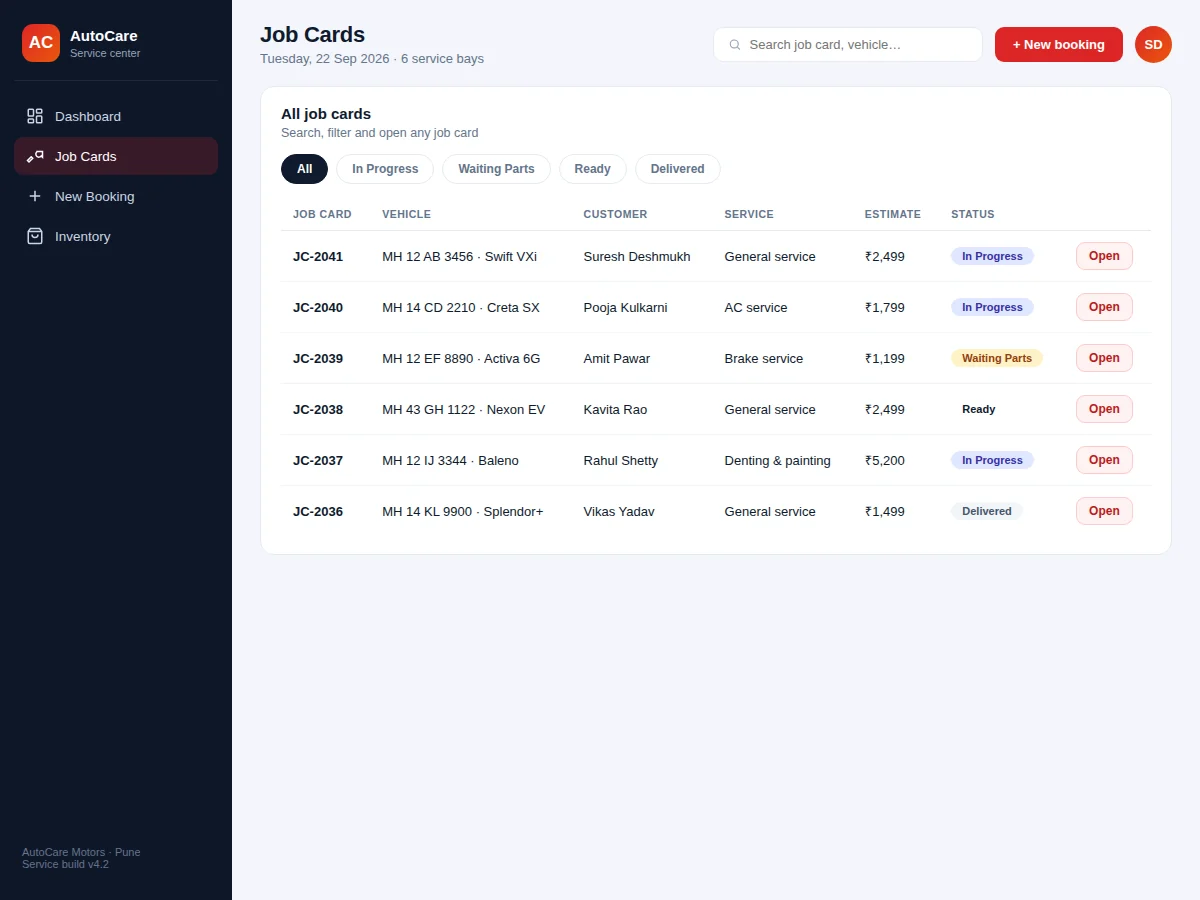
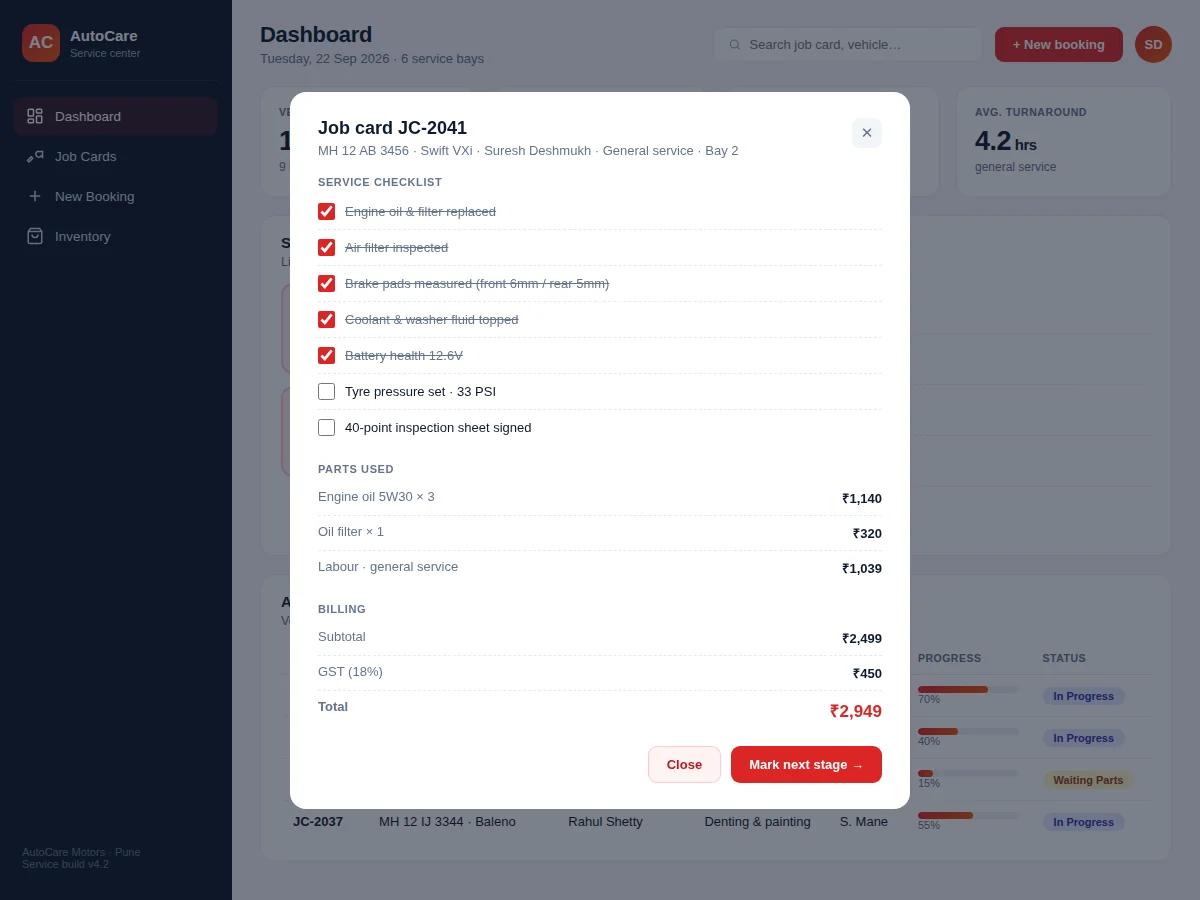
Independent garages usually run on paper job cards: the service advisor scribbles the complaint, the mechanic ticks boxes by hand, parts are billed from memory, and the customer calls three times asking "is my car ready?". Paper gets lost, handwriting gets misread, and nobody can answer which bay is free. This project digitises the whole loop. Customers book a service with vehicle details and a time slot; the advisor converts it into a digital job card assigned to a bay; mechanics work through a stage-wise checklist (oil, brakes, battery, 40-point inspection); parts issued are logged against the card; and the bill — parts + labour + GST — is generated from the card itself. Customers get stage updates instead of phone calls. The scope is one service center with a handful of bays, which keeps the data model (bookings, job cards, checklist items, parts, bills) tight enough to explain completely in a viva.
Books a service package online with vehicle number and slot, and gets notified when the vehicle is ready.
Follow the working sequence
How it works
- A customer books online: service package, vehicle number and model, preferred date and slot.
- The service advisor reviews the booking, confirms it, and creates the digital job card assigned to a free bay.
- The mechanic opens the card on a workshop terminal and works through the stage checklist, ticking items as done.
- Parts used are issued from inventory against the card, decrementing stock automatically.
- When the checklist is complete, the advisor reviews the card and generates the GST bill from parts + labour.
- The customer is notified the vehicle is ready; on payment the card moves to delivered with the full history archived.
- The dashboard aggregates daily vehicles, bay utilisation, revenue and average turnaround.
Tech stack:
- HTML5 · CSS3 · JavaScript (ES6)
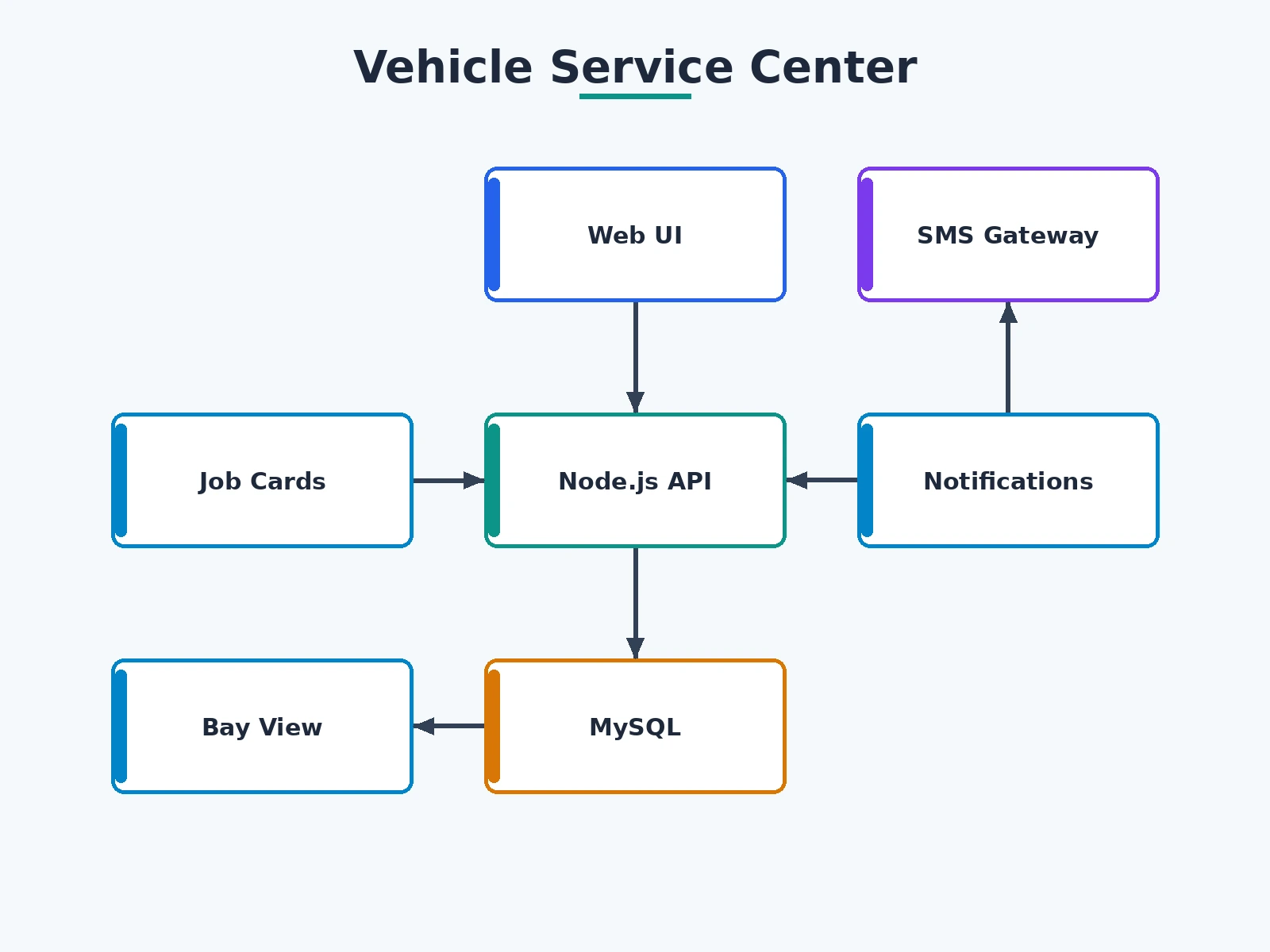
- Node.js · Express
- MySQL · relational schema design
- REST API architecture
- Responsive mobile-first UI
- GST billing computation
- Inventory ledger logic
- Git · version control
| Parameter | Value |
|---|---|
| User roles | Customer, advisor, mechanic, manager (design target) |
| Bays supported | Up to ~20 per center (expected) |
| Job cards | Unlimited; archived per vehicle (expected) |
| Billing | Parts + labour + 18% GST (configurable) |
| Page load | Under ~2 s on broadband (design target) |
| Database | MySQL with migration scripts and seed data |
| Deployment | Shared hosting or VPS; no special hardware needed |
| Browsers | Modern Chrome, Firefox, Edge, Safari (expected) |
Project features
- [Online service booking] Customers pick a service package, enter vehicle details and choose a date and time slot; the booking becomes a draft job card.
- [Digital job cards] Every vehicle gets a card with customer, vehicle, complaint, assigned bay and advisor — the single source of truth through the service.
- [Stage-wise service checklist] Mechanics tick off a configurable checklist (oil, filters, brakes, battery, 40-point inspection) with progress percentage per card.
- [Bay management] Live view of all service bays — which card occupies each bay and its progress — so advisors stop double-assigning.
- [Parts billing] Parts issued are logged against the job card from inventory, and the bill is computed as parts + labour + GST automatically.
- [Appointment schedule] Day-wise appointment list with time slots, so the front desk sees the day's load at a glance.
- [Parts inventory] Stock levels per part with low-stock alerts and a log of parts issued against job cards.
- [Customer notifications] Stage-change SMS hooks (ready-for-delivery alerts) so customers stop calling for updates.
What is included
- Complete source code: customer booking frontend, workshop dashboard, backend API and database schema
- Database migration scripts with realistic seed data (services, parts, sample job cards)
- Setup and deployment guide (local + shared hosting/VPS)
- Workshop user manual for advisors and mechanics
- Project report PDF (problem, design, schema, testing)
- PPT presentation for final review
- Viva Q&A preparation document
Limitations & prerequisites
- Scoped to a single service center; multi-branch chains are future scope.
- Payments are recorded at the counter; online payment gateway integration is a documented extension.
- The checklist templates cover common services; highly specialised repairs need custom templates.
- Customer notifications use gateway hooks — a paid SMS account is needed for real delivery.
- No mechanic payroll or commission module; that is a separate HR concern.
- Vehicle service history is only as complete as the job cards entered in this system.
Frequently Asked Questions
What is a digital job card?
The job card is the central record: customer + vehicle + complaint + assigned bay + advisor + checklist progress + parts used + bill. Everything about one service visit lives on it, replacing the paper card garages use today.
How does the billing work?
Parts issued against the card are priced from inventory, labour is added per the service package, and 18% GST is computed on the subtotal. The report shows the exact formula so it can be defended in the viva.
Can mechanics use it on a phone in the bay?
Yes — the UI is responsive and the checklist is designed for touch: big tick targets, one card per screen, works on any workshop tablet or phone browser.
Does it handle spare-parts stock?
Yes, at the level a teaching build should: part master, stock counts, low-stock alerts, and automatic decrement when parts are issued to a job card. Purchase orders are future scope.
Is this project suitable for a final-year project?
Yes — for Computer Science, IT and Web Development programs. It demonstrates multi-role workflows, inventory ledgers, state-machine checklists and GST billing — a realistic business system end to end. Suitable for B.E./B.Tech final-year projects in Computer Science, IT and Web Development.
Components & software requirements
- HTML5 · CSS3 · JavaScript (ES6)
- Node.js · Express
- MySQL · relational schema design
- REST API architecture
- Responsive mobile-first UI
- GST billing computation
- Inventory ledger logic
- Git · version control
Delivery information
Built-to-order project. Delivery timeline is shared after order confirmation based on current queue.
Support terms
Complete documentation, setup guide, and viva preparation included. Support for setup and explanation provided.
Download free synopsis (PDF)
Enter your name and WhatsApp number — the synopsis PDF downloads immediately. We may send occasional project updates on WhatsApp; no spam.