
More project photos (3)
The problem
Multicopters are easy to fly but wasteful in cruise: a quadcopter spends most of its battery fighting gravity with rotors alone, getting no help from wings. Fixed-wing aircraft are efficient in forward flight but need a runway, which rules out the dense-city operations passenger eVTOL makers are chasing. The transition between the two — the few seconds when an aircraft stops being a helicopter and starts being a plane — is the central control problem of the entire eVTOL industry: Volant's VE25-100 signed 20 firm orders with Sichuan Airlines in Oct 2026, and only achieved China's first piloted full-transition flight in May 2026. This project builds the honest student-scale version of that problem: an RC tilt-rotor aircraft with two servo-driven nacelles that takes off vertically, tilts its rotors forward under a PX4 VTOL state machine, and lands vertically — real transition physics a student can defend in a viva.
How it works
On the ground it sits as a VTOL machine: two 2212-class 920 KV motors on tilting nacelles point straight up, one MG996R-class servo per nacelle drives the tilt linkage, and a Pixhawk 6C-class flight controller running the PX4 VTOL tiltrotor firmware is in ROTARY_WING mode. The pilot lifts off vertically, climbs to test altitude, and flips the 3-position transition switch on RC_MAP_TRANS_SW. PX4 enters TRANSITION_TO_FW: the servos tilt the nacelles forward in two phases and the aircraft accelerates. As the pitot sensor confirms airspeed building toward the design-target transition speed (~45 km/h), the firmware withdraws hover authority — the wing starts paying rent: below transition airspeed the rotors hold the aircraft up, above it the wing does. In FIXED_WING mode it cruises on the wing at a fraction of hover power; flipping the switch back runs TRANSITION_TO_MC, the nacelles tilt home to vertical, and the pilot lands vertically, with the ESP32 dashboard mirroring every state change live.
- The pilot lifts off vertically in ROTARY_WING mode and climbs to test altitude (design target ~40 m), with the nacelles at 0° and the motors providing all lift.
- Flipping the 3-position transition switch on RC_MAP_TRANS_SW puts PX4 into TRANSITION_TO_FW; the two MG996R-class servos begin tilting the nacelles forward in two phases.
- The aircraft accelerates while PX4 blends multicopter and fixed-wing control by tilt angle and measured airspeed — control blending is the firmware's documented tiltrotor method, not a student invention.
- When the pitot sensor confirms airspeed at the design-target transition speed (~45 km/h), the wing is carrying the aircraft; PX4 withdraws hover authority and the build enters FIXED_WING cruise on the wing.
- Flipping the switch back runs TRANSITION_TO_MC: the nacelles tilt home to 0°, multicopter control authority is restored, and the aircraft descends on rotor thrust.
- The pilot lands vertically in ROTARY_WING mode; the ESP32 ground station has logged every state transition with timestamps for the tuning review.
Tech stack:
- Pixhawk 6C-class flight controller (STM32H743 · PX4 VTOL firmware)
- PX4 VTOL tiltrotor state machine (QGroundControl tuning)
- 2x MG996R-class tilt servos + separate 5 V BEC
- 2x 2212 920 KV-class brushless motors + 30 A ESCs
- M10-class GPS + MS5611 baro + pitot airspeed sensor
- 4S LiPo power system
- ESP32 ground-station dashboard (Wi-Fi telemetry mirror)
- Foam/CFRP VTOL airframe + 3D-printed tilt pivots
| Parameter | Value |
|---|---|
| Flight controller | Pixhawk 6C-class: STM32H743 @ 480 MHz · dual temperature-controlled IMUs (manufacturer spec) |
| VTOL firmware | PX4 VTOL tiltrotor airframe · documented two-phase tilt transition |
| Tilt servos | 2x MG996R-class: 9.4 kg-cm @ 4.8 V · 0.17–0.19 s/60° @ 4.8 V (datasheet) |
| Motors | 2x 2212-class 920 KV: ~600–900 g thrust each with 10-inch props (manufacturer data) |
| Battery | 4S LiPo · ~5200 mAh class (approximate) |
| All-up weight | ~1.2–1.5 kg (design target — inside the DGCA Micro category) |
| Transition airspeed | ~45 km/h (design target · validated during bench tuning) |
| Nacelle tilt range | 0°–90° (0° = hover thrust · 90° = forward thrust) |
| Sensor suite | M10-class GPS · MS5611 barometer (manufacturer spec) · pitot-style airspeed sensor |
| Thrust margin | ~2:1 at full throttle in hover (design target) |
| Transition command | 3-position RC switch mapped to RC_MAP_TRANS_SW |
Project features
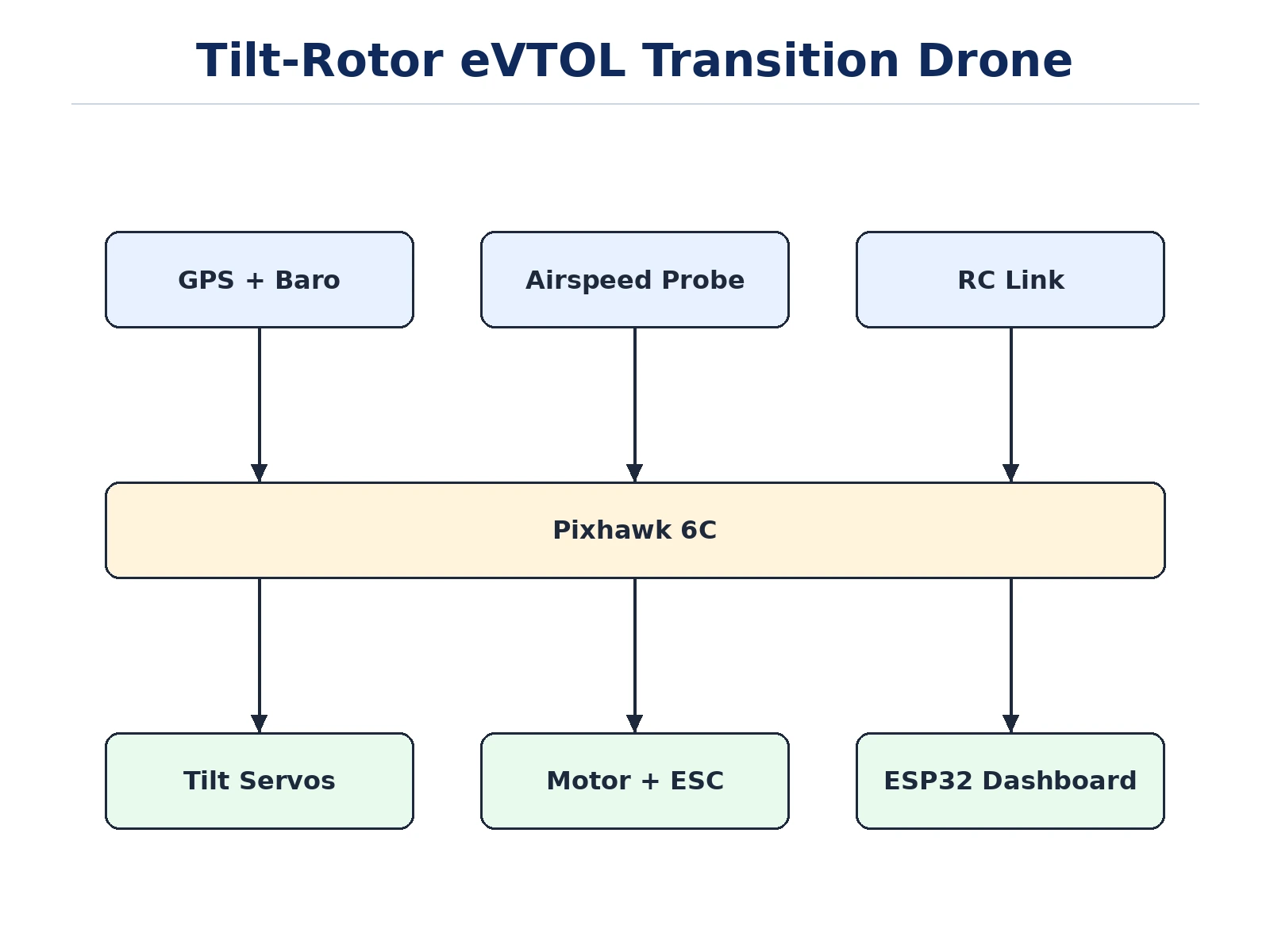
The capabilities that define this build are seven. First, a genuine tilt-rotor transition: two MG996R-class metal-gear servos rotate the motor nacelles 0–90° in flight while PX4 blends multicopter and fixed-wing control on tilt angle and measured airspeed, following the documented two-phase tilt approach of the firmware's tiltrotor airframe. Second, a Pixhawk 6C-class flight controller — STM32H743 at 480 MHz with dual temperature-controlled IMUs (manufacturer spec) — running the PX4 VTOL state machine: ROTARY_WING, TRANSITION_TO_FW, FIXED_WING and TRANSITION_TO_MC, commanded from a 3-position RC switch mapped to RC_MAP_TRANS_SW. Third, a full VTOL sensor suite: M10-class GPS, MS5611 barometer and a pitot-style airspeed sensor, because measured airspeed is what tells the firmware the wing is earning enough lift to withdraw hover thrust safely. Fourth, an ESP32 ground-station dashboard that mirrors the live transition state machine — airspeed, altitude, nacelle tilt, battery, mode timer and a transition event log.
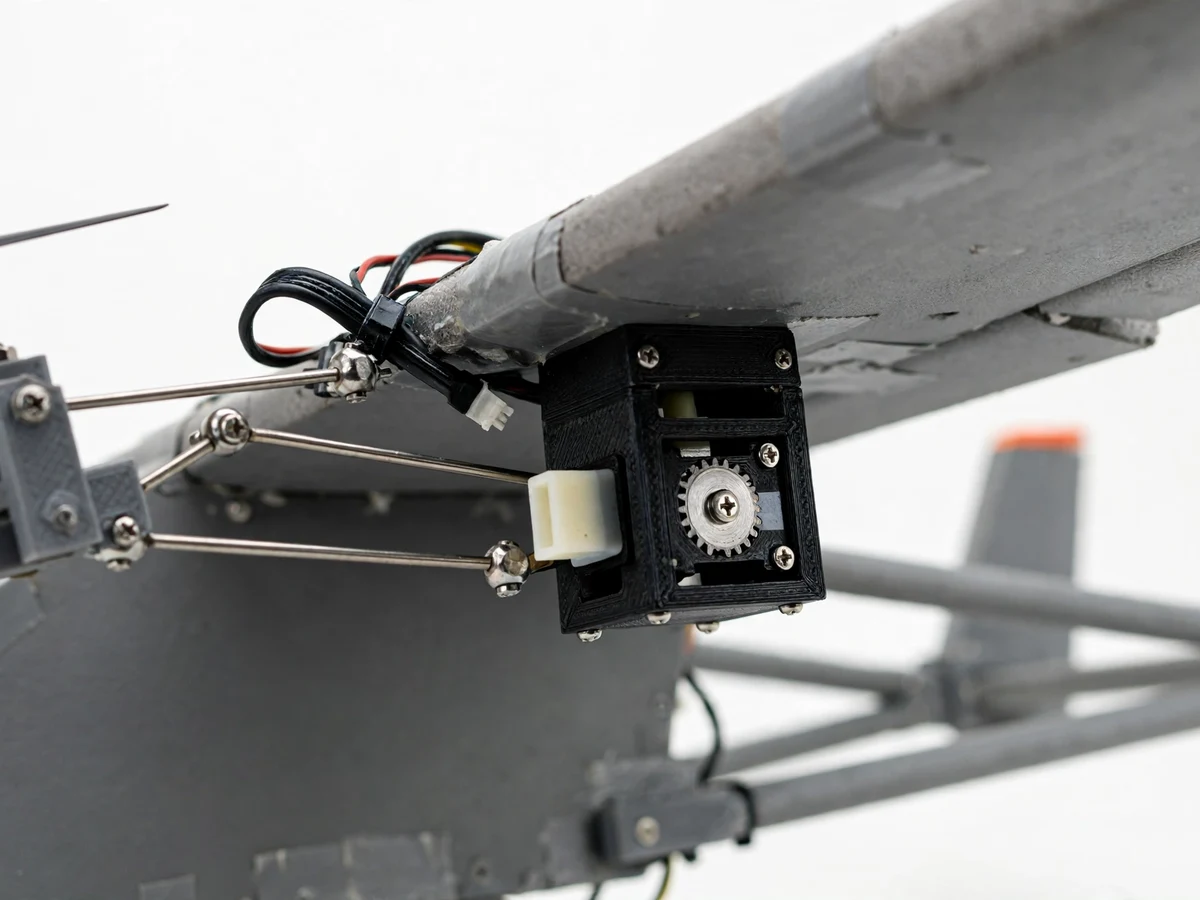
- [Servo-driven tilt nacelles] Two MG996R-class servos (9.4 kg-cm @ 4.8 V, 0.17–0.19 s/60° — datasheet) rotate the motor nacelles 0–90° in flight through direct linkages. Bench-build note: the servos run on a separate 5 V BEC — at stall they can draw ~2.5 A each (datasheet), which would brown out the flight-controller servo rail mid-tilt.
- [PX4 VTOL state machine] A Pixhawk 6C-class controller (STM32H743 @ 480 MHz, dual temperature-controlled IMUs — manufacturer spec) runs the PX4 VTOL tiltrotor airframe; transitions are commanded from a 3-position RC switch mapped to RC_MAP_TRANS_SW, with two-phase tilt and control blending by tilt angle and airspeed.
- [Airspeed-guarded transition] A pitot-style airspeed sensor feeds measured airspeed to the firmware; the transition target (~45 km/h — design target, validated during bench tuning) is the airspeed at which the wing is judged to be carrying the aircraft, so hover authority is withdrawn only when the wing can take over.
- [Full VTOL sensor suite] M10-class GPS, MS5611 barometer (manufacturer spec) and airspeed sensing give the autopilot position hold, altitude fusion and the transition safety signal — the three inputs the tiltrotor firmware actually reasons about.
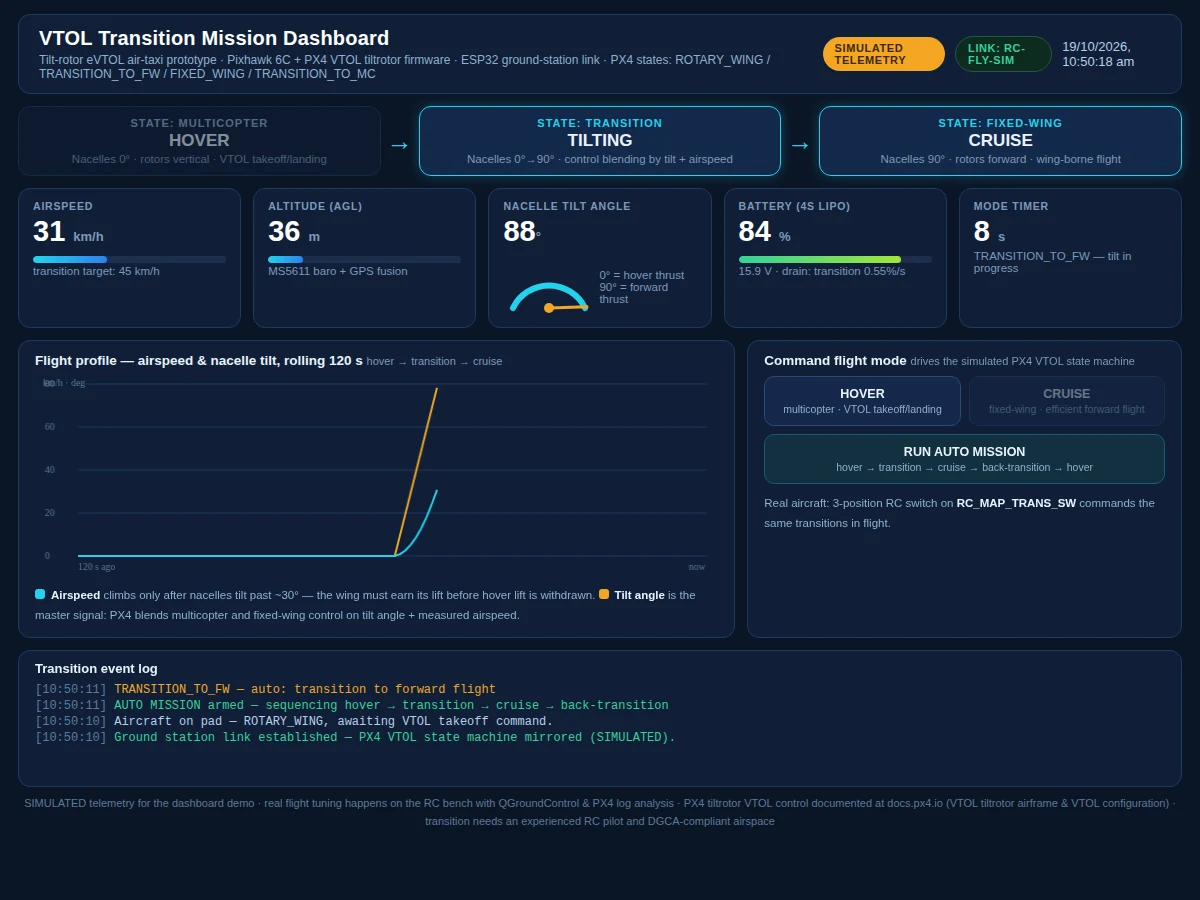
- [Ground-station transition dashboard] An ESP32 serves a live dashboard mirroring the PX4 state machine: airspeed, altitude, nacelle tilt angle, battery, mode timer and a timestamped transition event log — the working demo, usable for bench testing the transition sequence without flying.
- [Tuned 4S power system] Two 2212-class 920 KV brushless motors (~600–900 g thrust each with 10-inch props — manufacturer data) on 30 A ESCs with a 4S LiPo; the twin-motor hover is sized to a ~2:1 thrust margin at full throttle (design target).
- [RC air-taxi VTOL airframe] Foam/CFRP airframe with 3D-printed tilt pivots, twin tail booms and elevons; every servo throw, linkage geometry and pivot is part of the documented build the student tunes and defends.
What is included
- Assembled VTOL airframe: foam/CFRP wing and fuselage, 3D-printed tilt pivots, twin tail booms, elevons
- Pixhawk 6C-class flight controller programmed with the PX4 VTOL tiltrotor airframe and bench-tuned gains
- Two MG996R-class tilt servos with linkages, separate 5 V BEC and full wiring
- Two 2212-class 920 KV motors with 30 A ESCs, 10-inch props, 4S LiPo with balance charger
- M10-class GPS, MS5611 baro, pitot-style airspeed sensor, all wired and calibrated
- 8+ channel RC transmitter with the 3-position transition switch pre-mapped, plus matched receiver
- ESP32 ground station with the live transition dashboard (the working demo) and bench-test mode
- PX4 tuning walkthrough: airframe setup, sensor calibration, transition-airspeed tuning procedure, log-analysis checklist
- Project report PDF (tilt-rotor transition physics, PX4 VTOL control, sensor fusion, build log)
- PPT presentation for final review
- Viva Q&A preparation document (why two-phase tilt, why airspeed-gated transitions, tiltrotor vs tailsitter, DGCA micro-category rules)
Limitations & prerequisites
- DGCA honesty: at ~1.2–1.5 kg all-up weight this build sits in the Micro category (above 250 g up to 2 kg) under the Drone Rules 2021 — UIN registration on Digital Sky is required, flights stay in green zones up to 120 m, line of sight is mandatory, and there is no BVLOS flight without permission. The transition test flights must be run over a safe open area, not over people.
- This is an RC-scale model, not any kind of passenger aircraft — the Volant comparison is about the transition physics problem, nothing else. Nothing on this page implies carrying people or cargo.
- The transition is the hard part and the honest risk: mistimed back-transition near stall speed can drop the aircraft, and gusts during the tilt are unforgiving. First transitions are flown by an experienced RC pilot in calm conditions only; a first-time flyer does not learn to fly on this airframe.
- Tuning is the project, not a footnote: PX4 gains, servo throws, tilt phasing and the transition airspeed are calibrated per airframe, so expect bench iteration. The build ships bench-tuned; re-tuning guidance is included rather than a claim that it flies perfectly out of the box.
- Bench-build note (from the actual build): the two tilt servos are powered from a separate 5 V BEC — at stall they can draw ~2.5 A each (datasheet), which browns out the flight-controller servo rail and reboots the Pixhawk mid-tilt if they share it.
- LiPo discipline applies: 4S packs charge and store per standard LiPo practice, on a fire-safe surface, never unattended.
- The dashboard demo's telemetry is simulated for bench testing; real tuning is done with QGroundControl and PX4 log analysis, and the walkthrough shows how.
Frequently Asked Questions
What did the October 2026 Volant VE25-100 order actually announce?
Shanghai Volant Aerotech signed a purchase agreement with Sichuan Airlines Low Altitude at the Zigong low-altitude-economy conference on October 19, 2026: 50 VE25-100 passenger eVTOLs, of which 20 are firm orders. Volant also achieved China's first piloted full-transition flight in May 2026 — only the third company in the world to demonstrate that capability. This project takes the same central problem (the helicopter-to-plane transition) at RC student scale; it claims nothing about passenger flight, certification, or commercial operation.
Is this project suitable for a final-year project?
Yes — for IoT & Embedded, Electronics/E&TC and related programs. It combines a real control problem (PX4 VTOL tiltrotor state machine with two-phase tilt and airspeed-gated transitions), servo-driven mechanisms with honest power-system engineering, sensor fusion across GPS/baro/airspeed, and a ground-station dashboard that mirrors the flight state machine. The documented hard parts — transition tuning, back-transition risk, DGCA micro-category compliance — are exactly the viva material examiners probe.
Why not just buy a ready-made VTOL drone?
Ready tiltrotor toys exist, but they are sealed black boxes: you cannot show an examiner the transition logic, retune the transition airspeed, or change the tilt geometry. This project is built up from the PX4 VTOL tiltrotor airframe — every servo throw, linkage and gain is a documented decision the student made and can defend. The tuning procedure and the transition physics are the project; the airframe is where they live.
What happens if the transition fails mid-air?
The honest answer first: it can crash, and that is why the limitations require an experienced RC pilot, calm conditions and a safe open area. The firmware-side protection is the airspeed gate — hover authority is withdrawn only when measured airspeed shows the wing is carrying the aircraft — and the pilot can always flip the switch back to ROTARY_WING, which runs the back-transition and restores hover control. Recovery drills are part of the included tuning walkthrough.
What will I receive with the project?
The assembled and bench-tuned tilt-rotor airframe with all avionics (Pixhawk-class controller, GPS, baro, airspeed sensor, servos, motors, 4S pack and charger), an 8+ channel RC transmitter with the transition switch pre-mapped, the ESP32 ground station with the live transition dashboard, the full PX4 tuning walkthrough, and the viva kit: project report PDF, PPT and Q&A document.
Components & software requirements
- Pixhawk 6C-class flight controller (STM32H743 · PX4 VTOL firmware)
- PX4 VTOL tiltrotor state machine (QGroundControl tuning)
- 2x MG996R-class tilt servos + separate 5 V BEC
- 2x 2212 920 KV-class brushless motors + 30 A ESCs
- M10-class GPS + MS5611 baro + pitot airspeed sensor
- 4S LiPo power system
- ESP32 ground-station dashboard (Wi-Fi telemetry mirror)
- Foam/CFRP VTOL airframe + 3D-printed tilt pivots
Delivery information
Built-to-order project. Delivery timeline is shared after order confirmation based on current queue.
Support terms
Complete documentation, setup guide, and viva preparation included. Support for setup and explanation provided.
Download free synopsis (PDF)
Enter your name and WhatsApp number — the synopsis PDF downloads immediately. We may send occasional project updates on WhatsApp; no spam.