
More project photos (2)
The problem
Three-phase electricity powers workshops, farms, hostels and small factories, yet users learn what they consumed only when the monthly bill arrives. A Three-Phase Energy Meter with GSM Billing Alerts closes that gap by measuring energy on each of the three phases, adding the three per-phase energies into a single kWh total, and sending the consumer an SMS with the units consumed, the estimated amount and a due-date reminder. Ordinary plug-in meters measure one phase only, so they cannot meter a three-phase motor or pump, and a single-phase reading on a three-phase supply understates the real consumption. Manual meter reading adds a second problem: readings are taken once a month, so a consumer who crosses into a higher tariff slab or leaves a heavy load running discovers it weeks later. This project demonstrates the complete metering chain — sensing, per-phase energy accumulation, tariff computation and GSM messaging — as a working prototype that students can calibrate, test and explain.
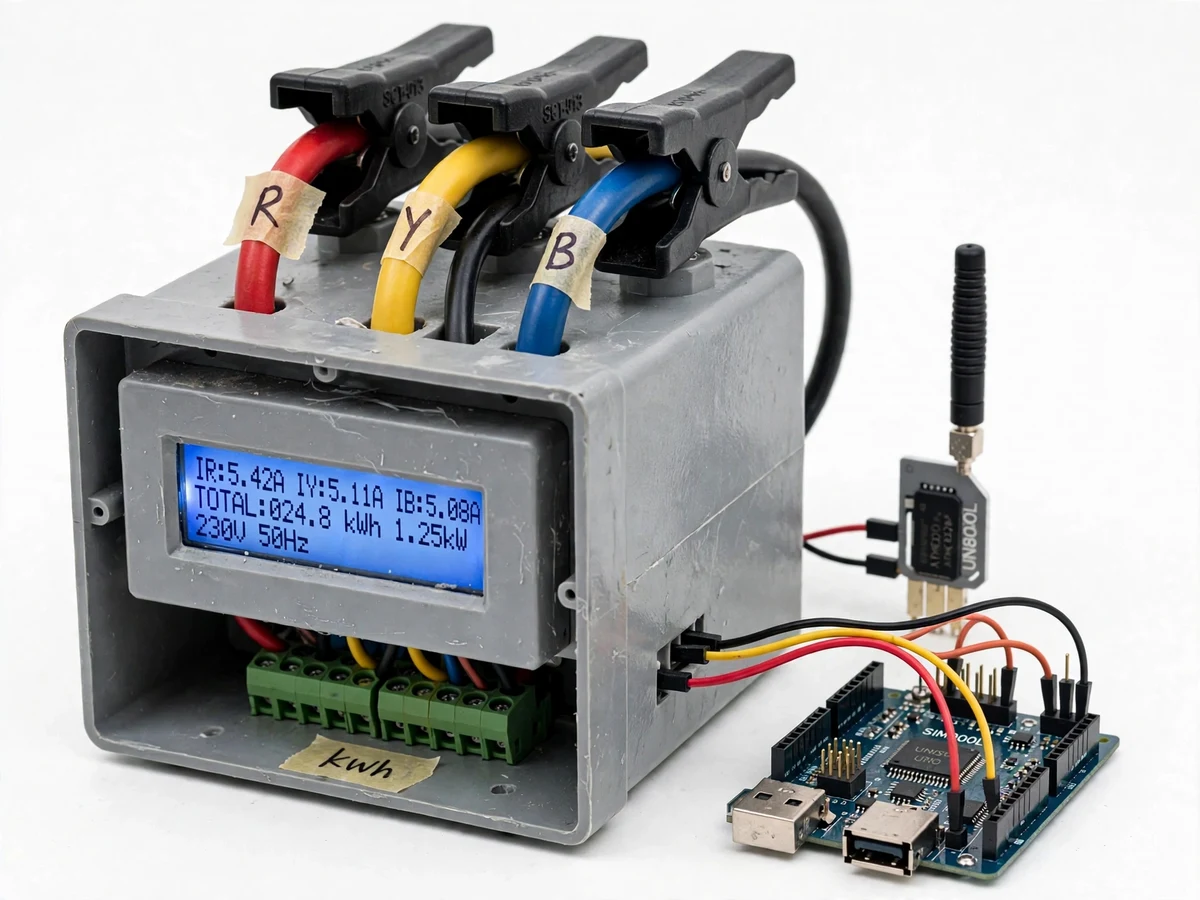
Three split-core CTs clip around the R, Y and B conductors and output a small current per phase.
Follow the working sequence
How it works
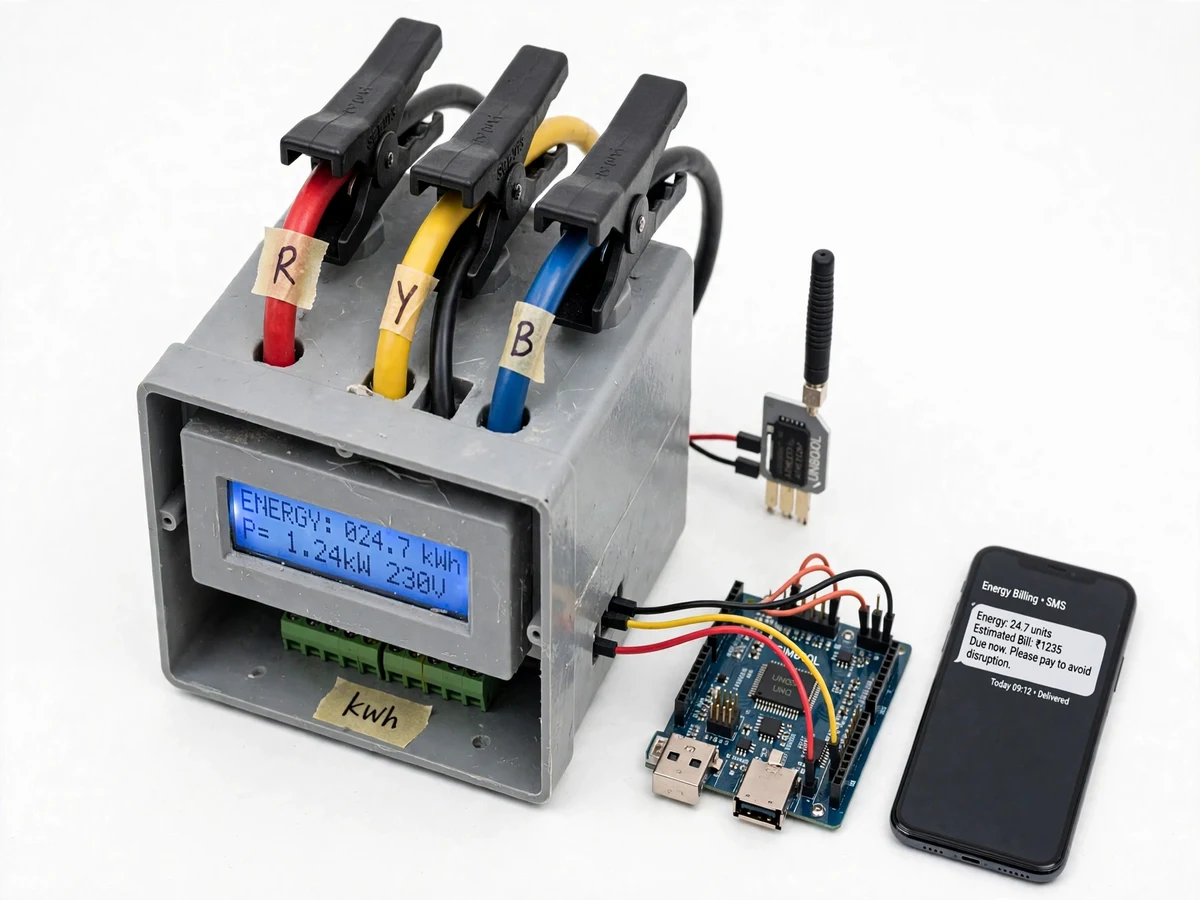
The Three-Phase Energy Meter with GSM Billing Alerts works by turning each phase's voltage and current into a running energy total, then converting that total into a bill sent by SMS. Three SCT-013 split-core current transformers clip around the red, yellow and blue phase conductors and produce a small secondary current proportional to each phase current, while a step-down transformer scales each phase voltage for the metering IC. The ADE7758 metering IC samples all three phases, multiplies voltage by current on each phase, and accumulates active energy per phase. An Arduino reads the accumulated energy over SPI, adds the three phases into total kWh, stores the total in EEPROM so it survives power cuts, and shows live voltage, current, power and kWh on the LCD. When the billing date arrives or a usage threshold is crossed, the Arduino sends AT commands to the SIM800L GSM module, which texts the consumer the units consumed, the estimated amount and the due date.
- Three SCT-013-000 split-core CTs clip around the R, Y and B phase conductors and output a secondary current proportional to each phase current, while a step-down transformer scales each phase voltage for sensing.
- The ADE7758 metering IC samples voltage and current on all three phases and computes active energy, voltage RMS and current RMS per phase, with on-chip SAG detection for phase loss.
- The Arduino reads the per-phase energy registers over SPI, sums the three phases into a total kWh figure, and stores the running total in EEPROM so it survives power cuts. Energy is power integrated over time: kWh equals the sum over the three phases of voltage x current x power factor, integrated over hours and divided by 1000. Builder note from the bench build: one CT clipped with its arrow facing away from the load made the summed power read low by roughly one phase, so the setup procedure now includes a per-phase current check on the LCD before the total is trusted.
- A 16x2 LCD displays per-phase currents, total power in kW, cumulative energy in kWh and the supply voltage, refreshing continuously.
- The Arduino multiplies the accumulated units by the configurable tariff rate to compute the estimated bill amount for the current billing cycle.
- On the configured billing date, and whenever a usage-threshold milestone is crossed, the Arduino sends AT commands to the SIM800L module, which texts the consumer the units, amount and due date.
- If a phase sags or disappears, or total load crosses the configured kW limit, the Arduino sends an immediate SMS alert identifying the fault condition.
Tech stack:
- Arduino Uno (ATmega328P)
- ADE7758 three-phase energy metering IC
- SCT-013-000 split-core current transformers (3 nos.)
- SIM800L GSM module
- 16x2 character LCD
- Arduino IDE (C/C++ firmware)
- SPI communication with the metering IC
- EEPROM energy storage
| Parameter | Value |
|---|---|
| Metering IC | ADE7758 (Analog Devices) |
| Supply system | 3-phase 4-wire, 230 V nominal per phase (design) |
| Line voltage | 400 V nominal line-to-line (design) |
| Current sensing | 3 x SCT-013-000 split-core CTs, current ratio 100 A : 50 mA (datasheet value) |
| CT accuracy | 1% (datasheet value) |
| Metering accuracy | Less than 0.1% active-energy error over a 1000:1 dynamic range at 25 °C (ADE7758 datasheet value; prototype accuracy depends on CT calibration) |
| Controller | Arduino Uno, ATmega328P, 16 MHz clock (datasheet value) |
| GSM module | SIM800L, quad-band 850/900/1800/1900 MHz (datasheet value) |
| GSM supply | 3.4–4.4 V, peak current up to 2 A during transmission (datasheet value) |
| Display | 16x2 character LCD |
| Energy storage | ATmega328P EEPROM, 1 KB (datasheet value) |
| Mains frequency | 50 Hz (design) |
| Tariff rate | Configurable in firmware (design default: Rs. 8 per unit) |
| Usage thresholds | Configurable unit milestones (design defaults: 50, 100 and 200 units) |
| Power supply | 12 V DC adapter with 5 V and 4 V regulation (design) |
Project features
The Three-Phase Energy Meter with GSM Billing Alerts is built around four capabilities that cover the whole metering job: per-phase energy measurement on all three phases, a running kWh total that survives power cuts, automatic billing SMS alerts over GSM, and a live LCD readout of voltage, current, power and energy. The ADE7758 metering IC measures active energy on each phase independently, so an unbalanced load — one phase drawing far more than the others — is visible instead of hidden inside a single total. The Arduino accumulates the three per-phase energies, keeps the total in EEPROM, and multiplies it by a configurable tariff rate to produce the bill. The SIM800L module sends the monthly summary, usage-threshold alerts and a due-date reminder as plain SMS, so the consumer needs no smartphone app and no internet connection. A 16x2 LCD shows the live readings, and the tariff rate and alert thresholds are configurable in firmware for the local tariff structure.
- [Per-phase energy measurement] The ADE7758 metering IC measures active energy, voltage RMS and current RMS on each of the three phases independently, so unbalanced loading is visible per phase rather than hidden in one total.
- [kWh accumulation with EEPROM backup] The Arduino adds the three per-phase energies into a running kWh total and stores it in EEPROM, so the accumulated units survive a power cut and resume from the same value.
- [GSM billing SMS alerts] The SIM800L module sends a monthly SMS with units consumed, estimated amount and payment due date, plus alerts when configurable usage thresholds are crossed.
- [Live LCD readout] A 16x2 LCD shows per-phase current, total power in kW, cumulative energy in kWh and the supply voltage, updating continuously while the load runs.
- [Phase-loss and overload alerts] The ADE7758 line-voltage SAG detection flags a missing or sagging phase, and firmware raises an SMS alert when total load crosses a configurable kW limit.
- [Configurable tariff and thresholds] The tariff rate, billing date and usage-threshold milestones are set in firmware, so the same build adapts to different local tariff structures.
- [Optional cloud dashboard] Optional customization: per-phase readings can be logged to a cloud dashboard over GPRS instead of SMS-only alerts, on request.
What is included
- Working prototype: meter enclosure with ADE7758 metering stage, 3 SCT-013 CTs, SIM800L GSM module, Arduino and 16x2 LCD
- Complete firmware source code (Arduino IDE, C/C++)
- Circuit diagram and wiring documentation
- Component list with part numbers
- CT calibration procedure with a reference-comparison method the student performs and reports
- Project abstract PDF
- Project report covering energy metering theory, three-phase measurement and GSM billing
- PPT presentation for review
- Viva Q&A preparation document
- Demonstration guidance for the billing-cycle SMS and threshold alerts
- To order, message Projectech on WhatsApp with the project title, your scope and delivery date for a quotation.
Limitations & prerequisites
- This is an academic prototype, not a certified billing meter: it cannot be used for utility billing, and its accuracy depends on CT calibration against a reference meter.
- Each SCT-013 CT carries a 1% accuracy figure (datasheet value), which limits the overall accuracy of the prototype even though the ADE7758 IC itself is rated below 0.1%.
- GSM alerts need 2G GSM network coverage and an active SIM with SMS balance; areas without GSM coverage cannot receive alerts.
- SMS delivery is not guaranteed and can be delayed by the network, so an alert is a notification, not a control action.
- Live three-phase mains work is hazardous: the demo must be set up and run only under qualified supervision, with proper isolation and insulated terminations.
- The base build uses a single flat tariff rate; slab-wise tariffs need a firmware change, listed as an optional customization.
- The cumulative kWh total is stored in EEPROM with 100,000 write cycles (datasheet value), so the firmware writes the total at intervals rather than continuously.
Frequently Asked Questions
Is this project suitable for a final-year project?
Yes, for Electrical Engineering and Electronics & Telecommunication programs. It demonstrates three-phase measurement, energy metering with a dedicated IC, tariff computation and GSM communication in one working build, and the calibration procedure gives the student measured results of their own to present and discuss.
How does the meter calculate the bill?
The meter multiplies the accumulated kWh units by the tariff rate set in firmware. The ADE7758 accumulates active energy per phase, the Arduino sums the three phases into total units, and the configured rate (design default Rs. 8 per unit) produces the estimated amount shown on the LCD and sent in the monthly SMS.
Does it need internet or Wi-Fi?
No. All alerts travel as plain SMS over the 2G GSM network through the SIM800L module, so the consumer needs no smartphone app and no internet connection. The meter itself needs only an active SIM with SMS balance and GSM coverage at the installation site.
Can this meter replace a utility electricity meter?
No. This is an academic prototype built for study and demonstration, not a certified billing meter. Its accuracy depends on CT calibration, it has no utility certification or tamper-proof sealing, and it must never be presented as a replacement for the meter installed by the electricity supplier.
What power supply does it need, and is it safe to demonstrate?
The prototype runs from a 12 V DC adapter with on-board 5 V and 4 V regulation for the Arduino and the SIM800L. Live three-phase mains work is hazardous, so the demo is set up only under qualified supervision with proper isolation, and the CT secondary must never be left open-circuited while a phase conductor carries current.
Can the tariff rate or alert thresholds be changed?
Yes. The tariff rate, billing date and usage-threshold milestones are all set in firmware and can be changed for the local tariff structure. The design defaults are Rs. 8 per unit with thresholds at 50, 100 and 200 units, and the report documents exactly where each value is changed.
Components & software requirements
- Arduino Uno (ATmega328P)
- ADE7758 three-phase energy metering IC
- SCT-013-000 split-core current transformers (3 nos.)
- SIM800L GSM module
- 16x2 character LCD
- Arduino IDE (C/C++ firmware)
- SPI communication with the metering IC
- EEPROM energy storage
Delivery information
Built-to-order project. Delivery timeline is shared after order confirmation based on current queue.
Support terms
Complete documentation, setup guide, and viva preparation included. Support for setup and explanation provided.
Download free synopsis (PDF)
Enter your name and WhatsApp number — the synopsis PDF downloads immediately. We may send occasional project updates on WhatsApp; no spam.