
More project photos (3)

The problem
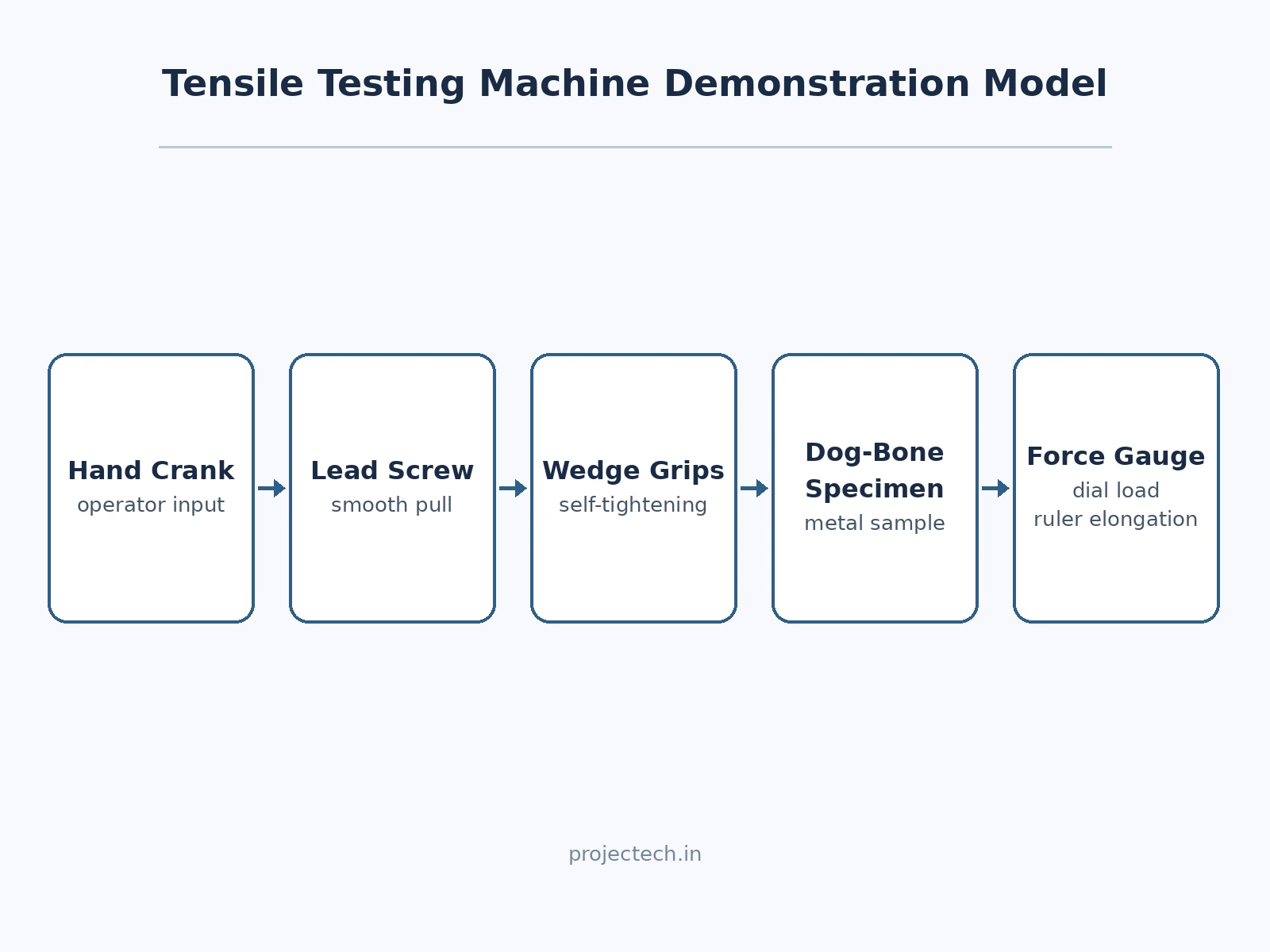
Every mechanical engineer meets the stress–strain curve in the second year — and most meet it only as a diagram, because universal testing machines are expensive, shared, and often booked out. This project brings the experiment to the student's own bench as a demonstration-scale model. A welded mild-steel frame carries a hand-crank screw drive: turning the crank draws the moving grip away from the fixed grip, stretching a dog-bone specimen held in wedge grips. A dial force gauge (0–500 kgf) in the load path reads the tensile force, and a ruler scale beside the specimen tracks elongation. The student loads the specimen in steps, records force and elongation, converts to stress and strain, and plots the curve — finding yield and ultimate strength from their own data. The report is explicit that this is a demonstration model: hand-cranked, analog-read, and honest about its limits versus a calibrated UTM.
Operates the hand crank and records force and elongation readings at each loading step.
Follow the working sequence
How it works
- The dog-bone specimen is clamped between the fixed and moving wedge grips in the steel frame.
- The student zeros the dial force gauge and notes the initial gauge length on the ruler scale.
- Turning the hand crank advances the screw, pulling the moving grip and stretching the specimen in small steps.
- At each step the student records the force from the dial gauge and the elongation from the ruler.
- Force and elongation are converted to engineering stress and strain using the specimen's measured cross-section.
- The plotted curve reveals the elastic region, yield point, ultimate strength and fracture — from the student's own readings.
Tech stack:
- Welded mild-steel frame
- Lead-screw + hand crank drive
- Wedge grips
- 0–500 kgf dial force gauge
- Ruler elongation scale
- Machined dog-bone specimens
- Manual test procedure + calculation sheets
| Parameter | Value |
|---|---|
| Frame | Welded mild-steel box frame (implemented) |
| Loading | Hand-crank lead-screw drive (implemented) |
| Force gauge | Dial type, 0–500 kgf range (implemented) |
| Specimen | Flat dog-bone, documented dimensions (implemented) |
| Elongation readout | Ruler scale, approximately 1 mm resolution (implemented) |
| Capacity | Up to approximately 500 kgf gauge limit (design target) |
| Footprint | Tabletop demonstration scale (approximately 600 mm long, expected) |
Project features
- [Welded steel frame] A rigid mild-steel box frame, welded and bolted, carries the tensile load without flexing — the fabrication itself is part of the project.
- [Hand-crank screw drive] A lead-screw with a crank handle applies the tensile load smoothly and controllably, with the mechanical advantage documented in the report.
- [Wedge grips] Self-tightening wedge grips hold the dog-bone specimen — the harder the pull, the tighter they bite, just like full-size machines.
- [Dial force gauge] A 0–500 kgf analog force gauge in the load path gives a direct, readable load at every step — no electronics to hide behind.
- [Elongation scale] A fixed ruler scale beside the specimen lets the student read extension to the millimeter for the strain calculation.
- [Dog-bone specimens] The kit includes machined flat dog-bone specimens, with the specimen drawing and dimensions documented.
- [Stress–strain procedure] A complete test procedure — stepwise loading, force/elongation logging, stress–strain computation and curve plotting — with recording sheets.
What is included
- Working tensile testing machine demonstration model
- Set of machined dog-bone specimens
- Fabrication drawings (frame, grips, screw drive)
- Step-by-step tensile test procedure with recording sheets
- Stress–strain calculation templates
- Project report PDF (tensile theory, machine design, student test results)
- PPT presentation for final review
- Viva Q&A preparation document
Limitations & prerequisites
- Hand-cranked loading means the strain rate is not controlled or constant — it is a demonstration model, not a standards-compliant UTM, and the report says so plainly.
- Analog dial and ruler readings limit precision; fine yield-point detection is approximate.
- Thin or brittle specimens may need adapted grips; the shipped setup suits the included mild-steel specimens.
- No extensometer or digital data logging as shipped — readings are manual by design.
- Standard lab safety applies: the manual covers eye protection and keeping clear of the fracture zone.
Frequently Asked Questions
What does the test actually measure?
Tensile force versus elongation, converted to engineering stress versus strain. From the student's plotted curve come the elastic modulus region, yield strength, ultimate tensile strength and fracture behavior — all from their own readings.
How is this different from a real UTM?
A universal testing machine controls strain rate precisely and logs data digitally to standards. This model is hand-cranked with analog readouts — it demonstrates the same test honestly at student scale, and the report contrasts the two explicitly.
What specimens are included?
Machined flat dog-bone mild-steel specimens with documented dimensions. The specimen drawing is included so more can be made in the college workshop.
Is it safe?
The forces are modest and the manual covers the precautions: eye protection, keeping hands clear of the grips during loading, and standing clear at fracture. It is designed as a supervised lab demonstration.
Is this project suitable for a final-year project?
Yes — for Mechanical and Materials/Manufacturing programs. It combines fabrication (welding, machining), machine design (screw drive, grips) and a genuine materials experiment with plotted results. Suitable for B.E./B.Tech final-year projects in Mechanical and Materials/Manufacturing.
Components & software requirements
- Welded mild-steel frame
- Lead-screw + hand crank drive
- Wedge grips
- 0–500 kgf dial force gauge
- Ruler elongation scale
- Machined dog-bone specimens
- Manual test procedure + calculation sheets
Delivery information
Built-to-order project. Delivery timeline is shared after order confirmation based on current queue.
Support terms
Complete documentation, setup guide, and viva preparation included. Support for setup and explanation provided.
Download free synopsis (PDF)
Enter your name and WhatsApp number — the synopsis PDF downloads immediately. We may send occasional project updates on WhatsApp; no spam.